Lisa Burns
2015AOTA
Education Summit
Please do not copy without permission!
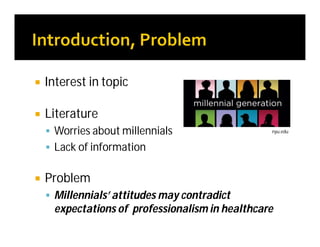
 Interest in topic
 Literature
 Worries about millennials
 Lack of information
 Problem
 Millennials’ attitudes may contradict
expectations of professionalism in healthcare
nyu.edu
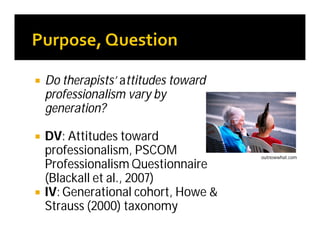
 Do therapists’ attitudes toward
professionalism vary by
generation?
 DV: Attitudes toward
professionalism, PSCOM
Professionalism Questionnaire
(Blackall et al., 2007)
 IV: Generational cohort, Howe &
Strauss (2000) taxonomy
outnowwhat.com
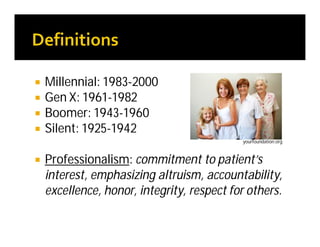
 Millennial: 1983-2000
 Gen X: 1961-1982
 Boomer: 1943-1960
 Silent: 1925-1942
 Professionalism: commitment to patient’s
interest, emphasizing altruism, accountability,
excellence, honor, integrity, respect for others.
yourfoundation.org
 Mannheim (1952): cohorts develop
common identity when they
experience unique, sociologically
significant events.
people.com
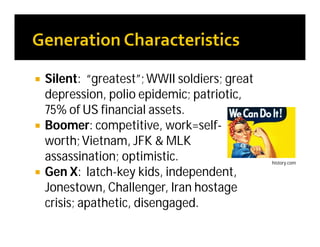
 Silent: “greatest”;WWII soldiers; great
depression, polio epidemic; patriotic,
75% of US financial assets.
 Boomer: competitive, work=self-
worth;Vietnam, JFK & MLK
assassination; optimistic.
 Gen X: latch-key kids, independent,
Jonestown, Challenger, Iran hostage
crisis; apathetic, disengaged.
history.com
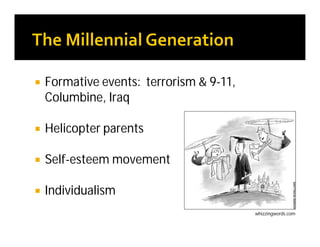
 Formative events: terrorism & 9-11,
Columbine, Iraq
 Helicopter parents
 Self-esteem movement
 Individualism
whizzingwords.com
 Technology
 Gaming, instant gratification
 Constant connection
 Poor communicators
 Workplace habits
 Next ‘greatest generation’ vs.
‘generation whine’
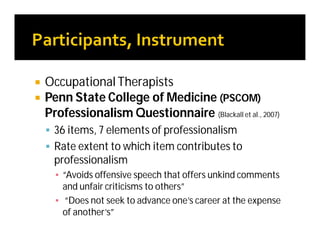
 OccupationalTherapists
 Penn State College of Medicine (PSCOM)
Professionalism Questionnaire (Blackall et al., 2007)
 36 items, 7 elements of professionalism
 Rate extent to which item contributes to
professionalism
▪ “Avoids offensive speech that offers unkind comments
and unfair criticisms to others”
▪ “Does not seek to advance one’s career at the expense
of another’s”
 Covert, post survey; SurveyMonkey
 SPSS 19.0, alpha set a priori at p < .05
 ANOVA grouped using cohort
▪ 36 individual questionnaire items
▪ 7 elements
surveymonkey.com
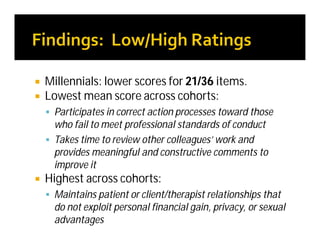
 Millennials: lower scores for 21/36 items.
 Lowest mean score across cohorts:
 Participates in correct action processes toward those
who fail to meet professional standards of conduct
 Takes time to review other colleagues’ work and
provides meaningful and constructive comments to
improve it
 Highest across cohorts:
 Maintains patient or client/therapist relationships that
do not exploit personal financial gain, privacy, or sexual
advantages
 11 items with significant variance
across cohorts
 Between boomers and Xers: 3 items
 Between millennials and others: 8
items (scores were significantly less)
 2 elements varied significantly
across cohorts (duty, honor &
integrity)
 Millennials provided lower average
scores for both
123rf.com
 OTs recognize some elements of
professionalism
 Appropriate client relationships
 Worrisome
 All cohorts: Low scores: feedback
 Millennials: Low scores, multiple areas
academicmedicineblog.org
 Honor & Integrity
 Reports data consistently, accurately and honestly
 Meets commitments and obligations conscientiously
 Assumes personal responsibility for decisions
 Represents information and actions truthfully
 Duty
 Reports errors in service provision
 Shows commitment to confidentiality
 Discloses conflicts of interest
• Duty
• Honor & Integrity
AttitudesVary
by Generation
• Recognize Relationships
• Fail to Recognize Feedback
Similarities
Across
Generations
• Continue efforts
• ↑ emphasis in specific areas
Education,
Practice
 Low scores across cohorts
 Increase familiarity and
comfort
 Professionalism:
 Self-reflection
 Accurate, multi-source feedback
 Evaluation
forbes.com
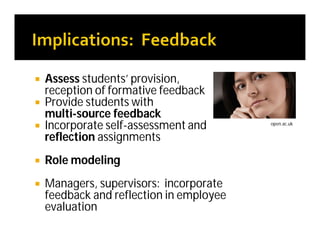
 Assess students’ provision,
reception of formative feedback
 Provide students with
multi-source feedback
 Incorporate self-assessment and
reflection assignments
 Role modeling
 Managers, supervisors: incorporate
feedback and reflection in employee
evaluation
open.ac.uk
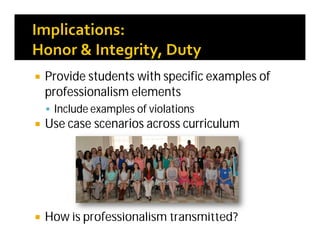
 Provide students with specific examples of
professionalism elements
 Include examples of violations
 Use case scenarios across curriculum
 How is professionalism transmitted?
 Additional elements of professionalism
 Professionalism in daily practice
 Compare to expectations and core values
aaronwrixon.com
 Blackall, G., Melnick, S., Shoop,G., Goerge, J., Lerner, S.,Wilson, P., & Kreher, M. (2007). Professionalism in
medical education:The development and validation of a survey instrument to assess attitudes toward
professionalism. MedicalTeacher, 29(2-3), e58-e62. doi:10.1080/01421590601044984.
 Coleman, J., Shay, D., & Lester, A. (2006). Connecting services to students: New technology and implications for
student affairs. College Student Affairs Journal, 25, 220-227.
 Greenberger, E., Lessard, J., Chen, C., & Farruggia, S. (2008). Self-entitled college students: Contributions of
personality, parenting, and motivational factors. Journal ofYouth Adolescence, 37, 1193-1204. 15(17), 13-16.
 Howe, N. & Strauss,W. (2000). Millennials rising:The next generation. NewYork, NY: Vintage Books.
 Shrank, W. H., Reed,V. A., & Jernstedt, G.C. (2004). Fostering professionalism in medical education. Journal of
General Internal Medicine, 19, 887-892.
 Twenge, J., Konrath, S., Foster, J., Campbell,W., & Bushman, B. (2008). Egos inflating over time:A cross-
temporal meta-analysis of the narcissistic personality inventory. Journal of Personality, 76, 875-901.
 Twenge, J., Zhang, L., & Im, C. (2004). It’s beyond my control: A cross-temporal meta- analysis of increasing
externality in locus of control, 1960-2002. Personality and Social Psychology Review, 8, 308-319.

 Please email for complete reference list!
 Lisa Burns PhD, OTR/L
 lburns@mbc.edu
Please do not copy without permission!

Professionalism and generational differences

  • 1.
    Lisa Burns 2015AOTA Education Summit Pleasedo not copy without permission!
  • 2.
     Interest intopic  Literature  Worries about millennials  Lack of information  Problem  Millennials’ attitudes may contradict expectations of professionalism in healthcare nyu.edu
  • 3.
     Do therapists’attitudes toward professionalism vary by generation?  DV: Attitudes toward professionalism, PSCOM Professionalism Questionnaire (Blackall et al., 2007)  IV: Generational cohort, Howe & Strauss (2000) taxonomy outnowwhat.com
  • 4.
     Millennial: 1983-2000 Gen X: 1961-1982  Boomer: 1943-1960  Silent: 1925-1942  Professionalism: commitment to patient’s interest, emphasizing altruism, accountability, excellence, honor, integrity, respect for others. yourfoundation.org
  • 5.
     Mannheim (1952):cohorts develop common identity when they experience unique, sociologically significant events. people.com
  • 6.
     Silent: “greatest”;WWIIsoldiers; great depression, polio epidemic; patriotic, 75% of US financial assets.  Boomer: competitive, work=self- worth;Vietnam, JFK & MLK assassination; optimistic.  Gen X: latch-key kids, independent, Jonestown, Challenger, Iran hostage crisis; apathetic, disengaged. history.com
  • 7.
     Formative events:terrorism & 9-11, Columbine, Iraq  Helicopter parents  Self-esteem movement  Individualism whizzingwords.com
  • 8.
     Technology  Gaming,instant gratification  Constant connection  Poor communicators  Workplace habits  Next ‘greatest generation’ vs. ‘generation whine’
  • 9.
     OccupationalTherapists  PennState College of Medicine (PSCOM) Professionalism Questionnaire (Blackall et al., 2007)  36 items, 7 elements of professionalism  Rate extent to which item contributes to professionalism ▪ “Avoids offensive speech that offers unkind comments and unfair criticisms to others” ▪ “Does not seek to advance one’s career at the expense of another’s”
  • 10.
     Covert, postsurvey; SurveyMonkey  SPSS 19.0, alpha set a priori at p < .05  ANOVA grouped using cohort ▪ 36 individual questionnaire items ▪ 7 elements surveymonkey.com
  • 11.
     Millennials: lowerscores for 21/36 items.  Lowest mean score across cohorts:  Participates in correct action processes toward those who fail to meet professional standards of conduct  Takes time to review other colleagues’ work and provides meaningful and constructive comments to improve it  Highest across cohorts:  Maintains patient or client/therapist relationships that do not exploit personal financial gain, privacy, or sexual advantages
  • 12.
     11 itemswith significant variance across cohorts  Between boomers and Xers: 3 items  Between millennials and others: 8 items (scores were significantly less)  2 elements varied significantly across cohorts (duty, honor & integrity)  Millennials provided lower average scores for both 123rf.com
  • 13.
     OTs recognizesome elements of professionalism  Appropriate client relationships  Worrisome  All cohorts: Low scores: feedback  Millennials: Low scores, multiple areas academicmedicineblog.org
  • 14.
     Honor &Integrity  Reports data consistently, accurately and honestly  Meets commitments and obligations conscientiously  Assumes personal responsibility for decisions  Represents information and actions truthfully  Duty  Reports errors in service provision  Shows commitment to confidentiality  Discloses conflicts of interest
  • 15.
    • Duty • Honor& Integrity AttitudesVary by Generation • Recognize Relationships • Fail to Recognize Feedback Similarities Across Generations • Continue efforts • ↑ emphasis in specific areas Education, Practice
  • 16.
     Low scoresacross cohorts  Increase familiarity and comfort  Professionalism:  Self-reflection  Accurate, multi-source feedback  Evaluation forbes.com
  • 17.
     Assess students’provision, reception of formative feedback  Provide students with multi-source feedback  Incorporate self-assessment and reflection assignments  Role modeling  Managers, supervisors: incorporate feedback and reflection in employee evaluation open.ac.uk
  • 18.
     Provide studentswith specific examples of professionalism elements  Include examples of violations  Use case scenarios across curriculum  How is professionalism transmitted?
  • 19.
     Additional elementsof professionalism  Professionalism in daily practice  Compare to expectations and core values aaronwrixon.com
  • 20.
     Blackall, G.,Melnick, S., Shoop,G., Goerge, J., Lerner, S.,Wilson, P., & Kreher, M. (2007). Professionalism in medical education:The development and validation of a survey instrument to assess attitudes toward professionalism. MedicalTeacher, 29(2-3), e58-e62. doi:10.1080/01421590601044984.  Coleman, J., Shay, D., & Lester, A. (2006). Connecting services to students: New technology and implications for student affairs. College Student Affairs Journal, 25, 220-227.  Greenberger, E., Lessard, J., Chen, C., & Farruggia, S. (2008). Self-entitled college students: Contributions of personality, parenting, and motivational factors. Journal ofYouth Adolescence, 37, 1193-1204. 15(17), 13-16.  Howe, N. & Strauss,W. (2000). Millennials rising:The next generation. NewYork, NY: Vintage Books.  Shrank, W. H., Reed,V. A., & Jernstedt, G.C. (2004). Fostering professionalism in medical education. Journal of General Internal Medicine, 19, 887-892.  Twenge, J., Konrath, S., Foster, J., Campbell,W., & Bushman, B. (2008). Egos inflating over time:A cross- temporal meta-analysis of the narcissistic personality inventory. Journal of Personality, 76, 875-901.  Twenge, J., Zhang, L., & Im, C. (2004). It’s beyond my control: A cross-temporal meta- analysis of increasing externality in locus of control, 1960-2002. Personality and Social Psychology Review, 8, 308-319.   Please email for complete reference list!  Lisa Burns PhD, OTR/L  lburns@mbc.edu Please do not copy without permission!