CHAPTER 4 – SELLING PROCESS
TREY
research
SELLING
PROCESS
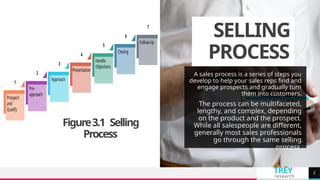
A sales process is a series of steps you
develop to help your sales reps find and
engage prospects and gradually turn
them into customers.
The process can be multifaceted,
lengthy, and complex, depending
on the product and the prospect.
While all salespeople are different,
generally most sales professionals
go through the same selling
process.
2
Figure3.1 Selling
Process
TREY
research
PROSPECTING
The first step in the sales process is to find, or prospect for, strong potential
customers.
• Prospecting is the step in identifying and researching potential prospects.
• Prospects are likely potential customers for your products or services. (In sales
teams with sales development representatives (SDRs), initial outreach also
happens at this stage.)
• One way to find good prospects is to develop buyer personas—profiles that
outline the characteristics of companies that likely need your product and the
relevant roles within those companies.
3
TREY
research
4
Once you have defined your needs, your sales reps can
start researching. Here are a few concrete tips to
improve your prospecting:
• Use sales tools to explore firmographic data and find
companies that are a good fit. Use your buyer profiles to
identify key people in the company.
• Check for any potential connections or previous touchpoints
with your company. Perhaps a sales rep went to school with a
potential champion. Or maybe an engineer has already used
your product at another company.
• Qualify leads that your marketing team generates with lead
generation efforts. Double-check that marketing-qualified leads
are worth calling.
TREY
research
PROSPECTING
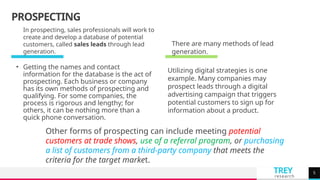
• Getting the names and contact
information for the database is the act of
prospecting. Each business or company
has its own methods of prospecting and
qualifying. For some companies, the
process is rigorous and lengthy; for
others, it can be nothing more than a
quick phone conversation.
5
In prospecting, sales professionals will work to
create and develop a database of potential
customers, called sales leads through lead
generation.
Utilizing digital strategies is one
example. Many companies may
prospect leads through a digital
advertising campaign that triggers
potential customers to sign up for
information about a product.
There are many methods of lead
generation.
Other forms of prospecting can include meeting potential
customers at trade shows, use of a referral program, or purchasing
a list of customers from a third-party company that meets the
criteria for the target market.
TREY
research
PROSPECTING
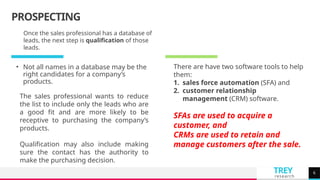
• Not all names in a database may be the
right candidates for a company’s
products.
6
Once the sales professional has a database of
leads, the next step is qualification of those
leads.
The sales professional wants to reduce
the list to include only the leads who are
a good fit and are more likely to be
receptive to purchasing the company’s
products.
Qualification may also include making
sure the contact has the authority to
make the purchasing decision.
There are have two software tools to help
them:
1. sales force automation (SFA) and
2. customer relationship
management (CRM) software.
SFAs are used to acquire a
customer, and
CRMs are used to retain and
manage customers after the sale.
TREY
research
Step 2: Pre-
approach
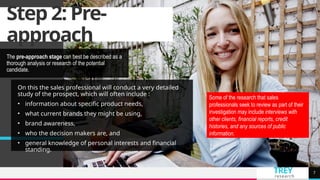
The pre-approach stage can best be described as a
thorough analysis or research of the potential
candidate.
7
On this the sales professional will conduct a very detailed
study of the prospect, which will often include :
• information about specific product needs,
• what current brands they might be using,
• brand awareness,
• who the decision makers are, and
• general knowledge of personal interests and financial
standing.
Some of the research that sales
professionals seek to review as part of their
investigation may include interviews with
other clients, financial reports, credit
histories, and any sources of public
information.
TREY
research
Step 3: Approach
Information gathered in the pre-approach
helps the sales professional during
the approach phase.
8
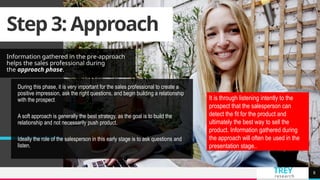
During this phase, it is very important for the sales professional to create a
positive impression, ask the right questions, and begin building a relationship
with the prospect.
A soft approach is generally the best strategy, as the goal is to build the
relationship and not necessarily push product.
Ideally the role of the salesperson in this early stage is to ask questions and
listen.
It is through listening intently to the
prospect that the salesperson can
detect the fit for the product and
ultimately the best way to sell the
product. Information gathered during
the approach will often be used in the
presentation stage..

PROFESSIONAL SALESMANSHIP CHAPTER 4 – SELLING PROCESS.pptx

  • 1.
    CHAPTER 4 –SELLING PROCESS
  • 2.
    TREY research SELLING PROCESS A sales processis a series of steps you develop to help your sales reps find and engage prospects and gradually turn them into customers. The process can be multifaceted, lengthy, and complex, depending on the product and the prospect. While all salespeople are different, generally most sales professionals go through the same selling process. 2 Figure3.1 Selling Process
  • 3.
    TREY research PROSPECTING The first stepin the sales process is to find, or prospect for, strong potential customers. • Prospecting is the step in identifying and researching potential prospects. • Prospects are likely potential customers for your products or services. (In sales teams with sales development representatives (SDRs), initial outreach also happens at this stage.) • One way to find good prospects is to develop buyer personas—profiles that outline the characteristics of companies that likely need your product and the relevant roles within those companies. 3
  • 4.
    TREY research 4 Once you havedefined your needs, your sales reps can start researching. Here are a few concrete tips to improve your prospecting: • Use sales tools to explore firmographic data and find companies that are a good fit. Use your buyer profiles to identify key people in the company. • Check for any potential connections or previous touchpoints with your company. Perhaps a sales rep went to school with a potential champion. Or maybe an engineer has already used your product at another company. • Qualify leads that your marketing team generates with lead generation efforts. Double-check that marketing-qualified leads are worth calling.
  • 5.
    TREY research PROSPECTING • Getting thenames and contact information for the database is the act of prospecting. Each business or company has its own methods of prospecting and qualifying. For some companies, the process is rigorous and lengthy; for others, it can be nothing more than a quick phone conversation. 5 In prospecting, sales professionals will work to create and develop a database of potential customers, called sales leads through lead generation. Utilizing digital strategies is one example. Many companies may prospect leads through a digital advertising campaign that triggers potential customers to sign up for information about a product. There are many methods of lead generation. Other forms of prospecting can include meeting potential customers at trade shows, use of a referral program, or purchasing a list of customers from a third-party company that meets the criteria for the target market.
  • 6.
    TREY research PROSPECTING • Not allnames in a database may be the right candidates for a company’s products. 6 Once the sales professional has a database of leads, the next step is qualification of those leads. The sales professional wants to reduce the list to include only the leads who are a good fit and are more likely to be receptive to purchasing the company’s products. Qualification may also include making sure the contact has the authority to make the purchasing decision. There are have two software tools to help them: 1. sales force automation (SFA) and 2. customer relationship management (CRM) software. SFAs are used to acquire a customer, and CRMs are used to retain and manage customers after the sale.
  • 7.
    TREY research Step 2: Pre- approach Thepre-approach stage can best be described as a thorough analysis or research of the potential candidate. 7 On this the sales professional will conduct a very detailed study of the prospect, which will often include : • information about specific product needs, • what current brands they might be using, • brand awareness, • who the decision makers are, and • general knowledge of personal interests and financial standing. Some of the research that sales professionals seek to review as part of their investigation may include interviews with other clients, financial reports, credit histories, and any sources of public information.
  • 8.
    TREY research Step 3: Approach Informationgathered in the pre-approach helps the sales professional during the approach phase. 8 During this phase, it is very important for the sales professional to create a positive impression, ask the right questions, and begin building a relationship with the prospect. A soft approach is generally the best strategy, as the goal is to build the relationship and not necessarily push product. Ideally the role of the salesperson in this early stage is to ask questions and listen. It is through listening intently to the prospect that the salesperson can detect the fit for the product and ultimately the best way to sell the product. Information gathered during the approach will often be used in the presentation stage..