Professional
Learning
Opportunity
Megan Blank
University of Phoenix
CUR/540 Methods of Coaching in the Instructional Setting
April 11, 2023
Introduction
Effective instruction plays a crucial role in meeting the diverse
learning needs of students. As coaches of teachers, it is our
responsibility to provide support and guidance to teachers to
enhance teaching practices. This professional learning aims to
provide coaches with the necessary knowledge and skills to
facilitate effective instruction in classrooms.
SMART Goals
What needs to be
accomplished?
Who is responsible for it?
What steps need to be taken?
S- Specific
Should include trackable
benchmarks to determine
progress and determine
finishing point.
M- Measurable
Questions to ask self- Is the
objective something that can be
reasonably accomplished?
A- Achievable
Why are you setting the goal?
What impact will this goal have
on the big picture?
R- Relevant
When will the goal be
implemented? How long before
the goal should be met?
T- Time-bound
Target Areas for Growth
Differentiating
instruction is a vital skill
for teachers. However,
some teachers may
struggle with this skill,
resulting in ineffective
instruction.
Classroom management is
critical for a successful
classroom (University of
Northern Colorado, 2022).
Without successful classroom
management, there are
disruptions that results in low
engagement and achievement.
Assessments should be used
to inform instruction and
provide constructive feedback
for students and teachers
(Fisher, Jr., 2023). If teachers
are unsure, the data would not
be used to guide instruction to
meet the needs of learners.
Differentiation
Classroom
Management
Assessment &
Feedback
Classroom Management
By the end of the quarter, the number of student behavior incidents will
decrease by 25% by implementing a positive behavior support system (PBIS),
clear expectations, and consistent consequences for misbehavior.
By the end of the semester, 75% of students will report feeling a sense of
belonging and positive classroom culture by implementing a classroom
management plan that fosters student autonomy, collaboration, and respect
for diversity.
By the end of the year, students will demonstrate improved self-regulation
skills by implementing classroom management strategies that teach and
reinforce self-regulation techniques.
SMART Goal #1
SMART Goal #2
Goal #3
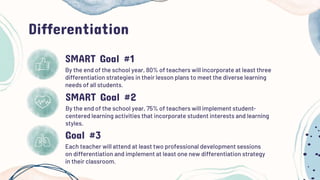
Differentiation
By the end of the school year, 80% of teachers will incorporate at least three
differentiation strategies in their lesson plans to meet the diverse learning
needs of all students.
By the end of the school year, 75% of teachers will implement student-
centered learning activities that incorporate student interests and learning
styles.
Each teacher will attend at least two professional development sessions
on differentiation and implement at least one new differentiation strategy
in their classroom.
SMART Goal #1
SMART Goal #2
Goal #3
Assessment & Feedback
By the end of the quarter, 100% of teachers will use formative and summative
assessments to guide instructional decisions and improve student outcomes by
attending PLCs to complete data chats, assess student learning, and drive instruction.
By the end of the quarter, 100% of students will receive timely and specific feedback
on their learning progress through the use of formative assessment strategies, (exit
tickets, peer/self assessment tools, etc.) to inform instructional decisions and
improve student outcomes.
By the end of the quarter, students will demonstrate a 15% increase in
their ability to self-assess their learning by implementing formative
assessment strategies that focus on self-reflection.
SMART Goal #1
SMART Goal #2
Goal #3
Fostering Awareness
Instructional coaches play a vital role in fostering awareness among teachers.
They help teachers become more self-aware by providing them with feedback,
guidance, and support.
Coaches should define the “why” for educators before collaborating to formulate
the “how” (Benigni et al., 2020).
 Classroom Observations & Feedback
 Data Analysis- determine student performance and identify areas for growth
 Teacher self-reflection and goal-setting
 Professional Development
 Professional Learning Communities
 Reflective Questioning
 Lesson Planning (Wise, 2023)
Modeling
Instructional coaches should model effective instruction in the
classroom to provide teachers with a visual representation of effective
teaching practices and a way to understand its importance (Gale, 2021).
 Model differentiation strategies or lessons
 Provide examples & a chance to practice
 Provide resources to support lessons
 Observations & Feedback
 Ongoing Support and Guidance
Motivation
Coaches should motivate teachers by providing positive feedback,
recognition, and opportunities for growth (Bauld, 2022).
Instructional coaches can help teachers identify their strengths
and weaknesses and provide feedback to help them grow.
• Build relationships (Bauld, 2022)
• Set SMART Goals
• Positive Reinforcement- praise strengths and successes
• Opportunities for Collaboration
• Ongoing support and guidance
• Professional Development Support
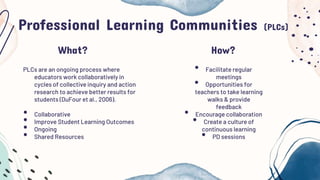
Professional Learning Communities (PLCs)
• Facilitate regular
meetings
• Opportunities for
teachers to take learning
walks & provide
feedback
• Encourage collaboration
• Create a culture of
continuous learning
• PD sessions
PLCs are an ongoing process where
educators work collaboratively in
cycles of collective inquiry and action
research to achieve better results for
students (DuFour et al., 2006).
• Collaborative
• Improve Student Learning Outcomes
• Ongoing
• Shared Resources
How?
What?
Conclusion
This professional learning opportunity aimed to
provide coaches with the necessary knowledge and
skills to facilitate effective instruction in classrooms.
By identifying target areas for growth, setting goals,
providing strategies for coaching and mentoring, and
incorporating professional learning communities,
coaches can support teachers in meeting the diverse
learning needs of students.
References
● Bauld, A. (2022, November 30). How instructional coaching helps teachers reach their
potential. https://xqsuperschool.org/rethinktogether/what-is-instructional-coaching/
● Benigni ED.D, M. D., Haeffner, B. A., Perrone, S. T., & (2020, January 13). When our teachers learn, our students learn:
creating a culture of coaching and collaboration. https://www.theedadvocate.org/when-our-teachers-learn-our-students-
learn-creating-a-culture-of-coaching-and-collaboration/
● Boogaard, K. (2021, December 26). How to write SMART goals. https://www.atlassian.com/blog/productivity/how-to-
write-smart-goals#:~:text=What%20are%20SMART%20goals%3F,within%20a%20certain%20time%20frame.
● Darling-Hammond, L., & Richardson, N. (2009). Teacher learning: What matters? Educational Leadership, 66(5), 46-53.
● DuFour, R., Eaker, R., & Many, T. (2006). Learning by doing: a handbook for professional learning communities at
work. https://www.allthingsplc.info/aboutFisher, Jr, M. R. (2023). Student assessment in teaching and
learning. https://cft.vanderbilt.edu/student-assessment-in-teaching-and-learning/
● Gale, Y. (2021, October 24). Instructional modeling, a powerful strategy in
coaching. https://yanira.net/blog/blog/instructional-modeling-a-powerful-strategy-in-
coaching/#:~:text=Modeling%20the%20implementation%20of%20instructional,overwhelm%20the%20observing%20coac
hing%20partner.
● Granite State College. (2022, October 21). Ch 12 differentiated
instruction. https://granite.pressbooks.pub/teachingdiverselearners/chapter/differentiated-instruction-2/
● University of Northern Colorado. (2022, June 11). Classroom management guide. https://www.unco.edu/cebs/teacher-
education/undergraduate-programs/classroom_management.aspx
● Wise, R. (2023, January 31). How do instructional coaches help teachers & their
students? https://educationandbehavior.com/how-do-instructional-coaches-support-teachers/

Professional Learning Opportunity .pptx

  • 1.
    Professional Learning Opportunity Megan Blank University ofPhoenix CUR/540 Methods of Coaching in the Instructional Setting April 11, 2023
  • 2.
    Introduction Effective instruction playsa crucial role in meeting the diverse learning needs of students. As coaches of teachers, it is our responsibility to provide support and guidance to teachers to enhance teaching practices. This professional learning aims to provide coaches with the necessary knowledge and skills to facilitate effective instruction in classrooms.
  • 3.
    SMART Goals What needsto be accomplished? Who is responsible for it? What steps need to be taken? S- Specific Should include trackable benchmarks to determine progress and determine finishing point. M- Measurable Questions to ask self- Is the objective something that can be reasonably accomplished? A- Achievable Why are you setting the goal? What impact will this goal have on the big picture? R- Relevant When will the goal be implemented? How long before the goal should be met? T- Time-bound
  • 4.
    Target Areas forGrowth Differentiating instruction is a vital skill for teachers. However, some teachers may struggle with this skill, resulting in ineffective instruction. Classroom management is critical for a successful classroom (University of Northern Colorado, 2022). Without successful classroom management, there are disruptions that results in low engagement and achievement. Assessments should be used to inform instruction and provide constructive feedback for students and teachers (Fisher, Jr., 2023). If teachers are unsure, the data would not be used to guide instruction to meet the needs of learners. Differentiation Classroom Management Assessment & Feedback
  • 5.
    Classroom Management By theend of the quarter, the number of student behavior incidents will decrease by 25% by implementing a positive behavior support system (PBIS), clear expectations, and consistent consequences for misbehavior. By the end of the semester, 75% of students will report feeling a sense of belonging and positive classroom culture by implementing a classroom management plan that fosters student autonomy, collaboration, and respect for diversity. By the end of the year, students will demonstrate improved self-regulation skills by implementing classroom management strategies that teach and reinforce self-regulation techniques. SMART Goal #1 SMART Goal #2 Goal #3
  • 6.
    Differentiation By the endof the school year, 80% of teachers will incorporate at least three differentiation strategies in their lesson plans to meet the diverse learning needs of all students. By the end of the school year, 75% of teachers will implement student- centered learning activities that incorporate student interests and learning styles. Each teacher will attend at least two professional development sessions on differentiation and implement at least one new differentiation strategy in their classroom. SMART Goal #1 SMART Goal #2 Goal #3
  • 7.
    Assessment & Feedback Bythe end of the quarter, 100% of teachers will use formative and summative assessments to guide instructional decisions and improve student outcomes by attending PLCs to complete data chats, assess student learning, and drive instruction. By the end of the quarter, 100% of students will receive timely and specific feedback on their learning progress through the use of formative assessment strategies, (exit tickets, peer/self assessment tools, etc.) to inform instructional decisions and improve student outcomes. By the end of the quarter, students will demonstrate a 15% increase in their ability to self-assess their learning by implementing formative assessment strategies that focus on self-reflection. SMART Goal #1 SMART Goal #2 Goal #3
  • 8.
    Fostering Awareness Instructional coachesplay a vital role in fostering awareness among teachers. They help teachers become more self-aware by providing them with feedback, guidance, and support. Coaches should define the “why” for educators before collaborating to formulate the “how” (Benigni et al., 2020).  Classroom Observations & Feedback  Data Analysis- determine student performance and identify areas for growth  Teacher self-reflection and goal-setting  Professional Development  Professional Learning Communities  Reflective Questioning  Lesson Planning (Wise, 2023)
  • 9.
    Modeling Instructional coaches shouldmodel effective instruction in the classroom to provide teachers with a visual representation of effective teaching practices and a way to understand its importance (Gale, 2021).  Model differentiation strategies or lessons  Provide examples & a chance to practice  Provide resources to support lessons  Observations & Feedback  Ongoing Support and Guidance
  • 10.
    Motivation Coaches should motivateteachers by providing positive feedback, recognition, and opportunities for growth (Bauld, 2022). Instructional coaches can help teachers identify their strengths and weaknesses and provide feedback to help them grow. • Build relationships (Bauld, 2022) • Set SMART Goals • Positive Reinforcement- praise strengths and successes • Opportunities for Collaboration • Ongoing support and guidance • Professional Development Support
  • 11.
    Professional Learning Communities(PLCs) • Facilitate regular meetings • Opportunities for teachers to take learning walks & provide feedback • Encourage collaboration • Create a culture of continuous learning • PD sessions PLCs are an ongoing process where educators work collaboratively in cycles of collective inquiry and action research to achieve better results for students (DuFour et al., 2006). • Collaborative • Improve Student Learning Outcomes • Ongoing • Shared Resources How? What?
  • 12.
    Conclusion This professional learningopportunity aimed to provide coaches with the necessary knowledge and skills to facilitate effective instruction in classrooms. By identifying target areas for growth, setting goals, providing strategies for coaching and mentoring, and incorporating professional learning communities, coaches can support teachers in meeting the diverse learning needs of students.
  • 13.
    References ● Bauld, A.(2022, November 30). How instructional coaching helps teachers reach their potential. https://xqsuperschool.org/rethinktogether/what-is-instructional-coaching/ ● Benigni ED.D, M. D., Haeffner, B. A., Perrone, S. T., & (2020, January 13). When our teachers learn, our students learn: creating a culture of coaching and collaboration. https://www.theedadvocate.org/when-our-teachers-learn-our-students- learn-creating-a-culture-of-coaching-and-collaboration/ ● Boogaard, K. (2021, December 26). How to write SMART goals. https://www.atlassian.com/blog/productivity/how-to- write-smart-goals#:~:text=What%20are%20SMART%20goals%3F,within%20a%20certain%20time%20frame. ● Darling-Hammond, L., & Richardson, N. (2009). Teacher learning: What matters? Educational Leadership, 66(5), 46-53. ● DuFour, R., Eaker, R., & Many, T. (2006). Learning by doing: a handbook for professional learning communities at work. https://www.allthingsplc.info/aboutFisher, Jr, M. R. (2023). Student assessment in teaching and learning. https://cft.vanderbilt.edu/student-assessment-in-teaching-and-learning/ ● Gale, Y. (2021, October 24). Instructional modeling, a powerful strategy in coaching. https://yanira.net/blog/blog/instructional-modeling-a-powerful-strategy-in- coaching/#:~:text=Modeling%20the%20implementation%20of%20instructional,overwhelm%20the%20observing%20coac hing%20partner. ● Granite State College. (2022, October 21). Ch 12 differentiated instruction. https://granite.pressbooks.pub/teachingdiverselearners/chapter/differentiated-instruction-2/ ● University of Northern Colorado. (2022, June 11). Classroom management guide. https://www.unco.edu/cebs/teacher- education/undergraduate-programs/classroom_management.aspx ● Wise, R. (2023, January 31). How do instructional coaches help teachers & their students? https://educationandbehavior.com/how-do-instructional-coaches-support-teachers/

Editor's Notes

  • #4 SMART goals are an approach to goal setting that eliminates generalities and guesswork. SMART goals set a clear timeline and make it easier to track progress and identify any missed milestones (Boogaard, 2021). S- Specific In order to be effective, SMART goals need to be specific to determine the heart of what is being aimed for (Boogaard, 2021). What needs to be accomplished? Who is responsible for it? What steps need to be taken? M- Measurable Make sure the goals are measurable- makes it easier to track progress and know when you have reached the end (Boogaard, 2021) A-Achievable Goals should be realistic. This also means that the person setting the goal needs to analyze what restraints are in place that could hinder achievement of the goal (Boogaard, 2021). R-Relevant Why are you setting the goal? What impact does this goal have on the big picture? T-Time-bound In order to truly measure success, the goal needs a clear determination to when the goal has been reached (Boogaard, 2021). When will the goal be created and implemented? How long before the goal should be met? This allows the goal to remain on track for completion.
  • #5 Target Areas for Growth Differentiation: The ability to differentiate instruction to meet the diverse learning needs of students is a vital skill for teachers. However, some teachers may struggle with this skill, resulting in ineffective instruction. Teachers can adjust the elements of a lesson to meet the needs of all students (Granite State College, 2022). Classroom Management: Classroom management is critical in creating an effective learning environment . Teachers who struggle with classroom management may experience disruptive classrooms, resulting in low student engagement and achievement. Assessment and Feedback: Teachers must be proficient in using assessments to inform instruction and provide meaningful feedback to students and teachers (Fisher, Jr., 2023). However, some teachers may struggle with this, resulting in ineffective instruction and disengaged students. Using data from assessments also allows educators to be reflective teachers and aids in developing as an educator (Fisher, Jr. 2023).
  • #6 Smart Goal #1 By the end of the quarter, the number of student behavior incidents will decrease by 25% by implementing a positive behavior support system (PBIS), clear expectations, and consistent consequences for misbehavior. Smart Goal #2 By the end of the semester, 75% of students will report feeling a sense of belonging and positive classroom culture by implementing a classroom management plan that fosters student autonomy, collaboration, and respect for diversity. Goal #3 By the end of the year, students will demonstrate improved self-regulation skills by implementing classroom management strategies that teach and reinforce self-regulation techniques.
  • #7 Smart Goal #1 By the end of the school year, 80% of teachers will incorporate at least three differentiation strategies in their lesson plans to meet the diverse learning needs of all students. Smart Goal #2 By the end of the school year, 75% of teachers will implement student-centered learning activities that incorporate student interests and learning styles. Goal #3 Each teacher will attend at least two professional development sessions on differentiation and implement at least one new differentiation strategy in their classroom.
  • #8 Smart Goal #1 By the end of the quarter, 100% of teachers will use formative and summative assessments to guide instructional decisions and improve student outcomes by attending PLCs to complete data chats, assess student learning, and drive instruction. Smart Goal #2 By the end of the quarter, 100% of students will receive timely and specific feedback on their learning progress through the use of formative assessment strategies, (exit tickets, peer/self assessment tools, etc.) to inform instructional decisions and improve student outcomes. Goal #3 By the end of the quarter, students will demonstrate a 15% increase in their ability to self-assess their learning by implementing formative assessment strategies that focus on self-reflection.
  • #9 Instructional coaches play a vital role in fostering awareness among teachers. They help teachers become more self-aware by providing them with feedback, guidance, and support. Coaches can use a variety of strategies to help teachers develop greater awareness of their instructional practices, their students' needs, and the overall learning environment. Coaches should define the “why” for educators before collaborating to formulate the “how” (Benigni et al., 2020). Classroom Observations & Feedback Data Analysis- determine student performance and identify areas for growth Teacher self-reflection and goal-setting Professional Development Professional Learning Communities Lesson planning (Wise, 2023)
  • #10 Instructional coaches should model effective instruction in the classroom to provide teachers with a visual representation of effective teaching practices and a way to understand its importance (Gale, 2021). When teachers observe effective instructional practices in action, they can gain a deeper understanding of how those practices work and how they can be adapted to their own teaching context. Instructional coaches can model a range of effective teaching strategies, such as questioning techniques, classroom management strategies, and differentiation strategies, to help teachers build their instructional repertoire. When teachers observe effective instructional practices in action, they can gain a deeper understanding of how those practices work and how they can be adapted to their own teaching context (Gale, 2021). Instructional coaches can model a range of effective teaching strategies, such as questioning techniques, classroom management strategies, and differentiation strategies, to help teachers build their instructional repertoire. Model differentiation strategies Provide examples & a chance to practice Provide resources to support lessons Observations & Feedback Ongoing Support and Guidance
  • #11 Coaches should motivate teachers by providing positive feedback, recognition, and opportunities for growth (Bauld, 2022). Instructional coaches can help teachers identify their strengths and weaknesses and provide feedback to help them grow. They can also help teachers set goals and develop a plan to achieve them, which can increase motivation. Build relationships- most important part to keep teachers motivated (Bauld, 2022) Set SMART Goals Positive Reinforcement- praise strengths and successes Opportunities for Collaboration Ongoing support and guidance Professional Development Support
  • #12 Professional Learning Communities (PLCs) are a powerful tool for fostering collaboration and improving student learning outcomes. As a coach or mentor, I would incorporate PLCs by: Facilitating regular meetings for teachers to discuss their practice and share resources Providing opportunities for teachers to observe each other's classrooms and provide feedback Encouraging teachers to collaborate on lesson planning and share their expertise Creating a culture of continuous learning and improvement by providing ongoing professional development opportunities within the PLC.