Professional Git 1stEdition Brent Laster
download
https://ebookultra.com/download/professional-git-1st-edition-
brent-laster/
Explore and download more ebooks or textbooks
at ebookultra.com
2.
We believe theseproducts will be a great fit for you. Click
the link to download now, or visit ebookultra.com
to discover even more!
Git in Practice 1st Edition Mike Mcquaid
https://ebookultra.com/download/git-in-practice-1st-edition-mike-
mcquaid/
Git for Humans 1st Edition David Demaree
https://ebookultra.com/download/git-for-humans-1st-edition-david-
demaree/
Pro Git 2nd Edition Scott Chacon
https://ebookultra.com/download/pro-git-2nd-edition-scott-chacon/
Git Apprentice Second Edition Raywenderlich Tutorial Team
https://ebookultra.com/download/git-apprentice-second-edition-
raywenderlich-tutorial-team/
3.
Version Control withGit 2nd Edition Jon Loeliger
https://ebookultra.com/download/version-control-with-git-2nd-edition-
jon-loeliger/
Superfoods For Dummies 1st Edition Brent Agin Md
https://ebookultra.com/download/superfoods-for-dummies-1st-edition-
brent-agin-md/
Git for Teams A User Centered Approach to Creating
Efficient Workflows in Git 1 (Early Release) Edition Emma
Jane Hogbin Westby
https://ebookultra.com/download/git-for-teams-a-user-centered-
approach-to-creating-efficient-workflows-in-git-1-early-release-
edition-emma-jane-hogbin-westby/
Better Git It in Your Soul First Edition Krin Gabbard
https://ebookultra.com/download/better-git-it-in-your-soul-first-
edition-krin-gabbard/
RxFiles Drug Comparion Charts 9th Edition Brent Jensen
https://ebookultra.com/download/rxfiles-drug-comparion-charts-9th-
edition-brent-jensen/
5.
Professional Git 1stEdition Brent Laster Digital Instant
Download
Author(s): Brent Laster
ISBN(s): 9781119284970, 111928497X
Edition: 1
File Details: PDF, 10.86 MB
Year: 2016
Language: english
8.
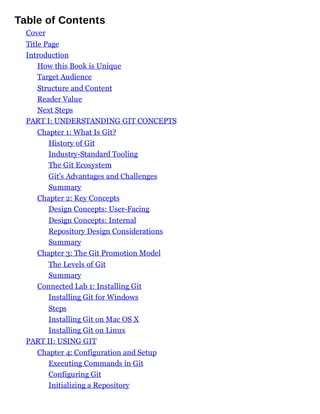
Table of Contents
Cover
TitlePage
Introduction
How this Book is Unique
Target Audience
Structure and Content
Reader Value
Next Steps
PART I: UNDERSTANDING GIT CONCEPTS
Chapter 1: What Is Git?
History of Git
Industry-Standard Tooling
The Git Ecosystem
Git's Advantages and Challenges
Summary
Chapter 2: Key Concepts
Design Concepts: User-Facing
Design Concepts: Internal
Repository Design Considerations
Summary
Chapter 3: The Git Promotion Model
The Levels of Git
Summary
Connected Lab 1: Installing Git
Installing Git for Windows
Steps
Installing Git on Mac OS X
Installing Git on Linux
PART II: USING GIT
Chapter 4: Configuration and Setup
Executing Commands in Git
Configuring Git
Initializing a Repository
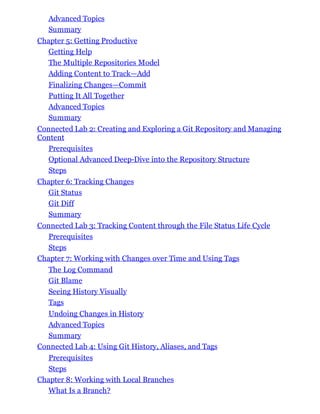
9.
Advanced Topics
Summary
Chapter 5:Getting Productive
Getting Help
The Multiple Repositories Model
Adding Content to Track—Add
Finalizing Changes—Commit
Putting It All Together
Advanced Topics
Summary
Connected Lab 2: Creating and Exploring a Git Repository and Managing
Content
Prerequisites
Optional Advanced Deep-Dive into the Repository Structure
Steps
Chapter 6: Tracking Changes
Git Status
Git Diff
Summary
Connected Lab 3: Tracking Content through the File Status Life Cycle
Prerequisites
Steps
Chapter 7: Working with Changes over Time and Using Tags
The Log Command
Git Blame
Seeing History Visually
Tags
Undoing Changes in History
Advanced Topics
Summary
Connected Lab 4: Using Git History, Aliases, and Tags
Prerequisites
Steps
Chapter 8: Working with Local Branches
What Is a Branch?
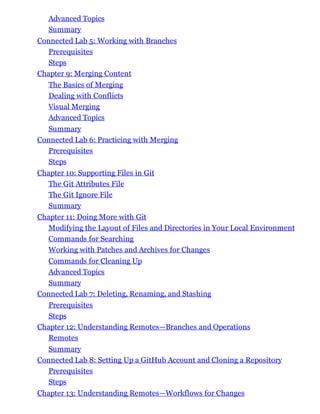
10.
Advanced Topics
Summary
Connected Lab5: Working with Branches
Prerequisites
Steps
Chapter 9: Merging Content
The Basics of Merging
Dealing with Conflicts
Visual Merging
Advanced Topics
Summary
Connected Lab 6: Practicing with Merging
Prerequisites
Steps
Chapter 10: Supporting Files in Git
The Git Attributes File
The Git Ignore File
Summary
Chapter 11: Doing More with Git
Modifying the Layout of Files and Directories in Your Local Environment
Commands for Searching
Working with Patches and Archives for Changes
Commands for Cleaning Up
Advanced Topics
Summary
Connected Lab 7: Deleting, Renaming, and Stashing
Prerequisites
Steps
Chapter 12: Understanding Remotes—Branches and Operations
Remotes
Summary
Connected Lab 8: Setting Up a GitHub Account and Cloning a Repository
Prerequisites
Steps
Chapter 13: Understanding Remotes—Workflows for Changes
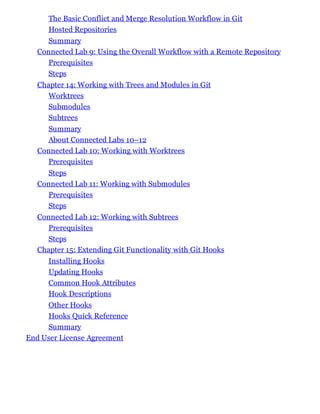
11.
The Basic Conflictand Merge Resolution Workflow in Git
Hosted Repositories
Summary
Connected Lab 9: Using the Overall Workflow with a Remote Repository
Prerequisites
Steps
Chapter 14: Working with Trees and Modules in Git
Worktrees
Submodules
Subtrees
Summary
About Connected Labs 10–12
Connected Lab 10: Working with Worktrees
Prerequisites
Steps
Connected Lab 11: Working with Submodules
Prerequisites
Steps
Connected Lab 12: Working with Subtrees
Prerequisites
Steps
Chapter 15: Extending Git Functionality with Git Hooks
Installing Hooks
Updating Hooks
Common Hook Attributes
Hook Descriptions
Other Hooks
Hooks Quick Reference
Summary
End User License Agreement
12.
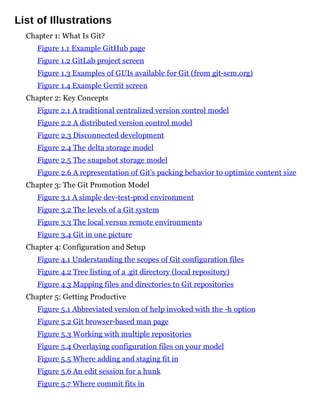
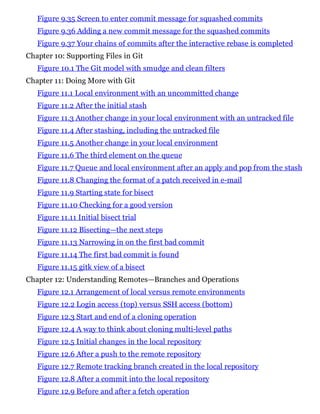
List of Illustrations
Chapter1: What Is Git?
Figure 1.1 Example GitHub page
Figure 1.2 GitLab project screen
Figure 1.3 Examples of GUIs available for Git (from git-scm.org)
Figure 1.4 Example Gerrit screen
Chapter 2: Key Concepts
Figure 2.1 A traditional centralized version control model
Figure 2.2 A distributed version control model
Figure 2.3 Disconnected development
Figure 2.4 The delta storage model
Figure 2.5 The snapshot storage model
Figure 2.6 A representation of Git's packing behavior to optimize content size
Chapter 3: The Git Promotion Model
Figure 3.1 A simple dev-test-prod environment
Figure 3.2 The levels of a Git system
Figure 3.3 The local versus remote environments
Figure 3.4 Git in one picture
Chapter 4: Configuration and Setup
Figure 4.1 Understanding the scopes of Git configuration files
Figure 4.2 Tree listing of a .git directory (local repository)
Figure 4.3 Mapping files and directories to Git repositories
Chapter 5: Getting Productive
Figure 5.1 Abbreviated version of help invoked with the -h option
Figure 5.2 Git browser-based man page
Figure 5.3 Working with multiple repositories
Figure 5.4 Overlaying configuration files on your model
Figure 5.5 Where adding and staging fit in
Figure 5.6 An edit session for a hunk
Figure 5.7 Where commit fits in
13.
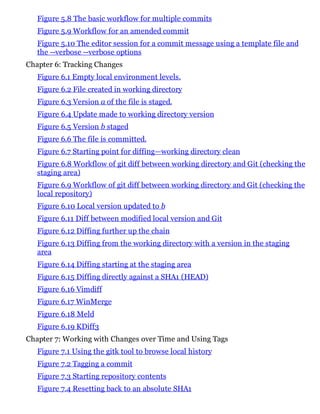
Figure 5.8 Thebasic workflow for multiple commits
Figure 5.9 Workflow for an amended commit
Figure 5.10 The editor session for a commit message using a template file and
the --verbose --verbose options
Chapter 6: Tracking Changes
Figure 6.1 Empty local environment levels.
Figure 6.2 File created in working directory
Figure 6.3 Version a of the file is staged.
Figure 6.4 Update made to working directory version
Figure 6.5 Version b staged
Figure 6.6 The file is committed.
Figure 6.7 Starting point for diffing—working directory clean
Figure 6.8 Workflow of git diff between working directory and Git (checking the
staging area)
Figure 6.9 Workflow of git diff between working directory and Git (checking the
local repository)
Figure 6.10 Local version updated to b
Figure 6.11 Diff between modified local version and Git
Figure 6.12 Diffing further up the chain
Figure 6.13 Diffing from the working directory with a version in the staging
area
Figure 6.14 Diffing starting at the staging area
Figure 6.15 Diffing directly against a SHA1 (HEAD)
Figure 6.16 Vimdiff
Figure 6.17 WinMerge
Figure 6.18 Meld
Figure 6.19 KDiff3
Chapter 7: Working with Changes over Time and Using Tags
Figure 7.1 Using the gitk tool to browse local history
Figure 7.2 Tagging a commit
Figure 7.3 Starting repository contents
Figure 7.4 Resetting back to an absolute SHA1
14.
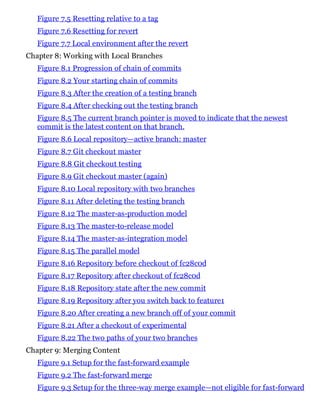
Figure 7.5 Resettingrelative to a tag
Figure 7.6 Resetting for revert
Figure 7.7 Local environment after the revert
Chapter 8: Working with Local Branches
Figure 8.1 Progression of chain of commits
Figure 8.2 Your starting chain of commits
Figure 8.3 After the creation of a testing branch
Figure 8.4 After checking out the testing branch
Figure 8.5 The current branch pointer is moved to indicate that the newest
commit is the latest content on that branch.
Figure 8.6 Local repository—active branch: master
Figure 8.7 Git checkout master
Figure 8.8 Git checkout testing
Figure 8.9 Git checkout master (again)
Figure 8.10 Local repository with two branches
Figure 8.11 After deleting the testing branch
Figure 8.12 The master-as-production model
Figure 8.13 The master-to-release model
Figure 8.14 The master-as-integration model
Figure 8.15 The parallel model
Figure 8.16 Repository before checkout of fc28c0d
Figure 8.17 Repository after checkout of fc28c0d
Figure 8.18 Repository state after the new commit
Figure 8.19 Repository after you switch back to feature1
Figure 8.20 After creating a new branch off of your commit
Figure 8.21 After a checkout of experimental
Figure 8.22 The two paths of your two branches
Chapter 9: Merging Content
Figure 9.1 Setup for the fast-forward example
Figure 9.2 The fast-forward merge
Figure 9.3 Setup for the three-way merge example—not eligible for fast-forward
15.
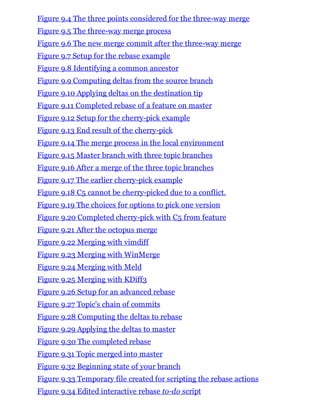
Figure 9.4 Thethree points considered for the three-way merge
Figure 9.5 The three-way merge process
Figure 9.6 The new merge commit after the three-way merge
Figure 9.7 Setup for the rebase example
Figure 9.8 Identifying a common ancestor
Figure 9.9 Computing deltas from the source branch
Figure 9.10 Applying deltas on the destination tip
Figure 9.11 Completed rebase of a feature on master
Figure 9.12 Setup for the cherry-pick example
Figure 9.13 End result of the cherry-pick
Figure 9.14 The merge process in the local environment
Figure 9.15 Master branch with three topic branches
Figure 9.16 After a merge of the three topic branches
Figure 9.17 The earlier cherry-pick example
Figure 9.18 C5 cannot be cherry-picked due to a conflict.
Figure 9.19 The choices for options to pick one version
Figure 9.20 Completed cherry-pick with C5 from feature
Figure 9.21 After the octopus merge
Figure 9.22 Merging with vimdiff
Figure 9.23 Merging with WinMerge
Figure 9.24 Merging with Meld
Figure 9.25 Merging with KDiff3
Figure 9.26 Setup for an advanced rebase
Figure 9.27 Topic's chain of commits
Figure 9.28 Computing the deltas to rebase
Figure 9.29 Applying the deltas to master
Figure 9.30 The completed rebase
Figure 9.31 Topic merged into master
Figure 9.32 Beginning state of your branch
Figure 9.33 Temporary file created for scripting the rebase actions
Figure 9.34 Edited interactive rebase to-do script
16.
Figure 9.35 Screento enter commit message for squashed commits
Figure 9.36 Adding a new commit message for the squashed commits
Figure 9.37 Your chains of commits after the interactive rebase is completed
Chapter 10: Supporting Files in Git
Figure 10.1 The Git model with smudge and clean filters
Chapter 11: Doing More with Git
Figure 11.1 Local environment with an uncommitted change
Figure 11.2 After the initial stash
Figure 11.3 Another change in your local environment with an untracked file
Figure 11.4 After stashing, including the untracked file
Figure 11.5 Another change in your local environment
Figure 11.6 The third element on the queue
Figure 11.7 Queue and local environment after an apply and pop from the stash
Figure 11.8 Changing the format of a patch received in e-mail
Figure 11.9 Starting state for bisect
Figure 11.10 Checking for a good version
Figure 11.11 Initial bisect trial
Figure 11.12 Bisecting—the next steps
Figure 11.13 Narrowing in on the first bad commit
Figure 11.14 The first bad commit is found
Figure 11.15 gitk view of a bisect
Chapter 12: Understanding Remotes—Branches and Operations
Figure 12.1 Arrangement of local versus remote environments
Figure 12.2 Login access (top) versus SSH access (bottom)
Figure 12.3 Start and end of a cloning operation
Figure 12.4 A way to think about cloning multi-level paths
Figure 12.5 Initial changes in the local repository
Figure 12.6 After a push to the remote repository
Figure 12.7 Remote tracking branch created in the local repository
Figure 12.8 After a commit into the local repository
Figure 12.9 Before and after a fetch operation
17.
Figure 12.10 Thelocal repository before and after the merge
Figure 12.11 Before and after a pull operation
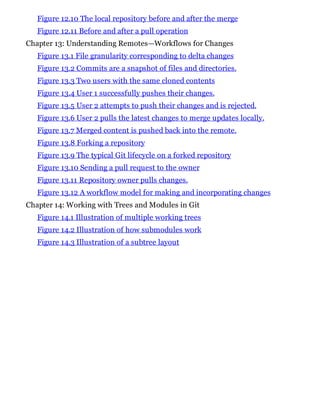
Chapter 13: Understanding Remotes—Workflows for Changes
Figure 13.1 File granularity corresponding to delta changes
Figure 13.2 Commits are a snapshot of files and directories.
Figure 13.3 Two users with the same cloned contents
Figure 13.4 User 1 successfully pushes their changes.
Figure 13.5 User 2 attempts to push their changes and is rejected.
Figure 13.6 User 2 pulls the latest changes to merge updates locally.
Figure 13.7 Merged content is pushed back into the remote.
Figure 13.8 Forking a repository
Figure 13.9 The typical Git lifecycle on a forked repository
Figure 13.10 Sending a pull request to the owner
Figure 13.11 Repository owner pulls changes.
Figure 13.12 A workflow model for making and incorporating changes
Chapter 14: Working with Trees and Modules in Git
Figure 14.1 Illustration of multiple working trees
Figure 14.2 Illustration of how submodules work
Figure 14.3 Illustration of a subtree layout
18.
List of Tables
Chapter3: The Git Promotion Model
Table 3.1 Core Commands for Moving Content between Levels in Git
Chapter 4: Configuration and Setup
Table 4.1 Components of a Git Command Line Invocation
Table 4.2 Porcelain Commands in Git
Table 4.3 Plumbing Commands in Git
Chapter 6: Tracking Changes
Table 6.1 Git Status Codes for Short Options
Chapter 10: Supporting Files in Git
Table 10.1 The File Scope for Git Attributes
Table 10.2 Options for Specifying Attributes
Table 10.3 Scopes and Precedence for Git Ignore Files
Chapter 12: Understanding Remotes—Branches and Operations
Table 12.1 Summarizing the Types of Branches in Git
Chapter 15: Extending Git Functionality with Git Hooks
Table 15.1 List of Git Hooks by Operation
She left theroom with no signs of unseemly haste, delighted to feel the
grasp of her husband’s fingers literally smarting on her arm. Cruelty! She
had heard of that.
She went straight upstairs to her own room and locked herself in. It had
been a sudden and brilliant inspiration of hers to leave them. She wanted
very much to hear what it was that her aunt had to say to her husband, but
still more she did want time to think. The ground had been cut beneath her
feet. She felt like Alnaschar when his basket of eggs was rudely kicked
away from him. A completely new plan of action was imperative, and how
could she act when she was so dreadfully in the dark and so puzzled by her
husband’s constant allusions to Mrs. Poynder, whom she had not seen since
she left Newcastle?
But stay! In her hurried glimpse of Mrs. Poynder she had realized that
that lady was wearing a black dress, trimmed with little shining things, as
Rivers had called them, and that the black bag that she had slammed down
on the table was the one that Rivers had described as belonging to the
unknown visitor at the Heather Bell on that summer night that seemed so
long ago and was only last night. And the face seen at the window at the
very moment when she had fallen into her lover’s arms, for the first and
only time! All these things came crowding into her mind; a bewildering
vision of what had been rose before her eyes, with the damning significance
in ears inimical of all the little foolish foolhardy things she had done in the
innocent audacity of her unreturned love—and she realized how she and
Rivers had been betrayed!
She must find out how much and what Aunt Poynder had seen before she
committed herself by a single word. She must be clever and diplomatic to
the full extent of her powers. Her excitement grew as she sat there on the
edge of the bed thinking out a plan—many plans, and she bounded to her
feet when there came a very ordinary knock at the door.
“Come in!” she cried, forgetting that she had locked it.
There was a furious rattling and “How can I?” came in Mrs. Poynder’s
angry voice.
Mrs. Elles had taken her line.
“Oh, I forgot,” she said, insolently. “Well, you can say what you want to
through the keyhole. I shall hear you well enough.”
“Do you want all the servants to hear what I have to say?”
23.
“I haven’t theslightest objection, if you haven’t,” said Mrs. Elles, airily.
“You’re quite shameless, then?”
“Perhaps, Aunt, you had better take care what you say, for your own
sake.”
“For my own sake, says she! Jane Poynder has nought to be ashamed of.
But I should have thought, after what I saw last night with my own eyes
——”
“Through the keyhole?” interrupted her niece impertinently.
“Through the window, woman!—the window of the hotel where you
were living with——”
“Hush, Aunt,” Mrs. Elles interrupted again—this time really for the sake
of the servants and common decency. And then there was nothing fine,
dramatic or romantic about this discussion; it sickened her. Not so should a
husband accuse his wife of infidelity: through the mouth of a vulgar, foul-
mouthed beldam. How different from Hero’s “Let me but know of what
man I am accused”! Still it behooved her to listen and learn, if she could,
from Aunt Poynder the precise terms of the indictment against her.
“And I saw you in his arms,” continued the old lady, “and the girl Jane
Anne saw you walking hand in hand out in the public street! Don’t attempt
to deny it!”
In point of fact Mrs. Elles said nothing, but Mrs. Poynder thought she
did, and her fury rose.
“You have the face——! Well, it’s more than your man has. He turned as
white as a leaf when I was giving him a piece of my mind this morning.
He’d nothing to say for himself except that your room was the common
room.”
“So it was!”
“Tell that to me! I know what’s what. It’s I that made him promise to
marry you, when all’s said and done. But, Lord!—trust him! He’ll not touch
you with a pair of tongs! Men aren’t so fond of marrying the women they
have disgraced. Mercy, what’s that?” she added in extreme perturbation.
“Only the dinner gong, Aunt,” said Mrs. Elles, spitefully smiling on the
other side of the door. She had learned what she wanted. “I can’t come
down,” she said decidedly. “Tell Mortimer to come up here and speak to me
after he has dined.”
24.
“You give yourorders, my lady!” grumbled the older woman. “What’s to
say that Mortimer’s going to condescend to even speak to you?”
“Give him my message,” said Mrs. Elles peremptorily.
Mrs. Poynder’s footsteps creaked on the stairs as she withdrew, and her
angry mutterings were like a heavy ground swell at sea as she went
downstairs. How her niece loathed her! And the man whose comfort and
well-being she placed before every other earthly consideration had been
exposed for at least half an hour to that malign influence. She realized the
full horrors of the scene at the Heather Bell which her aunt had only faintly
adumbrated, and most of her thought was for him.
“I must get him out of this,” she said to herself, “at all costs! I used to
think myself clever—I shall be clever if I manage this. I don’t care a pin for
myself, but for him! If I only knew something about it all—how they set
about these things. What can be done? What is possible? If only I could
look it up somewhere.”
A vain glance at the little bookcase stocked with Ibsens and Merediths
did not help her.
“What is the good of you?” she said, apostrophising them violently.
“You are no good when it comes to the serious crises of life. Even a
common old ‘Enquire Within’ would be better. I don’t know what it is I am
in for—what it all means. Can Mortimer divorce me straight away? What is
the formula?” She wrung her hands. “If only I could keep his name out of
it?”
She unlocked the door of her room and went out upon the landing and
looked down over the banisters. Mortimer was dining! “Though empires
crumble,” she murmured to herself. She heard the clatter of knives and
forks; through the long well-like slip between the banisters she could see
the parlour-maid carrying dishes. Mortimer was dining well, and intending
to divorce his wife!
She was too frightened to properly enjoy the antithesis. She went back
into her own room and lay down upon the bed, shaking in every limb. She
had eaten hardly anything that day.
She must have dozed a little. She woke with a start, to see a broad shaft
of light coming in from the doorway, and her husband, a stout undignified
sort of avenging angel, standing on the threshold. She sprang into a sitting
posture.
25.
“Make some light!”he said impatiently.
“Why bother?” she said languidly. “You can see to scold me quite well
enough in the dark!”
“Scold!” he said, in an accent of contemptuous reproach, coming nearer.
He was flushed, but quite sober. She wondered if he really had had the heart
to dine.
He enlightened her. “You don’t seem to realize,” he said, “the position of
affairs. I have been quite unable to eat any dinner.”
“What about me? But, however, that is neither here nor there. The point
is”—assuming as viragoish an air as she could—“will you please tell me
what you can have meant by allowing Aunt Poynder to come up here as
your emissary and abuse me, your wife, and say awful things out loud for
all the house to hear?”
“You are begging the question, Phœbe,” her husband said, and in his
earnestness and sincerity he was almost dignified. “You must know how
serious all this is! What have you to say in explanation of the charges which
Aunt Poynder brings against you, and that woman’s letter to me which I
showed you?”
“What are the charges?” she asked valiantly and without the flippancy
with which she had thought fit to characterize all her previous remarks.
“Wait!” he said, and she gave a little frightened cry, and clutched his
arm.
“What are you going to do, Mortimer?”
“I am going to look at your face while you sit there and lie to me!” he
said, striking a match, and lighting the gas. It showed her countenance
frightened and pale, his reddish and set. Even in her agitation she was
struck by the expression he had used. It was the second time she had been
taxed with the mendacious habit. She began to think there was something in
it. It was, however, the first time Mortimer had permitted himself to allude
to it so roundly. She was nonplussed by his attitude; she had expected him
to bluster and be ridiculous. He was dignified even to a tragedy. The
thought crossed her mind that he still loved her, which would make it
difficult for him to adopt the point of view she was intending to put before
him.
26.
“Mortimer,” she said,raising her eyes to his with an intentional effect of
extreme and businesslike candour, “what Aunt Poynder tells you she saw
she did see, but the inferences she draws are false.”
“Explain yourself more clearly.”
“I mean”—she strictly persevered in her steadfast gaze—“that it is not
true that I have been unfaithful to you.”
“Not——!”
“I swear it,” she said simply, “but I do not expect you to believe me. Are
you going to divorce me?”
“What—and leave you free to run off and join your lover!” roared
Mortimer in a spasm of jealous rage. “I’m——”
“I have no lover—I wish I had!” she interrupted. Her sad sincerity had a
convincingness her husband was too angry to apprehend.
“Mortimer,” she went on, clasping her hands, “could you possibly
divorce me—I know nothing of these things—without having a co-
respondent at all? I do so hate having him dragged in!”
The solicitor stared at her.
“Mortimer, isn’t it possible? You are a man of business, you ought to
know about these things. We do get on so badly together, don’t we? It is
quite hopeless our trying to get on. Isn’t there—there must be—some sort
of arrangement by which husband and wife can agree to live apart because
they are unsuited to each other, without dragging in a third person? There
isn’t a third person, I do assure you, and I know how he would hate it. This
poor man Aunt Poynder saw is a painter—a hater of women. I bored him
really, only I laid myself out to please him and plagued his life out! I
interfered terribly with his work. You would not understand how. He
wanted to be left alone. Artists are like that. He did not know I was married,
and when he found I had compromised myself against him—that’s the only
honest way to put it—he proposed to me because he was a gentleman and
thought he ought. It is I who am to blame, for trying to make him like me. I
kissed him, not he me!... I am a wretch, I know, but if only you knew how
miserable my life is here with you! We ought never to have married. Let me
go! I am sure you will be happier without me, believe me! Let me go
quietly—let it be between you and me! Don’t let all the world in! Don’t ruin
an innocent man’s life over it—for it would! He is a Royal Academician
and might be President some day, and if he is forced to marry me he will
27.
lose that andhis position in the world, and it is such a good one. Besides, he
is engaged to be married to another woman—he really is!”
She paused breathless, and caught hold of his hand. He shook her off.
“Lies! Lies! Lies!” he said. “I don’t believe a single word you have been
saying, Phœbe. And as for a judicial separation between us, which is what
you seem to want, I say ‘No, thank you.’ The laws are made to enable a
man to get completely rid of such a woman as you!”
He left her and she heard him leave the house. It was exactly nine
o’clock.
28.
CHAPTER XI
She knewwhat she had to do. She composed her features and covered
them with powder, and rang the bell.
It was the cook who answered it, not the new parlour maid. The cook,
whom Mrs. Poynder worked hard and bullied, was in consequence a firm
ally of the young and far niente mistress of the house, who preferred
pleasant and flattering looks even to good service.
“Mary,” Mrs. Elles said urbanely, “come and help me! I want to catch
the night mail for the south.”
They pulled open drawers and dragged in trunks. Mrs. Elles was not sure
that she was not leaving her husband’s house for ever, and she did not mean
to go without her things. The two women worked hard, carrying on a
fragmentary conversation the while.
“How has your master been while I was away?” she asked of the cook,
proud of being able to show that amount of good feeling.
“He’s not been to say sae well. The doctor’s been in once or twice, to
please the missis—Mrs. Poynder, I mean. But the master doesn’t seem to
hold with doctors much.”
“No, I know he hates them,” said his wife, carefully controlling her
surprise. It was natural that Mortimer should have given way a little during
her absence, partly through temper, and partly for want of her supervision,
but still a little fit of excess did not seem to indicate so important a step as
the calling in of doctors. “But I wonder why I have not heard anything of all
this except through you?” she added, forgetting to be prudent. “What was
it?”
“Oh, just a fainting fit like. Missis Poynder found him in his study a day
or two back, and it took a fair half hour to bring him round.”
“Why wasn’t I telegraphed for?”
“Eh, ma’am, ye were away for your health, and so Missis Poynder
thought she wouldn’t go for to agitate ye. It’s all passed off, but the doctor
he says as Master behoved to be car’ful.”
“Heart?” murmured Mrs. Elles, with the interrogative inflexion, not
liking to ask a direct question. She was really a little anxious. She did not
29.
positively hate herhusband.
“Yes, that’s what doctor said. Avoid excitement—sperrits the worst
thing!”
Everyone in the house knew that this prohibition was by no means
unnecessary.
“Well, Mary, you must look after him while I am away. I am going up to
London on business. See that he has what he likes.” She pressed five
shillings into the cook’s hand, feeling the glow of accomplishment of the
whole duty of a married woman and picturesque forgiveness of insult and
injuries.
Her packing was done. It was half-past eleven. She had a whole hour
before her.
Of the laws of her country she had about as much practical knowledge as
most women—that is to say none at all! She was full of the proposition she
had made to Mortimer, of a bloodless duel, an amicable separation, a social
catastrophe which should affect herself only, leaving Rivers untouched. The
engagement between Rivers and Egidia, which she was going to London to
suggest, would surely tell very much in favour of her plan, but she must
neglect nothing, leave no stone unturned for the accomplishment of his
salvation. She had made up her mind to work this thing for Rivers, to be his
diplomatic angel, and that her heroic plan involved the surrendering of him
to another woman only added to the sublimity of the act.
She went down to her husband’s study; she knew he was out; she hoped
she would not have the ill luck to meet Mrs. Poynder.
The house was perfectly still. There stood the row of collected legal
wisdom, dusty, dull, abstruse, but full of vital truths for her at this moment.
In a few minutes she was deep in law, and covered and daubed with its dust.
She found no hint of a previous engagement of the co-respondent being
considered as a circumstance invalidating the divorce, but she saw that she
and her husband must on no account sleep under the same roof to-night.
That was why he had gone out. He probably did not intend to return. It was
a pity he did not know that she was going to take the initiative and leave
him, and could not see her boxes at that very moment standing in the hall,
strapped and corded and mountainous.
She stood there, taking down one volume after another, feeling the thief
of knowledge, since it was from her husband’s own books that she was
30.
gleaning the wherewithalto discomfit him when the time came. At any rate
they would start fair! About on a level with her hand, she noticed a Blue
Book on the Laws of Divorce. She eagerly took it down from the shelf. It
seemed clearly written and fairly explanatory.
“There is no divorce by mutual consent of husband and wife.”
She saw that she had been talking nonsense to Mortimer upstairs. How
he must have laughed at her absurd proposition!
“The Causes of Divorce.” This seemed a useful heading! She read on
eagerly.
“Attempt by one of the parties on the life of the other, either personally,
or by an accomplice.”
But she had not attempted Mortimer’s life, nor had Rivers attempted that
of Mortimer, and though she had heard of cruelty, she had not thought of
this definition of it.
“I had no idea the laws of my country were so absurd!” she exclaimed,
laying down the blue book in a pet. Then a glance at its cover showed her
that the volume she held referred to the Laws of Foreign Countries, and this
was the procedure of the Argentine Republic that she was looking at!
She gave that up, and reached down Stephen’s Commentaries, and tried
to find some hint there that would be useful to her.
She read on it for a good quarter of an hour, but the legal phrases
puzzled her, the scantiness of details left her uncertain, the heavy volumes
tired her hands to hold. She was no wiser, and a good deal wearier.
The door opened behind her. Instinctively she turned round.
“Oh, Mortimer, what is a femme sole?”
. . . . . . . .
She laughed to herself, as the train sped southwards through the night,
when she thought of her last sight of her husband as he stood in the
doorway, apparently transfixed by her extraordinarily indiscreet question.
His abrupt volte face and retreat reminded her that an injured husband is not
to be used as an Encyclopædia Britannica. Henceforth she was as a noxious
animal, to be got rid of, not argued with. She laughed, and then she cried,
but finally her offended dignity won the day, and the train deposited a
heroine, rugless, hopeless, comfortless, but still a heroine, every inch of her,
on the platform at King’s Cross in the early dawn.
31.
She took aroom at the Great Northern Hotel and waited in all the day till
the calling hour, except for a little excursion to a jeweller’s shop near the
station, where she sold her one magnificent diamond ring for about a third
of its value. At four o’clock she dressed herself beautifully and took a
hansom to Queen Anne’s Mansions, where Egidia lived. She made sure of
finding the novelist at home; she had heard her say she was at home on
Fridays; if she was not alone she would outstay the other callers. As she
drove along she looked at herself critically in the little glass in the corner of
the cab.
“Talk of the empire of the mind over the body, it is nothing to that of the
mind over the complexion!” she said to herself, but was pleased to see that
two sleepless nights had only made her eyes larger and her face more
interesting. Looks are the sinews of a woman’s war and, though she was not
going to quarrel with Egidia but merely give up her lover to her, her
prettiness would serve to mark and accentuate her heroism.
It was five o’clock when her cab drove under the archway and pulled up
at the big door which is the portal to so many homes. Egidia lived very near
the top, but she preferred to walk up, she was afraid of the lift. On the
threshold of the door which was the novelist’s, as the boy who rang the bell
for her informed her, she caught her dress in the mat and stumbled as the
maid opened the door.
“It means something!” she said to herself.
It meant that she was nervous. She was going to do an absurd thing;
make a most curiously intimate proposition to a woman she hardly knew! It
was like a scene in a novel. If only Egidia would not be too matter-of-fact,
—would consent to stay in the picture, as it were! As a novelist she would
be apt for irregular situations, and able to enjoy and employ them.
The parlour-maid mumbled her name, which she had mumbled to her.
Egidia, in a red teagown, like a handsome velvet moth, rose from a low seat
to receive her, and Mrs. Elles felt like a frivolous butterfly in the somewhat
freakish, bizarre habiliments in which she elected to express her personality.
“Oh, it is you!” exclaimed the novelist, her lips breaking into a kind
smile and her eyes diffusing cordiality, as she held out both hands.
A tall figure rose from his seat on the other side of the fireplace, and
Mrs. Elles’s eyes were fixed on him while Egidia was speaking.
32.
“So you havefound your way here at last! Where are you staying? Let
me introduce Mr. Edmund Rivers—Mrs. Mortimer Elles!”
Why should he not be calling on Egidia? It was the most natural thing.
Mrs. Elles had never thought of this contingency, and yet she would not
have had it not happen for the world. She was not a woman who would go
out of her way to avoid situations. She bowed—he bowed; and then Egidia
seeming by her manner to prescribe a greater intimacy, they shook hands.
Oh! why was it so dark? She could not see his face.
“Will you ring the bell, Edmund, please, for another cup. Mrs. Elles, you
must have some tea!”
“Thank you, no. I think I won’t——” began Mrs. Elles. To calmly sit
down and drink a cup of tea at a juncture like this! It was not to be thought
of.
“Oh, but you must. North country people can’t do without their tea, I
know that. Only in London we don’t have sweet little cakes like yours.
What do you call them—girdle cakes?”
So Egidia ran on, putting her visitor into a chair and pouring out a cup of
tea and looking after her comfort in the most solicitous manner. Mrs. Elles
felt that, considering “everything,” this made her look ridiculous—but then
Egidia could not be expected to know about “everything”! Rivers would
surely not have told her about what had happened in the woods of Brignal.
That was their affair—hers and his. Egidia would never have received her
like this had she known. She felt a warm glow of pleasure on recognising
the bond between her and him of a common secret.
But he was very cleverly neutral in manner. As he handed her the cake
his eyes met hers with a curious look, searching but impenetrable. It
disconcerted her. It seemed to take her all in, but it gave nothing out. But
she was at least positive that there was no love in it, no pleasurable
excitement in a loved mistress refound. Under the oppression of this idea
she took a draught of hot tea that scalded her and in the access of pain that
ensued persuaded herself that she was glad of the counter-irritant.
“Look, Mrs. Elles, at this little sketch Mr. Rivers has just given me for
my birthday,” Egidia was saying, as she held up a framed water-colour
drawing lovingly.
Mrs. Elles looked at it. The rush of recollection was not so blinding as
she expected, but poignant enough.
33.
“Where is it?”she asked, for form’s sake. She knew well enough.
“May I tell her, Edmund?”
He made a little nod in the affirmative.
“Well, he could scarcely try to keep that knowledge from me,” Mrs.
Elles thought to herself.
“It is Rokeby,” Egidia went on, “Scott’s Rokeby—that place where Mr.
Rivers works so much. Rather near your part of the world, I believe.”
“I know it well,” Mrs. Elles said.
Rivers was standing abstractedly a few yards away from the two women.
Mrs. Elles resented his lack of emotional interest.
“It is quite charming!” she said, raising her voice. “And is that a little
figure I see—on the edge of the stream? Some village girl you got to stand
for you, I suppose?”
It was no village girl, and she knew it. It was herself, done by her own
desire. She had begged him to put in some human interest for once, and he
had indulgently agreed to do so, on condition she supplied it herself. She
had posed for twenty minutes under a broiling sun, and had refused the gift
of the sketch when it was done. She had somehow wished that the memento
of her should be retained by him, not her.
No, he could never have cared for her, or he could never have borne to
give away that sketch to another woman! Her lips stiffened and then
quivered. Had she known what was actually the fact, that the circumstance
of her posing for that particular sketch had completely lapsed from the
painter’s memory, would she have been less distressed?
“That is the very reason I chose it,” Egidia said, taking the drawing out
of her hands. “Mr. Rivers gave me my choice of the Rokeby sketches, and
out of a whole quantity of them in his studio I chose this one because it had
a little human interest in it. I like people, you know. I should feel the world
so cold, so dull, without them. I can’t think how you, Cousin Edmund,
manage to do without them so nicely!”
The painter actually laughed—from an excess of nervousness, Phœbe
Elles hoped.
“Do say that I may bring Mrs. Elles to see your studio one day? I am
sure she would like to see it!”
34.
“I should bedelighted,” he said, “only you know a landscape painter’s
studio is not much to look at. Now Tadema’s——”
“Ah! but then Mrs. Elles is not blasée on the subject of studios as yet, are
you, Mrs. Elles? She wants to see a little bit of everything now that she is
here, don’t you? You remember our conversation in Newcastle? We must go
about a little together and see the sights. I don’t mean the Tower and the
Monument—you are of course far above these. You might ask us to tea in
your studio,” she ended, turning, suddenly appealing, to Rivers.
“She wants to show off her intimacy with him,” Mrs. Elles thought
bitterly.
“I will,” said Rivers gravely. “You must write and name your own day. It
will have to be when I come back from Paris.”
“Oh, are you going to Paris?” Egidia exclaimed, obviously surprised and
completely uninstructed in his movements.
“I think I shall have to, on business; but I will let you know when I come
back, and I will try to get a few interesting people to meet you—and your
friend!”
Mrs. Elles had to make what she could out of the slight hesitation. He
smiled, forcedly—she was sure it was forcedly.
Egidia’s face was wreathed in kindly natural smiles as he bade good-bye
—so was hers. It was pathetic. Mrs. Elles, with her superior knowledge of
“fearful consequences, yet hanging in the stars,” felt as if they were all
dancing on a grave—treading a volcano. She knew well enough that she
would never go to tea with him, never touch his hand again perhaps, as she
gave hers, and dreamt of the accustomed thrill of pleasure that the mere
contact used to give her. It did not now. Was it that she was too nervous, too
frightened to be receptive, or was it that his magnetism had ceased to flow
for her, as a consequence of his indifference?
He raised the heavy portière, and the light seemed to go out of two
women’s lives as it fell to behind him.
“Well,” said Egidia, complacently, “that will be the first tea party my
cousin has ever given in his studio in his life, to my knowledge! I do hope it
will come off, for I want you two to be great friends. You will—you are the
veritable antithesis of each other.”
Mrs. Elles interrupted her with a sudden burst of hysterical laughter.
35.
“Friends!” she said.“Friends! And my husband is going to make a co-
respondent of him!”
36.
CHAPTER XII
Egidia laidher head on her hands. The tale of Brignal Banks had been
told. “Good God!” she said passionately. “And it is to Edmund Rivers that
this thing has happened!”
She thought of the poignant tale of love and disaster only as it affected
the man. It was natural; Mrs. Elles had expected that she would do so, and
yet she was a little aggrieved at not being treated as the central figure of any
romance that happened to be forward. She valiantly stifled her feelings on
this occasion, however, and rising from the low prie-dieu chair from which
she had delivered her confession, knelt at Egidia’s feet, and gently pulled
her hands down from her face. The gesture was pretty and appealing, but at
this juncture it irritated the other woman almost beyond endurance by its
dash of theatricality. Thus behave erring heroines of melodrama when they
reveal “all” to their mentors. Egidia sat and stared at the little flushed face
opposite her with an almost unfriendly gaze, and listened but coldly to the
trickle of her excitable speech.
“But it must not happen!” Mrs. Elles was saying. “It must not! It must
not! You can save him, if you will, and that is why I have come to you. I
have travelled all night, and I have not slept for two. If I tell my story badly,
that’s why. There’s an iron band across my forehead. And I have had
nothing to eat for ages. But I knew that you and he had always been great
friends, to say the very least, and that it would be so easy for you—— You
must forgive me, and understand that I did what I could. I acted for the best
—on the spur of the moment. I thought it was the only way to save the
situation—”
“What, in the name of Heaven, have you done?” exclaimed the other.
“Do, please, tell me exactly.”
“I used your name——” began Mrs. Elles, hesitatingly.
“Please go on!”
“I am afraid I told my husband straight out, when he pressed me, that
Mr. Rivers was engaged to you!”
“To me! Mr. Rivers! What possible authority——”
Egidia rose to her feet, and Mrs. Elles perforce rose too.
37.
“Have I donesuch a mischief?” she asked supplicatingly. “Stay! the lace
of my dress has got caught in yours!”
She disentangled it, while Egidia stood, a prisoner, shivering with
impatience, and some disgust.
“Surely,” Phœbe Elles went on, “you are very fond of each other? I
always thought so, from the way he spoke—or rather did not speak of you.
With some men reticence about a woman is the sure sign of their feeling
keenly about her. Indeed, I was quite jealous of you sometimes!” she added
ingenuously.
Egidia’s face had stiffened into the very haughtiest expression a proud
face can assume. She was a woman who could curl her lip, and she did it
now, but Mrs. Elles was too tactless and too much excited to notice.
“So you see that I am doing this entirely for his sake—quite against the
grain, I assure you, but it seemed the only way—and I thought you would
want to do anything to keep him out of it!”
“Keep him out of it!” exclaimed the other, pointing down towards the
basement of her own house, as to the depths of an imaginary Divorce Court.
“I should think I did! But how could you suppose that such an absurd lie as
that could do him any good?”
“Couldn’t it? I thought it could. And I seem to be always being scolded
for telling lies now!” sighed Mrs. Elles, “but I really thought I was
splendide mendax this time! And though it was a lie, of course, you can
make it true to save him, don’t you see?”
Egidia recovered herself. What was the use of being angry?
“But supposing Mr. Rivers did care for—was engaged to me—I don’t
see what possible difference it could make?”
She succeeded in smiling almost indulgently on this sweet simpleton,
who was to be suffered gladly, for the sake of Rivers.
“Well, of course, I don’t know much about these things,” Mrs. Elles said,
plaintively, “but I thought if the co-respondent——”
“Please don’t use that word,” said Egidia, shivering.
“It is the word, I know that much. Well, if the man is already engaged to
someone else at the time that the accusation is made—it surely makes it less
—likely that he would—wouldn’t a jury think better of him? He would
38.
have to marryher at once, of course, and send the slip of the Times
containing the announcement to my husband——”
She looked so serious, so innocent, so like the fair Ophelia, “incapable of
her own grief,” so utterly woe-begone, that Egidia’s mood changed. She
laughed, and sat down, and took her visitor’s little soft, incompetent,
feverish hand in her own cool firm one, and held it.
“My dear Mrs. Elles, have you been all these years married to a solicitor,
and know so little of it all as to suppose that a jury would be affected by
such a detail as the one you have mentioned!” No, no, we must get your
husband to stay proceedings altogether. I hope it isn’t so bad as you think—
in fact, I am sure it isn’t! Your husband could not, I think, possibly divorce
you merely on what you have told me—and perhaps you have even
exaggerated that a little? You are very tired——”
“I am not hysterical!” exclaimed Mrs. Elles angrily.
“Forgive me, but your voice and your eyes belie you. Besides, you said
yourself you were ill. Of course you are, naturally, after what you have
undergone!”
“It was pretty dreadful!” Mrs. Elles owned, mollified.
“To-morrow,” Egidia continued, with a little imperceptible shudder, “you
must go over it all again to me. After you have had a night’s rest, you will
be able to think and marshall your facts more clearly. I ought to know
exactly where we stand. Meantime, will you send for your things from the
Great Northern Hotel and pay your bill?”
“But I must live somewhere!” exclaimed the other in a sick fright. “You
surely don’t want me to go back to Mortimer, when I have just run away
from him?”
“No, but you must write to him, and tell him you are staying here with
me. Though literary, I am supposed to be respectable.” She smiled. She had
taken her line. “And, by the way, I have a dinner party here to-night, and I
want you to enjoy it and look nice.”
“I have an evening dress in my box at the Hotel,” said Mrs. Elles,
eagerly.
“Well, then, we will get it here in time for you. I will send at once.”
She rang the bell, gave her orders, and then turning, stopped and kissed
the little bit of thistledown who stood there, grateful and apprehensive. It
39.
was an effort,the whole scene had been one long effort, but she flattered
herself she had come out of it well, and had not betrayed herself. In the
exercise of her profession she had studied the feelings of others and their
development and outward manifestations so closely that she had grown
almost morbidly desirous of not showing her own.
“Please call me Phœbe!” her visitor had murmured as she led her to her
room and left her there.
Yes, she, a simple, honest, unsophisticated woman, would do anything,
dare, contrive, and practise anything that might deliver Edmund Rivers
from the consequences of his accidental connection with this miracle of
indiscretion, this butterfly, who, unfortunately for others, took herself so
seriously.
He should not, if she could help it, have to rue the day when he had
allowed the human interest to come into his life, and occupy even a portion
of his mental foreground. That was all he had done; he had never flirted
with her, Egidia felt sure. “Love plays the deuce with landscape!” he had
once laughingly proclaimed, to excuse himself from marrying. No, he
should not be forced, by the stain of the courts, the horrors of imputation, to
take on himself the shackles of the marriage tie, with which the little
woman who had played the part of his evil genius, would so carelessly
invest him!
. . . . . . . .
“She kissed me, but all the while, she would like to scratch my eyes
out,” Mrs. Elles in the silence of the spare room was saying to herself. She
was not spiteful—oh no, that was not her character at all—but she had
studied and could not help knowing human nature! There was no misprision
of motive in her mind; she was perfectly aware of Egidia’s reasons for
being kind to her. That lady had taken her rival to stay with her because, as
the saying is, she preferred to see mischief in front of her—she would keep
her safe under her own roof the better to control her. It was all for the man’s
sake, not for the woman’s at all!
The welfare of Edmund Rivers was the object of Phœbe Elles too, she
must not forget that, and she must consent, for his sake, to be the creature of
his cousin’s bounty. It must be so, but it was very hard. Egidia, perhaps
unconsciously, assumed proprietary airs. Her visitor stamped a little modest
stamp of the foot at the thought, and was assailed by a wild desire to prove
40.
to Egidia andthe world the genuineness of Rivers’ love, by purposely
losing her case, and letting him marry her!
But would that prove it?
. . . . . . . .
“Les hommes sont la cause que les femmes ne s’aiment pas!” Mrs. Elles
murmured to herself, as arrayed in her prettiest dress, and conscious that
she became it, she went to dinner, in the big public room of the Mansions,
where Egidia mustered all her famous little parties of twelve.
This was Mrs. Elles’s first taste of London society. She had thought of it,
dreamed of it, yearned for it for years. Now it had come to her, like a
draught of heady champagne, vivifying after the two nights of waking
misery and anxiety she had undergone. Only two nights ago, she had stood,
a shaking, quaking figure in the dark passage of the inn at Rokeby, hearing
the clock tick, and the rustle of the heavy leaf screen against the pane
outside the door of her lover’s room, whence no sound came—no voice of
pardon. Here in the successful novelist’s pretty electric-lighted rooms all
was gaiety, easy, social merriment, facile smiles and light-hearted repartee.
She was made for this. She held her own. She smiled and retorted with all
but the last touch of up-to-dateness, and her hostess put her forward, and
gave her every opportunity of shining. Mrs. Elles thoroughly appreciated
her generosity, and, woman-like, was far more deeply touched by Egidia’s
kindness in this instance, than by her greater charity in so ardently
espousing her cause in the matter of the divorce.
She for a time forgot the Damocles sword that hung over her head. In a
few months, perhaps, nobody would care to speak to her; now they were at
any rate glad enough to do so. She went in to dinner with Mr. St. Jerome,
the popular novelist, and he seemed to think her interesting. She had
intended at first to try to sink her disqualification of country cousin, but by
the time they had got to the first entrée, decided otherwise, since the
assumption of mundaneity prevented her asking questions, and she did so
want to know so many things. She would make conversational capital out of
it instead.
“Is every one here a celebrity?” she asked.
“So much so, that they are all trying to hide it,” St. Jerome answered.
“Did you ever see a more modest looking set of people, calmly eating their
fish, and saving their good things for their books?”
41.
“Are you doingthat too?” she asked with the sweetest of smiles. She
knew he wrote novels. She allowed a little time to elapse before she
removed the sting, then—“Because, if so, you succeed very badly. You have
said several things I shall feel obliged to use again in the provinces. But—
forgive me, I am like Pope’s definition of a mark of interrogation——”
“You want to know who that is?” he said briskly, indicating a dark,
bearded man, with impressive eyes, who sat next Egidia.
“How quick you are!”
“Not at all. Everybody wants to know who Dr. André is!”
She felt snubbed; he went on.
“He is the celebrated occultist and oculist. The first is his business, the
second his pleasure. But he works the two together with great success. I
don’t know if he quite succeeds in taking in our dear Egidia; she is very
shrewd, for a woman novelist. André’s theory of ocular practice consists
largely of the due relation of the state of the eyesight to general health, and
thence to hypnotism, do you see? People are unkind enough to call him a
quack, but I think that very unfair, for he is quite amusing!”
Mrs. Elles did not know if St. Jerome was amusing or not; she was sure
he was spiteful. She felt that his flighty and casual manner suggested some
disrespect towards the Lady from the Provinces, but perhaps that was
London’s way? She meant that London’s way should not by any means
astonish or perturb her, so she went on calmly.
“If I were not afraid of your thinking me conceited, I should say that I
think the hypnotist is looking at me!”
“Of course he is. He is trying to mesmerize you. That is his little game.
He boasts that he can make anyone in the world cross the whole length of
the room to him if he has a mind—and yet he lives only three floors down,
in these very Mansions.”
Mrs. Elles again suspected Mr. St. Jerome of making fun of her.
“I hope he won’t care to thoroughly exercise his powers just now,” she
said, “for I am a very impressionable subject. I might get up, and go to him
this very minute, and that would be awkward. Introduce me after dinner,
and I will tell him that I once wore blue spectacles for a month without
stopping.”
42.
“That is whyyour eyes look so bright!” said St. Jerome, lightly. As a
matter of fact he suspected her of taking morphia.
“Oh, I had a better reason than that!” she said, impatiently. “Tell me, do
you know an artist called Rivers?”
“Was he your reason? And a very nice reason too!”
“Mr. St. Jerome, you are chaffing me, and it is not fair, as I come from
the provinces! Besides,” she explained, beginning to be terrified at the
possible consequences of her imprudence, “I hardly know Mr. Rivers. I met
him here for the first time at tea.”
“Of course you did!”
Mrs. Elles inferred from this speech that Rivers was a constant visitor at
Egidia’s tea-table, which is perhaps what St. Jerome intended her to do. She
was piqued. “I—that is we—are going to tea with him in his studio, one of
these days,” she remarked.
“I congratulate you! Rivers is not a quiet tea-party man at all, and enjoys
the reputation of being a misogynist. I have long tried to acquire it in vain.
Naturally all your sex are devoted to him. He takes it very well, I must say,
and shows no signs of being unduly puffed up. A lady’s man sans le
savior!”
“There are a good many people like that!” remarked Mrs. Elles, though
in her heart of hearts she thought there was but one. But she wanted to draw
the polite and analytical novelist, and lead him on to discuss the man she
loved.
“Yes, and all the women adore them, confound it! They mistake; they
see the man full of energy and spirit, making for a given point in life, and
allowing nothing to distract his attention from it, like a horse with blinkers
on. They naturally want to remove the blinkers, and divert a little of that
force and energy into a more useful channel, i. e., love-making. They take
no account of the correlation of forces; they don’t see that what a man gives
to one thing he cannot give to another, that dominated as he is by an
abstraction, charming concrete objects”—he looked at Mrs. Elles—“have
no chance at all!”
“You are making Mr. Rivers out a mild kind of Robespierre!”
“Oh, well, I don’t go so far as to suppose that he would wade through
seas of blood to his ambition—let us say the painting of the most perfect
43.
landscape in theworld; his easel is not a guillotine, and besides, he has
more or less realized his ambition, he has everything he wants, name, and
fame, and money, and the right to be as misogynistical as he pleases. He is
no curmudgeon, but he is eminently unsociable. I have never even been in
his studio myself, for he doesn’t go in for the vulgarity of a Show Sunday,
and he is away in the country half the year, propitiating the deities of woods
and streams. I meet him now and then at the Athenæum—young women,
you know, are not admitted there, only bishops and so on!”
“Isn’t it a great honour to belong to the Athenæum?”
“Yes, especially if you are elected under Rule II. Rivers is a great swell. I
shouldn’t be surprised if they made him President some day—that is, if they
ever make a landscape painter President of the R. A., which they have a
natural prejudice against doing.”
Rule II. of the Athenæum Club—the limitations of landscape painters as
Possible Presidents of the Royal Academy—it was all Greek to Mrs. Elles,
but still she managed very well. Her eyes sparkled, she was gay and
sympathetic; the two things that London wants. There was no denying it,
she was happy here, happier than she had ever been, dining in the lonely inn
with the man of her heart, though she would not for worlds have admitted
such a truth had she been taxed with it. She would have liked Rivers with
her here; she would have been friends with God and Mammon. Love, and
the World! Rivers and she were true incompatibles; but that again she
would not have owned.
Looking down the table, she sometimes caught Egidia’s deep-set, serious
eyes fixed on her, and immediately composed her own face to a decent
semblance of mental distress, subdued and controlled by the dictates of
social standards of gaiety.
Egidia smiled sweetly at her now and then, as a mother might at a
promising débutante daughter. She herself was feeling it an effort to sustain
her own reputation for brilliancy and repartee. Her spirits were so leaden;
she had received such a shock. She could think of nothing but the painter’s
affairs, and the crushing blow that was so soon to fall on him. Edmund
Rivers, a very Galahad of stainless life, a knight sans peur and sans
reproche! The social fall of such is always the severer, since the eager
hounds of envy are so glad of an excuse to worry a name that has heretofore
stood high. What though the aspersion was so utterly false, it would be cast
44.
all the same;the mud would be flung, and some of it would stick. And she
who would lay down her life to save him a moment’s annoyance must
endure to look on the little enemy of his peace, sitting opposite her,
careless, irresponsible, drinking in flattery and champagne, flashing her
bright eyes about, and waving the little fluttering hands that held the future
of a man worth twenty such as she, in the might of his art and intellect!
However, that Phœbe Elles should thoroughly enjoy her dinner party
was necessary for the furtherance of a plan of action that Egidia had
conceived—one of the many plans that she had conceived. The better
pleased Mrs. Elles was, the better would the particular plan work, but
though Egidia was an authoress, she was human, and presently found
herself actually avoiding her guest’s laughing eyes.
Looking round at her own neighbour, she noticed the mesmeric eyes of
Dr. André fixed on her guest, and knew that he had singled her out for his
particular line of experiment. Egidia was “apt now at all sorts of treasons
and stratagems,” and a new idea shot through her brain. She was no believer
in hypnotism, except in its extraordinary power over a certain kind of silly
woman, in the way of suggestion.
She turned round to Dr. André.
“I see you are considering the little lady who was the occasion of my
wild appeal to you to come and dine in a hurry. Do you think she would be
a good subject for hypnotic suggestion?”
“No.”
“Too clever?”
“She could never succeed in making her mind a blank, I fancy. She
thinks all the time—nothing particularly worth thinking, I daresay. Still, she
is so pretty, I should like to try. She is not a London woman?”
“How do you know that?”
“Oh, she is beautifully dressed. It isn’t that,” he said smiling. “The dress
may be Paris, but the soul is Newcastle.”
Egidia started. “You are really a wonderful man, Dr. André, or else you
have the luck of coincidences!”
He smiled, with the fatuity of the occultist.
“You are right, she does come from Newcastle, but let me tell you that
when I introduce you, you will find her quite au fait of all the latest London
45.
fads. She makesit her business to be. These illustrated papers do a great
deal to prepare the provincial mind for the more startling developments of
our civilization. Mrs. Elles has looked on the Medusa head of certain
aspects of society through the medium of ‘Black and White,’ and the
‘Ladies’ Field.’ ”
“How you hate her!” said Dr. André.
Egidia wore mental sackcloth and ashes for the rest of the evening,
conscious that she had for once allowed herself to be drawn to the very
verge of the fathomless gulf of feminine spite.
. . . . . . . .
“Did I look nice? Did I seem too dreadfully provincial?” was what Mrs.
Elles said to her hostess when the door had closed on the last guest.
Egidia had sunk into a chair, and sat staring at vacancy. Mrs. Elles’s
voice recalled her from her reverie.
“Not at all—I mean provincial. You and the Doctor seemed to get on?
Did he propose to mesmerize you?”
“Oh, yes!” Mrs. Elles answered eagerly. “Soon. May he? Here in your
flat?”
“Certainly!” Egidia replied, feeling now a little apprehension of the
consequences. “But you must not believe in him too much. You must not let
him get an influence over you!”
“I shouldn’t mind. I am sure he would not use his power for harm
against me—or any woman!”
“Oh, no, he is a good old thing!” Egidia said condescendingly. “And this
little social trick of his amuses people, and makes him a personage, and
asked out a great deal!”
“I believe very much in hypnotism as a serious force in life,” said the
other sturdily. “I can’t laugh at it. And I think Dr. André is a most
interesting man who could give one a real glimpse into one’s self and into
futurity, if he chose, and one turned out to be a good subject.”
“And he thinks you a very pretty woman—he told me so.”
“Oh—pretty!” said Mrs. Elles, as much as to imply that she did not wish
to stand on anything so trivial as good looks in the seër’s good opinion.
“At any rate, you enjoyed yourself?”
46.
“Enormously! I mean,that I did not want to be a blot on your party, so I
screwed myself up, and was gay!”
“You mean you were acting a part?” Egidia answered, coldly.
“Well, partly,” Mrs. Elles replied; then she added with the pretty smile
that leavened so many of her little insincerities, “but I confess—I forgot
every now and then, and let myself feel as if nothing had happened, and I
was a girl again, beginning life—the life I always wanted, the life I was
made for, I think. Oh, don’t you see how hard it all is for me, this course I
have to take—that I must take for his sake?”
With a comical little twist of the mouth, she went on: “Some are born
virtuous, some are—something or other—what is it?—and some have
virtue thrust upon them! I know that I must defend this wretched case for
the sake of other people, but I can’t help thinking that if Mortimer did win it
and get his divorce, it would be the very thing for me!”
“I confess I don’t understand——”
“Mr. Rivers would marry me,” she said, wistfully, “and then I should
live in London!”
Egidia laughed—she could not help it! This, then, was the net result of
her carefully arranged plan for indoctrinating her guest with the pleasures of
respectability and the advantages of a defined social position.
“My dear woman, forgive me!” she exclaimed. “Have you the very
remotest notion of what you are saying? You cannot have the most
elementary knowledge of social laws if you imagine that a man having
married a divorced woman—divorced on his account—could take her out,
and expect his friends to call on her! On the contrary, you and he—God
help you both—would have to forego all society. You would have to live
abroad in some shady place, and be thankful for the company of blacklegs
and second-rate women, or else make up your minds to live entirely apart
from the world. He would not mind that; he is used to it; but you! What
would you do without life, movement, and, above all, consideration? That is
what I was asking myself when I looked down the table to-night, and saw
you happy and gay——”
Mrs. Elles demurred.
“Well, pretending to be happy and gay—though I really and truly believe
you were. As you have just been saying yourself, you were in your element.
And I thought what a volcano it was that you were standing on, and how, if
47.
Welcome to ourwebsite – the ideal destination for book lovers and
knowledge seekers. With a mission to inspire endlessly, we offer a
vast collection of books, ranging from classic literary works to
specialized publications, self-development books, and children's
literature. Each book is a new journey of discovery, expanding
knowledge and enriching the soul of the reade
Our website is not just a platform for buying books, but a bridge
connecting readers to the timeless values of culture and wisdom. With
an elegant, user-friendly interface and an intelligent search system,
we are committed to providing a quick and convenient shopping
experience. Additionally, our special promotions and home delivery
services ensure that you save time and fully enjoy the joy of reading.
Let us accompany you on the journey of exploring knowledge and
personal growth!
ebookultra.com















![[2015/2016] Collaborative software development with Git](https://cdn.slidesharecdn.com/ss_thumbnails/04secollaborativedevelopment-151120174340-lva1-app6891-thumbnail.jpg?width=640&height=640&fit=bounds)


