PROFESSIONAL EDUCATION
5
1. If a test item has a difficulty index of 0.06, how
would you describe the test item?
a. It is very easy.
b. It is moderately difficulty.
c. It is very difficult
d. It is difficult
2. Two sections have the same mean but the
standard deviation of section 2 is higher than
section 1. Which of the two sections is more
homogeneous?
a. Section 1
b. Section 2
c. Both A and B
d. None of the above
3. Miss Corteza administered a test to her class
and the result is positively skewed. What kind of
test do you think Miss Corteza gave to her pupils?
a. Posttest
b. Pretest
c. Mastery test
d. Criterion-referenced test
4. In his second item analysis, Mr. Gonzales found
out that more from the lower group got the test
item 15 correctly. What does this mean?
a. The item has become more valid
b. The item has become more reliable
c. The item has a positive discriminating power
d. The item has a negative discriminating power
5. Q1 is 25th percentile as media is to what
percentile?
a. 40th percentile
b. 60th percentile
c. 50th percentile
d. 75th percentile
6. Which is implied by a positively skewed scores
distribution?
a. The mean, the median, and the mode are
equal.
b. Most of the scores are high
c. Most of the scores are low.
d. The mode is high
7. In a normal distribution curve, what does a T-
score of 60 mean?
a. Two SDs below the mean
b. Two SDs below the mean
c. One SD below the mean
d. One SD above the mean
For items 8 to 13, what does each
figure/distribution on the right indicate?
8. a. mean > median > mode
b. mean < mode > median
c. mean > mode < median
d. mean < median < mode
9. a. mode < mean < median
b. mode > mean > median
c. median < mode > mean
d. none of the above
10. a. equal means, unequal standard deviations
b. equal means, equal standard deviations
c. unequal means, equal standard deviations
d. unequal means unequal standard deviations
11. a unequal means, equal standard deviations
b. unequal means, equal standard deviations
c. equal means, equal standard deviations
d. equal means, unequal standard deviations
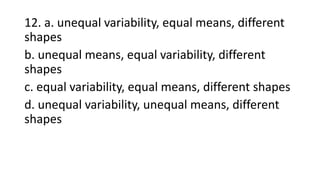
12. a. unequal variability, equal means, different
shapes
b. unequal means, equal variability, different
shapes
c. equal variability, equal means, different shapes
d. unequal variability, unequal means, different
shapes
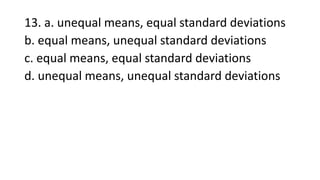
13. a. unequal means, equal standard deviations
b. equal means, unequal standard deviations
c. equal means, equal standard deviations
d. unequal means, unequal standard deviations
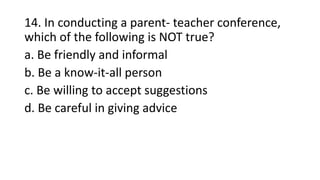
14. In conducting a parent- teacher conference,
which of the following is NOT true?
a. Be friendly and informal
b. Be a know-it-all person
c. Be willing to accept suggestions
d. Be careful in giving advice
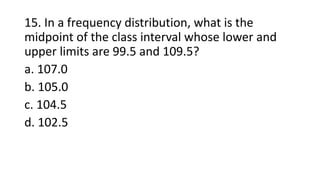
15. In a frequency distribution, what is the
midpoint of the class interval whose lower and
upper limits are 99.5 and 109.5?
a. 107.0
b. 105.0
c. 104.5
d. 102.5
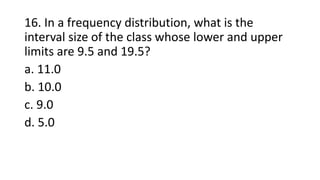
16. In a frequency distribution, what is the
interval size of the class whose lower and upper
limits are 9.5 and 19.5?
a. 11.0
b. 10.0
c. 9.0
d. 5.0
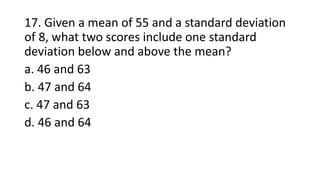
17. Given a mean of 55 and a standard deviation
of 8, what two scores include one standard
deviation below and above the mean?
a. 46 and 63
b. 47 and 64
c. 47 and 63
d. 46 and 64
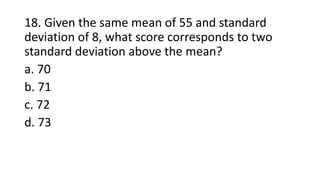
18. Given the same mean of 55 and standard
deviation of 8, what score corresponds to two
standard deviation above the mean?
a. 70
b. 71
c. 72
d. 73
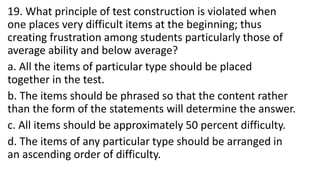
19. What principle of test construction is violated when
one places very difficult items at the beginning; thus
creating frustration among students particularly those of
average ability and below average?
a. All the items of particular type should be placed
together in the test.
b. The items should be phrased so that the content rather
than the form of the statements will determine the answer.
c. All items should be approximately 50 percent difficulty.
d. The items of any particular type should be arranged in
an ascending order of difficulty.
20. Mrs. Reyes would like to find out how well her
students know each other. What assessment
instrument would best suit her objective?
a. Self-report instrument
b. Sociometric technique
c. Guess-who technique
d. All of the above
21. Mr. Reyes asked his pupils to indicate on the
piece of paper the names of their classmates
whom they would like to be with for some group
activity, what assessment technique did Mr. Reyes
use?
a. Self-report technique
b. Guess-who technique
c. Sociometric technique
d. Anecdotal technique
22. Which of the following assessment
procedures/tools is useful in assessing social
relation skills?
a. Anecdotal record
b. Attitude scale
c. Peer appraisal
d. any of the above
23. If the proportion passing for the upper and
lower group is .90 and .30 respectively, what is
the discrimination index?
a. .40
b. .50
c. .60
d. .70
24. Which is an example of affective learning
outcome?
a. Interpret stimuli from various modalities to
provide data needed in making adjustments to
the environment
b. Judge problem and issues in terms of situations
involved than in terms of fixed dogmatic thinking
c. Appreciate the quality and worth of the story
read
d. None of the above
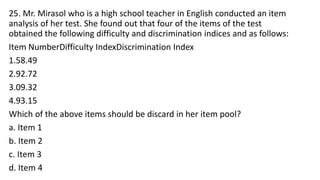
25. Mr. Mirasol who is a high school teacher in English conducted an item
analysis of her test. She found out that four of the items of the test
obtained the following difficulty and discrimination indices and as follows:
Item NumberDifficulty IndexDiscrimination Index
1.58.49
2.92.72
3.09.32
4.93.15
Which of the above items should be discard in her item pool?
a. Item 1
b. Item 2
c. Item 3
d. Item 4

PROFESSIONAL EDUCATION 5.pptx

  • 1.
  • 2.
    1. If atest item has a difficulty index of 0.06, how would you describe the test item? a. It is very easy. b. It is moderately difficulty. c. It is very difficult d. It is difficult
  • 3.
    2. Two sectionshave the same mean but the standard deviation of section 2 is higher than section 1. Which of the two sections is more homogeneous? a. Section 1 b. Section 2 c. Both A and B d. None of the above
  • 4.
    3. Miss Cortezaadministered a test to her class and the result is positively skewed. What kind of test do you think Miss Corteza gave to her pupils? a. Posttest b. Pretest c. Mastery test d. Criterion-referenced test
  • 5.
    4. In hissecond item analysis, Mr. Gonzales found out that more from the lower group got the test item 15 correctly. What does this mean? a. The item has become more valid b. The item has become more reliable c. The item has a positive discriminating power d. The item has a negative discriminating power
  • 6.
    5. Q1 is25th percentile as media is to what percentile? a. 40th percentile b. 60th percentile c. 50th percentile d. 75th percentile
  • 7.
    6. Which isimplied by a positively skewed scores distribution? a. The mean, the median, and the mode are equal. b. Most of the scores are high c. Most of the scores are low. d. The mode is high
  • 8.
    7. In anormal distribution curve, what does a T- score of 60 mean? a. Two SDs below the mean b. Two SDs below the mean c. One SD below the mean d. One SD above the mean
  • 9.
    For items 8to 13, what does each figure/distribution on the right indicate? 8. a. mean > median > mode b. mean < mode > median c. mean > mode < median d. mean < median < mode
  • 10.
    9. a. mode< mean < median b. mode > mean > median c. median < mode > mean d. none of the above
  • 11.
    10. a. equalmeans, unequal standard deviations b. equal means, equal standard deviations c. unequal means, equal standard deviations d. unequal means unequal standard deviations
  • 12.
    11. a unequalmeans, equal standard deviations b. unequal means, equal standard deviations c. equal means, equal standard deviations d. equal means, unequal standard deviations
  • 13.
    12. a. unequalvariability, equal means, different shapes b. unequal means, equal variability, different shapes c. equal variability, equal means, different shapes d. unequal variability, unequal means, different shapes
  • 14.
    13. a. unequalmeans, equal standard deviations b. equal means, unequal standard deviations c. equal means, equal standard deviations d. unequal means, unequal standard deviations
  • 15.
    14. In conductinga parent- teacher conference, which of the following is NOT true? a. Be friendly and informal b. Be a know-it-all person c. Be willing to accept suggestions d. Be careful in giving advice
  • 16.
    15. In afrequency distribution, what is the midpoint of the class interval whose lower and upper limits are 99.5 and 109.5? a. 107.0 b. 105.0 c. 104.5 d. 102.5
  • 17.
    16. In afrequency distribution, what is the interval size of the class whose lower and upper limits are 9.5 and 19.5? a. 11.0 b. 10.0 c. 9.0 d. 5.0
  • 18.
    17. Given amean of 55 and a standard deviation of 8, what two scores include one standard deviation below and above the mean? a. 46 and 63 b. 47 and 64 c. 47 and 63 d. 46 and 64
  • 19.
    18. Given thesame mean of 55 and standard deviation of 8, what score corresponds to two standard deviation above the mean? a. 70 b. 71 c. 72 d. 73
  • 20.
    19. What principleof test construction is violated when one places very difficult items at the beginning; thus creating frustration among students particularly those of average ability and below average? a. All the items of particular type should be placed together in the test. b. The items should be phrased so that the content rather than the form of the statements will determine the answer. c. All items should be approximately 50 percent difficulty. d. The items of any particular type should be arranged in an ascending order of difficulty.
  • 21.
    20. Mrs. Reyeswould like to find out how well her students know each other. What assessment instrument would best suit her objective? a. Self-report instrument b. Sociometric technique c. Guess-who technique d. All of the above
  • 22.
    21. Mr. Reyesasked his pupils to indicate on the piece of paper the names of their classmates whom they would like to be with for some group activity, what assessment technique did Mr. Reyes use? a. Self-report technique b. Guess-who technique c. Sociometric technique d. Anecdotal technique
  • 23.
    22. Which ofthe following assessment procedures/tools is useful in assessing social relation skills? a. Anecdotal record b. Attitude scale c. Peer appraisal d. any of the above
  • 24.
    23. If theproportion passing for the upper and lower group is .90 and .30 respectively, what is the discrimination index? a. .40 b. .50 c. .60 d. .70
  • 25.
    24. Which isan example of affective learning outcome? a. Interpret stimuli from various modalities to provide data needed in making adjustments to the environment b. Judge problem and issues in terms of situations involved than in terms of fixed dogmatic thinking c. Appreciate the quality and worth of the story read d. None of the above
  • 26.
    25. Mr. Mirasolwho is a high school teacher in English conducted an item analysis of her test. She found out that four of the items of the test obtained the following difficulty and discrimination indices and as follows: Item NumberDifficulty IndexDiscrimination Index 1.58.49 2.92.72 3.09.32 4.93.15 Which of the above items should be discard in her item pool? a. Item 1 b. Item 2 c. Item 3 d. Item 4