A Commercial Paper (CP) is an
unsecured, short-term debt
instrument issued by a
corporation, typically
for meeting short-term liabilities.
But what does this definition mean?
• Most definitions end up looking very
boring and sometimes leave us more
confused than ever before! While they
are known as definitions, they usually
fail to define anything.
• In this lesson, I will try to simplify the
concept of ‘Commercial Papers’ for
you…
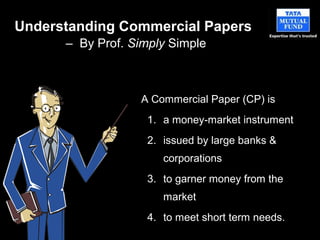
Understanding Commercial Papers
– By Prof. Simply Simple
A Commercial Paper (CP) is
1. a money-market instrument
2. issued by large banks &
corporations
3. to garner money from the
market
4. to meet short term needs.
• It was introduced in India in 1990.
• It was aimed at providing highly rated corporates
with a borrowing option.
• So while they could borrow from a bank, now with
the help of a CP, they could also borrow from the
open market.
• Since CP is used to borrow directly from the
market, the rate of interest is lesser as compared
to the banks.
When & why was it
introduced in India?
• A commercial paper is a lower cost alternative
to borrowing from a bank.
• However not all organizations are in a position
to issue CPs.
• Only reputed organizations whose papers have
a good rating can borrow directly through CPs
and save money.
Thus…
• Say Future Group, the owner of a large retail
store like Big Bazaar, wishes to raise funds
from the market to purchase its merchandise.
• If it were to go to a bank for a loan, then it
would probably have to pay around 15%
interest on the loan.
• But from the open market it could perhaps get
the loan at only 10%.
• Hence by resorting to an instrument like CP, the
organization gains 5%.
To give an
example…
• By issuing CPs the organization borrows
directly from investors and by-passes the
banks.
• As a result, it gets to borrow at a lower rate
from the market as compared to what the
banks would have charged.
• This process is also called Financial
Disintermediation or in other words getting
rid of the mediator.
Therefore…
• Corporates
• Primary dealers
• Financial Institutions (FIs)
So who is eligible to issue
CPs?
• Individuals
• Banking companies
• Non-Resident Indians (NRIs) and
• Foreign Institutional Investors (FIIs)
etc.
And who can
invest in CPs?
And for what
maturity periods
are CPs issued?
CPs can be issued for maturities between a
minimum of 15 days and a maximum of up to
one year from the date of issue.
Therefore it is used to fund the working capital
or current requirements of organizations.
• A major benefit of a CP is that it does not need
to be registered with the Securities and
Exchange Board of India (SEBI) as long as it
matures before nine months (270 days).
• However, one important point to note is that
the borrowed amount can only be used to fulfill
current requirements. It is not meant be used
for purchase of fixed assets, such as a new
plant.
Some other things to
remember about CPs…
• Treasury Bills or T- Bills are exactly the same as
CPs.
• Except that while CPs are issued by corporates,
T- Bills are issued by the Government for
financing its working capital needs.
If you have understood CPs,
let me tell you what Treasury
Bills are…
To Sum
Up
• What: A Commercial Paper (CP) is
an unsecured money market
instrument issued by a corporation or
bank in the form of a promissory note.
• Why: It provides the organization a
borrowing option other than a bank.
• When: CPs are issued or sold when
an organization needs to borrow
money for its short term needs.
• How: Once a business becomes
established, it can issue CPs after
having them rated.
Hope you have now understood the concept of
Commercial Papers
In case of any query, please e-mail
professor@tataamc.com
The views expressed in these lessons are for information
purposes only and do not construe to be of any investment,
legal or taxation advice. They are not indicative of future
market trends, nor is Tata Asset Management Ltd.
attempting to predict the same. Reprinting any part of this
presentation will be at your own risk and Tata Asset
Management Ltd. will not be liable for the consequences of
any such action.
Disclaimer
Mutual Fund investments are subject to market risks,
read all scheme related documents carefully.
For more lessons visit
www.tatamutualfund.com

Prof Simply Simple - Commercial Papers

  • 1.
    A Commercial Paper(CP) is an unsecured, short-term debt instrument issued by a corporation, typically for meeting short-term liabilities. But what does this definition mean?
  • 2.
    • Most definitionsend up looking very boring and sometimes leave us more confused than ever before! While they are known as definitions, they usually fail to define anything. • In this lesson, I will try to simplify the concept of ‘Commercial Papers’ for you…
  • 3.
    Understanding Commercial Papers –By Prof. Simply Simple A Commercial Paper (CP) is 1. a money-market instrument 2. issued by large banks & corporations 3. to garner money from the market 4. to meet short term needs.
  • 4.
    • It wasintroduced in India in 1990. • It was aimed at providing highly rated corporates with a borrowing option. • So while they could borrow from a bank, now with the help of a CP, they could also borrow from the open market. • Since CP is used to borrow directly from the market, the rate of interest is lesser as compared to the banks. When & why was it introduced in India?
  • 5.
    • A commercialpaper is a lower cost alternative to borrowing from a bank. • However not all organizations are in a position to issue CPs. • Only reputed organizations whose papers have a good rating can borrow directly through CPs and save money. Thus…
  • 6.
    • Say FutureGroup, the owner of a large retail store like Big Bazaar, wishes to raise funds from the market to purchase its merchandise. • If it were to go to a bank for a loan, then it would probably have to pay around 15% interest on the loan. • But from the open market it could perhaps get the loan at only 10%. • Hence by resorting to an instrument like CP, the organization gains 5%. To give an example…
  • 7.
    • By issuingCPs the organization borrows directly from investors and by-passes the banks. • As a result, it gets to borrow at a lower rate from the market as compared to what the banks would have charged. • This process is also called Financial Disintermediation or in other words getting rid of the mediator. Therefore…
  • 8.
    • Corporates • Primarydealers • Financial Institutions (FIs) So who is eligible to issue CPs?
  • 9.
    • Individuals • Bankingcompanies • Non-Resident Indians (NRIs) and • Foreign Institutional Investors (FIIs) etc. And who can invest in CPs?
  • 10.
    And for what maturityperiods are CPs issued? CPs can be issued for maturities between a minimum of 15 days and a maximum of up to one year from the date of issue. Therefore it is used to fund the working capital or current requirements of organizations.
  • 11.
    • A majorbenefit of a CP is that it does not need to be registered with the Securities and Exchange Board of India (SEBI) as long as it matures before nine months (270 days). • However, one important point to note is that the borrowed amount can only be used to fulfill current requirements. It is not meant be used for purchase of fixed assets, such as a new plant. Some other things to remember about CPs…
  • 12.
    • Treasury Billsor T- Bills are exactly the same as CPs. • Except that while CPs are issued by corporates, T- Bills are issued by the Government for financing its working capital needs. If you have understood CPs, let me tell you what Treasury Bills are…
  • 13.
    To Sum Up • What:A Commercial Paper (CP) is an unsecured money market instrument issued by a corporation or bank in the form of a promissory note. • Why: It provides the organization a borrowing option other than a bank. • When: CPs are issued or sold when an organization needs to borrow money for its short term needs. • How: Once a business becomes established, it can issue CPs after having them rated.
  • 14.
    Hope you havenow understood the concept of Commercial Papers In case of any query, please e-mail professor@tataamc.com
  • 15.
    The views expressedin these lessons are for information purposes only and do not construe to be of any investment, legal or taxation advice. They are not indicative of future market trends, nor is Tata Asset Management Ltd. attempting to predict the same. Reprinting any part of this presentation will be at your own risk and Tata Asset Management Ltd. will not be liable for the consequences of any such action. Disclaimer Mutual Fund investments are subject to market risks, read all scheme related documents carefully.
  • 16.
    For more lessonsvisit www.tatamutualfund.com