Production and theLaw of Variable
Proportions
• Theory of Production – Economics
2.
Introduction to Production
•Production means creation or addition of
utility
• Process of transforming inputs into outputs
• Helps satisfy human wants
3.
Factors of Production
•Land – Natural resources
• Labour – Human effort
• Capital – Machines and tools
• Entrepreneur – Organizer and risk bearer
4.
Importance of Production
•Increases national income
• Generates employment
• Improves standard of living
• Promotes economic growth
5.
Meaning of Lawof Variable
Proportions
• Studies relationship between variable factor
and output
• One factor varies while others remain fixed
• Output first increases, then decreases
6.
Assumptions of theLaw
• Technology remains constant
• Only one factor is variable
• Other factors are fixed
• Units are homogeneous
• Operates in the short run
7.
Why It Operatesin the Short Run
• Some factors cannot be changed quickly
• Factory size and machines remain fixed
• Only labour can be increased or decreased
8.
Total Product (TP)
•Total output produced with given inputs
• Increases as labour increases initially
• Shows overall production level
9.
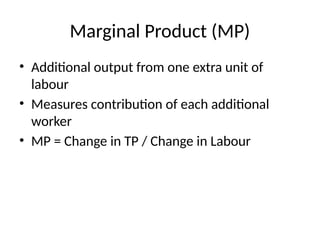
Marginal Product (MP)
•Additional output from one extra unit of
labour
• Measures contribution of each additional
worker
• MP = Change in TP / Change in Labour
10.
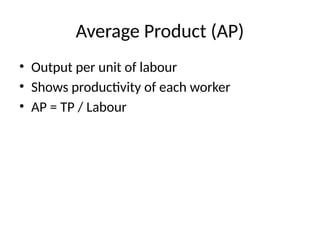
Average Product (AP)
•Output per unit of labour
• Shows productivity of each worker
• AP = TP / Labour
11.
Three Stages ofthe Law
• Stage I – Increasing Returns
• Stage II – Diminishing Returns
• Stage III – Negative Returns
12.
Stage I –Increasing Returns
• TP increases at increasing rate
• MP rises and AP rises
• Better utilization of fixed factors
• Efficiency improves
13.
Stage II –Diminishing Returns
• TP increases at decreasing rate
• MP falls but remains positive
• AP falls
• Most efficient and rational stage
14.
Stage III –Negative Returns
• TP starts declining
• MP becomes negative
• Overcrowding and inefficiency occur
15.
Graph Setup (Axes)
•X-axis – Labour (Variable Factor)
• Y-axis – Product or Output
• Shows relation between input and output
16.
Total Product Curve
•First rises steeply
• Then rises slowly
• Finally declines
• Shows three stages of production
17.
MP and APCurves
• Both curves are inverted U-shaped
• MP rises faster and falls faster
• MP cuts AP at AP's maximum point
18.
Relationship Between TP,MP, and
AP
• When MP rises, TP rises faster
• When MP falls, TP rises slowly
• When MP becomes negative, TP falls
19.
Stages on theGraph
• Stage I – Increasing returns
• Stage II – Diminishing returns (rational stage)
• Stage III – Negative returns
• Stages separated by vertical lines
20.
Importance / Significanceof the
Law
• Helps optimum use of resources
• Prevents overuse of labour
• Assists production planning
• Useful for managerial decisions
21.
Limitations of theLaw
• Assumes constant technology
• Difficult to measure output accurately
• Applicable only in short run
• Based on simplified assumptions
22.
Conclusion
• Production dependson combination of factors
• Output changes with variation in labour
• Stage II is the most efficient stage
• Law is essential for production decisions