
VI Procurement
• Procurement of equipment and bulk
• Material coordination
• ATS – Coordination
• QS
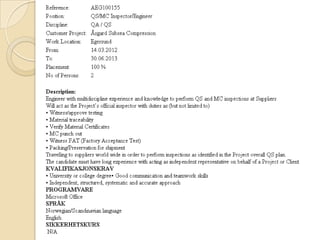
• Contract engineer
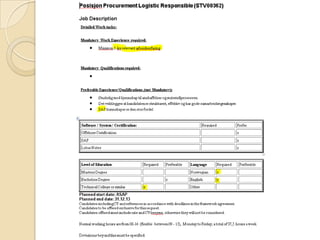
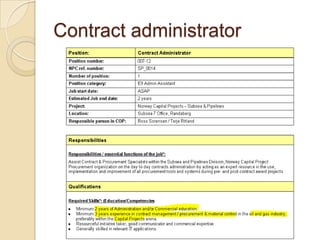
• Contract administrator
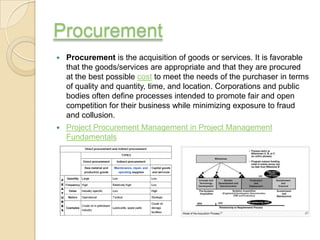
Procurement
   Procurement is the acquisition of goods or services. It is favorable
    that the goods/services are appropriate and that they are procured
    at the best possible cost to meet the needs of the purchaser in terms
    of quality and quantity, time, and location. Corporations and public
    bodies often define processes intended to promote fair and open
    competition for their business while minimizing exposure to fraud
    and collusion.
   Project Procurement Management in Project Management
    Fundamentals
Material coordination
   A material coordinator is responsible for managing the flow of
    materials and supplies. This position is commonly found in the
    construction, distribution and manufacturing sectors. The accurate
    and timely management of shipments is central to the cost-effective
    operation of businesses in these industries.
Coordinator
   A coordinator position is a job in which the employee brings together
    all aspects of a production or project. Coordinators work in mostly
    medium to large businesses. A coordinator position is often at the
    intermediate management level, such as one or two steps up from a
    supervisory capacity. Coordinators work in many different industries
    and fields. Sales, marketing, events, health and administrative are
    some of the most common types of coordinator positions.
QS- Quantity surveyor
   A quantity surveyor (QS) is a professional working within the
    construction industry concerned with building costs.
   The QS handles estimating and cost control
   QSs should be able to carry out estimating and measurement of
    construction works prior to tender
   A number of QSs work in procurement in the oil & gas industry,
    process and power industries, and civil engineering.
   Their preferred title, in countries where the QS profession is less
    known, is "Contracts engineer“
   Some QSs spesialice in project management and running multi-
    disciplinary projects
   QS background being a good foundation for understanding the
    complexities of modern large-scale projects
   Quantity Surveying
   Quantity Surveying Course
Contract engineer
   Contractors typically work through a contract firm that assigns them
    to companies for particular projects. The contract firms pay the
    contractors an hourly rate and then collect fees (generally 40 to 50
    percent more than the contractor’s hourly rate) from the third party
    company. Perhaps one of the most attractive aspects of being a
    contract engineer is that the contract firm finds assignments for you.
    Sometimes, contract work opens doors that might otherwise not be
    available to you. In fact, contract positions sometimes lead to
    permanent full-time positions.
CONTRACT
ADMINISTRATOR
1) Directs activities concerned with contracts for purchase or sale of equipment, materials, products, or services:
     Examines performance requirements, delivery schedules, and estimates of costs of material, equipment, and
     production to ensure completeness and accuracy.


2) Prepares bids, process specifications, test and progress reports, and other exhibits that may be required.


3) Reviews bids from other firms for conformity to contract requirements and determines acceptable bids.


4) Negotiates contract with customer or bidder.


5) Requests or approves amendments to or extensions of contracts.


6) Advises planning and production departments of contractual rights and obligations.


7) May compile data for preparing estimates.


8) May coordinate work of sales department with production and shipping department to implement fulfillment of
    contracts.


9) May act as liaison between company and subcontractors.


10) May direct sales program.
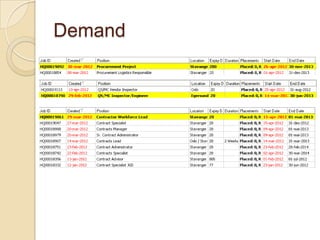
Demand
Contract administrator

Procurement

  • 1.
    VI Procurement • Procurementof equipment and bulk • Material coordination • ATS – Coordination • QS • Contract engineer • Contract administrator
  • 2.
    Procurement  Procurement is the acquisition of goods or services. It is favorable that the goods/services are appropriate and that they are procured at the best possible cost to meet the needs of the purchaser in terms of quality and quantity, time, and location. Corporations and public bodies often define processes intended to promote fair and open competition for their business while minimizing exposure to fraud and collusion.  Project Procurement Management in Project Management Fundamentals
  • 3.
    Material coordination  A material coordinator is responsible for managing the flow of materials and supplies. This position is commonly found in the construction, distribution and manufacturing sectors. The accurate and timely management of shipments is central to the cost-effective operation of businesses in these industries.
  • 4.
    Coordinator  A coordinator position is a job in which the employee brings together all aspects of a production or project. Coordinators work in mostly medium to large businesses. A coordinator position is often at the intermediate management level, such as one or two steps up from a supervisory capacity. Coordinators work in many different industries and fields. Sales, marketing, events, health and administrative are some of the most common types of coordinator positions.
  • 5.
    QS- Quantity surveyor  A quantity surveyor (QS) is a professional working within the construction industry concerned with building costs.  The QS handles estimating and cost control  QSs should be able to carry out estimating and measurement of construction works prior to tender  A number of QSs work in procurement in the oil & gas industry, process and power industries, and civil engineering.  Their preferred title, in countries where the QS profession is less known, is "Contracts engineer“  Some QSs spesialice in project management and running multi- disciplinary projects  QS background being a good foundation for understanding the complexities of modern large-scale projects  Quantity Surveying  Quantity Surveying Course
  • 6.
    Contract engineer  Contractors typically work through a contract firm that assigns them to companies for particular projects. The contract firms pay the contractors an hourly rate and then collect fees (generally 40 to 50 percent more than the contractor’s hourly rate) from the third party company. Perhaps one of the most attractive aspects of being a contract engineer is that the contract firm finds assignments for you. Sometimes, contract work opens doors that might otherwise not be available to you. In fact, contract positions sometimes lead to permanent full-time positions.
  • 7.
    CONTRACT ADMINISTRATOR 1) Directs activitiesconcerned with contracts for purchase or sale of equipment, materials, products, or services: Examines performance requirements, delivery schedules, and estimates of costs of material, equipment, and production to ensure completeness and accuracy. 2) Prepares bids, process specifications, test and progress reports, and other exhibits that may be required. 3) Reviews bids from other firms for conformity to contract requirements and determines acceptable bids. 4) Negotiates contract with customer or bidder. 5) Requests or approves amendments to or extensions of contracts. 6) Advises planning and production departments of contractual rights and obligations. 7) May compile data for preparing estimates. 8) May coordinate work of sales department with production and shipping department to implement fulfillment of contracts. 9) May act as liaison between company and subcontractors. 10) May direct sales program.
  • 8.
  • 11.