Process Models in Software Engineering
A process model in software engineering defines the structured approach to software
development. It provides guidelines on planning, designing, implementing, testing, and
maintaining software systems.
1. Types of Process Models
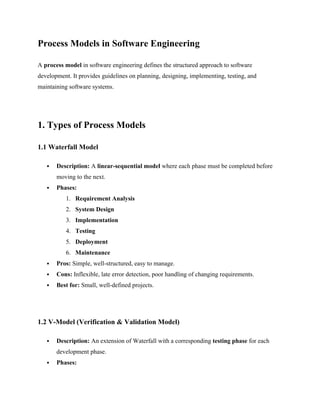
1.1 Waterfall Model
 Description: A linear-sequential model where each phase must be completed before
moving to the next.
 Phases:
1. Requirement Analysis
2. System Design
3. Implementation
4. Testing
5. Deployment
6. Maintenance
 Pros: Simple, well-structured, easy to manage.
 Cons: Inflexible, late error detection, poor handling of changing requirements.
 Best for: Small, well-defined projects.
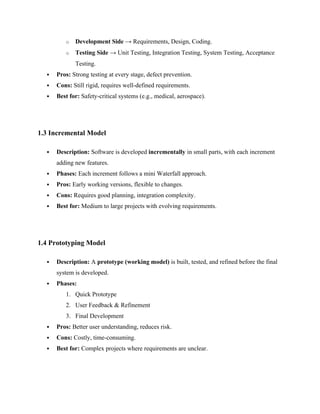
1.2 V-Model (Verification & Validation Model)
 Description: An extension of Waterfall with a corresponding testing phase for each
development phase.
 Phases:
o Development Side → Requirements, Design, Coding.
o Testing Side → Unit Testing, Integration Testing, System Testing, Acceptance
Testing.
 Pros: Strong testing at every stage, defect prevention.
 Cons: Still rigid, requires well-defined requirements.
 Best for: Safety-critical systems (e.g., medical, aerospace).
1.3 Incremental Model
 Description: Software is developed incrementally in small parts, with each increment
adding new features.
 Phases: Each increment follows a mini Waterfall approach.
 Pros: Early working versions, flexible to changes.
 Cons: Requires good planning, integration complexity.
 Best for: Medium to large projects with evolving requirements.
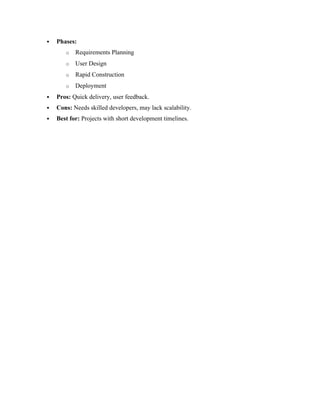
1.4 Prototyping Model
 Description: A prototype (working model) is built, tested, and refined before the final
system is developed.
 Phases:
1. Quick Prototype
2. User Feedback & Refinement
3. Final Development
 Pros: Better user understanding, reduces risk.
 Cons: Costly, time-consuming.
 Best for: Complex projects where requirements are unclear.
1.5 Spiral Model
 Description: A risk-driven model that combines iterative development with systematic
risk analysis.
 Phases:
1. Planning
2. Risk Analysis
3. Engineering
4. Evaluation
 Pros: Risk management, flexibility.
 Cons: Expensive, complex.
 Best for: Large, high-risk projects.
1.6 Agile Model
 Description: An iterative and flexible approach focused on customer collaboration and
rapid delivery.
 Popular Agile Frameworks:
o Scrum → Sprints, daily stand-ups.
o Kanban → Visual workflow with boards.
o Extreme Programming (XP) → Continuous testing, pair programming.
 Pros: Fast delivery, adaptive to changes.
 Cons: Requires close customer involvement, hard to predict costs.
 Best for: Dynamic projects with evolving requirements.
1.7 RAD Model (Rapid Application Development)
 Description: A fast-paced model that emphasizes rapid prototyping and quick
iterations.
 Phases:
o Requirements Planning
o User Design
o Rapid Construction
o Deployment
 Pros: Quick delivery, user feedback.
 Cons: Needs skilled developers, may lack scalability.
 Best for: Projects with short development timelines.

Process Models in software Engineering.docx

  • 1.
    Process Models inSoftware Engineering A process model in software engineering defines the structured approach to software development. It provides guidelines on planning, designing, implementing, testing, and maintaining software systems. 1. Types of Process Models 1.1 Waterfall Model  Description: A linear-sequential model where each phase must be completed before moving to the next.  Phases: 1. Requirement Analysis 2. System Design 3. Implementation 4. Testing 5. Deployment 6. Maintenance  Pros: Simple, well-structured, easy to manage.  Cons: Inflexible, late error detection, poor handling of changing requirements.  Best for: Small, well-defined projects. 1.2 V-Model (Verification & Validation Model)  Description: An extension of Waterfall with a corresponding testing phase for each development phase.  Phases:
  • 2.
    o Development Side→ Requirements, Design, Coding. o Testing Side → Unit Testing, Integration Testing, System Testing, Acceptance Testing.  Pros: Strong testing at every stage, defect prevention.  Cons: Still rigid, requires well-defined requirements.  Best for: Safety-critical systems (e.g., medical, aerospace). 1.3 Incremental Model  Description: Software is developed incrementally in small parts, with each increment adding new features.  Phases: Each increment follows a mini Waterfall approach.  Pros: Early working versions, flexible to changes.  Cons: Requires good planning, integration complexity.  Best for: Medium to large projects with evolving requirements. 1.4 Prototyping Model  Description: A prototype (working model) is built, tested, and refined before the final system is developed.  Phases: 1. Quick Prototype 2. User Feedback & Refinement 3. Final Development  Pros: Better user understanding, reduces risk.  Cons: Costly, time-consuming.  Best for: Complex projects where requirements are unclear.
  • 3.
    1.5 Spiral Model Description: A risk-driven model that combines iterative development with systematic risk analysis.  Phases: 1. Planning 2. Risk Analysis 3. Engineering 4. Evaluation  Pros: Risk management, flexibility.  Cons: Expensive, complex.  Best for: Large, high-risk projects. 1.6 Agile Model  Description: An iterative and flexible approach focused on customer collaboration and rapid delivery.  Popular Agile Frameworks: o Scrum → Sprints, daily stand-ups. o Kanban → Visual workflow with boards. o Extreme Programming (XP) → Continuous testing, pair programming.  Pros: Fast delivery, adaptive to changes.  Cons: Requires close customer involvement, hard to predict costs.  Best for: Dynamic projects with evolving requirements. 1.7 RAD Model (Rapid Application Development)  Description: A fast-paced model that emphasizes rapid prototyping and quick iterations.
  • 4.
     Phases: o RequirementsPlanning o User Design o Rapid Construction o Deployment  Pros: Quick delivery, user feedback.  Cons: Needs skilled developers, may lack scalability.  Best for: Projects with short development timelines.