Procedures for English 7 
Samsky 
English 7 
Huntington Middle School
Homeroom Policies 
• Enter the room. 
• Go to your assigned locker, get what you need, and sit down 
in the chair attached to your assigned desk. 
• No eating, no drinking—breakfast is in the cafeteria. 
• Stand still for the pledge, no talking. 
• Continue standing still for the moment of silence. 
• Do not talk during the announcements. 
• Recite the Team Pledge. 
• Complete the DAILY APS ACTIVITY. 
• http://www.theteacherscorner.net/daily-writing-prompts/ 
8/22/2014 2
Team Pledge 
A mind is a terrible thing to 
waste. 
I am a Navigator. 
I will do great things with 
my mind because I am focused, 
prepared and positive.
Expectations 
• This is English class where we read and write 
daily. 
• Supplies needed: pencils, lead and/or 
sharpener, pens (blue or black ink), a single-subject 
notebook and loose-leaf paper, daily! 
• Today’s date and A/B Day is posted by the 
door: Look there to include the date in your 
heading of writing page(s) and/or your 
notebook.
Let’s understand each other. 
This is a classroom; I am your teacher 
What the teacher is NOT: 
• Your babysitter 
• Your “BFF” 
• Your mother 
• Your grandmother or aunt 
• A referee 
• An entertainer 
• A game show host 
• A waitress 
• A talk show host 
Who the student is: 
• A neophyte: who is learning 
to be an adult 
• A student learning a lot of 
different kinds of 
information 
• A child who may want/need 
more attention than others 
• A “subordinate”: you are 
learning to be an adult. See 
Rule #8 in R&R Handbook
Procedures: Entering the Room 
• Classes 1 and 2, line up on the wall: right if your 
last name begins with A-M; left if your name 
begins with N-Z (Left and right determined from 
hallway view.) 
• SOL Prep: Line up to the left of the door. 
• When all are lined up and NOT talking, the 
teacher will permit entrance into the room 
silently. 
• Sit down at your assigned desk. 
• Place your stuff under your desk.
Class 5 Entrance 
• Class 5: clear the hall immediately, go to your 
locker, exit if you are assigned to Social Studies, 
Science, Algebra. If you are assigned to English, 
sit at your assigned desk. 
• When the hall has cleared, exit to the hall way 
and line up on the wall: left if your last name 
begins with A-M, right if your name begins with 
N-Z (Left and right determined from hallway 
view.) 
• At the teacher’s signal, enter the room silently.
Beginning the Class 
• Open your English notebook to the next clean 
page or section: a line drawn separates each 
section. 
• Title for the next section is Day of the Week’s 
Work; for example, Wednesday’s Work 
• Date each section of work in the upper right 
corner. 
• Record the homework assignment and the Daily 
Checklist in your notebook. The Daily Checklist 
will be on the board or on your desk. LOOK! 
• Write the title of the DO NOW on the page after 
the checklist and go to work: DO it NOW!
Homework 
• Homework is 20% of your English grade. 
• It is your responsibility to complete the 
homework in your homework notebook. 
• Label: HOMEWORK, page #, Exercise # and 
date. 
• Write complete sentences to answer all 
homework questions or prompts.
Class Structure T 
• If the DO NOW is timed, put your pencil down 
when the timer sounds or when you are 
finished—whichever comes first. Wait without 
talking. 
• At the sound of the timer, you will turn and 
talk for 90 seconds. 
• After that ninety seconds, volunteers will 
share their ideas with the class: five minutes 
• Go to the next item on your daily checklist.
Class Structure U 
• If the Do Now is NOT timed, then you will move 
on to the next item on your Daily Checklist. 
• If your task is to read independently, then you 
will locate the reading source, find the correct 
location or page and begin reading. 
• Respond to questions or prompts for the reading 
as assigned on the Daily Checklist. Write 
responses in your notebook. Label your work.
Class Structure G 
• Working in groups on designated days 
– To read and respond to assigned passages: Fiction 
and Nonfiction and Poetry 
– To read and respond to a play: Reader’s Theater 
– To read and respond to another student’s writing 
(Peer Editing) 
– Keep the noise level at a “working level.” You can 
hear the discussion in your group. 
– Participation is part of your English grade: 45%
Moving Desks 
• Writing Days: at the signal, turn your desk to 
face the bulletin board and word wall. 
• Turn and Talk: No desk movement. You will 
turn and talk to the person closest to you. 
• Pair/Share work is organized and functional. 
Desks are turned so that they face each other. 
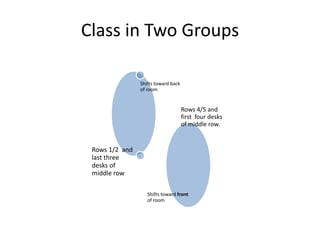
• Class in Two Groups: Rows 1/2 and last 3 
desks in middle row; rows 4 and 5 and first 4 
desks in middle row
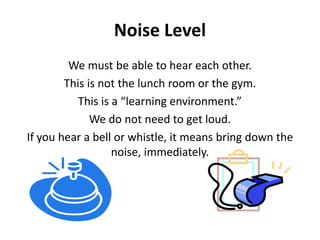
Noise Level 
We must be able to hear each other. 
This is not the lunch room or the gym. 
This is a “learning environment.” 
We do not need to get loud. 
If you hear a bell or whistle, it means bring down the 
noise, immediately.
One to One Conferencing 
• We will talk about your notebook(s) and your 
writing portfolio as we discuss process, 
product and motivation. 
• Other conference topics: Tracking DATA 
reading fluency, reading comprehension, word 
patterns, pacing, test strategies, and other 
relevant topics as needed.
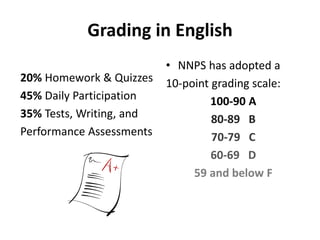
Grading in English 
20% Homework & Quizzes 
45% Daily Participation 
35% Tests, Writing, and 
Performance Assessments 
• NNPS has adopted a 
10-point grading scale: 
100-90 A 
80-89 B 
70-79 C 
60-69 D 
59 and below F
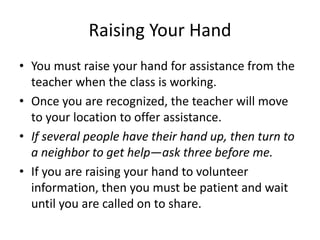
Raising Your Hand 
• You must raise your hand for assistance from the 
teacher when the class is working. 
• Once you are recognized, the teacher will move 
to your location to offer assistance. 
• If several people have their hand up, then turn to 
a neighbor to get help—ask three before me. 
• If you are raising your hand to volunteer 
information, then you must be patient and wait 
until you are called on to share.
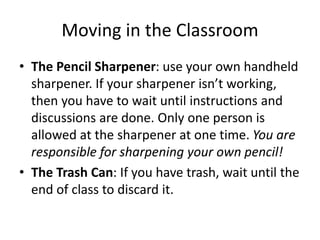
Moving in the Classroom 
• The Pencil Sharpener: use your own handheld 
sharpener. If your sharpener isn’t working, 
then you have to wait until instructions and 
discussions are done. Only one person is 
allowed at the sharpener at one time. You are 
responsible for sharpening your own pencil! 
• The Trash Can: If you have trash, wait until the 
end of class to discard it.
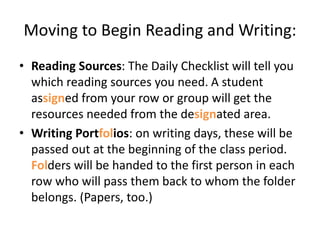
Moving to Begin Reading and Writing: 
• Reading Sources: The Daily Checklist will tell you 
which reading sources you need. A student 
assigned from your row or group will get the 
resources needed from the designated area. 
• Writing Portfolios: on writing days, these will be 
passed out at the beginning of the class period. 
Folders will be handed to the first person in each 
row who will pass them back to whom the folder 
belongs. (Papers, too.)
Returning Class Resources 
• At the close of class, the student assigned to 
gather and return the resources will return 
these items to the designated area. 
• Please be sure books, magazines, and 
handouts are closed to the front cover or 
page. 
• Your exit slip will be recorded in your 
notebook, labeled Exit Slip and today’s date.
Personal Hygiene Items 
• Tissue if you have seasonal allergies, you 
will need to bring your own tissue. 
• Hand Sanitizer is a necessary item in 
today’s world. 
• Lotion, etc. 
• Personal hygiene is just that, “personal.” Be 
aware of your personal needs and do your 
best to be prepared.
Food in the Classroom 
• Gum, candy and other food items are not 
permitted in the classroom. 
• This is a medical issue that is becoming a legal 
issue because so many students now have 
food allergies. 
• You may not even know you have an allergy 
and the classroom is not a good place to 
discover that.
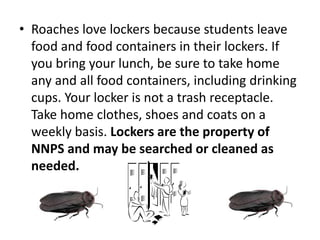
• Roaches love lockers because students leave 
food and food containers in their lockers. If 
you bring your lunch, be sure to take home 
any and all food containers, including drinking 
cups. Your locker is not a trash receptacle. 
Take home clothes, shoes and coats on a 
weekly basis. Lockers are the property of 
NNPS and may be searched or cleaned as 
needed.
Did you finish your Daily Checklist? 
• Continue working on writing in your Writing 
Portfolio. 
• Novel (entry) 
• Homework 
• Work on the next day’s Daily Checklist 
Whatever your choice, be sure to record/ add 
this information in your “Note to Self” at the 
close of the class period.
Class in Two Groups 
Rows 1/2 and 
last three 
desks of 
middle row 
Shifts toward back 
of room 
Rows 4/5 and 
first four desks 
of middle row. 
Shifts toward front 
of room
Writing: Loose Leaf and Portfolio 
• For designated Writing Sessions, you will use 
loose leaf notebook paper. This work will be 
stored in your blue Writing Portfolio. 
• These pages will be labeled according to 
district standards. 
• The first writing is a Baseline Writing. 
• Do not tear pages out of your notebook.
Class Structure C 
• Computer Lab is a work session, not play! 
• Moby Max.com 
• E-Media.com 
• http://eng110htms.blogspot.com/ 
• The URL is for this English class’s blog. This is 
where you can find each day’s lesson, as well 
as homework assignments and other 
information relevant to our class.
Testing Sessions 
• Tests are serious, it will be silent when 
everyone is taking a test. 
• You have to concentrate, it will be 
silent when everyone is taking a test. 
• There will be multiple choice test items and 
writing prompts. 
• Tests are “open book.” 
• Tests count for 35% of your nine weeks 
average.
10-10 Rule 
• No one enters or exits the 
classroom during the first ten 
minutes of class or the last ten 
minutes of instruction.
Hall Passes (4 minutes out) 
• Hall passes will be written on pass paper. 
DO NOT WASTE A WHOLE SHEET OF PAPER FOR 
A PASS. 
Pass information: Your name 
Date/Time 
Where you want to go… 
Teacher’s Signature 
I will record your time to track how often you 
are out of the room.
Closing Each Class Period 
• The teacher will signal the end of the class. 
• At this time, write a Note to Self and explain 
where you have left off with your assignments. 
• Include titles, page numbers, item numbers and 
other relevant information in your Note to Self so 
you’ll know how/where to continue when you 
see this Daily Checklist again. 
• If an EXIT Slip is requested, complete it in your 
notebook, labeled EXIT SLIP for (today’s date)
Dismissal: Classes 1 and 2 
• Students will be dismissed by the teacher. 
• At closure, your stuff will be stacked neatly on 
your desk for easy pick-up when your row is 
called. 
• Class 1: students proceed to their next class when 
their next class is announced by the teacher. 
• Class 2: students line up on the right or left side 
of the door; (A-M right side, N-Z left side) when 
their row is called. At the teacher’s signal we will 
move quietly in a single file line to the lunch 
room.
Class 5 and Dismissal 
• Students will be dismissed by the teacher. 
• At closure, your stuff will be stacked neatly on 
your desk for easy pick-up when your row is 
called. 
• Class 5: Walkers will be called first. Bus riders 
will line up in the front of the room and be 
escorted to the bus lot when bus riders are 
announced.
Emergency Situations 
• If you know you are about to be sick, you 
should leave the classroom and get to the 
restroom; and then to the clinic. 
• Fire Drills: Exit 2 x 2 quickly and quietly. Go to 
the right and out the doors to Orcutt Ave. 
Walk to the track. Line up with your class. 
• Lock Downs: Lights off, all sit silently in the 
left, rear corner of the classroom.
Official Visitors: Observation and 
Conversation 
• A visitor is a person we don’t see everyday. That 
person will move around the room to observe your 
activities. 
• You may be asked, “What are you learning 
today?” 
• Feel free to refer to your Daily Checklist, 
explain what you’re reading about or what 
you are writing.
Absent or Tardy 
• If you are absent, write ABSENT and the 
date(s) of your absence in your notebook. 
Proceed with today’s Daily Checklist. If you 
need to make up a test, we will schedule a 
time for make-up. 
• If you are tardy, please make sure you have a 
note from an adult and a reason for being late. 
Write TARDY, the time and date in your 
notebook; proceed with the Daily Checklist.
English is Essential 
• Stories and language are 
“patterns to preserve.” 
• Letters form words which 
form sentences that are 
ideas which are explained 
in paragraphs which are 
developed into stories 
and articles which 
preserve the philosophies 
of a society and 
culture. 
• New thinking 
often comes from reading, 
then writing more words 
and sentences to form new 
ideas emerging from the old 
thinking and the society’s 
culture moves forward and 
makes progress. 
This is a formula for 
freedom. 
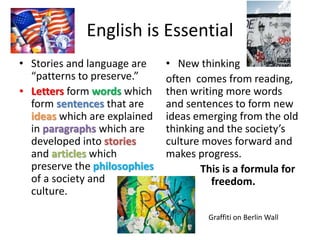
Graffiti on Berlin Wall
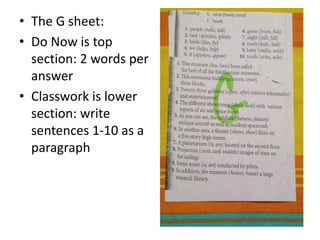
• The G sheet: 
• Do Now is top 
section: 2 words per 
answer 
• Classwork is lower 
section: write 
sentences 1-10 as a 
paragraph
Hall Movement 
• Classes will line up 
when rows are called 
• Line up by last names 
• A-M on the right side of 
the door. 
• N-Z on the left side of 
the door. 
• Move in a silent, single 
file line: 
• First stop end of hall, 
across from auditorium 
• Second stop at first 
cafeteria door. 
_____________________ 
• To the library involves 
going up the stairs. 
• BE CAREFUL, don’t 
push, don’t rush.
Stop at the Library Entrance 
• Bring the line back into a 
single file. 
• Enter the library quietly 
and orderly—no running 
or pushing. 
• Sit in the designated area. 
• Listen for announcements 
and directions. 
• Choose the assigned 
genre of reading. 
• Today, please read the 
back cover or the jacket 
flap of an autobiography. 
• Check it out to read or 
choose a novel that you 
will read.
Perseverance 
• Father and Son Run: Hoyts 
• http://www.youtube.com/watch?v=BaZwpD1 
Paag 
• Derrick Redmond and Father 
• http://www.youtube.com/watch?v=WSJOIaZS 
yYQ
Global Poverty 
• World on Fire video Sarah McLachlan 
• http://www.youtube.com/watch?v=FDmPcSW 
E0WU&feature=youtu.be

Procedures and expectations

  • 1.
    Procedures for English7 Samsky English 7 Huntington Middle School
  • 2.
    Homeroom Policies •Enter the room. • Go to your assigned locker, get what you need, and sit down in the chair attached to your assigned desk. • No eating, no drinking—breakfast is in the cafeteria. • Stand still for the pledge, no talking. • Continue standing still for the moment of silence. • Do not talk during the announcements. • Recite the Team Pledge. • Complete the DAILY APS ACTIVITY. • http://www.theteacherscorner.net/daily-writing-prompts/ 8/22/2014 2
  • 3.
    Team Pledge Amind is a terrible thing to waste. I am a Navigator. I will do great things with my mind because I am focused, prepared and positive.
  • 4.
    Expectations • Thisis English class where we read and write daily. • Supplies needed: pencils, lead and/or sharpener, pens (blue or black ink), a single-subject notebook and loose-leaf paper, daily! • Today’s date and A/B Day is posted by the door: Look there to include the date in your heading of writing page(s) and/or your notebook.
  • 5.
    Let’s understand eachother. This is a classroom; I am your teacher What the teacher is NOT: • Your babysitter • Your “BFF” • Your mother • Your grandmother or aunt • A referee • An entertainer • A game show host • A waitress • A talk show host Who the student is: • A neophyte: who is learning to be an adult • A student learning a lot of different kinds of information • A child who may want/need more attention than others • A “subordinate”: you are learning to be an adult. See Rule #8 in R&R Handbook
  • 6.
    Procedures: Entering theRoom • Classes 1 and 2, line up on the wall: right if your last name begins with A-M; left if your name begins with N-Z (Left and right determined from hallway view.) • SOL Prep: Line up to the left of the door. • When all are lined up and NOT talking, the teacher will permit entrance into the room silently. • Sit down at your assigned desk. • Place your stuff under your desk.
  • 7.
    Class 5 Entrance • Class 5: clear the hall immediately, go to your locker, exit if you are assigned to Social Studies, Science, Algebra. If you are assigned to English, sit at your assigned desk. • When the hall has cleared, exit to the hall way and line up on the wall: left if your last name begins with A-M, right if your name begins with N-Z (Left and right determined from hallway view.) • At the teacher’s signal, enter the room silently.
  • 8.
    Beginning the Class • Open your English notebook to the next clean page or section: a line drawn separates each section. • Title for the next section is Day of the Week’s Work; for example, Wednesday’s Work • Date each section of work in the upper right corner. • Record the homework assignment and the Daily Checklist in your notebook. The Daily Checklist will be on the board or on your desk. LOOK! • Write the title of the DO NOW on the page after the checklist and go to work: DO it NOW!
  • 9.
    Homework • Homeworkis 20% of your English grade. • It is your responsibility to complete the homework in your homework notebook. • Label: HOMEWORK, page #, Exercise # and date. • Write complete sentences to answer all homework questions or prompts.
  • 10.
    Class Structure T • If the DO NOW is timed, put your pencil down when the timer sounds or when you are finished—whichever comes first. Wait without talking. • At the sound of the timer, you will turn and talk for 90 seconds. • After that ninety seconds, volunteers will share their ideas with the class: five minutes • Go to the next item on your daily checklist.
  • 11.
    Class Structure U • If the Do Now is NOT timed, then you will move on to the next item on your Daily Checklist. • If your task is to read independently, then you will locate the reading source, find the correct location or page and begin reading. • Respond to questions or prompts for the reading as assigned on the Daily Checklist. Write responses in your notebook. Label your work.
  • 12.
    Class Structure G • Working in groups on designated days – To read and respond to assigned passages: Fiction and Nonfiction and Poetry – To read and respond to a play: Reader’s Theater – To read and respond to another student’s writing (Peer Editing) – Keep the noise level at a “working level.” You can hear the discussion in your group. – Participation is part of your English grade: 45%
  • 13.
    Moving Desks •Writing Days: at the signal, turn your desk to face the bulletin board and word wall. • Turn and Talk: No desk movement. You will turn and talk to the person closest to you. • Pair/Share work is organized and functional. Desks are turned so that they face each other. • Class in Two Groups: Rows 1/2 and last 3 desks in middle row; rows 4 and 5 and first 4 desks in middle row
  • 14.
    Noise Level Wemust be able to hear each other. This is not the lunch room or the gym. This is a “learning environment.” We do not need to get loud. If you hear a bell or whistle, it means bring down the noise, immediately.
  • 15.
    One to OneConferencing • We will talk about your notebook(s) and your writing portfolio as we discuss process, product and motivation. • Other conference topics: Tracking DATA reading fluency, reading comprehension, word patterns, pacing, test strategies, and other relevant topics as needed.
  • 16.
    Grading in English 20% Homework & Quizzes 45% Daily Participation 35% Tests, Writing, and Performance Assessments • NNPS has adopted a 10-point grading scale: 100-90 A 80-89 B 70-79 C 60-69 D 59 and below F
  • 17.
    Raising Your Hand • You must raise your hand for assistance from the teacher when the class is working. • Once you are recognized, the teacher will move to your location to offer assistance. • If several people have their hand up, then turn to a neighbor to get help—ask three before me. • If you are raising your hand to volunteer information, then you must be patient and wait until you are called on to share.
  • 18.
    Moving in theClassroom • The Pencil Sharpener: use your own handheld sharpener. If your sharpener isn’t working, then you have to wait until instructions and discussions are done. Only one person is allowed at the sharpener at one time. You are responsible for sharpening your own pencil! • The Trash Can: If you have trash, wait until the end of class to discard it.
  • 19.
    Moving to BeginReading and Writing: • Reading Sources: The Daily Checklist will tell you which reading sources you need. A student assigned from your row or group will get the resources needed from the designated area. • Writing Portfolios: on writing days, these will be passed out at the beginning of the class period. Folders will be handed to the first person in each row who will pass them back to whom the folder belongs. (Papers, too.)
  • 20.
    Returning Class Resources • At the close of class, the student assigned to gather and return the resources will return these items to the designated area. • Please be sure books, magazines, and handouts are closed to the front cover or page. • Your exit slip will be recorded in your notebook, labeled Exit Slip and today’s date.
  • 21.
    Personal Hygiene Items • Tissue if you have seasonal allergies, you will need to bring your own tissue. • Hand Sanitizer is a necessary item in today’s world. • Lotion, etc. • Personal hygiene is just that, “personal.” Be aware of your personal needs and do your best to be prepared.
  • 22.
    Food in theClassroom • Gum, candy and other food items are not permitted in the classroom. • This is a medical issue that is becoming a legal issue because so many students now have food allergies. • You may not even know you have an allergy and the classroom is not a good place to discover that.
  • 23.
    • Roaches lovelockers because students leave food and food containers in their lockers. If you bring your lunch, be sure to take home any and all food containers, including drinking cups. Your locker is not a trash receptacle. Take home clothes, shoes and coats on a weekly basis. Lockers are the property of NNPS and may be searched or cleaned as needed.
  • 24.
    Did you finishyour Daily Checklist? • Continue working on writing in your Writing Portfolio. • Novel (entry) • Homework • Work on the next day’s Daily Checklist Whatever your choice, be sure to record/ add this information in your “Note to Self” at the close of the class period.
  • 25.
    Class in TwoGroups Rows 1/2 and last three desks of middle row Shifts toward back of room Rows 4/5 and first four desks of middle row. Shifts toward front of room
  • 26.
    Writing: Loose Leafand Portfolio • For designated Writing Sessions, you will use loose leaf notebook paper. This work will be stored in your blue Writing Portfolio. • These pages will be labeled according to district standards. • The first writing is a Baseline Writing. • Do not tear pages out of your notebook.
  • 27.
    Class Structure C • Computer Lab is a work session, not play! • Moby Max.com • E-Media.com • http://eng110htms.blogspot.com/ • The URL is for this English class’s blog. This is where you can find each day’s lesson, as well as homework assignments and other information relevant to our class.
  • 28.
    Testing Sessions •Tests are serious, it will be silent when everyone is taking a test. • You have to concentrate, it will be silent when everyone is taking a test. • There will be multiple choice test items and writing prompts. • Tests are “open book.” • Tests count for 35% of your nine weeks average.
  • 29.
    10-10 Rule •No one enters or exits the classroom during the first ten minutes of class or the last ten minutes of instruction.
  • 30.
    Hall Passes (4minutes out) • Hall passes will be written on pass paper. DO NOT WASTE A WHOLE SHEET OF PAPER FOR A PASS. Pass information: Your name Date/Time Where you want to go… Teacher’s Signature I will record your time to track how often you are out of the room.
  • 31.
    Closing Each ClassPeriod • The teacher will signal the end of the class. • At this time, write a Note to Self and explain where you have left off with your assignments. • Include titles, page numbers, item numbers and other relevant information in your Note to Self so you’ll know how/where to continue when you see this Daily Checklist again. • If an EXIT Slip is requested, complete it in your notebook, labeled EXIT SLIP for (today’s date)
  • 32.
    Dismissal: Classes 1and 2 • Students will be dismissed by the teacher. • At closure, your stuff will be stacked neatly on your desk for easy pick-up when your row is called. • Class 1: students proceed to their next class when their next class is announced by the teacher. • Class 2: students line up on the right or left side of the door; (A-M right side, N-Z left side) when their row is called. At the teacher’s signal we will move quietly in a single file line to the lunch room.
  • 33.
    Class 5 andDismissal • Students will be dismissed by the teacher. • At closure, your stuff will be stacked neatly on your desk for easy pick-up when your row is called. • Class 5: Walkers will be called first. Bus riders will line up in the front of the room and be escorted to the bus lot when bus riders are announced.
  • 34.
    Emergency Situations •If you know you are about to be sick, you should leave the classroom and get to the restroom; and then to the clinic. • Fire Drills: Exit 2 x 2 quickly and quietly. Go to the right and out the doors to Orcutt Ave. Walk to the track. Line up with your class. • Lock Downs: Lights off, all sit silently in the left, rear corner of the classroom.
  • 35.
    Official Visitors: Observationand Conversation • A visitor is a person we don’t see everyday. That person will move around the room to observe your activities. • You may be asked, “What are you learning today?” • Feel free to refer to your Daily Checklist, explain what you’re reading about or what you are writing.
  • 36.
    Absent or Tardy • If you are absent, write ABSENT and the date(s) of your absence in your notebook. Proceed with today’s Daily Checklist. If you need to make up a test, we will schedule a time for make-up. • If you are tardy, please make sure you have a note from an adult and a reason for being late. Write TARDY, the time and date in your notebook; proceed with the Daily Checklist.
  • 37.
    English is Essential • Stories and language are “patterns to preserve.” • Letters form words which form sentences that are ideas which are explained in paragraphs which are developed into stories and articles which preserve the philosophies of a society and culture. • New thinking often comes from reading, then writing more words and sentences to form new ideas emerging from the old thinking and the society’s culture moves forward and makes progress. This is a formula for freedom. Graffiti on Berlin Wall
  • 38.
    • The Gsheet: • Do Now is top section: 2 words per answer • Classwork is lower section: write sentences 1-10 as a paragraph
  • 39.
    Hall Movement •Classes will line up when rows are called • Line up by last names • A-M on the right side of the door. • N-Z on the left side of the door. • Move in a silent, single file line: • First stop end of hall, across from auditorium • Second stop at first cafeteria door. _____________________ • To the library involves going up the stairs. • BE CAREFUL, don’t push, don’t rush.
  • 40.
    Stop at theLibrary Entrance • Bring the line back into a single file. • Enter the library quietly and orderly—no running or pushing. • Sit in the designated area. • Listen for announcements and directions. • Choose the assigned genre of reading. • Today, please read the back cover or the jacket flap of an autobiography. • Check it out to read or choose a novel that you will read.
  • 41.
    Perseverance • Fatherand Son Run: Hoyts • http://www.youtube.com/watch?v=BaZwpD1 Paag • Derrick Redmond and Father • http://www.youtube.com/watch?v=WSJOIaZS yYQ
  • 42.
    Global Poverty •World on Fire video Sarah McLachlan • http://www.youtube.com/watch?v=FDmPcSW E0WU&feature=youtu.be

Editor's Notes

  • #38 This accompanies “Structures are keys to success” on back of English newsletter.