Probe Card Manufacturers Enhancing Semiconductor Testing Efficiency
Semiconductor testing plays a crucial role in ensuring the functionality and reliability of
integrated circuits (ICs) before they are deployed in electronic devices. A key component in this
testing process is the probe card, which acts as a bridge between the IC and the testing
equipment. Probe card manufacturers are the driving force behind the development of these
vital tools, constantly innovating to enhance testing efficiency and accuracy. We will explore the
world of Probe Card Manufacturers, their role in the semiconductor industry, and the cutting-
edge technologies they employ to meet the demands of the ever-evolving market.
The Importance of Probe Cards:
Before delving into the world of probe card manufacturers, it's essential to understand the critical
role probe cards play in semiconductor testing.
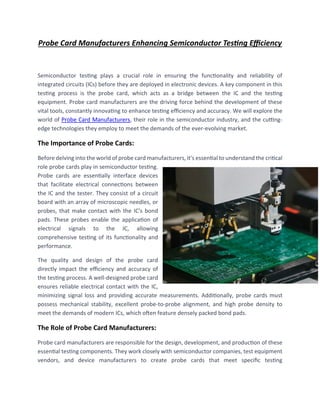
Probe cards are essentially interface devices
that facilitate electrical connections between
the IC and the tester. They consist of a circuit
board with an array of microscopic needles, or
probes, that make contact with the IC's bond
pads. These probes enable the application of
electrical signals to the IC, allowing
comprehensive testing of its functionality and
performance.
The quality and design of the probe card
directly impact the efficiency and accuracy of
the testing process. A well-designed probe card
ensures reliable electrical contact with the IC,
minimizing signal loss and providing accurate measurements. Additionally, probe cards must
possess mechanical stability, excellent probe-to-probe alignment, and high probe density to
meet the demands of modern ICs, which often feature densely packed bond pads.
The Role of Probe Card Manufacturers:
Probe card manufacturers are responsible for the design, development, and production of these
essential testing components. They work closely with semiconductor companies, test equipment
vendors, and device manufacturers to create probe cards that meet specific testing
requirements. This collaborative effort ensures that probe cards are tailored to the unique needs
of each IC design, accommodating different pad pitches, shapes, and sizes.
The role of probe cards and manufacturers extends beyond merely producing standardized probe
cards. They also offer customization services, adapting probe card designs to accommodate
specific testing environments and IC technologies. By leveraging their expertise, probe card, and
manufacturers can optimize contact performance, minimize signal interference, and maximize
testing throughput.
Key Challenges Faced by Probe Card Manufacturers:
The field of probe card manufacturing presents several challenges that manufacturers must
overcome to ensure optimal performance and reliability. These challenges include:
• Shrinking IC Form Factors
As IC technology advances, the size of integrated circuits continues to decrease while their
complexity and functionality increase. This trend poses significant challenges for probe card
manufacturers. The shrinking form factors demand higher probe density, finer pitch, and
enhanced mechanical stability. Manufacturers must invest in advanced manufacturing processes
and cutting-edge materials to achieve the required precision and reliability in probe card
fabrication.
• Signal Integrity
Signal integrity is a critical aspect of semiconductor testing. As data rates increase and ICs become
more complex, maintaining signal integrity during the testing process becomes increasingly
challenging. Probes card manufacturers must develop innovative solutions to minimize signal
loss, crosstalk, and noise interference, ensuring accurate measurements and reliable testing
results.
• Cost and Time-to-Market Pressure
The semiconductor industry operates in a highly competitive landscape where time-to-market is
a crucial factor. Manufacturers face constant pressure to deliver high-quality probe cards within
tight schedules. Moreover, cost optimization is essential to remain competitive in the market.
Achieving the delicate balance between cost, time-to-market, and performance places significant
demands on probes card manufacturers.
Technological Advancements in Probe Card Manufacturing:
To overcome the challenges discussed earlier, probes card manufacturers continually invest in
research and development, leveraging cutting-edge technologies to enhance their products'
performance and capabilities. Let's explore some of the key technological advancements that
have transformed the probe card manufacturing landscape:
• MEMS Probe Cards
Microelectromechanical systems (MEMS) technology has revolutionized the field of probe card
manufacturing. MEMS probe cards employ miniature probes that can be individually controlled,
offering exceptional flexibility in testing multiple ICs simultaneously. MEMS-based probe cards
provide improved probe density, better mechanical stability, and reduced probe-to-probe pitch
variations. These advancements enhance testing throughput and accuracy, making MEMS probe
cards a popular choice for high-volume production environments.
• Advanced Materials
The selection of materials for probe card fabrication significantly impacts their performance and
reliability. Manufacturers are now turning to advanced materials, such as tungsten, beryllium
copper, and composite materials, to meet the demanding requirements of modern IC testing.
These materials offer superior electrical conductivity, mechanical strength, and resistance to
wear and corrosion. Additionally, the development of new plating techniques and surface
coatings further enhances probe card durability and signal integrity.
• Multi-DUT Probe Cards
Multi-DUT (Device Under Test) probe cards enable simultaneous testing of multiple ICs on a single
wafer. This technology maximizes testing throughput and reduces testing costs by eliminating
the need for sequential testing. Multi-DUT probe cards incorporate advanced interconnect
technologies, such as micropumps and copper pillar, to achieve high-density probe
configurations. With the ability to test numerous ICs simultaneously, these probe cards
significantly enhance productivity and accelerate time-to-market.
• Probe Card Analytics and Monitoring
To ensure the ongoing reliability and performance of probe cards, manufacturers are adopting
advanced analytics and monitoring techniques. These techniques involve the integration of
sensors, such as strain gauges and temperature sensors, within the probe card assembly. Real-
time data from these sensors allows manufacturers to monitor probe card health, identify
potential issues, and optimize performance. By leveraging analytics, manufacturers can
proactively address problems, reduce downtime, and extend the lifespan of probe cards.
Conclusion:
Probe Card Manufacturers are instrumental in advancing semiconductor testing capabilities.
Through constant innovation and the adoption of cutting-edge technologies, they overcome the
challenges posed by shrinking form factors, signal integrity, and time-to-market pressures. MEMS
probe cards, advanced materials, multi-DUT probe cards, and probe card analytics are some of
the notable advancements that have transformed the probe card manufacturing landscape. As
the semiconductor industry continues to evolve, probe card manufacturers will play a pivotal role
in enabling efficient and accurate testing, contributing to the development of advanced
electronics that power our modern world.

Probe Card Manufacturers Enhancing Semiconductor Testing Efficiency.pdf

  • 1.
    Probe Card ManufacturersEnhancing Semiconductor Testing Efficiency Semiconductor testing plays a crucial role in ensuring the functionality and reliability of integrated circuits (ICs) before they are deployed in electronic devices. A key component in this testing process is the probe card, which acts as a bridge between the IC and the testing equipment. Probe card manufacturers are the driving force behind the development of these vital tools, constantly innovating to enhance testing efficiency and accuracy. We will explore the world of Probe Card Manufacturers, their role in the semiconductor industry, and the cutting- edge technologies they employ to meet the demands of the ever-evolving market. The Importance of Probe Cards: Before delving into the world of probe card manufacturers, it's essential to understand the critical role probe cards play in semiconductor testing. Probe cards are essentially interface devices that facilitate electrical connections between the IC and the tester. They consist of a circuit board with an array of microscopic needles, or probes, that make contact with the IC's bond pads. These probes enable the application of electrical signals to the IC, allowing comprehensive testing of its functionality and performance. The quality and design of the probe card directly impact the efficiency and accuracy of the testing process. A well-designed probe card ensures reliable electrical contact with the IC, minimizing signal loss and providing accurate measurements. Additionally, probe cards must possess mechanical stability, excellent probe-to-probe alignment, and high probe density to meet the demands of modern ICs, which often feature densely packed bond pads. The Role of Probe Card Manufacturers: Probe card manufacturers are responsible for the design, development, and production of these essential testing components. They work closely with semiconductor companies, test equipment vendors, and device manufacturers to create probe cards that meet specific testing
  • 2.
    requirements. This collaborativeeffort ensures that probe cards are tailored to the unique needs of each IC design, accommodating different pad pitches, shapes, and sizes. The role of probe cards and manufacturers extends beyond merely producing standardized probe cards. They also offer customization services, adapting probe card designs to accommodate specific testing environments and IC technologies. By leveraging their expertise, probe card, and manufacturers can optimize contact performance, minimize signal interference, and maximize testing throughput. Key Challenges Faced by Probe Card Manufacturers: The field of probe card manufacturing presents several challenges that manufacturers must overcome to ensure optimal performance and reliability. These challenges include: • Shrinking IC Form Factors As IC technology advances, the size of integrated circuits continues to decrease while their complexity and functionality increase. This trend poses significant challenges for probe card manufacturers. The shrinking form factors demand higher probe density, finer pitch, and enhanced mechanical stability. Manufacturers must invest in advanced manufacturing processes and cutting-edge materials to achieve the required precision and reliability in probe card fabrication. • Signal Integrity Signal integrity is a critical aspect of semiconductor testing. As data rates increase and ICs become more complex, maintaining signal integrity during the testing process becomes increasingly challenging. Probes card manufacturers must develop innovative solutions to minimize signal loss, crosstalk, and noise interference, ensuring accurate measurements and reliable testing results. • Cost and Time-to-Market Pressure The semiconductor industry operates in a highly competitive landscape where time-to-market is a crucial factor. Manufacturers face constant pressure to deliver high-quality probe cards within tight schedules. Moreover, cost optimization is essential to remain competitive in the market. Achieving the delicate balance between cost, time-to-market, and performance places significant demands on probes card manufacturers. Technological Advancements in Probe Card Manufacturing:
  • 3.
    To overcome thechallenges discussed earlier, probes card manufacturers continually invest in research and development, leveraging cutting-edge technologies to enhance their products' performance and capabilities. Let's explore some of the key technological advancements that have transformed the probe card manufacturing landscape: • MEMS Probe Cards Microelectromechanical systems (MEMS) technology has revolutionized the field of probe card manufacturing. MEMS probe cards employ miniature probes that can be individually controlled, offering exceptional flexibility in testing multiple ICs simultaneously. MEMS-based probe cards provide improved probe density, better mechanical stability, and reduced probe-to-probe pitch variations. These advancements enhance testing throughput and accuracy, making MEMS probe cards a popular choice for high-volume production environments. • Advanced Materials The selection of materials for probe card fabrication significantly impacts their performance and reliability. Manufacturers are now turning to advanced materials, such as tungsten, beryllium copper, and composite materials, to meet the demanding requirements of modern IC testing. These materials offer superior electrical conductivity, mechanical strength, and resistance to wear and corrosion. Additionally, the development of new plating techniques and surface coatings further enhances probe card durability and signal integrity. • Multi-DUT Probe Cards Multi-DUT (Device Under Test) probe cards enable simultaneous testing of multiple ICs on a single wafer. This technology maximizes testing throughput and reduces testing costs by eliminating the need for sequential testing. Multi-DUT probe cards incorporate advanced interconnect technologies, such as micropumps and copper pillar, to achieve high-density probe configurations. With the ability to test numerous ICs simultaneously, these probe cards significantly enhance productivity and accelerate time-to-market. • Probe Card Analytics and Monitoring To ensure the ongoing reliability and performance of probe cards, manufacturers are adopting advanced analytics and monitoring techniques. These techniques involve the integration of sensors, such as strain gauges and temperature sensors, within the probe card assembly. Real- time data from these sensors allows manufacturers to monitor probe card health, identify potential issues, and optimize performance. By leveraging analytics, manufacturers can proactively address problems, reduce downtime, and extend the lifespan of probe cards.
  • 4.
    Conclusion: Probe Card Manufacturersare instrumental in advancing semiconductor testing capabilities. Through constant innovation and the adoption of cutting-edge technologies, they overcome the challenges posed by shrinking form factors, signal integrity, and time-to-market pressures. MEMS probe cards, advanced materials, multi-DUT probe cards, and probe card analytics are some of the notable advancements that have transformed the probe card manufacturing landscape. As the semiconductor industry continues to evolve, probe card manufacturers will play a pivotal role in enabling efficient and accurate testing, contributing to the development of advanced electronics that power our modern world.