Probability
By Nuruzzaman Faruqui
Content courtesy – indiabix.com
Essential Concepts
• Experiment: An operation which can produce some well-defined
outcomes is called an experiment.
Essential Concepts
• Random Experiment: An experiment in which all possible outcomes
are know and the exact output cannot be predicted in advance, is
called a random experiment.
• Examples:
i. Rolling an unbiased dice.
ii.Tossing a fair coin.
iii.Drawing a card from a pack of well-shuffled cards.
iv.Picking up a ball of certain color from a bag containing balls of different
colors.
How Random Experiments are Random?
1. When we throw a coin, then either a Head (H) or a Tail (T) appears.
2. A dice is a solid cube, having 6 faces, marked 1, 2, 3, 4, 5, 6
respectively. When we throw a die, the outcome is the number that
appears on its upper face.
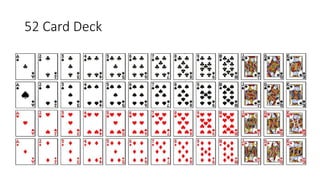
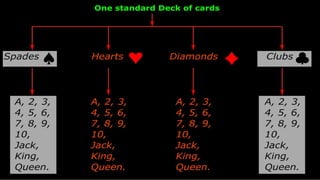
3. A pack of cards has 52 cards.
I. It has 13 cards of each suit, name Spades, Clubs, Hearts and Diamonds.
II. Cards of spades and clubs are black cards.
III. Cards of hearts and diamonds are red cards.
IV. There are 4 honors of each unit.
V. There are Kings, Queens and Jacks. These are all called face cards.
Essential Concepts
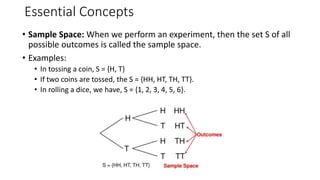
• Sample Space: When we perform an experiment, then the set S of all
possible outcomes is called the sample space.
• Examples:
• In tossing a coin, S = {H, T}
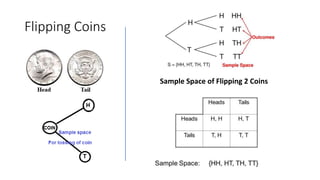
• If two coins are tossed, the S = {HH, HT, TH, TT}.
• In rolling a dice, we have, S = {1, 2, 3, 4, 5, 6}.
Essential Concepts
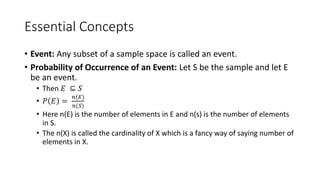
• Event: Any subset of a sample space is called an event.
• Probability of Occurrence of an Event: Let S be the sample and let E
be an event.
• Then 𝐸 ⊆ 𝑆
• 𝑃 𝐸 =
𝑛(𝐸)
𝑛(𝑆)
• Here n(E) is the number of elements in E and n(s) is the number of elements
in S.
• The n(X) is called the cardinality of X which is a fancy way of saying number of
elements in X.
Essential Concepts
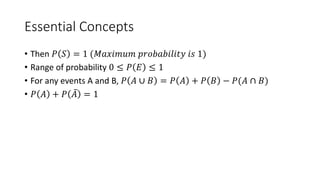
• Then 𝑃 𝑆 = 1 (𝑀𝑎𝑥𝑖𝑚𝑢𝑚 𝑝𝑟𝑜𝑏𝑎𝑏𝑖𝑙𝑖𝑡𝑦 𝑖𝑠 1)
• Range of probability 0 ≤ 𝑃 𝐸 ≤ 1
• For any events A and B, 𝑃 𝐴 ∪ 𝐵 = 𝑃 𝐴 + 𝑃 𝐵 − 𝑃(𝐴 ∩ 𝐵)
• 𝑃 𝐴 + 𝑃 𝐴 = 1
52 Card Deck
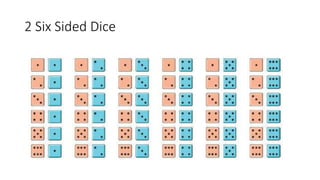
2 Six Sided Dice
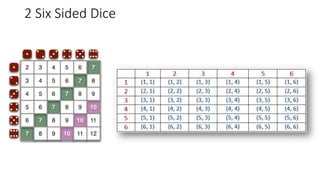
2 Six Sided Dice
Flipping Coins
Sample Space of Flipping 2 Coins
Exercise Problems
1. Tickets numbered 1 to 20 are mixed up and then a ticket is drawn at
random. What is the probability that the ticket drawn has a number
which is a multiple of 3 or 5? (Answer 9/20)
2. A bag contains 2 red, 3 green and 2 blue balls. Two balls are drawn
at random. What is the probability that none of the balls drawn is
blue? (Answer 10/21)
3. In a box, there are 8 red, 7 blue and 6 green balls. One ball is picked
up randomly. What is the probability that it is neither red nor
green? (Answer 1/3)
Exercise Problems
1. What is the probability of getting a sum 9 from two throws of a
dice? (Answer: 1/9)
2. Three unbiased coins are tossed. What is the probability of getting
at most two heads? (Answer: 7/8)
3. Two dice are thrown simultaneously. What is the probability of
getting two numbers whose product is even? (Answer: 3/4)
4. In a class, there are 15 boys and 10 girls. Three students are
selected at random. The probability that 1 girl and 2 boys are
selected, is what? (Answer: 21/46)
Exercise Problems
1. What is the probability of getting a sum 9 from two throws of a
dice? (Answer: 1/9)
2. Three unbiased coins are tossed. What is the probability of getting
at most two heads? (Answer: 7/8)
3. Two dice are thrown simultaneously. What is the probability of
getting two numbers whose product is even? (Answer: 3/4)
4. In a class, there are 15 boys and 10 girls. Three students are
selected at random. The probability that 1 girl and 2 boys are
selected, is what? (Answer: 21/46)
Exercise Problems
1. In a lottery, there are 10 prizes and 25 blanks. A lottery is drawn at
random. What is the probability of getting a prize? (Answer: 2/7)
2. From a pack of 52 cards, two cards are drawn together at random.
What is the probability of both the cards being kings? (Answer:
1/221)
3. Two dice are tossed. The probability that the total score is a prime
number is what? (Answer: 5/12)
Exercise Problems
1. A bag contains 4 white, 5 red and 6 blue balls. Three balls are drawn
at random from the bag. The probability that all of them are red is
what? (Answer: 2/91)
2. Two cards are drawn together from a pack of 52 cards. The
probability that one is a spade and one is a heart is what? (Answer:
13/102)
3. One card is drawn at random from a pack of 52 cards. What is the
probability that the card drawn is a face card (Jack, Queen and King
only)? (Answer: 3/13)
4. A bag contains 6 black and 8 white balls. One ball is drawn at
random. What is the probability that the ball drawn is white?
(Answer: 4/7)

Probability.pptx

  • 1.
  • 2.
    Essential Concepts • Experiment:An operation which can produce some well-defined outcomes is called an experiment.
  • 3.
    Essential Concepts • RandomExperiment: An experiment in which all possible outcomes are know and the exact output cannot be predicted in advance, is called a random experiment. • Examples: i. Rolling an unbiased dice. ii.Tossing a fair coin. iii.Drawing a card from a pack of well-shuffled cards. iv.Picking up a ball of certain color from a bag containing balls of different colors.
  • 4.
    How Random Experimentsare Random? 1. When we throw a coin, then either a Head (H) or a Tail (T) appears. 2. A dice is a solid cube, having 6 faces, marked 1, 2, 3, 4, 5, 6 respectively. When we throw a die, the outcome is the number that appears on its upper face. 3. A pack of cards has 52 cards. I. It has 13 cards of each suit, name Spades, Clubs, Hearts and Diamonds. II. Cards of spades and clubs are black cards. III. Cards of hearts and diamonds are red cards. IV. There are 4 honors of each unit. V. There are Kings, Queens and Jacks. These are all called face cards.
  • 5.
    Essential Concepts • SampleSpace: When we perform an experiment, then the set S of all possible outcomes is called the sample space. • Examples: • In tossing a coin, S = {H, T} • If two coins are tossed, the S = {HH, HT, TH, TT}. • In rolling a dice, we have, S = {1, 2, 3, 4, 5, 6}.
  • 6.
    Essential Concepts • Event:Any subset of a sample space is called an event. • Probability of Occurrence of an Event: Let S be the sample and let E be an event. • Then 𝐸 ⊆ 𝑆 • 𝑃 𝐸 = 𝑛(𝐸) 𝑛(𝑆) • Here n(E) is the number of elements in E and n(s) is the number of elements in S. • The n(X) is called the cardinality of X which is a fancy way of saying number of elements in X.
  • 7.
    Essential Concepts • Then𝑃 𝑆 = 1 (𝑀𝑎𝑥𝑖𝑚𝑢𝑚 𝑝𝑟𝑜𝑏𝑎𝑏𝑖𝑙𝑖𝑡𝑦 𝑖𝑠 1) • Range of probability 0 ≤ 𝑃 𝐸 ≤ 1 • For any events A and B, 𝑃 𝐴 ∪ 𝐵 = 𝑃 𝐴 + 𝑃 𝐵 − 𝑃(𝐴 ∩ 𝐵) • 𝑃 𝐴 + 𝑃 𝐴 = 1
  • 8.
  • 10.
  • 11.
  • 12.
    Flipping Coins Sample Spaceof Flipping 2 Coins
  • 13.
    Exercise Problems 1. Ticketsnumbered 1 to 20 are mixed up and then a ticket is drawn at random. What is the probability that the ticket drawn has a number which is a multiple of 3 or 5? (Answer 9/20) 2. A bag contains 2 red, 3 green and 2 blue balls. Two balls are drawn at random. What is the probability that none of the balls drawn is blue? (Answer 10/21) 3. In a box, there are 8 red, 7 blue and 6 green balls. One ball is picked up randomly. What is the probability that it is neither red nor green? (Answer 1/3)
  • 14.
    Exercise Problems 1. Whatis the probability of getting a sum 9 from two throws of a dice? (Answer: 1/9) 2. Three unbiased coins are tossed. What is the probability of getting at most two heads? (Answer: 7/8) 3. Two dice are thrown simultaneously. What is the probability of getting two numbers whose product is even? (Answer: 3/4) 4. In a class, there are 15 boys and 10 girls. Three students are selected at random. The probability that 1 girl and 2 boys are selected, is what? (Answer: 21/46)
  • 15.
    Exercise Problems 1. Whatis the probability of getting a sum 9 from two throws of a dice? (Answer: 1/9) 2. Three unbiased coins are tossed. What is the probability of getting at most two heads? (Answer: 7/8) 3. Two dice are thrown simultaneously. What is the probability of getting two numbers whose product is even? (Answer: 3/4) 4. In a class, there are 15 boys and 10 girls. Three students are selected at random. The probability that 1 girl and 2 boys are selected, is what? (Answer: 21/46)
  • 16.
    Exercise Problems 1. Ina lottery, there are 10 prizes and 25 blanks. A lottery is drawn at random. What is the probability of getting a prize? (Answer: 2/7) 2. From a pack of 52 cards, two cards are drawn together at random. What is the probability of both the cards being kings? (Answer: 1/221) 3. Two dice are tossed. The probability that the total score is a prime number is what? (Answer: 5/12)
  • 17.
    Exercise Problems 1. Abag contains 4 white, 5 red and 6 blue balls. Three balls are drawn at random from the bag. The probability that all of them are red is what? (Answer: 2/91) 2. Two cards are drawn together from a pack of 52 cards. The probability that one is a spade and one is a heart is what? (Answer: 13/102) 3. One card is drawn at random from a pack of 52 cards. What is the probability that the card drawn is a face card (Jack, Queen and King only)? (Answer: 3/13) 4. A bag contains 6 black and 8 white balls. One ball is drawn at random. What is the probability that the ball drawn is white? (Answer: 4/7)