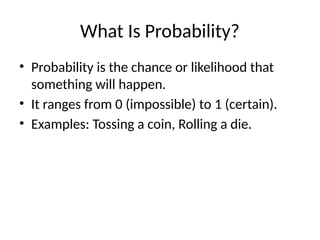
What Is Probability?
•Probability is the chance or likelihood that
something will happen.
• It ranges from 0 (impossible) to 1 (certain).
• Examples: Tossing a coin, Rolling a die.
3.
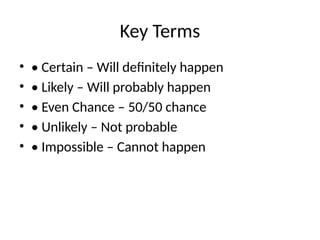
Key Terms
• •Certain – Will definitely happen
• • Likely – Will probably happen
• • Even Chance – 50/50 chance
• • Unlikely – Not probable
• • Impossible – Cannot happen
4.
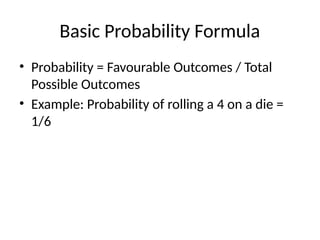
Basic Probability Formula
•Probability = Favourable Outcomes / Total
Possible Outcomes
• Example: Probability of rolling a 4 on a die =
1/6
5.
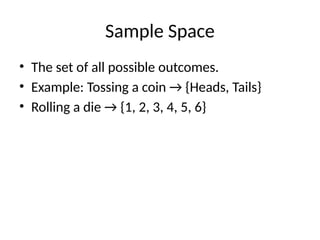
Sample Space
• Theset of all possible outcomes.
• Example: Tossing a coin → {Heads, Tails}
• Rolling a die → {1, 2, 3, 4, 5, 6}
Simple Experiments
• •Tossing one or two coins
• • Rolling one die or two dice
• • Spinners and cards (basic probability)
8.
Combined Events (Grade9)
• Example: Tossing two coins → Outcomes: HH,
HT, TH, TT
• Two dice → Use tables to count outcomes
• Start discussing independent and dependent
events
9.
Real-Life Examples
• •Weather forecasts
• • Drawing names from a hat
• • Sports predictions
• • Classroom games and spinners
10.
Grade 10: AdvancedProbability
Concepts
• • Mutually exclusive events
• • Venn diagrams with probabilities
• • Independent vs Dependent events
• • Addition Rule: P(A or B) = P(A) + P(B) - P(A
and B)
11.
Grade 11: CompoundEvents
• • Tree diagrams for multiple events
• • Conditional probability (P(A|B))
• • Multiplication Rule: P(A and B) = P(A) × P(B|
A)
12.
Grade 12: ProblemSolving &
Interpretation
• • Using probability in real data scenarios
• • Probability distributions (brief)
• • Exam-level questions and interpretation of
data
13.
Activity Ideas
• •Classroom experiments (dice, coins,
spinners)
• • Group tasks to build tree diagrams
• • Card games to demonstrate randomness
• • Surveys and predictions from real data
14.
Summary
• • Probabilityis all about measuring
uncertainty.
• • It evolves from simple experiments in Grade
8 to abstract reasoning in Grade 12.
• • Real-life application is key to understanding.
• • Practice with examples and activities is
essential.


![Polymer [ बहुलक ] Chemistry Notes PDF - Irfanullah Mehar - JJ Sir Chemistry.pdf](https://cdn.slidesharecdn.com/ss_thumbnails/polymerchemistrynotespdf-irfanullahmehar-jjsirchemistry-260210172118-3f9b37f7-thumbnail.jpg?width=640&height=640&fit=bounds)


![ANIMAL_CELL_,_TISSUE_AND_ORGAN_CULTURE[1].pptx](https://cdn.slidesharecdn.com/ss_thumbnails/animalcelltissueandorganculture1-260204172026-4462b440-thumbnail.jpg?width=640&height=640&fit=bounds)


