STAT 714 HOMEWORK 6
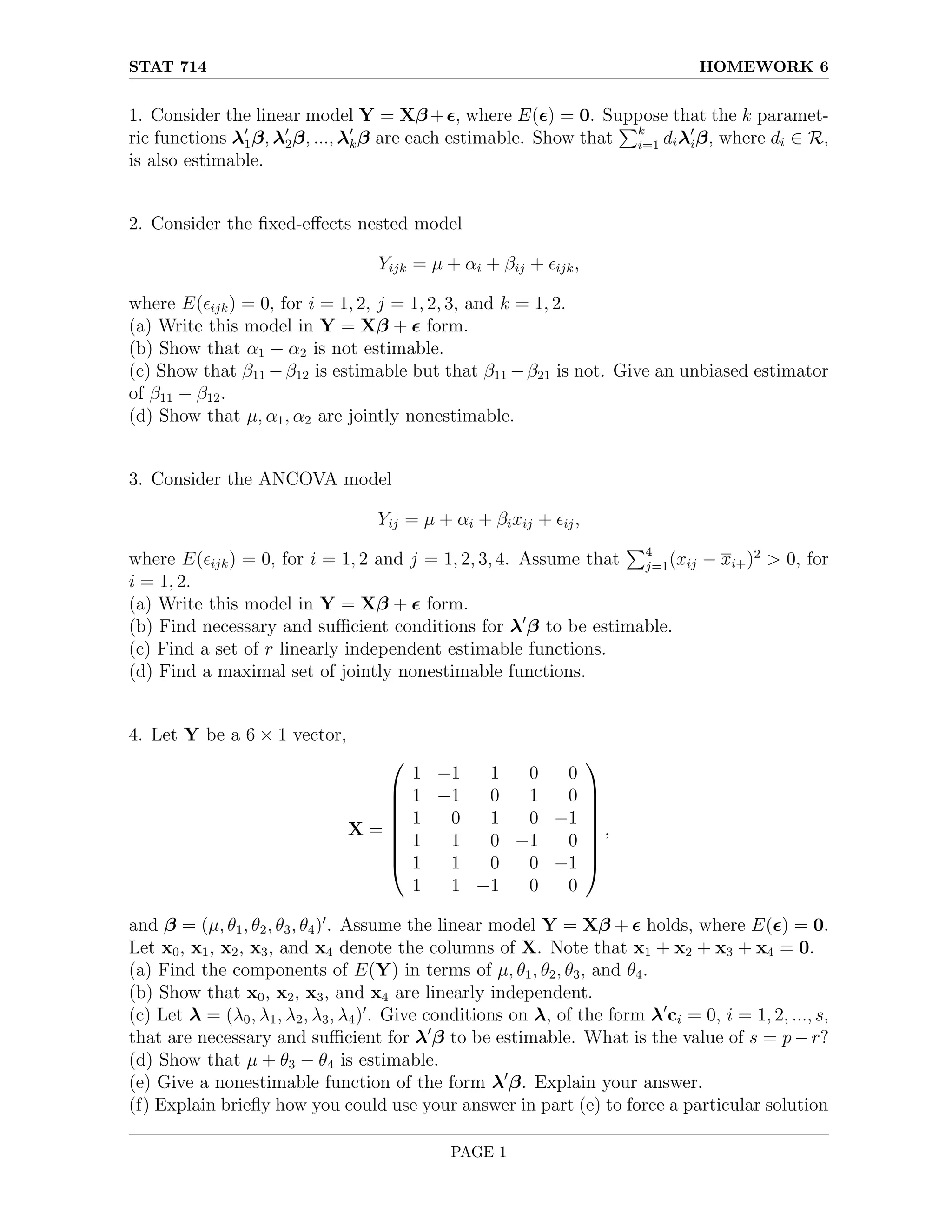
1. Consider the linear model Y = Xβ+, where E() = 0. Suppose that the k paramet-
ric functions λ0
1β, λ0
2β, ..., λ0
kβ are each estimable. Show that
Pk
i=1 diλ0
iβ, where di ∈ R,
is also estimable.
2. Consider the fixed-effects nested model
Yijk = µ + αi + βij + ijk,
where E(ijk) = 0, for i = 1, 2, j = 1, 2, 3, and k = 1, 2.
(a) Write this model in Y = Xβ +  form.
(b) Show that α1 − α2 is not estimable.
(c) Show that β11 −β12 is estimable but that β11 −β21 is not. Give an unbiased estimator
of β11 − β12.
(d) Show that µ, α1, α2 are jointly nonestimable.
3. Consider the ANCOVA model
Yij = µ + αi + βixij + ij,
where E(ijk) = 0, for i = 1, 2 and j = 1, 2, 3, 4. Assume that
P4
j=1(xij − xi+)2
 0, for
i = 1, 2.
(a) Write this model in Y = Xβ +  form.
(b) Find necessary and sufficient conditions for λ0
β to be estimable.
(c) Find a set of r linearly independent estimable functions.
(d) Find a maximal set of jointly nonestimable functions.
4. Let Y be a 6 × 1 vector,
X =








1 −1 1 0 0
1 −1 0 1 0
1 0 1 0 −1
1 1 0 −1 0
1 1 0 0 −1
1 1 −1 0 0








,
and β = (µ, θ1, θ2, θ3, θ4)0
. Assume the linear model Y = Xβ +  holds, where E() = 0.
Let x0, x1, x2, x3, and x4 denote the columns of X. Note that x1 + x2 + x3 + x4 = 0.
(a) Find the components of E(Y) in terms of µ, θ1, θ2, θ3, and θ4.
(b) Show that x0, x2, x3, and x4 are linearly independent.
(c) Let λ = (λ0, λ1, λ2, λ3, λ4)0
. Give conditions on λ, of the form λ0
ci = 0, i = 1, 2, ..., s,
that are necessary and sufficient for λ0
β to be estimable. What is the value of s = p − r?
(d) Show that µ + θ3 − θ4 is estimable.
(e) Give a nonestimable function of the form λ0
β. Explain your answer.
(f) Explain briefly how you could use your answer in part (e) to force a particular solution
PAGE 1
STAT 714 HOMEWORK 6
to the normal equations X0
Xβ = X0
Y. If you did this, would your nonestimable λ0
β in
part (e) become estimable? Explain.
5. Consider the linear model Y = Xβ +  where E() = 0. Show that the following four
statements are equivalent.
1. λ0
β is estimable.
2. λ0
a = 0, for every a such that Xa = 0.
3. λ ∈ C(X0
X).
4. λ0
= λ0
(X0
X)−
X0
X.
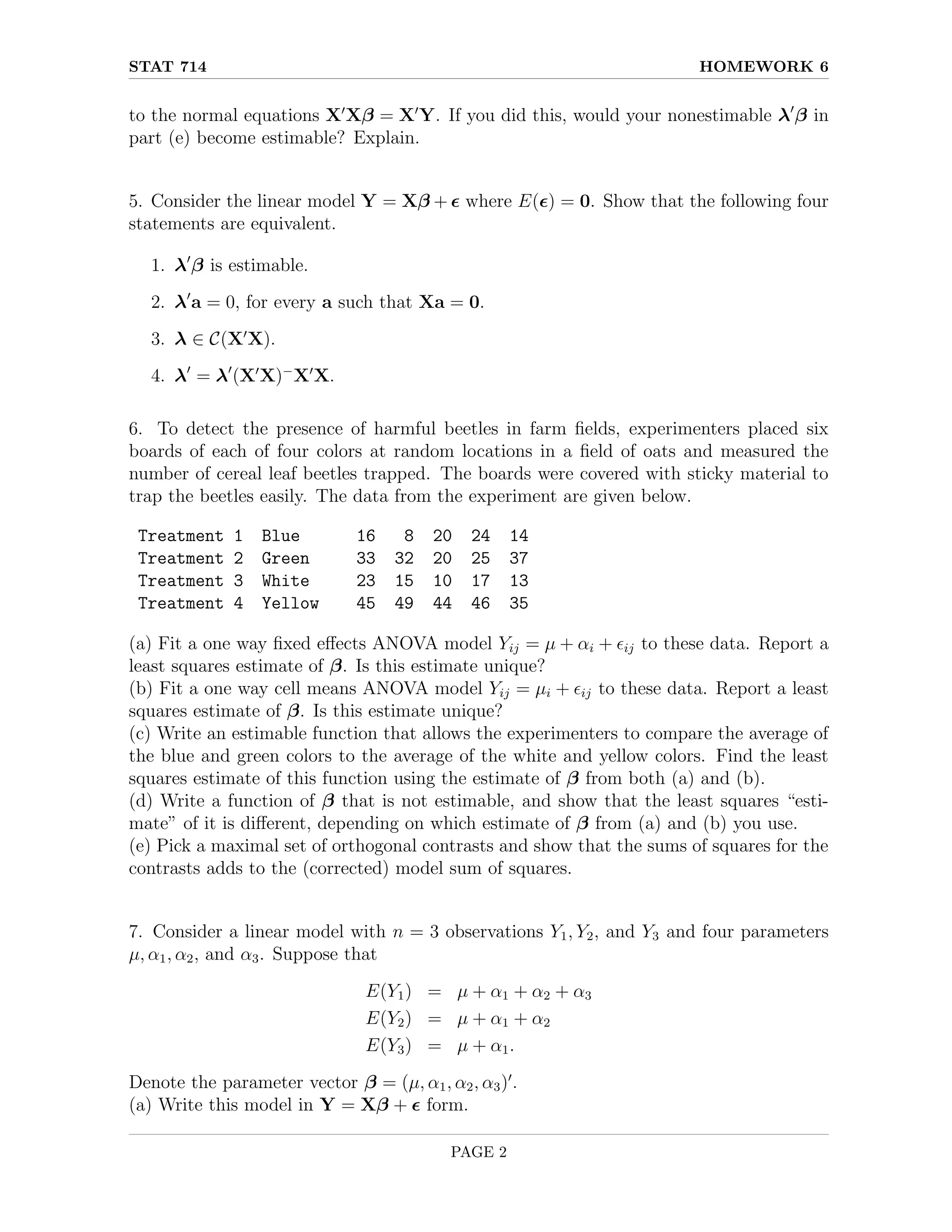
6. To detect the presence of harmful beetles in farm fields, experimenters placed six
boards of each of four colors at random locations in a field of oats and measured the
number of cereal leaf beetles trapped. The boards were covered with sticky material to
trap the beetles easily. The data from the experiment are given below.
Treatment 1 Blue 16 8 20 24 14
Treatment 2 Green 33 32 20 25 37
Treatment 3 White 23 15 10 17 13
Treatment 4 Yellow 45 49 44 46 35
(a) Fit a one way fixed effects ANOVA model Yij = µ + αi + ij to these data. Report a
least squares estimate of β. Is this estimate unique?
(b) Fit a one way cell means ANOVA model Yij = µi + ij to these data. Report a least
squares estimate of β. Is this estimate unique?
(c) Write an estimable function that allows the experimenters to compare the average of
the blue and green colors to the average of the white and yellow colors. Find the least
squares estimate of this function using the estimate of β from both (a) and (b).
(d) Write a function of β that is not estimable, and show that the least squares “esti-
mate” of it is different, depending on which estimate of β from (a) and (b) you use.
(e) Pick a maximal set of orthogonal contrasts and show that the sums of squares for the
contrasts adds to the (corrected) model sum of squares.
7. Consider a linear model with n = 3 observations Y1, Y2, and Y3 and four parameters
µ, α1, α2, and α3. Suppose that
E(Y1) = µ + α1 + α2 + α3
E(Y2) = µ + α1 + α2
E(Y3) = µ + α1.
Denote the parameter vector β = (µ, α1, α2, α3)0
.
(a) Write this model in Y = Xβ +  form.
PAGE 2
STAT 714 HOMEWORK 6
(b) Characterize each of the following functions as estimable or nonestimable: µ, α1,
µ + α1, µ + α1 + α2 + α3. For each one, justify your answer.
(c) Write down the normal equations for this model.
(d) Find two solutions b
β1 and b
β2 to the normal equations.
(e) Find the least squares estimates of the estimable functions in part (b). Verify that
these estimates are invariant to which of b
β1 and b
β2 is used.
8. This is a simple model involving spline functions. Data pairs (xi, yi) are collected. If
xi  0, then E(Yi) = µ. If xi ≥ 0, then E(Yi) = α + βxi. Consider the four data pairs
(−2, −3), (−1, −1), (1, 1), (2, 2).
(a) What are the vectors Y and β and the matrix X for this model?
(b) Compute a least squares estimate of β. You can just write this down by considering
what functions would minimize Q(β).
(c) Now add the restriction that the two functions µ and α + βx must be equal at x = 0.
Find a least squares estimate of β in this restricted model. The resulting function of x
might be called a spline function.
PAGE 3

probability problem with brief solution 6

  • 1.
    STAT 714 HOMEWORK6 1. Consider the linear model Y = Xβ+, where E() = 0. Suppose that the k paramet- ric functions λ0 1β, λ0 2β, ..., λ0 kβ are each estimable. Show that Pk i=1 diλ0 iβ, where di ∈ R, is also estimable. 2. Consider the fixed-effects nested model Yijk = µ + αi + βij + ijk, where E(ijk) = 0, for i = 1, 2, j = 1, 2, 3, and k = 1, 2. (a) Write this model in Y = Xβ + form. (b) Show that α1 − α2 is not estimable. (c) Show that β11 −β12 is estimable but that β11 −β21 is not. Give an unbiased estimator of β11 − β12. (d) Show that µ, α1, α2 are jointly nonestimable. 3. Consider the ANCOVA model Yij = µ + αi + βixij + ij, where E(ijk) = 0, for i = 1, 2 and j = 1, 2, 3, 4. Assume that P4 j=1(xij − xi+)2 0, for i = 1, 2. (a) Write this model in Y = Xβ + form. (b) Find necessary and sufficient conditions for λ0 β to be estimable. (c) Find a set of r linearly independent estimable functions. (d) Find a maximal set of jointly nonestimable functions. 4. Let Y be a 6 × 1 vector, X =         1 −1 1 0 0 1 −1 0 1 0 1 0 1 0 −1 1 1 0 −1 0 1 1 0 0 −1 1 1 −1 0 0         , and β = (µ, θ1, θ2, θ3, θ4)0 . Assume the linear model Y = Xβ + holds, where E() = 0. Let x0, x1, x2, x3, and x4 denote the columns of X. Note that x1 + x2 + x3 + x4 = 0. (a) Find the components of E(Y) in terms of µ, θ1, θ2, θ3, and θ4. (b) Show that x0, x2, x3, and x4 are linearly independent. (c) Let λ = (λ0, λ1, λ2, λ3, λ4)0 . Give conditions on λ, of the form λ0 ci = 0, i = 1, 2, ..., s, that are necessary and sufficient for λ0 β to be estimable. What is the value of s = p − r? (d) Show that µ + θ3 − θ4 is estimable. (e) Give a nonestimable function of the form λ0 β. Explain your answer. (f) Explain briefly how you could use your answer in part (e) to force a particular solution PAGE 1
  • 2.
    STAT 714 HOMEWORK6 to the normal equations X0 Xβ = X0 Y. If you did this, would your nonestimable λ0 β in part (e) become estimable? Explain. 5. Consider the linear model Y = Xβ + where E() = 0. Show that the following four statements are equivalent. 1. λ0 β is estimable. 2. λ0 a = 0, for every a such that Xa = 0. 3. λ ∈ C(X0 X). 4. λ0 = λ0 (X0 X)− X0 X. 6. To detect the presence of harmful beetles in farm fields, experimenters placed six boards of each of four colors at random locations in a field of oats and measured the number of cereal leaf beetles trapped. The boards were covered with sticky material to trap the beetles easily. The data from the experiment are given below. Treatment 1 Blue 16 8 20 24 14 Treatment 2 Green 33 32 20 25 37 Treatment 3 White 23 15 10 17 13 Treatment 4 Yellow 45 49 44 46 35 (a) Fit a one way fixed effects ANOVA model Yij = µ + αi + ij to these data. Report a least squares estimate of β. Is this estimate unique? (b) Fit a one way cell means ANOVA model Yij = µi + ij to these data. Report a least squares estimate of β. Is this estimate unique? (c) Write an estimable function that allows the experimenters to compare the average of the blue and green colors to the average of the white and yellow colors. Find the least squares estimate of this function using the estimate of β from both (a) and (b). (d) Write a function of β that is not estimable, and show that the least squares “esti- mate” of it is different, depending on which estimate of β from (a) and (b) you use. (e) Pick a maximal set of orthogonal contrasts and show that the sums of squares for the contrasts adds to the (corrected) model sum of squares. 7. Consider a linear model with n = 3 observations Y1, Y2, and Y3 and four parameters µ, α1, α2, and α3. Suppose that E(Y1) = µ + α1 + α2 + α3 E(Y2) = µ + α1 + α2 E(Y3) = µ + α1. Denote the parameter vector β = (µ, α1, α2, α3)0 . (a) Write this model in Y = Xβ + form. PAGE 2
  • 3.
    STAT 714 HOMEWORK6 (b) Characterize each of the following functions as estimable or nonestimable: µ, α1, µ + α1, µ + α1 + α2 + α3. For each one, justify your answer. (c) Write down the normal equations for this model. (d) Find two solutions b β1 and b β2 to the normal equations. (e) Find the least squares estimates of the estimable functions in part (b). Verify that these estimates are invariant to which of b β1 and b β2 is used. 8. This is a simple model involving spline functions. Data pairs (xi, yi) are collected. If xi 0, then E(Yi) = µ. If xi ≥ 0, then E(Yi) = α + βxi. Consider the four data pairs (−2, −3), (−1, −1), (1, 1), (2, 2). (a) What are the vectors Y and β and the matrix X for this model? (b) Compute a least squares estimate of β. You can just write this down by considering what functions would minimize Q(β). (c) Now add the restriction that the two functions µ and α + βx must be equal at x = 0. Find a least squares estimate of β in this restricted model. The resulting function of x might be called a spline function. PAGE 3