Privacy Law Update: Red Flags, HITECH & the New Massachusetts Data Privacy RegulationsStephen E. Meltzer, Esquire, CIPP
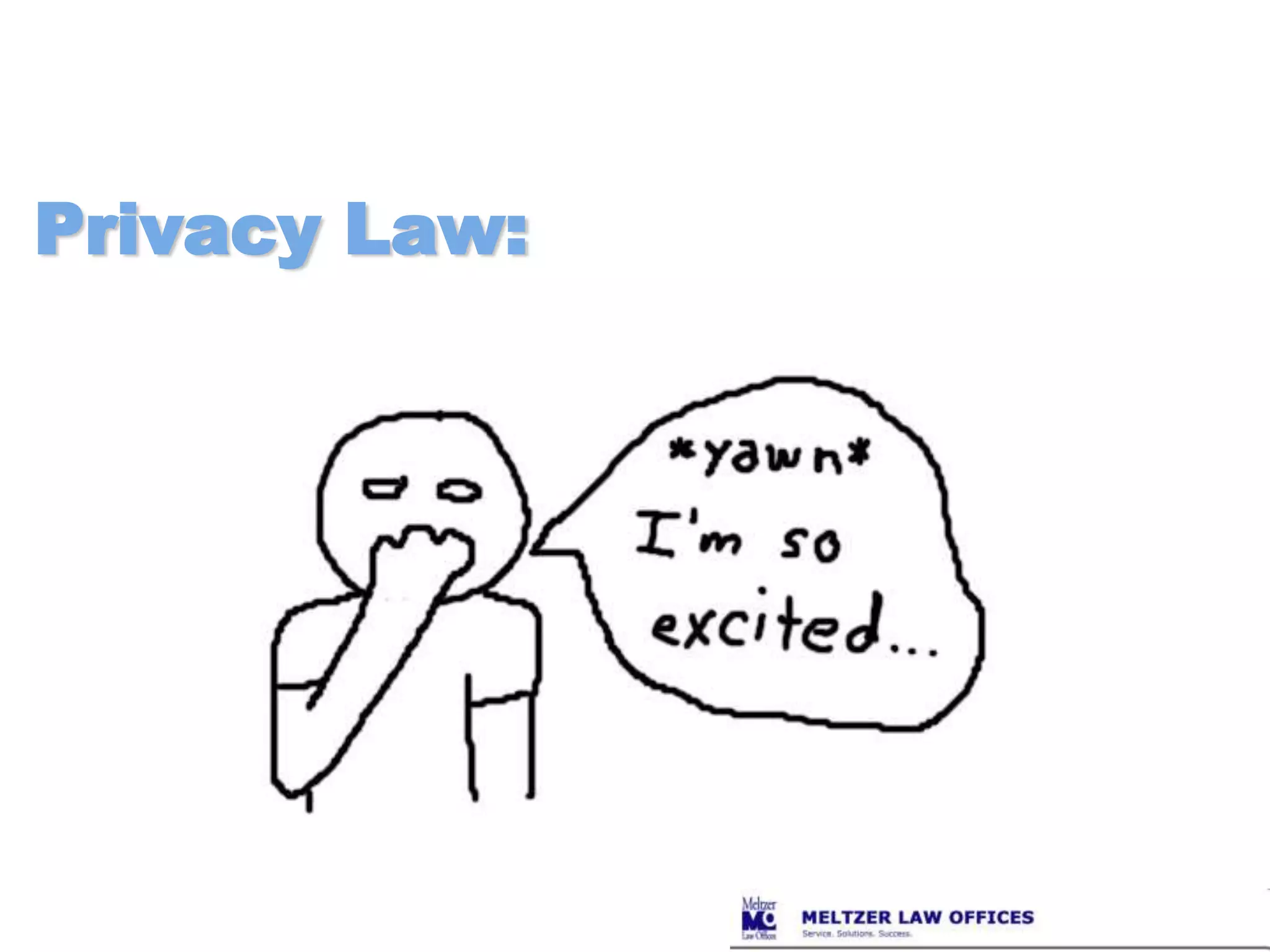
Privacy Law:
HIPAA, ARRA and HITECHRed Flags201 CMR 17.00
?
HIPAA, ARRA & HITECHHealth Insurance Portability & Accountability Act of 1996Not HIPPA (Health Insurance Portability Prevention Act)American Recovery & Reinvestment ActHealth Information Technology for Economic and Clinical Health
HITECH RequirementsExpands the definitions of “business associates.” Mandates that HIPAA security standards that apply to health plans and health care providers will also apply directly to business associates.Establishes new security breach notice requirements.Entitles individuals to electronic copies of health information. Calls for regulations regarding the sale of electronic health records and protected health information by mid-August, 2010.
Business Associates“Business associates” are persons and organizations (typically subcontractors) that perform activities involving the use or disclosure of individually identifiable health information, such as claims processing, data analysis, quality assurance, billing, and benefit management, as well as those who provide legal, accounting, or administrative functions. 45 CFR §160.103. The HITECH Act adds as “business associates” organizations that transmit protected health information and require access on a routine basis to such information. See 42 USC §17938.
Business AssociatesSubject to the administrative, physical, and technical security requirements of HIPAA, must implement appropriate policies and procedures, and must document their security activities. Penalties for violating these HIPAA procedures will apply to business associates, just as they now do to health plans and health care providers. 42 USC §17931.
Breach Notificationa health plan or health care provider that accesses, maintains, retains, modifies, records, stores, destroys, or otherwise holds, uses, or discloses unsecured protected health information and discovers a breach of the information to notify each individual whose health information has been, or is reasonably believed to have been, accessed, acquired, or disclosed as a result of the breach. 42 USC §17932(a). Business associates will also be required to give notice of such a data breach to the health plan or health care provider, and will need to identify each individual whose unsecured protected health information was illegally accessed, acquired, or disclosed. 42 USC §17932(b). The health plan, health care provider, or business associate will be required to give notice of the breach without unreasonable delay, and no later than 60 calendar days after its discovery. 42 USC §17932(d). Notice must be provided by first-class mail to individuals at their last known address, or, if specified by the individual, via e-mail. 42 USC §17932(e)(1).
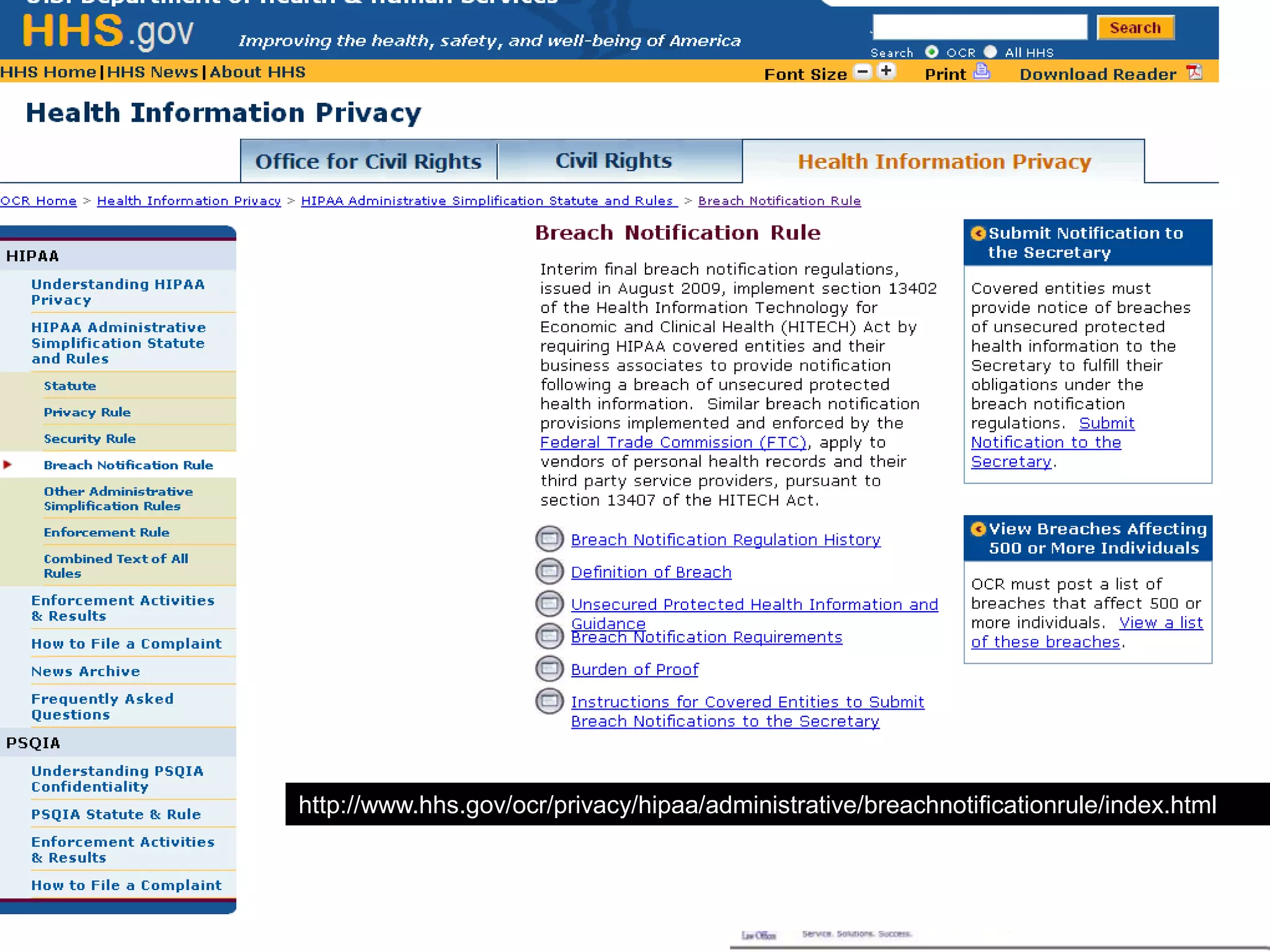
http://www.hhs.gov/ocr/privacy/hipaa/administrative/breachnotificationrule/index.html
Individual Patient RightsIndividuals are entitled to copies of their health information in electronic format from any health plan or health care provider that uses or maintains electronic health records. An individual will be able to direct the health plan or health care provider to transmit the copy directly to anyone he or she designates. Fees for providing this service must not be greater than the entity’s labor costs. 42 USC 17935(e).
AuthorizationThe HITECH Act will prohibit a health plan, health care provider, or business associate from receiving payment for an individual’s protected health information without authorization from the individual. 42 USC §17935(d).
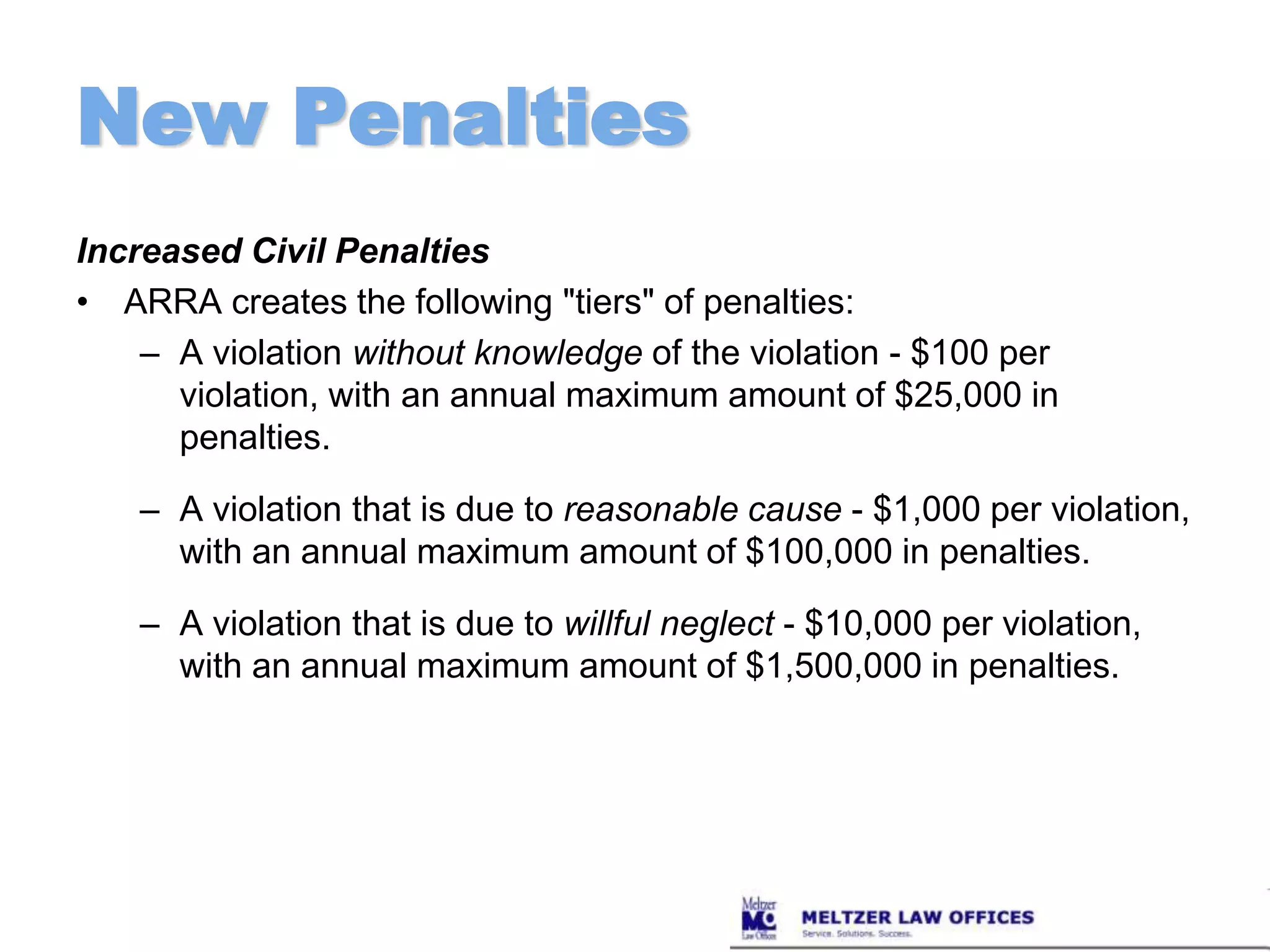
New PenaltiesIncreased Civil PenaltiesARRA creates the following "tiers" of penalties:A violation without knowledge of the violation - $100 per violation, with an annual maximum amount of $25,000 in penalties.A violation that is due to reasonable cause - $1,000 per violation, with an annual maximum amount of $100,000 in penalties.A violation that is due to willful neglect - $10,000 per violation, with an annual maximum amount of $1,500,000 in penalties.
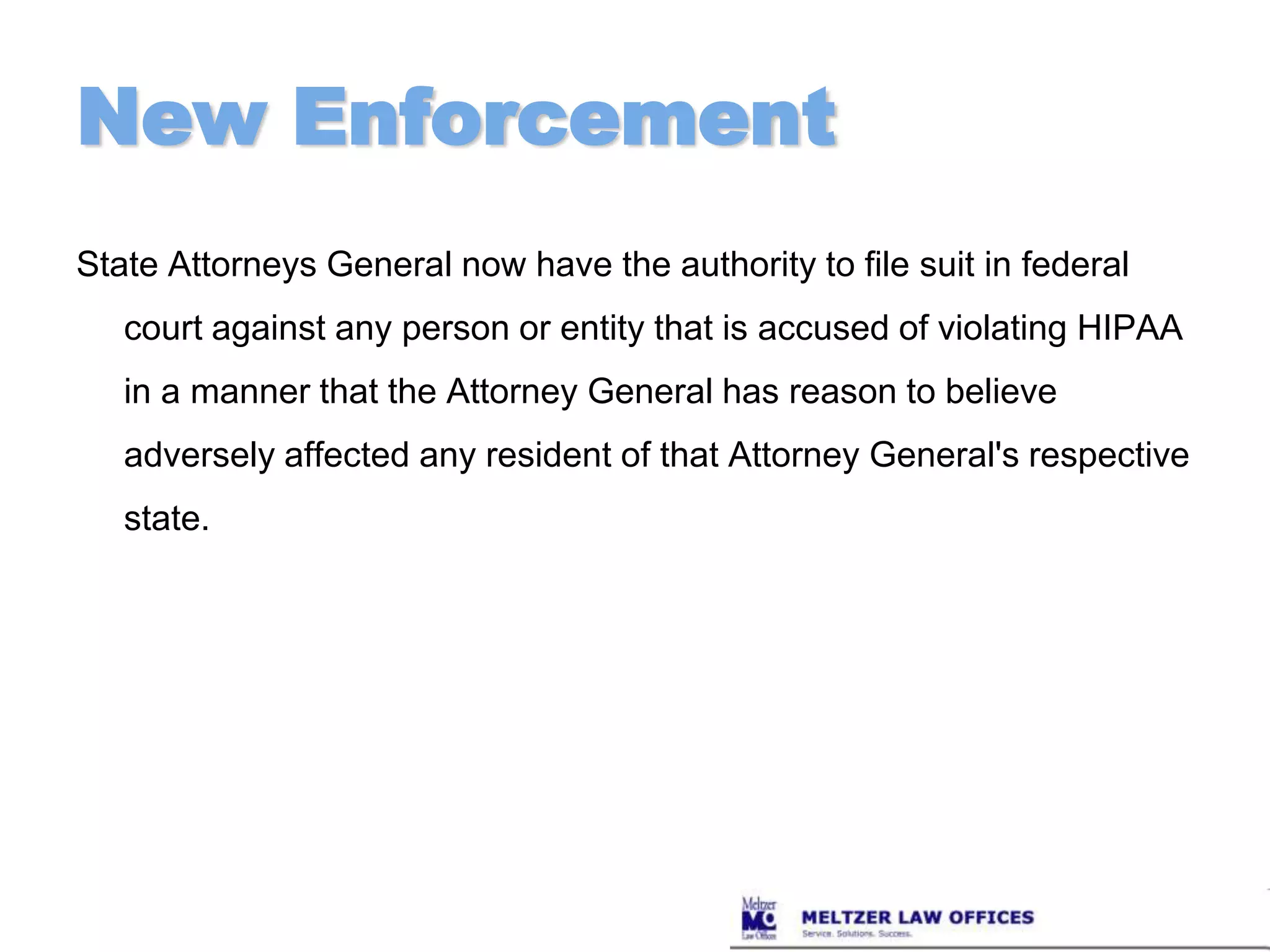
New EnforcementState Attorneys General now have the authority to file suit in federal court against any person or entity that is accused of violating HIPAA in a manner that the Attorney General has reason to believe adversely affected any resident of that Attorney General's respective state.
RED FLAGSJune 1, 2010
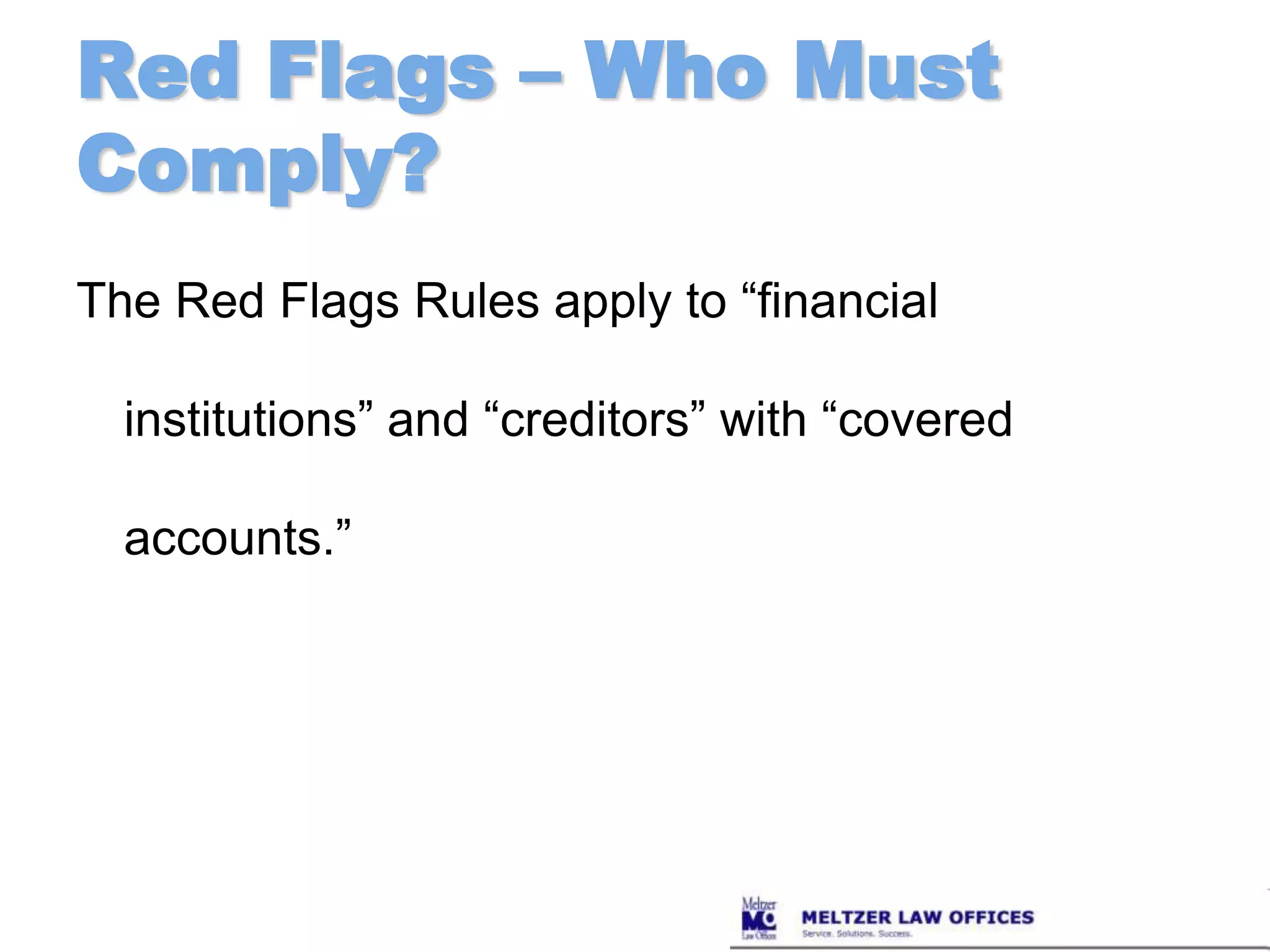
Red Flags – Who Must Comply?The Red Flags Rules apply to “financial institutions” and “creditors” with “covered accounts.”
Red Flags – Financial InstitutionsState or national bank, a state or federal savings and loan association, a mutual savings bank, a state or federal credit union, or any other entity that holds a “transaction account” belonging to a consumer. Most of these institutions are regulated by the Federal bank regulatory agencies and the NCUA. Financial institutions under the FTC’s jurisdiction include state-chartered credit unions and certain other entities that hold consumer transaction accounts.
Red Flags – Transaction AccountA transaction account is a deposit or other account from which the owner makes payments or transfers. Transaction accounts include checking accounts, negotiable order of withdrawal accounts, savings deposits subject to automatic transfers, and share draft accounts.
Red Flags - CreditorAny entity that regularly extends, renews, or continues credit; any entity that regularly arranges for the extension, renewal, or continuation of credit; or any assignee of an original creditor who is involved in the decision to extend, renew, or continue credit. Accepting credit cards as a form of payment does not in and of itself make an entity a creditor. Creditors include finance companies, automobile dealers, mortgage brokers, utility companies, and telecommunications companies. Where non-profit and government entities defer payment for goods or services, they, too, are to be considered creditors. 
Red Flags – Covered AccountAn account used mostly for personal, family, or household purposes, and that involves multiple payments or transactions. Covered accounts include credit card accounts, mortgage loans, automobile loans, margin accounts, cell phone accounts, utility accounts, checking accounts, and savings accounts. A covered account is also an account for which there is a foreseeable risk of identity theft – for example, small business or sole proprietorship accounts
Red Flags – Exempt?Only LawyersFTC has filed a Notice of Appeal Judge Walton is reported to have questioned whether the term could be interpreted so broadly as to render a plumber who bills a customer after performing his work a "creditor" within the meaning of the Rule.CPA’s have filed a lawsuit
Red Flags - RequirementsDevelop a written program that identifies and detects the relevant warning signs – or “red flags” – of identity theft. These may include, for example, unusual account activity, fraud alerts on a consumer report, or attempted use of suspicious account application documents. The program must also describe appropriate responses that would prevent and mitigate the crime and detail a plan to update the program. The program must be managed by the Board of Directors or senior employees of the financial institution or creditor, include appropriate staff training, and provide for oversight of any service providers.
Red Flags – Requirements – suggested “Starting Points”alerts, notifications, or warnings from a consumer reporting agency;suspicious documents;suspicious personally identifying information, such as a suspicious address;unusual use of – or suspicious activity relating to – a covered account; andnotices from customers, victims of identity theft, law enforcement authorities, or other businesses about possible identity theft in connection with covered accounts.
Red Flags - Penalties$3,500 per violation
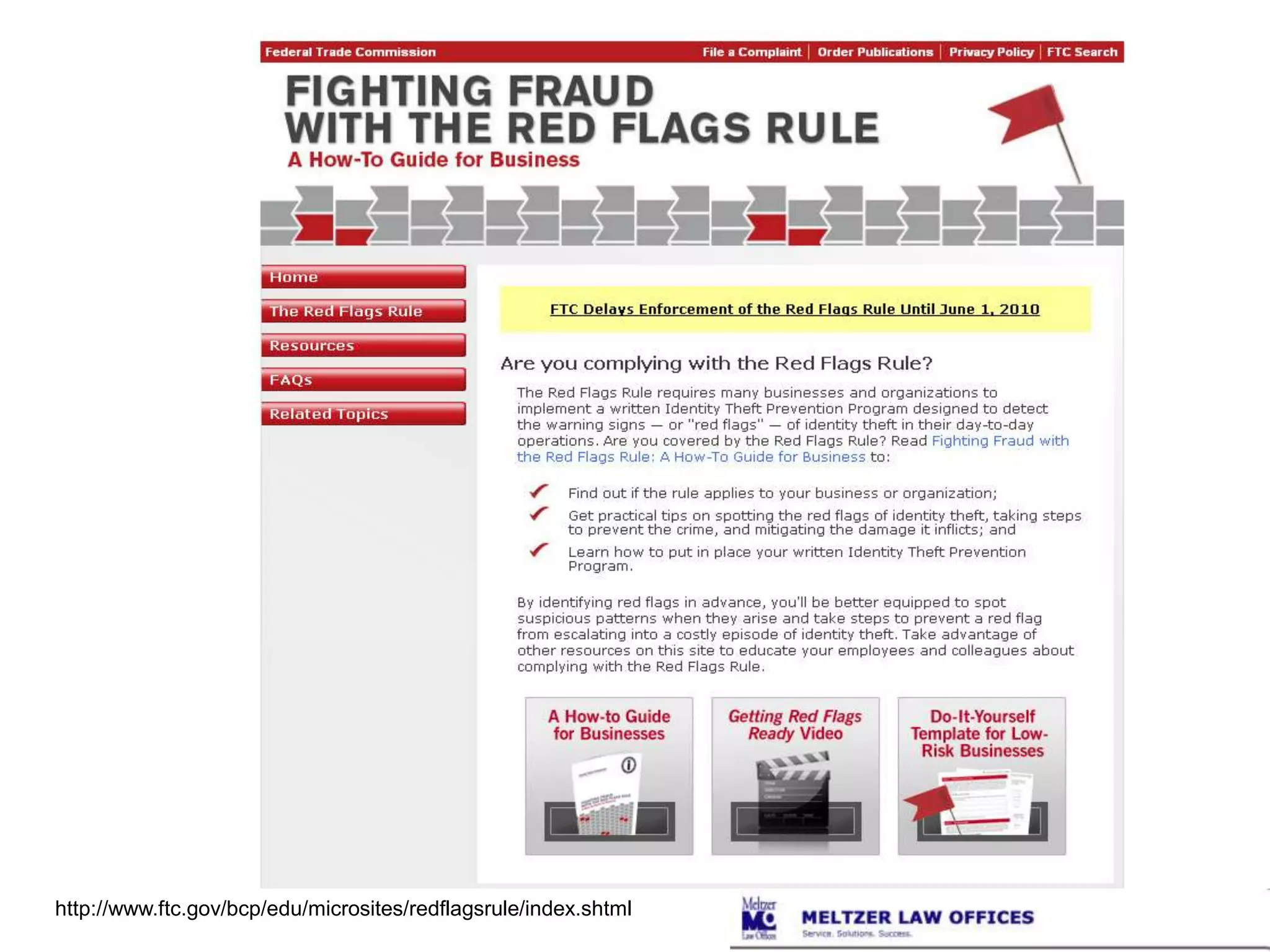
No private right of actionhttp://www.ftc.gov/bcp/edu/microsites/redflagsrule/index.shtml
201 CMR 17.00Massachusetts Data Privacy RegulationsEffective March 1, 2010.
New Mandate:PI = PIPersonal Information = Privacy Infrastructure
Scope of Rules
Scope of RulesCovers ALL PERSONS that own or license personal information about a Massachusetts residentNeed not have operations in MassachusettsFinancial institutions, health care and other regulated entities not exempt
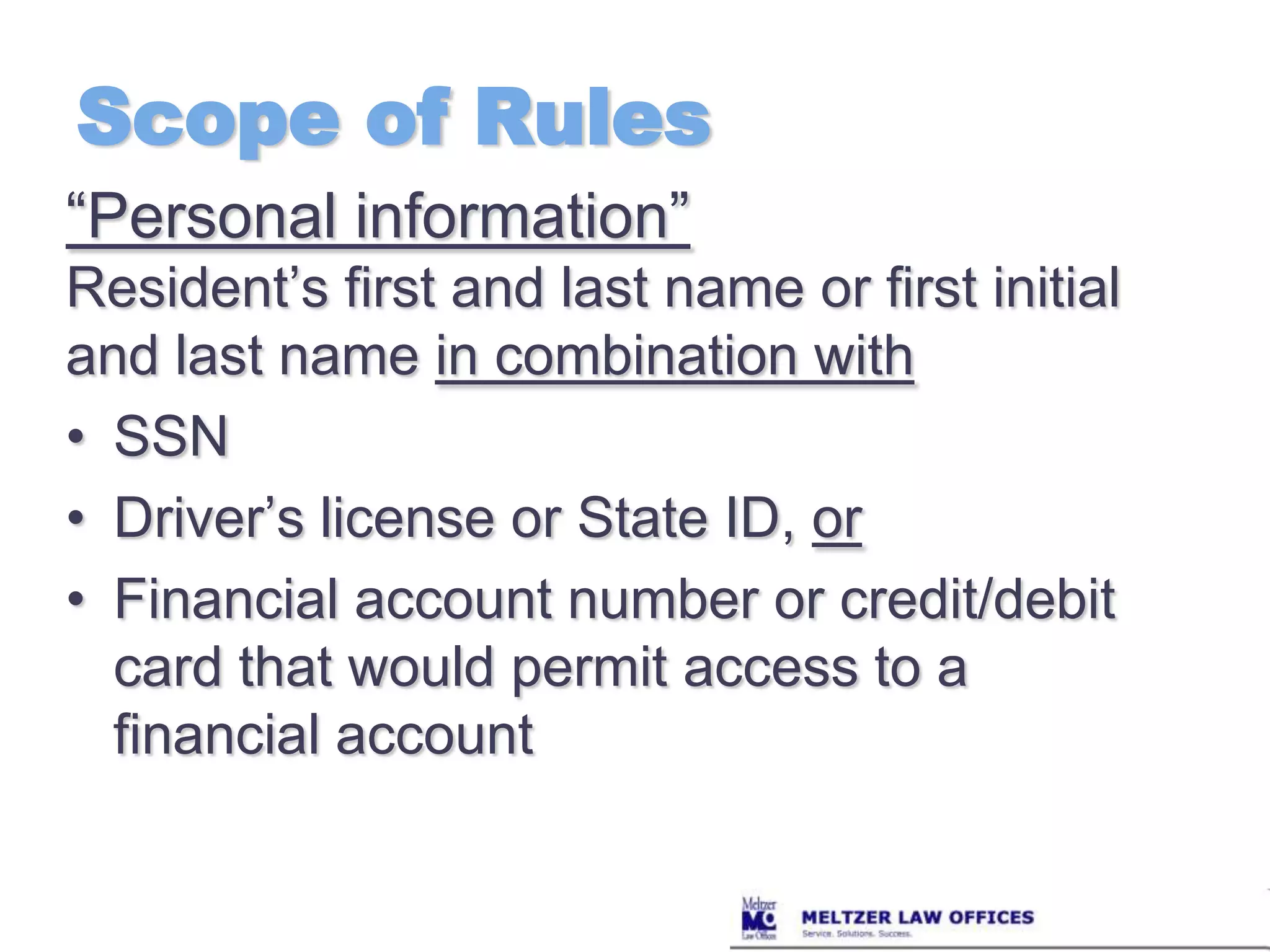
Scope of Rules“Personal information”Resident’s first and last name or first initial and last name in combination withSSNDriver’s license or State ID, orFinancial account number or credit/debit card that would permit access to a financial account
Three Requirements1.Develop, implement, maintain and maintain a comprehensive, written information security program that meets very specific requirements (cWISP)2.Heightened information security meeting specific computer information security requirements3.Vendor Compliance	(Phase-in)
Evaluating Compliance(not Evaluating Applicability)AppropriateSize of businessScope of businessType of businessResources availableAmount of data storedNeed for security and confidentialityConsumer and employee information
Evaluating Compliance(not Evaluating Applicability)“The safeguards contained in such program must be consistent with the safeguards for protection of personal information and information of a similar character set forth in any state or federal regulations by which the person who owns or licenses such information may be regulated.”
EnforcementLitigation and enforcement by the Massachusetts Attorney GeneralMassachusetts law requires notice to Attorney General of any breach, in addition to affected consumersAttorney General likely to investigate based on breach reportsNo explicit private right of action or penalties
Comprehensive WrittenInformation SecurityProgram201 CMR 17.03
Information SecurityProgram“[D]evelop, implement, and maintain a comprehensive information security program that is written in one or more readily accessible parts and contains administrative, technical, and physical safeguards”
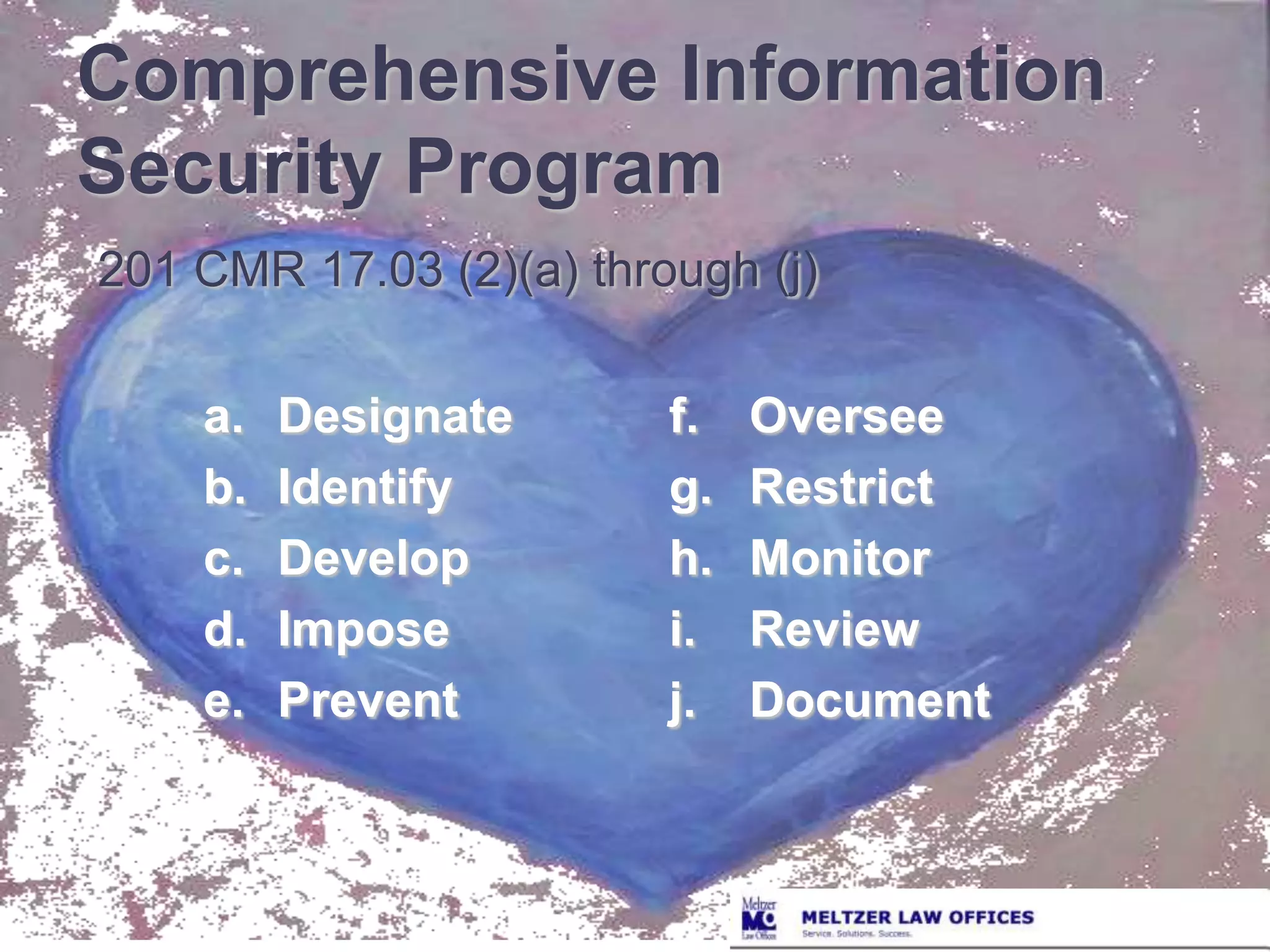
Comprehensive Information Security Program201 CMR 17.03 (2)(a) through (j)a.	Designateb.	Identifyc.	Developd.	Imposee.	PreventOverseeRestrictMonitorReviewDocument
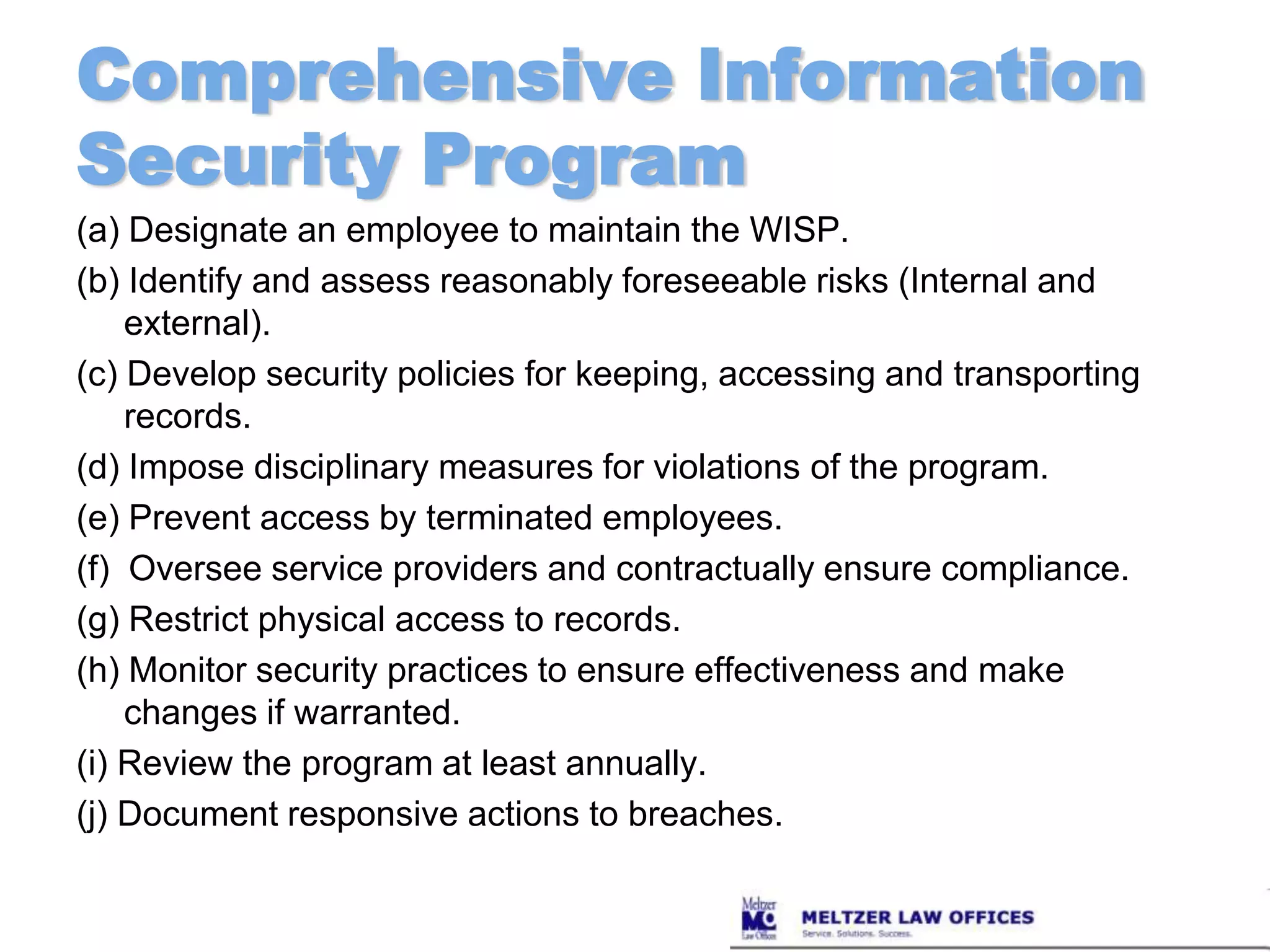
Comprehensive Information Security Program(a) Designate an employee to maintain the WISP.(b) Identify and assess reasonably foreseeable risks (Internal and external).(c) Develop security policies for keeping, accessing and transporting records.(d) Impose disciplinary measures for violations of the program.(e) Prevent access by terminated employees.(f)  Oversee service providers and contractually ensure compliance.(g) Restrict physical access to records.(h) Monitor security practices to ensure effectiveness and make changes if warranted.(i) Review the program at least annually.(j) Document responsive actions to breaches.
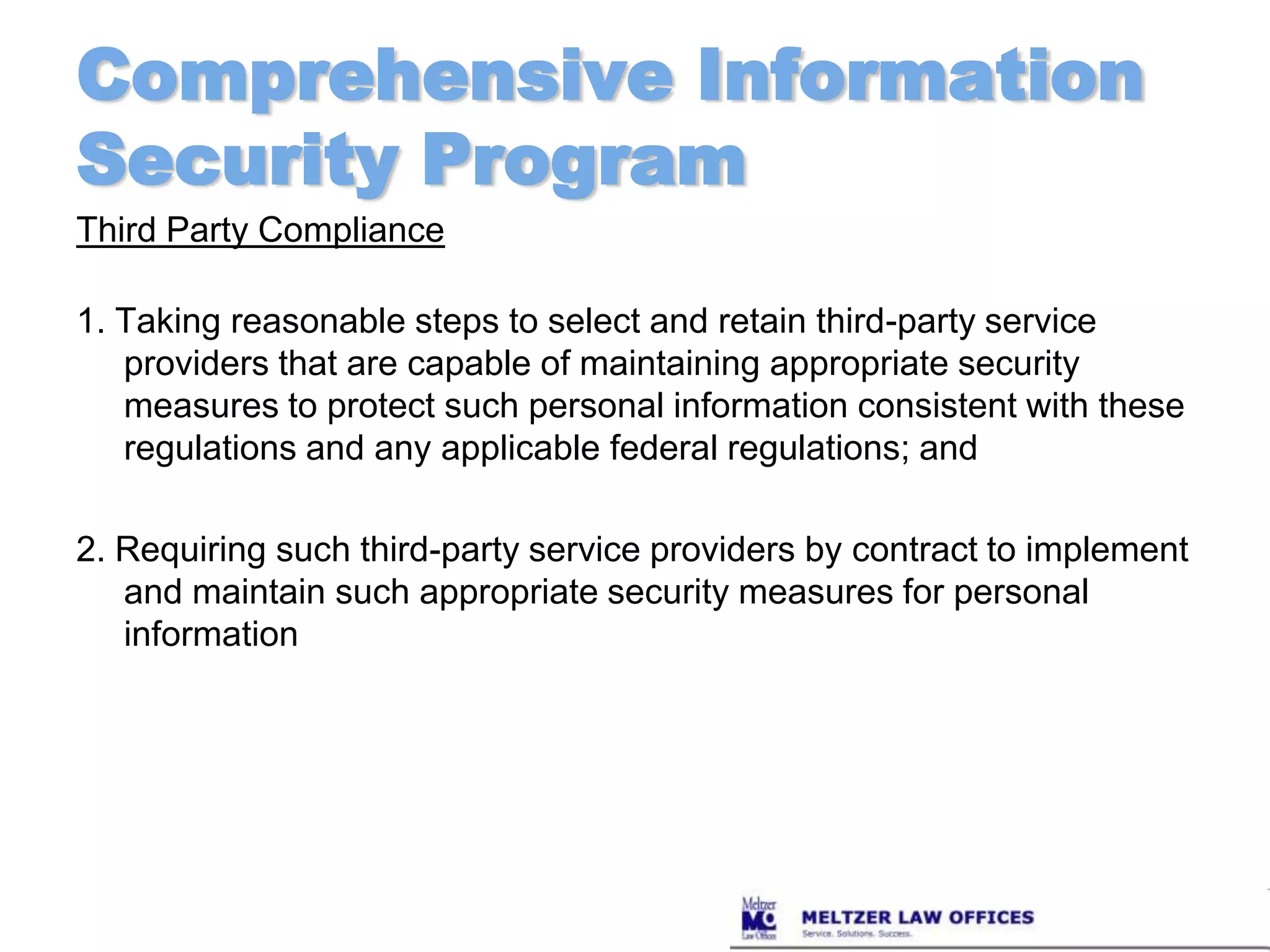
Comprehensive Information Security ProgramThird Party Compliance1. Taking reasonable steps to select and retain third-party service providers that are capable of maintaining appropriate security measures to protect such personal information consistent with these regulations and any applicable federal regulations; and 2. Requiring such third-party service providers by contract to implement and maintain such appropriate security measures for personal information
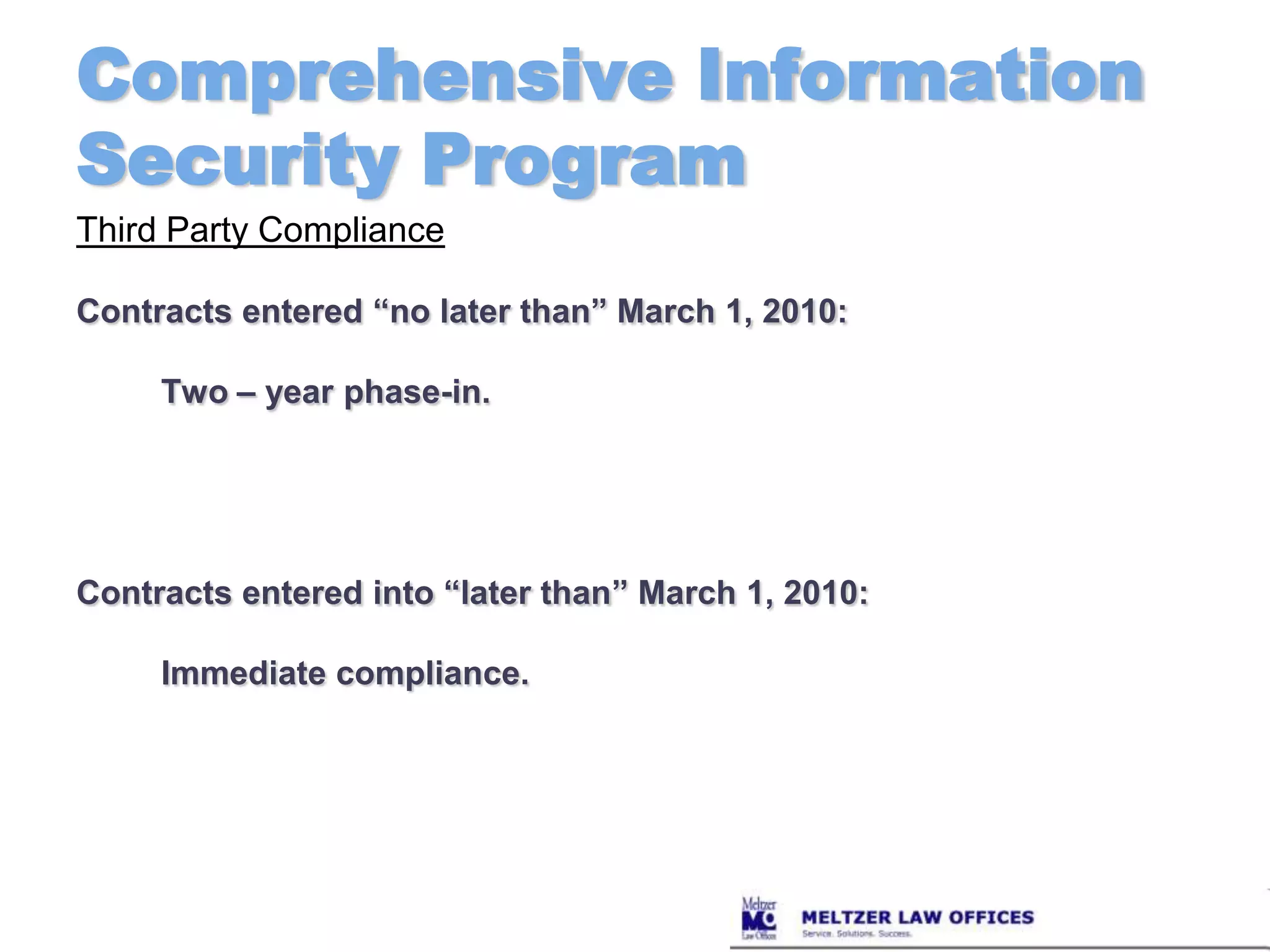
Comprehensive Information Security ProgramThird Party ComplianceContracts entered “no later than” March 1, 2010:	Two – year phase-in.Contracts entered into “later than” March 1, 2010:	Immediate compliance.
Comprehensive Information Security Program“INDUSTRY STANDARDS”
Breach ReportingG.L. c. 93H § 3
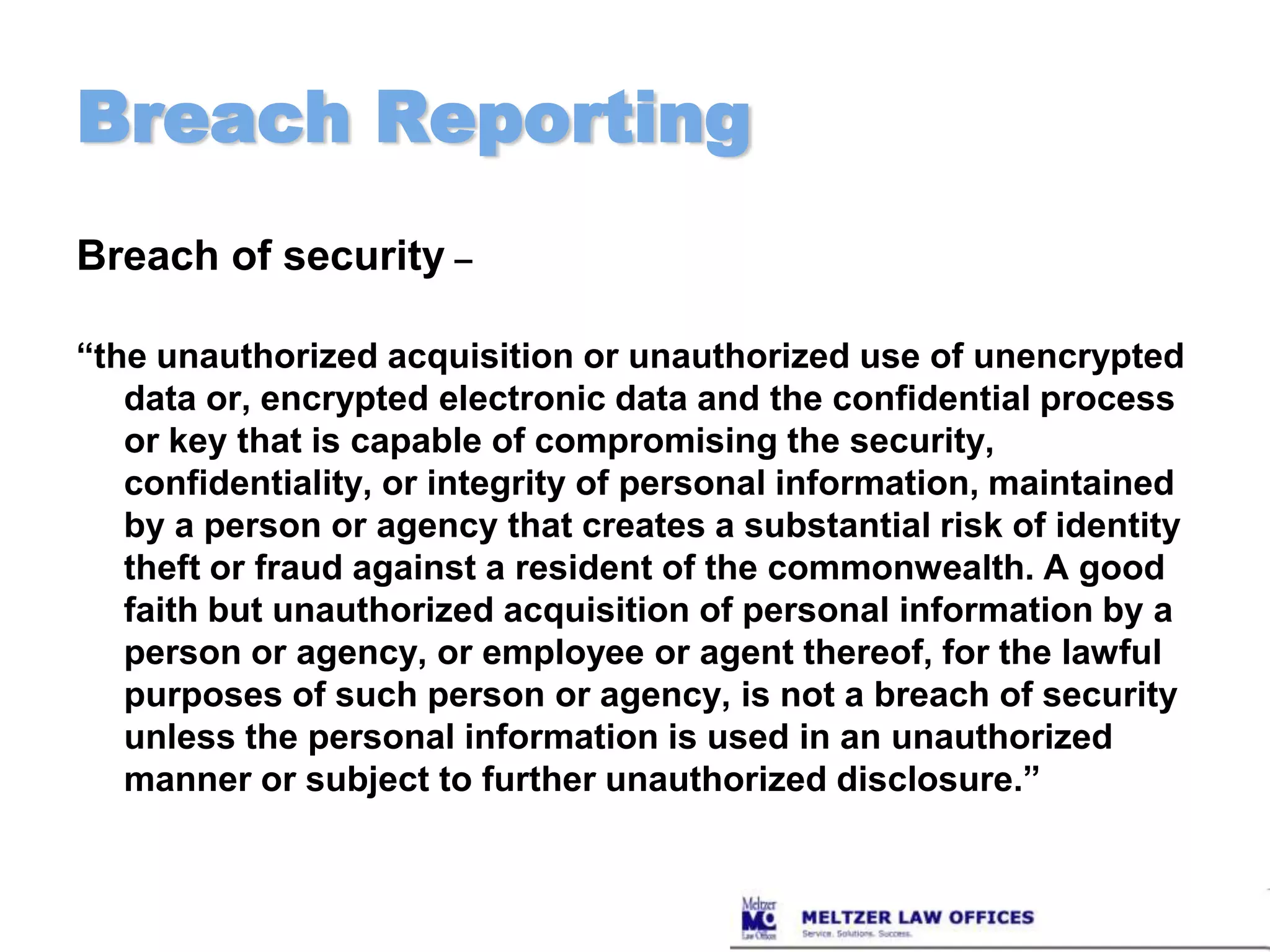
Breach ReportingBreach of security –“the unauthorized acquisition or unauthorized use of unencrypted data or, encrypted electronic data and the confidential process or key that is capable of compromising the security, confidentiality, or integrity of personal information, maintained by a person or agency that creates a substantial risk of identity theft or fraud against a resident of the commonwealth. A good faith but unauthorized acquisition of personal information by a person or agency, or employee or agent thereof, for the lawful purposes of such person or agency, is not a breach of security unless the personal information is used in an unauthorized manner or subject to further unauthorized disclosure.”
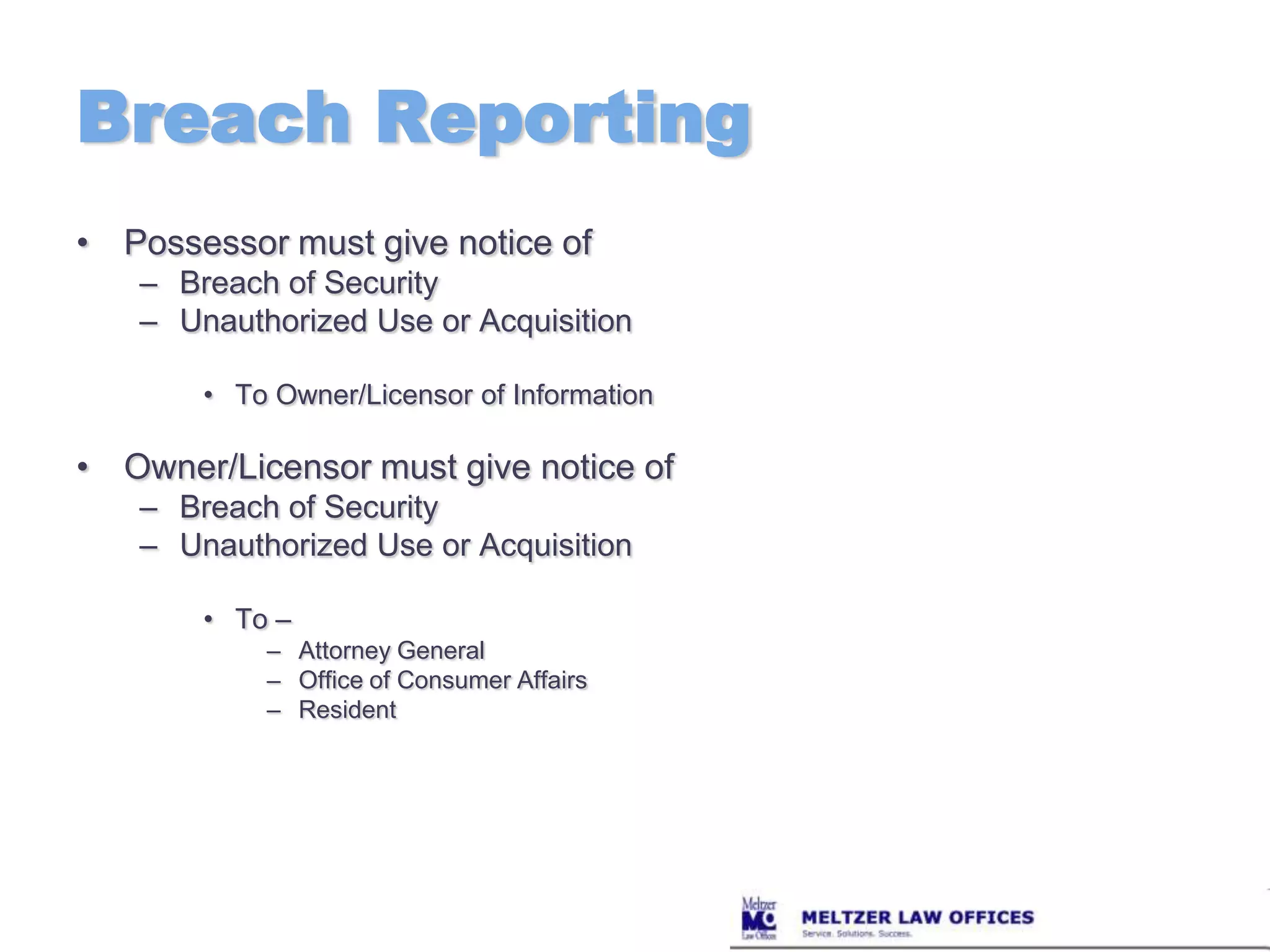
Breach ReportingPossessor must give notice ofBreach of SecurityUnauthorized Use or AcquisitionTo Owner/Licensor of InformationOwner/Licensor must give notice of Breach of SecurityUnauthorized Use or AcquisitionTo – Attorney GeneralOffice of Consumer AffairsResident
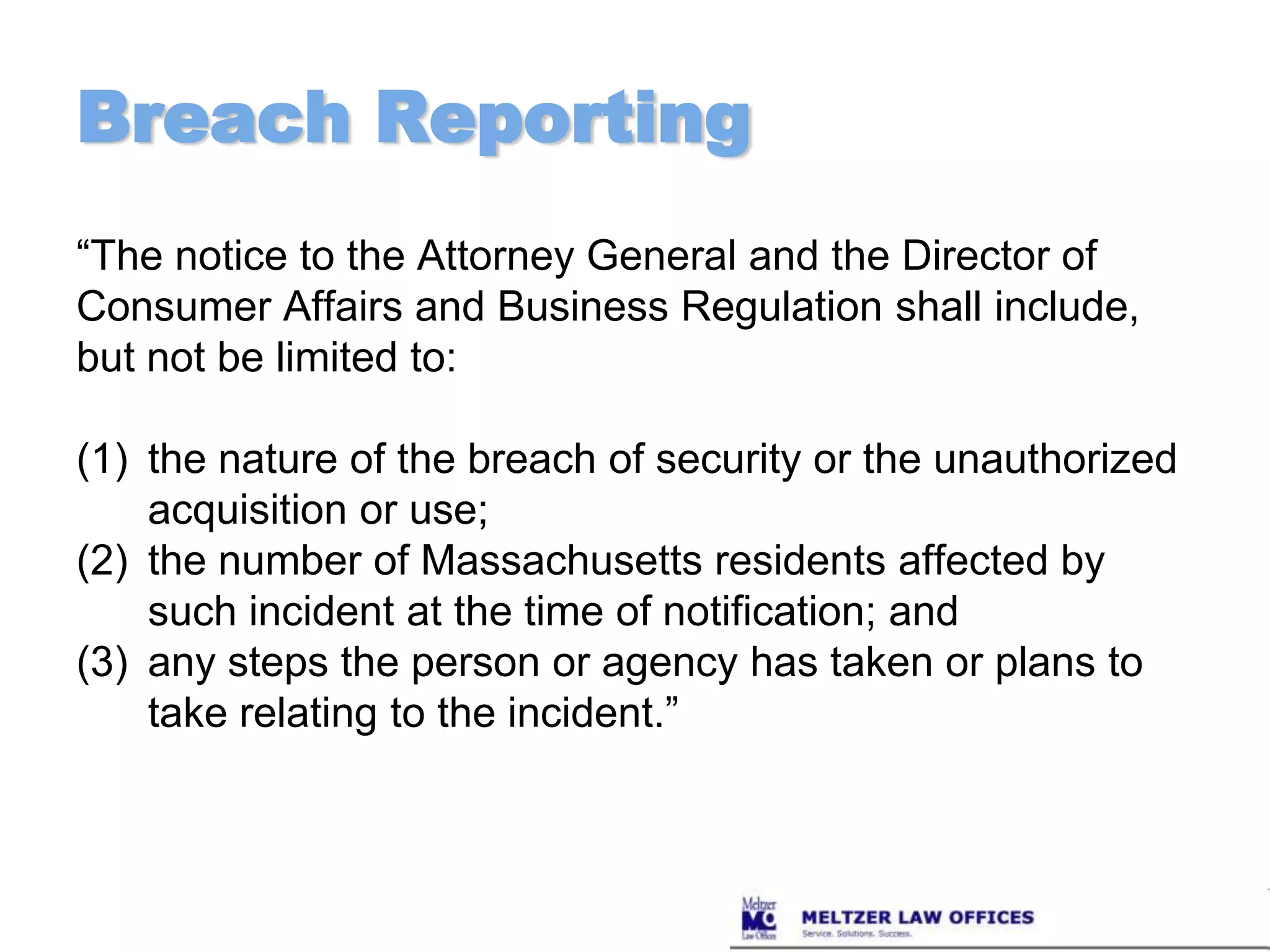
Breach Reporting“The notice to the Attorney General and the Director of Consumer Affairs and Business Regulation shall include, but not be limited to: the nature of the breach of security or the unauthorized acquisition or use; the number of Massachusetts residents affected by such incident at the time of notification; and any steps the person or agency has taken or plans to take relating to the incident.”
Sample Breach Notification Letterhttp://www.mass.gov/Cago/docs/Consumer/93h_sampleletter_ago.pdf
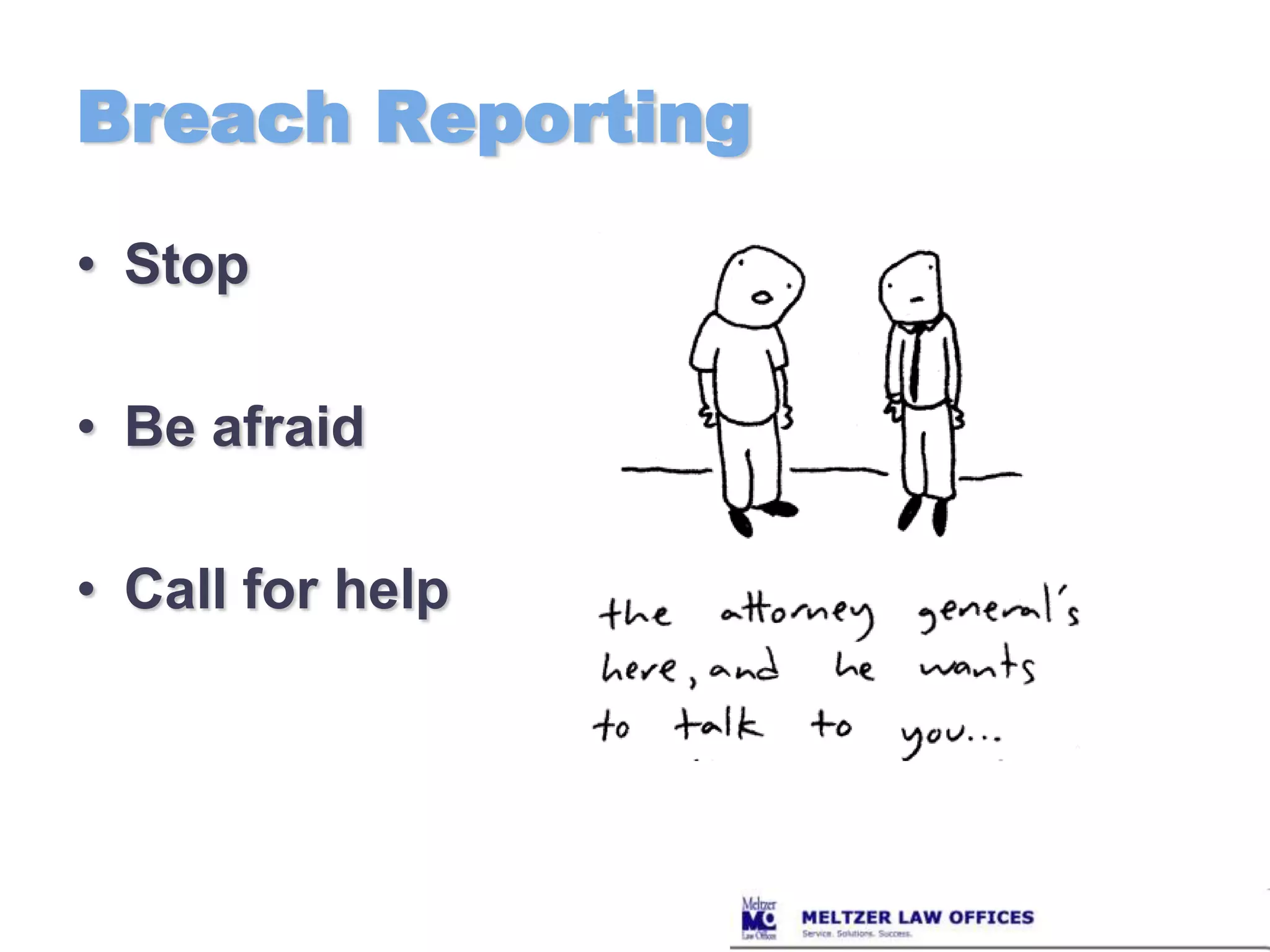
Breach ReportingStopBe afraidCall for help
Computer System SecurityRequirements201 CMR 17.04
Electronic Requirements201 CMR 17.04Laptop and mobile device encryption
Security patches and firewalls
System security agents
IT Security user awarenessUse authentication protocolsSecure access controlsEncryption of transmittable recordsMentoring systems
User Authentication ProtocolsControl of user IDsSecure password selectionSecure or encrypted password filesUser accounts blocked for unusual logon attemptsExamples:  Passwords should be at least 9 characters, alpha numeric with special charactersAfter 3 attempts to login users are blocked access
Secure Access Control MeasuresPermit “access” on a need to know basisPassword protect account and login to determine level of accessExample:  Network Access Control Software/Hardware 	Consentry	SophosAudit control who is accessing what and when?
Encryption of Transmitted RecordsEncryption of personal information accessed over a public networkTunneling options (VPN)Faxes, VOIP, phone callsEncryption of PI on wirelessBluetooth, WEP, WifiEncryption definition if very broadExamples:PGP and Utimaco are encryption technologies
Monitoring of SystemsRequire systems to detect unauthorized use of, access to personal informationSome existing user account based on systems will already complyExamples:Again, Network Access ControlAudit controls
Laptop and Mobile Device EncryptionEncryption of PI stored on laptopsApplies regardless of laptop locationEncryption of PI stored on “mobile” devicesDoes incoming email become a problem?This applies only if you have data in motion of personal information.Email is clear text.  So anyone can read any ones email on the internet.
Security Patches and Firewalls“Reasonably up-to-date firewall protection and operating systems patches” for Internet connected computersDate on operating systemsAll organizations should have a firewall in place (not a router a firewall)Can hire an organization to update and manage the security infrastructure:	Firewall	Anti-virus	Patches…
Systems Security Agent SoftwareMalware is what is infecting most enviroments.  HTTP and HTTPS traffic.Your users are your worst enemyProducts to look at for MalwareTrendMicroWebsenseWebwasherAnti-malware technology requiredAre certain products better?What about MACs or Linux?Set to receive auto-updates
Employee Education and IT Security TrainingProper training on all IT security policiesUser awarenessImportance of PI securityProper use of  the computerEveryone is involvedYour employees are your weakest link to any IT security program.They need to know the rules.Suggestions:	Stand up training	News Letters	Programs	Online training
The ApproachInventory type of personal information is being keptAssess riskPlan information security strategyDataSecurity, Confidentially, IntegrityIT infrastructure and information change processesImplement, plan and policiesTechnology deploymentPolicy implementation User awarenessContinual reviewSecurity is all about vigilance…Compliance is knowing what you need to protect and building a fortress around it and testing it on a frequent basis!
Data DestructionG.L. c. 93I
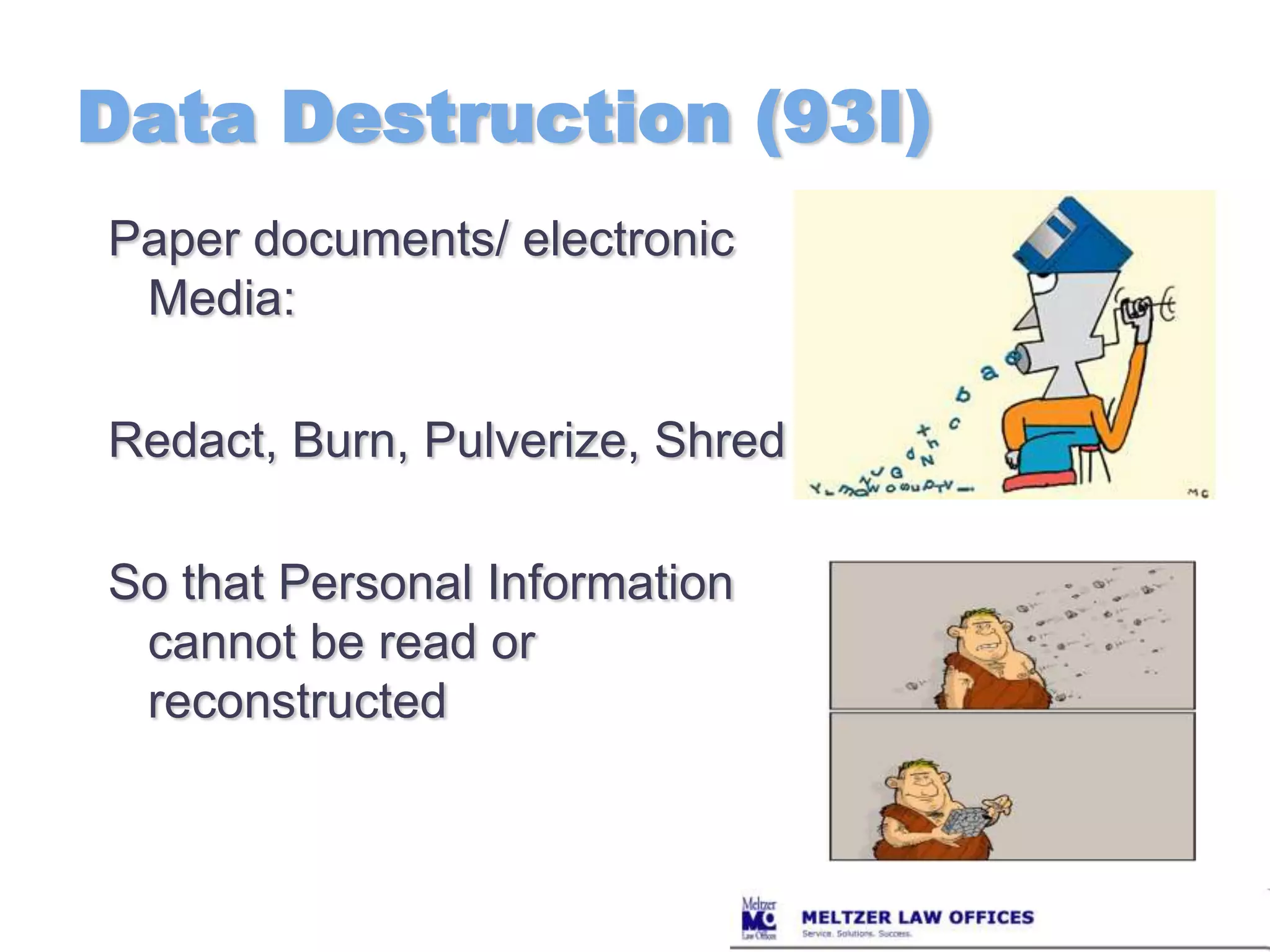
Data Destruction (93I)Paper documents/ electronic Media: Redact, Burn, Pulverize, ShredSo that Personal Information cannot be read or reconstructed

Privacy update 04.29.2010

  • 1.
    Privacy Law Update:Red Flags, HITECH & the New Massachusetts Data Privacy RegulationsStephen E. Meltzer, Esquire, CIPP
  • 2.
  • 3.
    HIPAA, ARRA andHITECHRed Flags201 CMR 17.00
  • 5.
  • 7.
    HIPAA, ARRA &HITECHHealth Insurance Portability & Accountability Act of 1996Not HIPPA (Health Insurance Portability Prevention Act)American Recovery & Reinvestment ActHealth Information Technology for Economic and Clinical Health
  • 8.
    HITECH RequirementsExpands thedefinitions of “business associates.” Mandates that HIPAA security standards that apply to health plans and health care providers will also apply directly to business associates.Establishes new security breach notice requirements.Entitles individuals to electronic copies of health information. Calls for regulations regarding the sale of electronic health records and protected health information by mid-August, 2010.
  • 9.
    Business Associates“Business associates”are persons and organizations (typically subcontractors) that perform activities involving the use or disclosure of individually identifiable health information, such as claims processing, data analysis, quality assurance, billing, and benefit management, as well as those who provide legal, accounting, or administrative functions. 45 CFR §160.103. The HITECH Act adds as “business associates” organizations that transmit protected health information and require access on a routine basis to such information. See 42 USC §17938.
  • 10.
    Business AssociatesSubject tothe administrative, physical, and technical security requirements of HIPAA, must implement appropriate policies and procedures, and must document their security activities. Penalties for violating these HIPAA procedures will apply to business associates, just as they now do to health plans and health care providers. 42 USC §17931.
  • 11.
    Breach Notificationa healthplan or health care provider that accesses, maintains, retains, modifies, records, stores, destroys, or otherwise holds, uses, or discloses unsecured protected health information and discovers a breach of the information to notify each individual whose health information has been, or is reasonably believed to have been, accessed, acquired, or disclosed as a result of the breach. 42 USC §17932(a). Business associates will also be required to give notice of such a data breach to the health plan or health care provider, and will need to identify each individual whose unsecured protected health information was illegally accessed, acquired, or disclosed. 42 USC §17932(b). The health plan, health care provider, or business associate will be required to give notice of the breach without unreasonable delay, and no later than 60 calendar days after its discovery. 42 USC §17932(d). Notice must be provided by first-class mail to individuals at their last known address, or, if specified by the individual, via e-mail. 42 USC §17932(e)(1).
  • 12.
  • 13.
    Individual Patient RightsIndividualsare entitled to copies of their health information in electronic format from any health plan or health care provider that uses or maintains electronic health records. An individual will be able to direct the health plan or health care provider to transmit the copy directly to anyone he or she designates. Fees for providing this service must not be greater than the entity’s labor costs. 42 USC 17935(e).
  • 14.
    AuthorizationThe HITECH Actwill prohibit a health plan, health care provider, or business associate from receiving payment for an individual’s protected health information without authorization from the individual. 42 USC §17935(d).
  • 15.
    New PenaltiesIncreased CivilPenaltiesARRA creates the following "tiers" of penalties:A violation without knowledge of the violation - $100 per violation, with an annual maximum amount of $25,000 in penalties.A violation that is due to reasonable cause - $1,000 per violation, with an annual maximum amount of $100,000 in penalties.A violation that is due to willful neglect - $10,000 per violation, with an annual maximum amount of $1,500,000 in penalties.
  • 16.
    New EnforcementState AttorneysGeneral now have the authority to file suit in federal court against any person or entity that is accused of violating HIPAA in a manner that the Attorney General has reason to believe adversely affected any resident of that Attorney General's respective state.
  • 17.
  • 18.
    Red Flags –Who Must Comply?The Red Flags Rules apply to “financial institutions” and “creditors” with “covered accounts.”
  • 19.
    Red Flags –Financial InstitutionsState or national bank, a state or federal savings and loan association, a mutual savings bank, a state or federal credit union, or any other entity that holds a “transaction account” belonging to a consumer. Most of these institutions are regulated by the Federal bank regulatory agencies and the NCUA. Financial institutions under the FTC’s jurisdiction include state-chartered credit unions and certain other entities that hold consumer transaction accounts.
  • 20.
    Red Flags –Transaction AccountA transaction account is a deposit or other account from which the owner makes payments or transfers. Transaction accounts include checking accounts, negotiable order of withdrawal accounts, savings deposits subject to automatic transfers, and share draft accounts.
  • 21.
    Red Flags -CreditorAny entity that regularly extends, renews, or continues credit; any entity that regularly arranges for the extension, renewal, or continuation of credit; or any assignee of an original creditor who is involved in the decision to extend, renew, or continue credit. Accepting credit cards as a form of payment does not in and of itself make an entity a creditor. Creditors include finance companies, automobile dealers, mortgage brokers, utility companies, and telecommunications companies. Where non-profit and government entities defer payment for goods or services, they, too, are to be considered creditors. 
  • 22.
    Red Flags –Covered AccountAn account used mostly for personal, family, or household purposes, and that involves multiple payments or transactions. Covered accounts include credit card accounts, mortgage loans, automobile loans, margin accounts, cell phone accounts, utility accounts, checking accounts, and savings accounts. A covered account is also an account for which there is a foreseeable risk of identity theft – for example, small business or sole proprietorship accounts
  • 23.
    Red Flags –Exempt?Only LawyersFTC has filed a Notice of Appeal Judge Walton is reported to have questioned whether the term could be interpreted so broadly as to render a plumber who bills a customer after performing his work a "creditor" within the meaning of the Rule.CPA’s have filed a lawsuit
  • 24.
    Red Flags -RequirementsDevelop a written program that identifies and detects the relevant warning signs – or “red flags” – of identity theft. These may include, for example, unusual account activity, fraud alerts on a consumer report, or attempted use of suspicious account application documents. The program must also describe appropriate responses that would prevent and mitigate the crime and detail a plan to update the program. The program must be managed by the Board of Directors or senior employees of the financial institution or creditor, include appropriate staff training, and provide for oversight of any service providers.
  • 25.
    Red Flags –Requirements – suggested “Starting Points”alerts, notifications, or warnings from a consumer reporting agency;suspicious documents;suspicious personally identifying information, such as a suspicious address;unusual use of – or suspicious activity relating to – a covered account; andnotices from customers, victims of identity theft, law enforcement authorities, or other businesses about possible identity theft in connection with covered accounts.
  • 26.
    Red Flags -Penalties$3,500 per violation
  • 27.
    No private rightof actionhttp://www.ftc.gov/bcp/edu/microsites/redflagsrule/index.shtml
  • 28.
    201 CMR 17.00MassachusettsData Privacy RegulationsEffective March 1, 2010.
  • 29.
    New Mandate:PI =PIPersonal Information = Privacy Infrastructure
  • 31.
  • 32.
    Scope of RulesCoversALL PERSONS that own or license personal information about a Massachusetts residentNeed not have operations in MassachusettsFinancial institutions, health care and other regulated entities not exempt
  • 33.
    Scope of Rules“Personalinformation”Resident’s first and last name or first initial and last name in combination withSSNDriver’s license or State ID, orFinancial account number or credit/debit card that would permit access to a financial account
  • 34.
    Three Requirements1.Develop, implement,maintain and maintain a comprehensive, written information security program that meets very specific requirements (cWISP)2.Heightened information security meeting specific computer information security requirements3.Vendor Compliance (Phase-in)
  • 35.
    Evaluating Compliance(not EvaluatingApplicability)AppropriateSize of businessScope of businessType of businessResources availableAmount of data storedNeed for security and confidentialityConsumer and employee information
  • 36.
    Evaluating Compliance(not EvaluatingApplicability)“The safeguards contained in such program must be consistent with the safeguards for protection of personal information and information of a similar character set forth in any state or federal regulations by which the person who owns or licenses such information may be regulated.”
  • 37.
    EnforcementLitigation and enforcementby the Massachusetts Attorney GeneralMassachusetts law requires notice to Attorney General of any breach, in addition to affected consumersAttorney General likely to investigate based on breach reportsNo explicit private right of action or penalties
  • 38.
  • 39.
    Information SecurityProgram“[D]evelop, implement,and maintain a comprehensive information security program that is written in one or more readily accessible parts and contains administrative, technical, and physical safeguards”
  • 40.
    Comprehensive Information SecurityProgram201 CMR 17.03 (2)(a) through (j)a. Designateb. Identifyc. Developd. Imposee. PreventOverseeRestrictMonitorReviewDocument
  • 41.
    Comprehensive Information SecurityProgram(a) Designate an employee to maintain the WISP.(b) Identify and assess reasonably foreseeable risks (Internal and external).(c) Develop security policies for keeping, accessing and transporting records.(d) Impose disciplinary measures for violations of the program.(e) Prevent access by terminated employees.(f) Oversee service providers and contractually ensure compliance.(g) Restrict physical access to records.(h) Monitor security practices to ensure effectiveness and make changes if warranted.(i) Review the program at least annually.(j) Document responsive actions to breaches.
  • 42.
    Comprehensive Information SecurityProgramThird Party Compliance1. Taking reasonable steps to select and retain third-party service providers that are capable of maintaining appropriate security measures to protect such personal information consistent with these regulations and any applicable federal regulations; and 2. Requiring such third-party service providers by contract to implement and maintain such appropriate security measures for personal information
  • 43.
    Comprehensive Information SecurityProgramThird Party ComplianceContracts entered “no later than” March 1, 2010: Two – year phase-in.Contracts entered into “later than” March 1, 2010: Immediate compliance.
  • 44.
    Comprehensive Information SecurityProgram“INDUSTRY STANDARDS”
  • 45.
  • 46.
    Breach ReportingBreach ofsecurity –“the unauthorized acquisition or unauthorized use of unencrypted data or, encrypted electronic data and the confidential process or key that is capable of compromising the security, confidentiality, or integrity of personal information, maintained by a person or agency that creates a substantial risk of identity theft or fraud against a resident of the commonwealth. A good faith but unauthorized acquisition of personal information by a person or agency, or employee or agent thereof, for the lawful purposes of such person or agency, is not a breach of security unless the personal information is used in an unauthorized manner or subject to further unauthorized disclosure.”
  • 47.
    Breach ReportingPossessor mustgive notice ofBreach of SecurityUnauthorized Use or AcquisitionTo Owner/Licensor of InformationOwner/Licensor must give notice of Breach of SecurityUnauthorized Use or AcquisitionTo – Attorney GeneralOffice of Consumer AffairsResident
  • 48.
    Breach Reporting“The noticeto the Attorney General and the Director of Consumer Affairs and Business Regulation shall include, but not be limited to: the nature of the breach of security or the unauthorized acquisition or use; the number of Massachusetts residents affected by such incident at the time of notification; and any steps the person or agency has taken or plans to take relating to the incident.”
  • 49.
    Sample Breach NotificationLetterhttp://www.mass.gov/Cago/docs/Consumer/93h_sampleletter_ago.pdf
  • 50.
  • 51.
  • 52.
    Electronic Requirements201 CMR17.04Laptop and mobile device encryption
  • 53.
  • 54.
  • 55.
    IT Security userawarenessUse authentication protocolsSecure access controlsEncryption of transmittable recordsMentoring systems
  • 56.
    User Authentication ProtocolsControlof user IDsSecure password selectionSecure or encrypted password filesUser accounts blocked for unusual logon attemptsExamples: Passwords should be at least 9 characters, alpha numeric with special charactersAfter 3 attempts to login users are blocked access
  • 57.
    Secure Access ControlMeasuresPermit “access” on a need to know basisPassword protect account and login to determine level of accessExample: Network Access Control Software/Hardware Consentry SophosAudit control who is accessing what and when?
  • 58.
    Encryption of TransmittedRecordsEncryption of personal information accessed over a public networkTunneling options (VPN)Faxes, VOIP, phone callsEncryption of PI on wirelessBluetooth, WEP, WifiEncryption definition if very broadExamples:PGP and Utimaco are encryption technologies
  • 59.
    Monitoring of SystemsRequiresystems to detect unauthorized use of, access to personal informationSome existing user account based on systems will already complyExamples:Again, Network Access ControlAudit controls
  • 60.
    Laptop and MobileDevice EncryptionEncryption of PI stored on laptopsApplies regardless of laptop locationEncryption of PI stored on “mobile” devicesDoes incoming email become a problem?This applies only if you have data in motion of personal information.Email is clear text. So anyone can read any ones email on the internet.
  • 61.
    Security Patches andFirewalls“Reasonably up-to-date firewall protection and operating systems patches” for Internet connected computersDate on operating systemsAll organizations should have a firewall in place (not a router a firewall)Can hire an organization to update and manage the security infrastructure: Firewall Anti-virus Patches…
  • 62.
    Systems Security AgentSoftwareMalware is what is infecting most enviroments. HTTP and HTTPS traffic.Your users are your worst enemyProducts to look at for MalwareTrendMicroWebsenseWebwasherAnti-malware technology requiredAre certain products better?What about MACs or Linux?Set to receive auto-updates
  • 63.
    Employee Education andIT Security TrainingProper training on all IT security policiesUser awarenessImportance of PI securityProper use of the computerEveryone is involvedYour employees are your weakest link to any IT security program.They need to know the rules.Suggestions: Stand up training News Letters Programs Online training
  • 64.
    The ApproachInventory typeof personal information is being keptAssess riskPlan information security strategyDataSecurity, Confidentially, IntegrityIT infrastructure and information change processesImplement, plan and policiesTechnology deploymentPolicy implementation User awarenessContinual reviewSecurity is all about vigilance…Compliance is knowing what you need to protect and building a fortress around it and testing it on a frequent basis!
  • 65.
  • 66.
    Data Destruction (93I)Paperdocuments/ electronic Media: Redact, Burn, Pulverize, ShredSo that Personal Information cannot be read or reconstructed
  • 67.
    Data Destruction (93I)Violations:Attorney General: Unfair and Deceptive Practices remedies - 93HCivil Fine-$100/data subject not to exceed $50,000/instance – 93I
  • 68.
  • 69.
    Thank YouMeltzer LawOfficeshttp://www.meltzerlaw.com508.872-0000