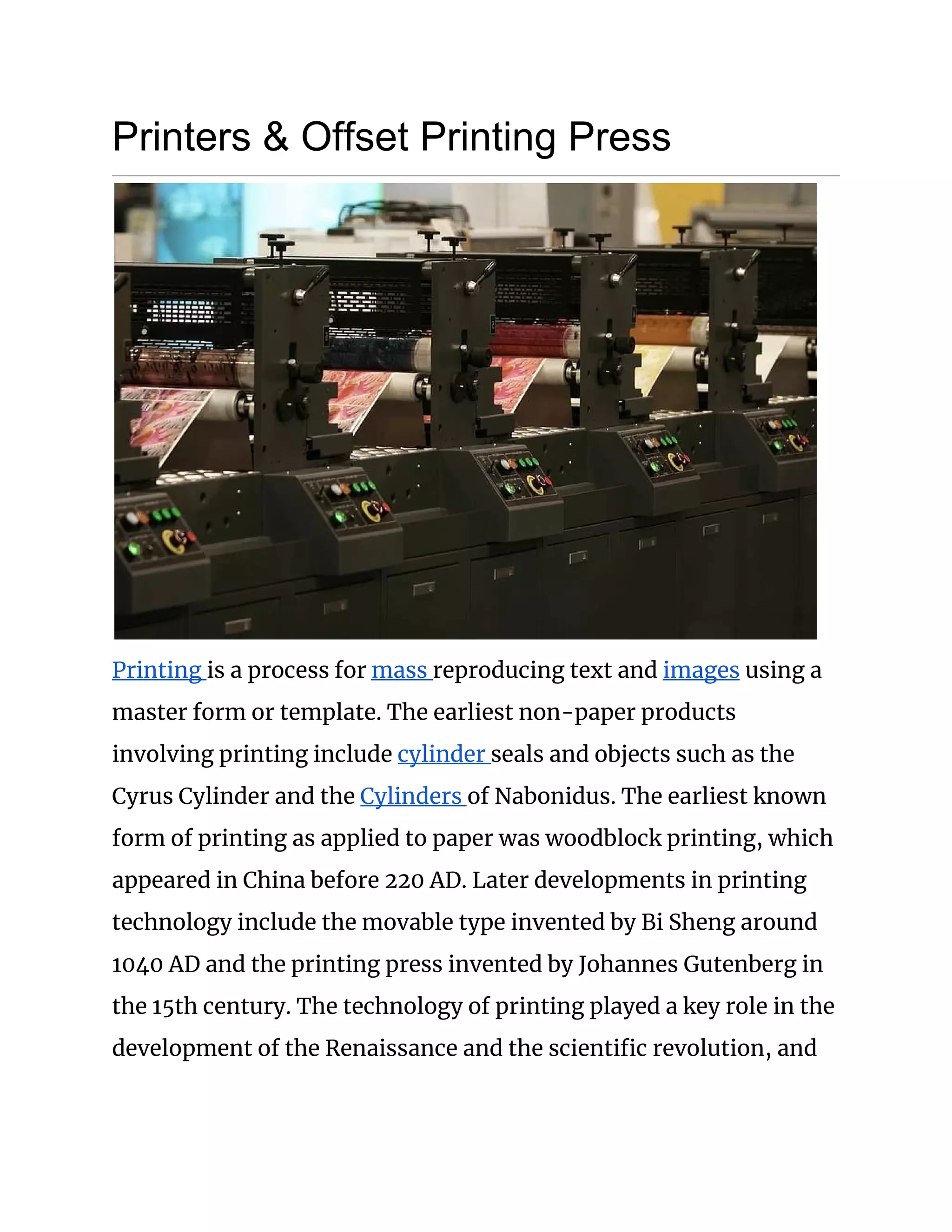
Printers & Offset Printing Press
 
Printing ​is a process for ​mass ​reproducing text and ​images​ using a 
master form or template. The earliest non-paper products 
involving printing include ​cylinder ​seals and objects such as the 
Cyrus Cylinder and the ​Cylinders ​of Nabonidus. The earliest known 
form of printing as applied to paper was woodblock printing, which 
appeared in China before 220 AD. Later developments in printing 
technology include the movable type invented by Bi Sheng around 
1040 AD and the printing press invented by Johannes Gutenberg in 
the 15th century. The technology of printing played a key role in the 
development of the Renaissance and the scientific revolution, and 
laid the ​material ​basis for the modern knowledge-based economy 
and the spread of learning to the masses. 
History 
Woodblock printing 
Woodblock printing is a technique for printing text, images or 
patterns that was used widely throughout East Asia. It originated in 
China in antiquity as a method of printing on textiles and later on 
paper. As a method of printing on cloth, the earliest surviving 
examples from ​China ​date to before 220 A.D. 
AddressBazar.com is an Bangladeshi Online Yellow Page. From here you
will find important and necessary information of various ​Printers and
offset printing press​ related organizations in Bangladesh.
 
In East Asia 
The earliest ​surviving ​woodblock printed fragments are from China. 
They are of silk printed with flowers in three colours from the Han 
Dynasty (before 220 A.D.). They are the earliest example of 
woodblock printing on paper and appeared in the mid-seventh 
century in China. 
By the ninth century, printing on paper had taken off, and the first 
extant complete printed book containing its date is the Diamond 
Sutra (British Library) of 868. By the tenth century, 400,000 copies 
of some sutras and pictures were printed, and the Confucian 
classics were in print. A skilled printer could print up to 2,000 
double-page sheets per day. 
 
Printing ​spread early to Korea and J​apa​n, w​hich als​o used Chinese 
logograms, but the technique was also used in Turpan and Vietnam 
using a number of other scripts. This technique then spread to 
Persia a​nd Russia. This technique was transmitted to Europe via the 
Islamic world, and by around 1400 was being used on paper for old 
master prints and playing cards. However, Arabs never used this to 
print the Quran because of the limits imposed by Islamic doctrine. 
In Muslim world 
Block printing, called tarsh in Arabic, developed in Arabic Egypt 
during the ninth and tenth centuries, mostly for prayers and 
amulets. There is some evidence to suggest that these print blocks 
were made from non-wood materials, possibly ​tin​, lead, or clay. 
The techniques employed are uncertain, however, and they appear 
to have had very little influence outside of the Muslim world. 
Though Europe adopted woodblock printing from the Muslim 
world, initially for fabric, the technique of metal block printing 
remained unknown in Europe. Block printing later went out of use 
in Islamic Timurid Renaissance. The Golden Age of Islam saw 
printing of texts, including passages from the Quran and Hadith, 
adopting the Chinese craft of paper making, developed it and 
adopted it immensely in the Islamic world, which led to a 
significant increase in the production of manuscript texts. The 
printing technique in Egypt embraced reproducing texts on paper 
strips and supplying them in different copies to meet the demand. 
In Europe 
Block printing first came to Europe as a method for printing on 
cloth, where it was common by 1300. Images printed on cloth for 
religious purposes could be quite large and elaborate. When paper 
became relatively easily available, around 1400, the technique 
transferred very quickly to small woodcut religious images and 
playing cards printed on paper. These prints were produced in very 
large numbers from about 1425 onward. 
 
Around the mid-fifteenth-century, block-books, woodcut books 
with both text and images, usually carved in the same block, 
emerged as a cheaper alternative to manuscripts and books printed 
with movable type. These were all short heavily illustrated works, 
the bestsellers of the day, repeated in many different block-book 
versions: the Ars moriendi and the Biblia pauperum were the most 
common. There is still some controversy among scholars as to 
whether their introduction preceded or, the majority view, followed 
the introduction of movable type, with the range of estimated dates 
being between about 1440 and 1460. 
Movable-type printing 
 
Movable type is the system of printing and typography using 
movable pieces of metal type, made by casting from matrices struck 
by letter punches. Movable type allowed for much more flexible 
processes than hand copying or block printing. 
Around 1040, the first known movable type system was created in 
China by Bi Sheng out of porcelain. Bi Sheng used clay type, which 
broke easily, but Wang Zhen by 1298 had carved a more durable 
type from wood. He also developed a complex system of revolving 
tables and number-association with written Chinese characters 
that made typesetting and printing more efficient. Still, the main 
method in use there remained woodblock printing (xylography), 
which "proved to be cheaper and more efficient for printing 
Chinese, with its thousands of characters".  
Copper movable type printing originated in China at the beginning 
of the 12th century. It was used in large-scale printing of paper 
money issued by the Northern Song dynasty. Movable type spread 
to Korea during the Goryeo dynasty. 
Around 1230, Koreans invented a metal type movable printing using 
bronze. The Jikji, published in 1377, is the earliest known metal 
printed book. Type-casting was used, adapted from the method of 
casting coins. The character was cut in beech wood, which was then 
pressed into a soft clay to form a mould, and bronze poured into the 
mould, and finally the type was polished, The Korean form of metal 
movable type was described by the French scholar Henri-Jean 
Martin as "extremely similar to Gutenberg's", 
The printing press 
Around 1450, Johannes Gutenberg introduced the first movable 
type printing system in Europe. He advanced innovations in casting 
type based on a matrix and hand mould, adaptations to the 
screw-press, the use of an oil-based ink, and the creation of a 
softer and more absorbent paper. Gutenberg was the first to create 
his type pieces from an alloy of lead, tin, antimony, copper and 
bismuth – the same components still used today. Johannes 
Gutenberg started work on his printing press around 1436, in 
partnership with Andreas Dritzehen – whom he had previously 
instructed in gem-cutting – and Andreas Heilmann, the owner of a 
paper mill. 
 
Compared to woodblock printing, movable type page setting and 
printing using a press was faster and more durable. Also, the metal 
type pieces were sturdier and the lettering more uniform, leading to 
typography and fonts. The high quality and relatively low price of 
the Gutenberg Bible (1455) established the superiority of movable 
type for Western languages. The printing press rapidly spread 
across Europe, leading up to the Renaissance, and later all around 
the world. 
Gutenberg's innovations in movable type printing have been called 
the most important invention of the second millennium. 
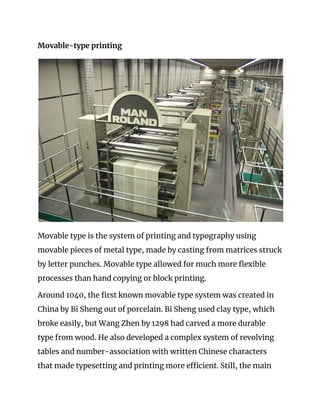
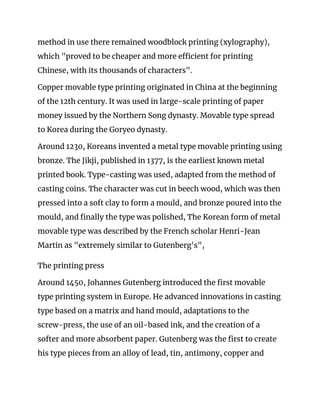
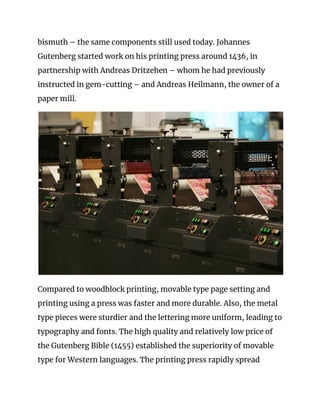
Rotary printing press 
The rotary printing press was invented by Richard March Hoe in 
1843. It uses impressions curved around a cylinder to print on long 
continuous rolls of paper or other substrates. Rotary drum printing 
was later significantly improved by William Bullock. There are 
multiple types of rotary printing press technologies that are still 
used today: sheetfed offset, rotogravure, and flexographic printing. 
 

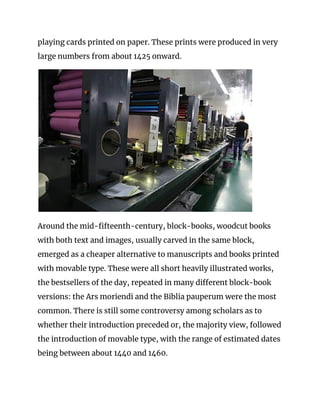
Printers & offset printing press

  • 1.
    Printers & OffsetPrinting Press   Printing ​is a process for ​mass ​reproducing text and ​images​ using a  master form or template. The earliest non-paper products  involving printing include ​cylinder ​seals and objects such as the  Cyrus Cylinder and the ​Cylinders ​of Nabonidus. The earliest known  form of printing as applied to paper was woodblock printing, which  appeared in China before 220 AD. Later developments in printing  technology include the movable type invented by Bi Sheng around  1040 AD and the printing press invented by Johannes Gutenberg in  the 15th century. The technology of printing played a key role in the  development of the Renaissance and the scientific revolution, and 
  • 2.
    laid the ​material​basis for the modern knowledge-based economy  and the spread of learning to the masses.  History  Woodblock printing  Woodblock printing is a technique for printing text, images or  patterns that was used widely throughout East Asia. It originated in  China in antiquity as a method of printing on textiles and later on  paper. As a method of printing on cloth, the earliest surviving  examples from ​China ​date to before 220 A.D.  AddressBazar.com is an Bangladeshi Online Yellow Page. From here you will find important and necessary information of various ​Printers and offset printing press​ related organizations in Bangladesh.   In East Asia  The earliest ​surviving ​woodblock printed fragments are from China.  They are of silk printed with flowers in three colours from the Han  Dynasty (before 220 A.D.). They are the earliest example of  woodblock printing on paper and appeared in the mid-seventh  century in China.  By the ninth century, printing on paper had taken off, and the first  extant complete printed book containing its date is the Diamond 
  • 3.
    Sutra (British Library)of 868. By the tenth century, 400,000 copies  of some sutras and pictures were printed, and the Confucian  classics were in print. A skilled printer could print up to 2,000  double-page sheets per day.    Printing ​spread early to Korea and J​apa​n, w​hich als​o used Chinese  logograms, but the technique was also used in Turpan and Vietnam  using a number of other scripts. This technique then spread to  Persia a​nd Russia. This technique was transmitted to Europe via the  Islamic world, and by around 1400 was being used on paper for old  master prints and playing cards. However, Arabs never used this to  print the Quran because of the limits imposed by Islamic doctrine. 
  • 4.
    In Muslim world  Blockprinting, called tarsh in Arabic, developed in Arabic Egypt  during the ninth and tenth centuries, mostly for prayers and  amulets. There is some evidence to suggest that these print blocks  were made from non-wood materials, possibly ​tin​, lead, or clay.  The techniques employed are uncertain, however, and they appear  to have had very little influence outside of the Muslim world.  Though Europe adopted woodblock printing from the Muslim  world, initially for fabric, the technique of metal block printing  remained unknown in Europe. Block printing later went out of use  in Islamic Timurid Renaissance. The Golden Age of Islam saw  printing of texts, including passages from the Quran and Hadith,  adopting the Chinese craft of paper making, developed it and  adopted it immensely in the Islamic world, which led to a  significant increase in the production of manuscript texts. The  printing technique in Egypt embraced reproducing texts on paper  strips and supplying them in different copies to meet the demand.  In Europe  Block printing first came to Europe as a method for printing on  cloth, where it was common by 1300. Images printed on cloth for  religious purposes could be quite large and elaborate. When paper  became relatively easily available, around 1400, the technique  transferred very quickly to small woodcut religious images and 
  • 5.
    playing cards printedon paper. These prints were produced in very  large numbers from about 1425 onward.    Around the mid-fifteenth-century, block-books, woodcut books  with both text and images, usually carved in the same block,  emerged as a cheaper alternative to manuscripts and books printed  with movable type. These were all short heavily illustrated works,  the bestsellers of the day, repeated in many different block-book  versions: the Ars moriendi and the Biblia pauperum were the most  common. There is still some controversy among scholars as to  whether their introduction preceded or, the majority view, followed  the introduction of movable type, with the range of estimated dates  being between about 1440 and 1460. 
  • 6.
    Movable-type printing    Movable typeis the system of printing and typography using  movable pieces of metal type, made by casting from matrices struck  by letter punches. Movable type allowed for much more flexible  processes than hand copying or block printing.  Around 1040, the first known movable type system was created in  China by Bi Sheng out of porcelain. Bi Sheng used clay type, which  broke easily, but Wang Zhen by 1298 had carved a more durable  type from wood. He also developed a complex system of revolving  tables and number-association with written Chinese characters  that made typesetting and printing more efficient. Still, the main 
  • 7.
    method in usethere remained woodblock printing (xylography),  which "proved to be cheaper and more efficient for printing  Chinese, with its thousands of characters".   Copper movable type printing originated in China at the beginning  of the 12th century. It was used in large-scale printing of paper  money issued by the Northern Song dynasty. Movable type spread  to Korea during the Goryeo dynasty.  Around 1230, Koreans invented a metal type movable printing using  bronze. The Jikji, published in 1377, is the earliest known metal  printed book. Type-casting was used, adapted from the method of  casting coins. The character was cut in beech wood, which was then  pressed into a soft clay to form a mould, and bronze poured into the  mould, and finally the type was polished, The Korean form of metal  movable type was described by the French scholar Henri-Jean  Martin as "extremely similar to Gutenberg's",  The printing press  Around 1450, Johannes Gutenberg introduced the first movable  type printing system in Europe. He advanced innovations in casting  type based on a matrix and hand mould, adaptations to the  screw-press, the use of an oil-based ink, and the creation of a  softer and more absorbent paper. Gutenberg was the first to create  his type pieces from an alloy of lead, tin, antimony, copper and 
  • 8.
    bismuth – thesame components still used today. Johannes  Gutenberg started work on his printing press around 1436, in  partnership with Andreas Dritzehen – whom he had previously  instructed in gem-cutting – and Andreas Heilmann, the owner of a  paper mill.    Compared to woodblock printing, movable type page setting and  printing using a press was faster and more durable. Also, the metal  type pieces were sturdier and the lettering more uniform, leading to  typography and fonts. The high quality and relatively low price of  the Gutenberg Bible (1455) established the superiority of movable  type for Western languages. The printing press rapidly spread 
  • 9.
    across Europe, leadingup to the Renaissance, and later all around  the world.  Gutenberg's innovations in movable type printing have been called  the most important invention of the second millennium.  Rotary printing press  The rotary printing press was invented by Richard March Hoe in  1843. It uses impressions curved around a cylinder to print on long  continuous rolls of paper or other substrates. Rotary drum printing  was later significantly improved by William Bullock. There are  multiple types of rotary printing press technologies that are still  used today: sheetfed offset, rotogravure, and flexographic printing.