05/18/15 1
Print Archiving
Tim Cote
05/18/15 2
Vision Statement
P A V E S
Print Archives Validate Electronic Serials
To achieve a network of support, through
libraries and dealers to develop a solution to
the preservation of printed material.
05/18/15 3
Goal and Objective
Make clear the importance of Print Archives
Develop innovative strategies for purposeful Print
Archives
Become a remarkable business within the industry
Gain support cooperatively to establish a template
for archiving printed material
05/18/15 4
Today’s Situation
In 2009 the price of Print-only Subscriptions
increased by and average of 10.2%, while the
Online-only journals decreased by 10.7%(1)
Access to electronic archives eliminates the need
for costly storage of print archives.
Libraries have been forced to cancel subscriptions
due to increases in subscription costs and budget
restraints(1)
Library floor space is valuable, has been re-
assigned for new purposes(2)
With technology advancing, students have begun
the transition to electronic media.
The availability of electronic resources may
weaken the necessity of the library(3)
05/18/15 5
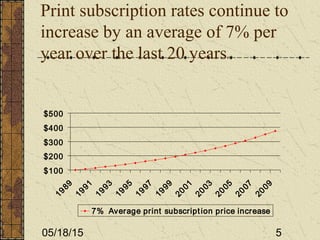
Print subscription rates continue to
increase by an average of 7% per
year over the last 20 years(1)
$100
$200
$300
$400
$500
1989
1991
1993
1995
1997
1999
2001
2003
2005
2007
2009
7% Average print subscription price increase
05/18/15 6
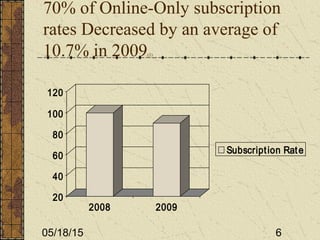
70% of Online-Only subscription
rates Decreased by an average of
10.7% in 2009(1)
20
40
60
80
100
120
2008 2009
Subscription Rate
05/18/15 7
How Did We Get Here?
The digital age has forged a need for instant information
Cost effectiveness has become a focus with both private
and public budgets
Radio, television and the Internet have made information
easy to access.
Libraries have always been typically cautious to change,
hesitancy to adapt to the evolving technology has lessened
the necessity of the library(3)
Libraries have already begun to build print archive storage
facilities, though network partnerships at centralized
access points. This has been a cost effective way to access
material through shared finances.(4)
05/18/15 8
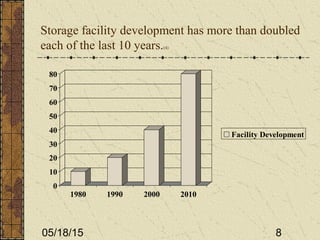
Storage facility development has more than doubled
each of the last 10 years.(4)
0
10
20
30
40
50
60
70
80
1980 1990 2000 2010
Facility Development
05/18/15 9
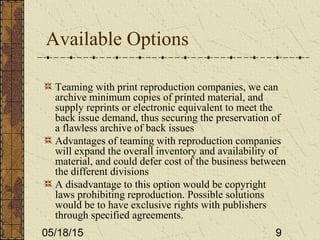
Available Options
Teaming with print reproduction companies, we can
archive minimum copies of printed material, and
supply reprints or electronic equivalent to meet the
back issue demand, thus securing the preservation of
a flawless archive of back issues
Advantages of teaming with reproduction companies
will expand the overall inventory and availability of
material, and could defer cost of the business between
the different divisions
A disadvantage to this option would be copyright
laws prohibiting reproduction. Possible solutions
would be to have exclusive rights with publishers
through specified agreements.
05/18/15 10
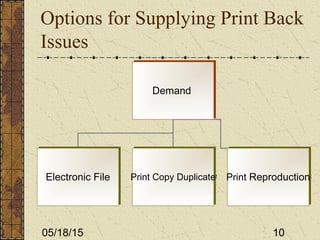
Options for Supplying Print Back
Issues
DemandDemand
Electronic FileElectronic File Print Copy DuplicatePrint Copy Duplicate Print ReproductionPrint Reproduction
05/18/15 11
Additional Options
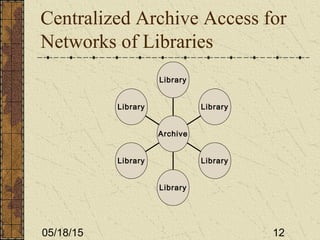
Strategic centralized locations of consolidated library
archives with shared access throughout an assigned
network
Advantages of centralized archives provides networks of
libraries with local access to archives, could be easier to
store wide assortments of materials across several storage
facilities
A disadvantage of centralized archives is the material
ownership within the library network. Libraries gain
accreditation in part because of “their” collections. A
possible solution would be to keep 1 copy of a publication
for each library in the network, giving each library an
ownership claim on the material
05/18/15 12
Centralized Archive Access for
Networks of Libraries
Library
Library
Library
Library
Library
Library
Archive
05/18/15 13
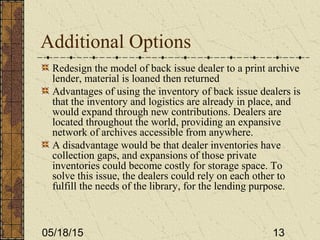
Additional Options
Redesign the model of back issue dealer to a print archive
lender, material is loaned then returned
Advantages of using the inventory of back issue dealers is
that the inventory and logistics are already in place, and
would expand through new contributions. Dealers are
located throughout the world, providing an expansive
network of archives accessible from anywhere.
A disadvantage would be that dealer inventories have
collection gaps, and expansions of those private
inventories could become costly for storage space. To
solve this issue, the dealers could rely on each other to
fulfill the needs of the library, for the lending purpose.
05/18/15 14
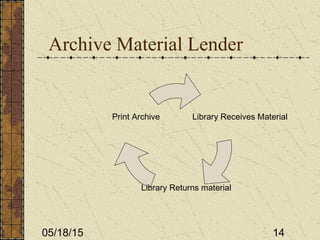
Archive Material Lender
Library Receives Material
Library Returns material
Print Archive
05/18/15 15
Recommendation
Further research into our competitors business practices
can help us develop new innovative strategies.
Becoming unique in the industry is imperative to ensure
the business thrives in the face of a changing industry
We must continue to pursue Archiving possibilities with
Library networks.
We should contact “built” Repositories to gain useful
information on how we can either assist the operation or
help develop new Repositories.
05/18/15 16
Further Recommendations
Contacting current clients to gain useful
information about how we can service them better.
This can be done with a survey inserted with
current orders, or through our customer service
representatives.
Understanding our clients needs and future will
allow us to redefine our mission to meet those
needs.
For the short term, to maximize profits, I propose
the implementation of referral benefits, and
customer specific bonuses.
05/18/15 17
Continued Recommendations
Current shipments can include a bonus code for
future order discounts, For example 1-4-20 as a
coupon code meaning a one time 20% discount
Inserting a Referral coupon in existing orders, for
that client to save on a future order if they refer a
new client to order from our stock, the client who
was referred could also receive a bonus incentive
on their first order.
Having existing orders work as a sales tool is a
cost effective resource not yet implemented
05/18/15 18
References
1. Mike Peine, Manager of Business Analytics, Allen Press, Inc. “2009 Study of
Subscription Prices for Scholarly Society Journals; Society Journal Pricing Trends and
Industry Overview.
http://allenpress.com/system/files/pdfs/library/ap_journal_pricing_study_2009.pdf
2. Roger C. Schonfeld, Manager of research, Ithaka. “Getting from Here to There,
Safely; Library Strategic Planning for the Transition Away from Print Journals” Article
published in “The Serials Librarian” Volume 52 Issue ½, 2007
3.James Michalko, Constance Malpas, and Arnold Arcolio. “Research Libraries, Risk
and Systemic Change” OCLC Research, March 10, 2010.
http://www.oclc.org/research/publications/library/2010/2010-03.pdf
4. Lizanne Payne, Print Archives Program Manager. CRL. Power Point Presentation
“CRL Collaborative Print Archives Framework, April 2010”
http://www.crl.edu/sites/default/files/attachments/pages/payne%20CRL
%202010%20April%20rev.pdf

PrintArchivingFinalDraft[1]

  • 1.
  • 2.
    05/18/15 2 Vision Statement PA V E S Print Archives Validate Electronic Serials To achieve a network of support, through libraries and dealers to develop a solution to the preservation of printed material.
  • 3.
    05/18/15 3 Goal andObjective Make clear the importance of Print Archives Develop innovative strategies for purposeful Print Archives Become a remarkable business within the industry Gain support cooperatively to establish a template for archiving printed material
  • 4.
    05/18/15 4 Today’s Situation In2009 the price of Print-only Subscriptions increased by and average of 10.2%, while the Online-only journals decreased by 10.7%(1) Access to electronic archives eliminates the need for costly storage of print archives. Libraries have been forced to cancel subscriptions due to increases in subscription costs and budget restraints(1) Library floor space is valuable, has been re- assigned for new purposes(2) With technology advancing, students have begun the transition to electronic media. The availability of electronic resources may weaken the necessity of the library(3)
  • 5.
    05/18/15 5 Print subscriptionrates continue to increase by an average of 7% per year over the last 20 years(1) $100 $200 $300 $400 $500 1989 1991 1993 1995 1997 1999 2001 2003 2005 2007 2009 7% Average print subscription price increase
  • 6.
    05/18/15 6 70% ofOnline-Only subscription rates Decreased by an average of 10.7% in 2009(1) 20 40 60 80 100 120 2008 2009 Subscription Rate
  • 7.
    05/18/15 7 How DidWe Get Here? The digital age has forged a need for instant information Cost effectiveness has become a focus with both private and public budgets Radio, television and the Internet have made information easy to access. Libraries have always been typically cautious to change, hesitancy to adapt to the evolving technology has lessened the necessity of the library(3) Libraries have already begun to build print archive storage facilities, though network partnerships at centralized access points. This has been a cost effective way to access material through shared finances.(4)
  • 8.
    05/18/15 8 Storage facilitydevelopment has more than doubled each of the last 10 years.(4) 0 10 20 30 40 50 60 70 80 1980 1990 2000 2010 Facility Development
  • 9.
    05/18/15 9 Available Options Teamingwith print reproduction companies, we can archive minimum copies of printed material, and supply reprints or electronic equivalent to meet the back issue demand, thus securing the preservation of a flawless archive of back issues Advantages of teaming with reproduction companies will expand the overall inventory and availability of material, and could defer cost of the business between the different divisions A disadvantage to this option would be copyright laws prohibiting reproduction. Possible solutions would be to have exclusive rights with publishers through specified agreements.
  • 10.
    05/18/15 10 Options forSupplying Print Back Issues DemandDemand Electronic FileElectronic File Print Copy DuplicatePrint Copy Duplicate Print ReproductionPrint Reproduction
  • 11.
    05/18/15 11 Additional Options Strategiccentralized locations of consolidated library archives with shared access throughout an assigned network Advantages of centralized archives provides networks of libraries with local access to archives, could be easier to store wide assortments of materials across several storage facilities A disadvantage of centralized archives is the material ownership within the library network. Libraries gain accreditation in part because of “their” collections. A possible solution would be to keep 1 copy of a publication for each library in the network, giving each library an ownership claim on the material
  • 12.
    05/18/15 12 Centralized ArchiveAccess for Networks of Libraries Library Library Library Library Library Library Archive
  • 13.
    05/18/15 13 Additional Options Redesignthe model of back issue dealer to a print archive lender, material is loaned then returned Advantages of using the inventory of back issue dealers is that the inventory and logistics are already in place, and would expand through new contributions. Dealers are located throughout the world, providing an expansive network of archives accessible from anywhere. A disadvantage would be that dealer inventories have collection gaps, and expansions of those private inventories could become costly for storage space. To solve this issue, the dealers could rely on each other to fulfill the needs of the library, for the lending purpose.
  • 14.
    05/18/15 14 Archive MaterialLender Library Receives Material Library Returns material Print Archive
  • 15.
    05/18/15 15 Recommendation Further researchinto our competitors business practices can help us develop new innovative strategies. Becoming unique in the industry is imperative to ensure the business thrives in the face of a changing industry We must continue to pursue Archiving possibilities with Library networks. We should contact “built” Repositories to gain useful information on how we can either assist the operation or help develop new Repositories.
  • 16.
    05/18/15 16 Further Recommendations Contactingcurrent clients to gain useful information about how we can service them better. This can be done with a survey inserted with current orders, or through our customer service representatives. Understanding our clients needs and future will allow us to redefine our mission to meet those needs. For the short term, to maximize profits, I propose the implementation of referral benefits, and customer specific bonuses.
  • 17.
    05/18/15 17 Continued Recommendations Currentshipments can include a bonus code for future order discounts, For example 1-4-20 as a coupon code meaning a one time 20% discount Inserting a Referral coupon in existing orders, for that client to save on a future order if they refer a new client to order from our stock, the client who was referred could also receive a bonus incentive on their first order. Having existing orders work as a sales tool is a cost effective resource not yet implemented
  • 18.
    05/18/15 18 References 1. MikePeine, Manager of Business Analytics, Allen Press, Inc. “2009 Study of Subscription Prices for Scholarly Society Journals; Society Journal Pricing Trends and Industry Overview. http://allenpress.com/system/files/pdfs/library/ap_journal_pricing_study_2009.pdf 2. Roger C. Schonfeld, Manager of research, Ithaka. “Getting from Here to There, Safely; Library Strategic Planning for the Transition Away from Print Journals” Article published in “The Serials Librarian” Volume 52 Issue ½, 2007 3.James Michalko, Constance Malpas, and Arnold Arcolio. “Research Libraries, Risk and Systemic Change” OCLC Research, March 10, 2010. http://www.oclc.org/research/publications/library/2010/2010-03.pdf 4. Lizanne Payne, Print Archives Program Manager. CRL. Power Point Presentation “CRL Collaborative Print Archives Framework, April 2010” http://www.crl.edu/sites/default/files/attachments/pages/payne%20CRL %202010%20April%20rev.pdf