POSITIONING
 A market that outlines what a
business should do to market its
product or service to its customer.
 In positioning, the marketing
department creates an image for the
product based in its intended
audience.
WHAT IS POSITIONING?
A manufacturer bag may position his/her
brand as a budget-friendly brand or the
other way around; a restaurant owner may
position his/her business as a provider of
cheap or expensive food.
FOR EXAMPLE:
● Tesla and Audi position themselves
as a luxury status symbol
● Starbucks positions itself as a trusted
source of upscale quality coffee and
beverage
● Mcdonald’s positions itself as a lace
to get quick and cheap meals
Typical examples of marketing
positioning:
1.Positioning by product benefits
- Better targets their customer and create
a unique value proposition
2.Positioning by price
- Pricing is an essential factor that impacts
the decisions of the most customer.
Companies with the lowest-priced products at
a reasonable level of quality usually wins in
many product areas.
POSITIONING STRATEGIES
3.Positioning by quality
- Quality can help rebuff most pricing wars.
In some markets, such as luxury cosmetics or
cars, quality can define who who the
competitors are.
4.Positioning by differentiation
- Differentation is what sets your
product or service apart from the crowd.
If your product or service is dramatically
different, rivals may not pose as much of
a threat.
5. Convenience
- Convenience creates an easier life for
customer. From location to usability,
convenience could incorporate
something like free returns and E-
commerce
6. Customer Service
- Customer service emphasizes
creating helpful and friendly interactions.
This can be especially critical in specific
industries, such as restaurants and E-
commerce.
7. User Group
- This type of positioning targets a
particular group of users and explains
why the company’s offerings are directly
applicable and relevant to this group.
5 Benefits of
Positioning in
Marketing
1. Create a strong competitive position.
- Proper positioning influences how
customers perceive your product or
service relative to the competition
2. Improve Sales
- One of the main goals of any
business is to improve sales and
revenue .
3. Define a clearer target market
- Positioning in marketing allows you
to claim a specific feature or benefit and
focus your product/ services accordingly
so that you appear as an expert in the
services
4. Make more effective decisions
- Once you have the core message that
ensures successful positioning
strategies, you’ll be in a position to
make more effective decisions
throughout the process.
5. Connect to consumer needs
- Through positioning in marketing
have an opportunity to communicate
the critical benefits that their product/
service offers.
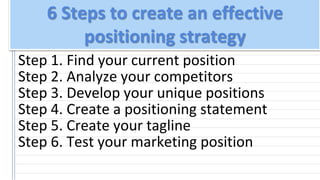
Step 1. Find your current position
Step 2. Analyze your competitors
Step 3. Develop your unique positions
Step 4. Create a positioning statement
Step 5. Create your tagline
Step 6. Test your marketing position
6 Steps to create an effective
positioning strategy
CREDITS: This presentation template was created by
Slidesgo, including icons by Flaticon, and infographics &
images by Freepik.
Thanks
For listening!

Positioning.pptx

  • 1.
  • 2.
     A marketthat outlines what a business should do to market its product or service to its customer.  In positioning, the marketing department creates an image for the product based in its intended audience. WHAT IS POSITIONING?
  • 3.
    A manufacturer bagmay position his/her brand as a budget-friendly brand or the other way around; a restaurant owner may position his/her business as a provider of cheap or expensive food. FOR EXAMPLE:
  • 4.
    ● Tesla andAudi position themselves as a luxury status symbol ● Starbucks positions itself as a trusted source of upscale quality coffee and beverage ● Mcdonald’s positions itself as a lace to get quick and cheap meals Typical examples of marketing positioning:
  • 5.
    1.Positioning by productbenefits - Better targets their customer and create a unique value proposition 2.Positioning by price - Pricing is an essential factor that impacts the decisions of the most customer. Companies with the lowest-priced products at a reasonable level of quality usually wins in many product areas. POSITIONING STRATEGIES
  • 6.
    3.Positioning by quality -Quality can help rebuff most pricing wars. In some markets, such as luxury cosmetics or cars, quality can define who who the competitors are.
  • 7.
    4.Positioning by differentiation -Differentation is what sets your product or service apart from the crowd. If your product or service is dramatically different, rivals may not pose as much of a threat.
  • 8.
    5. Convenience - Conveniencecreates an easier life for customer. From location to usability, convenience could incorporate something like free returns and E- commerce
  • 9.
    6. Customer Service -Customer service emphasizes creating helpful and friendly interactions. This can be especially critical in specific industries, such as restaurants and E- commerce.
  • 10.
    7. User Group -This type of positioning targets a particular group of users and explains why the company’s offerings are directly applicable and relevant to this group.
  • 11.
  • 12.
    1. Create astrong competitive position. - Proper positioning influences how customers perceive your product or service relative to the competition
  • 13.
    2. Improve Sales -One of the main goals of any business is to improve sales and revenue .
  • 14.
    3. Define aclearer target market - Positioning in marketing allows you to claim a specific feature or benefit and focus your product/ services accordingly so that you appear as an expert in the services
  • 15.
    4. Make moreeffective decisions - Once you have the core message that ensures successful positioning strategies, you’ll be in a position to make more effective decisions throughout the process.
  • 16.
    5. Connect toconsumer needs - Through positioning in marketing have an opportunity to communicate the critical benefits that their product/ service offers.
  • 17.
    Step 1. Findyour current position Step 2. Analyze your competitors Step 3. Develop your unique positions Step 4. Create a positioning statement Step 5. Create your tagline Step 6. Test your marketing position 6 Steps to create an effective positioning strategy
  • 18.
    CREDITS: This presentationtemplate was created by Slidesgo, including icons by Flaticon, and infographics & images by Freepik. Thanks For listening!