Principles of
International
Environment Law
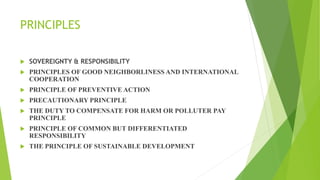
PRINCIPLES
 SOVEREIGNTY & RESPONSIBILITY
 PRINCIPLES OF GOOD NEIGHBORLINESS AND INTERNATIONAL
COOPERATION
 PRINCIPLE OF PREVENTIVE ACTION
 PRECAUTIONARY PRINCIPLE
 THE DUTY TO COMPENSATE FOR HARM OR POLLUTER PAY
PRINCIPLE
 PRINCIPLE OF COMMON BUT DIFFERENTIATED
RESPONSIBILITY
 THE PRINCIPLE OF SUSTAINABLE DEVELOPMENT
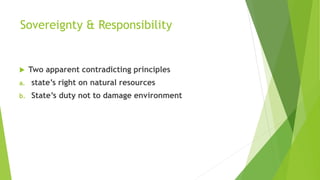
Sovereignty & Responsibility
 Two apparent contradicting principles
a. state’s right on natural resources
b. State’s duty not to damage environment
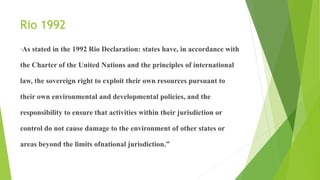
Rio 1992
“As stated in the 1992 Rio Declaration: states have, in accordance with
the Charter of the United Nations and the principles of international
law, the sovereign right to exploit their own resources pursuant to
their own environmental and developmental policies, and the
responsibility to ensure that activities within their jurisdiction or
control do not cause damage to the environment of other states or
areas beyond the limits ofnational jurisdiction.”
Trail Smelter
“There is an obligation of all states to protect the rights of
other states, as elaborated in Trail Smelter, a case which stated
that: under principles of international law. No state has the
right to use or permit the use of territory in such a manner
as to cause injury by fumes in or to the territory of
another of the properties or persons therein, when the case
is of serious consequence and the injury is established by
clear and convincing evidence."
PRINCIPLES OF GOOD NEIGHBORLINESS AND
INTERNATIONAL
COOPERATION
 Based on the application of the maxim sic utere tuo, et
alienum non laedas
 Use your own property in such a way that you do not
injure other people's: a maxim often used in cases of
nuisance.
 Other subprinciples embodied in good neighborliness
and international cooperation are the principles of
prior notification and consultation..
PRINCIPLE OF PREVENTIVE ACTION
 Under this new rule, a state may be under the obligation to
prevent damage within its own jurisdiction
 environmental impact assessmentshave been incorporated as
a decision-making instrument by international organizations
as well as in many conventions .
PRECAUTIONARY PRINCIPLE
 Principle fifteen of the Rio Declaration
 The first treaty to embody this principle is the 1985
Vienna Convention for the Protection of the Ozone Layer
 It states that where there are warnings of serious or
irreversible damage, lack of full scientific certainty shall
not be used as a reason for postponing cost-effective
measures to prevent environmental degradation
THE DUTY TO COMPENSATE FOR HARM OR
POLLUTER PAY PRINCIPLE
 An illegal or wrongful act exists where:
a) conduct consists of an action or omission imputed to a
state under international law; and
b) such conduct constitutes a breach of an international
obligation of the state.
The principles of strict/absolute liability do not apply.
PRINCIPLE OF COMMON BUT DIFFERENTIATED
RESPONSIBILITY
 This principle was acknowledged in the Rio Declaration at
principles four and seven
 This principle includes two constituent elements.
 The first is the common responsibility of states for the
protection of the environment.
 The second element is the elucidation of the different
circumstances of states.
 For example, industrialized countries have contributed more
to the global warming than underdeveloped countries.
THE PRINCIPLE OF SUSTAINABLE DEVELOPMENT
 Sustainable development, as reflected in international
agreements, encompasses three elements-
a. Intergenerational Equity
b. Sustainable Use of Natural Resources.
c. Integration of environment and development

principles under environmental laws.pptx

  • 1.
  • 2.
    PRINCIPLES  SOVEREIGNTY &RESPONSIBILITY  PRINCIPLES OF GOOD NEIGHBORLINESS AND INTERNATIONAL COOPERATION  PRINCIPLE OF PREVENTIVE ACTION  PRECAUTIONARY PRINCIPLE  THE DUTY TO COMPENSATE FOR HARM OR POLLUTER PAY PRINCIPLE  PRINCIPLE OF COMMON BUT DIFFERENTIATED RESPONSIBILITY  THE PRINCIPLE OF SUSTAINABLE DEVELOPMENT
  • 3.
    Sovereignty & Responsibility Two apparent contradicting principles a. state’s right on natural resources b. State’s duty not to damage environment
  • 4.
    Rio 1992 “As statedin the 1992 Rio Declaration: states have, in accordance with the Charter of the United Nations and the principles of international law, the sovereign right to exploit their own resources pursuant to their own environmental and developmental policies, and the responsibility to ensure that activities within their jurisdiction or control do not cause damage to the environment of other states or areas beyond the limits ofnational jurisdiction.”
  • 5.
    Trail Smelter “There isan obligation of all states to protect the rights of other states, as elaborated in Trail Smelter, a case which stated that: under principles of international law. No state has the right to use or permit the use of territory in such a manner as to cause injury by fumes in or to the territory of another of the properties or persons therein, when the case is of serious consequence and the injury is established by clear and convincing evidence."
  • 6.
    PRINCIPLES OF GOODNEIGHBORLINESS AND INTERNATIONAL COOPERATION  Based on the application of the maxim sic utere tuo, et alienum non laedas  Use your own property in such a way that you do not injure other people's: a maxim often used in cases of nuisance.  Other subprinciples embodied in good neighborliness and international cooperation are the principles of prior notification and consultation..
  • 7.
    PRINCIPLE OF PREVENTIVEACTION  Under this new rule, a state may be under the obligation to prevent damage within its own jurisdiction  environmental impact assessmentshave been incorporated as a decision-making instrument by international organizations as well as in many conventions .
  • 8.
    PRECAUTIONARY PRINCIPLE  Principlefifteen of the Rio Declaration  The first treaty to embody this principle is the 1985 Vienna Convention for the Protection of the Ozone Layer  It states that where there are warnings of serious or irreversible damage, lack of full scientific certainty shall not be used as a reason for postponing cost-effective measures to prevent environmental degradation
  • 9.
    THE DUTY TOCOMPENSATE FOR HARM OR POLLUTER PAY PRINCIPLE  An illegal or wrongful act exists where: a) conduct consists of an action or omission imputed to a state under international law; and b) such conduct constitutes a breach of an international obligation of the state. The principles of strict/absolute liability do not apply.
  • 10.
    PRINCIPLE OF COMMONBUT DIFFERENTIATED RESPONSIBILITY  This principle was acknowledged in the Rio Declaration at principles four and seven  This principle includes two constituent elements.  The first is the common responsibility of states for the protection of the environment.  The second element is the elucidation of the different circumstances of states.  For example, industrialized countries have contributed more to the global warming than underdeveloped countries.
  • 11.
    THE PRINCIPLE OFSUSTAINABLE DEVELOPMENT  Sustainable development, as reflected in international agreements, encompasses three elements- a. Intergenerational Equity b. Sustainable Use of Natural Resources. c. Integration of environment and development