1-1
Learning Objectives
Identify theactivities and users associated with accounting.
Explain the building blocks of accounting: ethics, principles, and
assumptions.
State the accounting equation, and define its components.
3
Analyze the effects of business transactions on the accounting
equation.
2
1
4
Describe the four financial statements and how they are
prepared.
5
Accounting in Action
1
2.
1-2
Accounting consists ofthree basic activities—it
identifies, (two criteria- it should be in money, it should be
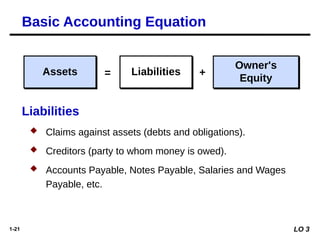
related to the organization)
records, and (format)
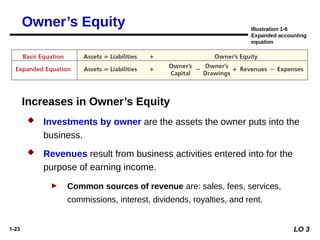
communicates
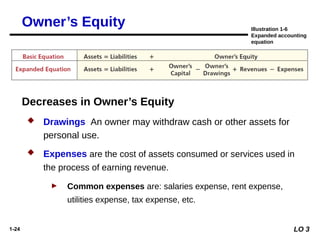
the economic events of an organization to interested users.
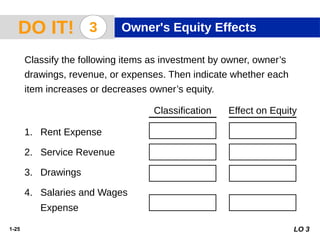
LEARNING
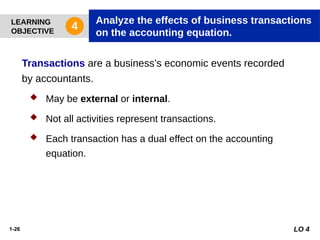
OBJECTIVE
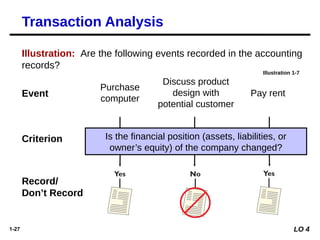
Identify the activities and users
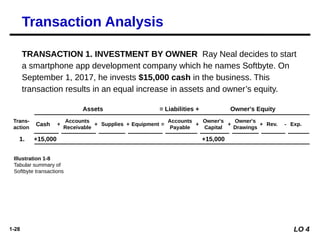
associated with accounting.
1
LO 1
3.
1-3
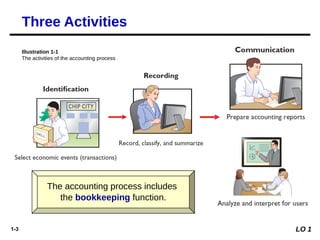
Illustration 1-1
The activitiesof the accounting process
The accounting process includes
the bookkeeping function.
Three Activities
LO 1
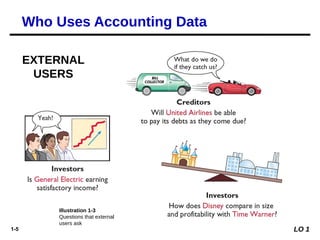
1-5 LO 1
Illustration1-3
Questions that external
users ask
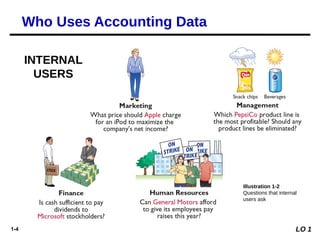
Who Uses Accounting Data
EXTERNAL
USERS
6.
1-6
1
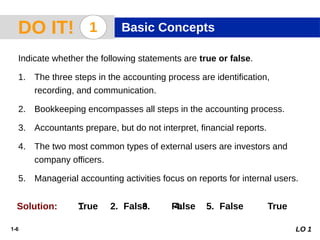
DO IT! 1
Solution:1. 2. 3. 4. 5.
Indicate whether the following statements are true or false.
1. The three steps in the accounting process are identification,
recording, and communication.
2. Bookkeeping encompasses all steps in the accounting process.
3. Accountants prepare, but do not interpret, financial reports.
4. The two most common types of external users are investors and
company officers.
5. Managerial accounting activities focus on reports for internal users.
LO 1
True False False False True
Basic Concepts
7.
1-7
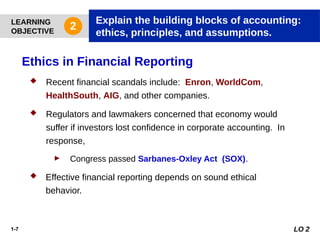
Ethics in FinancialReporting
Recent financial scandals include: Enron, WorldCom,
HealthSouth, AIG, and other companies.
Regulators and lawmakers concerned that economy would
suffer if investors lost confidence in corporate accounting. In
response,
► Congress passed Sarbanes-Oxley Act (SOX).
Effective financial reporting depends on sound ethical
behavior.
LO 2
LEARNING
OBJECTIVE
Explain the building blocks of accounting:
ethics, principles, and assumptions.
2
1-9
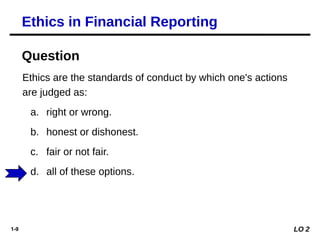
Ethics are thestandards of conduct by which one's actions
are judged as:
a. right or wrong.
b. honest or dishonest.
c. fair or not fair.
d. all of these options.
Question
Ethics in Financial Reporting
LO 2
10.
1-10
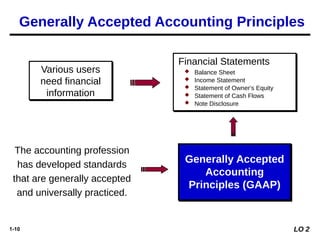
Various users
need financial
information
Theaccounting profession
has developed standards
that are generally accepted
and universally practiced.
Financial Statements
Balance Sheet
Income Statement
Statement of Owner's Equity
Statement of Cash Flows
Note Disclosure
Generally Accepted
Accounting
Principles (GAAP)
Generally Accepted Accounting Principles
LO 2
11.
1-11
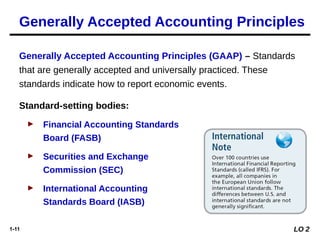
Generally Accepted AccountingPrinciples (GAAP) – Standards
that are generally accepted and universally practiced. These
standards indicate how to report economic events.
Standard-setting bodies:
► Financial Accounting Standards
Board (FASB)
► Securities and Exchange
Commission (SEC)
► International Accounting
Standards Board (IASB)
Generally Accepted Accounting Principles
LO 2
12.
1-12
Measurement Principles
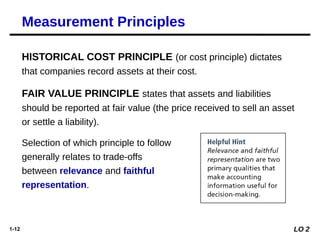
HISTORICAL COSTPRINCIPLE (or cost principle) dictates
that companies record assets at their cost.
FAIR VALUE PRINCIPLE states that assets and liabilities
should be reported at fair value (the price received to sell an asset
or settle a liability).
Selection of which principle to follow
generally relates to trade-offs
between relevance and faithful
representation.
LO 2
13.
1-13
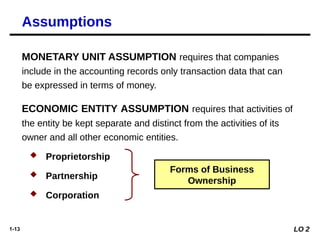
MONETARY UNIT ASSUMPTIONrequires that companies
include in the accounting records only transaction data that can
be expressed in terms of money.
ECONOMIC ENTITY ASSUMPTION requires that activities of
the entity be kept separate and distinct from the activities of its
owner and all other economic entities.
Proprietorship
Partnership
Corporation
Forms of Business
Ownership
Assumptions
LO 2
14.
1-14
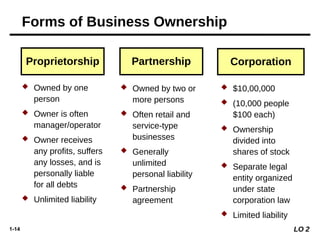
Proprietorship Partnership Corporation
Owned by two or
more persons
Often retail and
service-type
businesses
Generally
unlimited
personal liability
Partnership
agreement
$10,00,000
(10,000 people
$100 each)
Ownership
divided into
shares of stock
Separate legal
entity organized
under state
corporation law
Limited liability
Owned by one
person
Owner is often
manager/operator
Owner receives
any profits, suffers
any losses, and is
personally liable
for all debts
Unlimited liability
Forms of Business Ownership
LO 2
15.
1-15
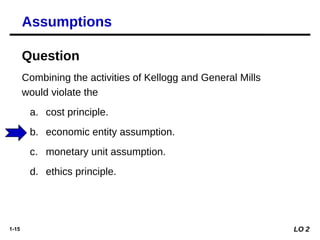
Question
Combining the activitiesof Kellogg and General Mills
would violate the
a. cost principle.
b. economic entity assumption.
c. monetary unit assumption.
d. ethics principle.
LO 2
Assumptions
16.
1-16
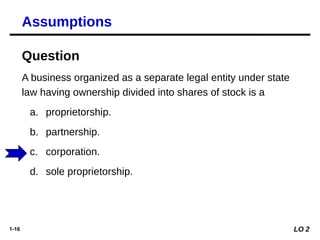
A business organizedas a separate legal entity under state
law having ownership divided into shares of stock is a
a. proprietorship.
b. partnership.
c. corporation.
d. sole proprietorship.
Question
LO 2
Assumptions
17.
1-17
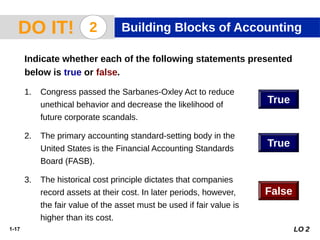
Indicate whether eachof the following statements presented
below is true or false.
1. Congress passed the Sarbanes-Oxley Act to reduce
unethical behavior and decrease the likelihood of
future corporate scandals.
2. The primary accounting standard-setting body in the
United States is the Financial Accounting Standards
Board (FASB).
3. The historical cost principle dictates that companies
record assets at their cost. In later periods, however,
the fair value of the asset must be used if fair value is
higher than its cost.
True
False
True
LO 2
DO IT! 2 Building Blocks of Accounting
18.
1-18
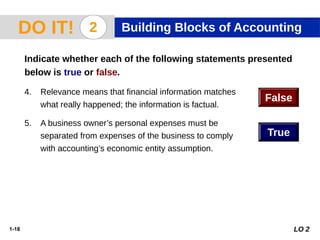
4. Relevance meansthat financial information matches
what really happened; the information is factual.
5. A business owner’s personal expenses must be
separated from expenses of the business to comply
with accounting’s economic entity assumption.
False
True
LO 2
Indicate whether each of the following statements presented
below is true or false.
DO IT! 2 Building Blocks of Accounting
19.
1-19
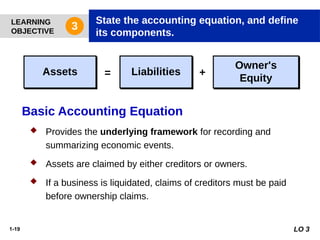
Assets Liabilities
Owner's
Equity
= +
LO3
LEARNING
OBJECTIVE
State the accounting equation, and define
its components.
3
Basic Accounting Equation
Provides the underlying framework for recording and
summarizing economic events.
Assets are claimed by either creditors or owners.
If a business is liquidated, claims of creditors must be paid
before ownership claims.
20.
1-20
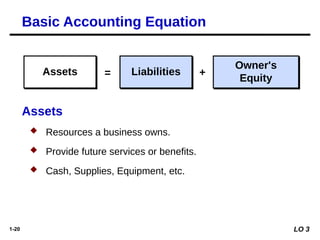
Assets Liabilities
Owner's
Equity
= +
Resources a business owns.
Provide future services or benefits.
Cash, Supplies, Equipment, etc.
Assets
LO 3
Basic Accounting Equation
21.
1-21
Assets Liabilities
Owner's
Equity
= +
BasicAccounting Equation
Claims against assets (debts and obligations).
Creditors (party to whom money is owed).
Accounts Payable, Notes Payable, Salaries and Wages
Payable, etc.
Liabilities
LO 3
22.
1-22
Owner's Equity
Assets Liabilities
Owner's
Equity(1000-
100=900)
=+
Basic Accounting Equation
LO 3
Ownership claim on total assets.
Referred to as residual equity.
Investment by owners and revenues (+)
Drawings and expenses (-).
Capital(+)Revenues(+)Expense(-)Drawings(-)
23.
1-23
Investments byowner are the assets the owner puts into the
business.
Revenues result from business activities entered into for the
purpose of earning income.
► Common sources of revenue are: sales, fees, services,
commissions, interest, dividends, royalties, and rent.
Owner’s Equity
Increases in Owner’s Equity
Illustration 1-6
Expanded accounting
equation
LO 3
24.
1-24
Drawings Anowner may withdraw cash or other assets for
personal use.
Expenses are the cost of assets consumed or services used in
the process of earning revenue.
► Common expenses are: salaries expense, rent expense,
utilities expense, tax expense, etc.
Owner’s Equity
Decreases in Owner’s Equity
Illustration 1-6
Expanded accounting
equation
LO 3
25.
1-25
Expense Decrease
Expense Decrease
RevenueIncrease
Drawings Decrease
Classification
Classify the following items as investment by owner, owner’s
drawings, revenue, or expenses. Then indicate whether each
item increases or decreases owner’s equity.
1. Rent Expense
2. Service Revenue
3. Drawings
4. Salaries and Wages
Expense
Effect on Equity
LO 3
DO IT! 3 Owner's Equity Effects
26.
1-26
Transactions are abusiness’s economic events recorded
by accountants.
May be external or internal.
Not all activities represent transactions.
Each transaction has a dual effect on the accounting
equation.
LO 4
LEARNING
OBJECTIVE
Analyze the effects of business transactions
on the accounting equation.
4
27.
1-27
Illustration: Are thefollowing events recorded in the accounting
records?
Event
Purchase
computer
Criterion Is the financial position (assets, liabilities, or
owner’s equity) of the company changed?
Discuss product
design with
potential customer
Pay rent
Record/
Don’t Record
Transaction Analysis
LO 4
Illustration 1-7
28.
1-28
Transaction Analysis
TRANSACTION 1.INVESTMENT BY OWNER Ray Neal decides to start
a smartphone app development company which he names Softbyte. On
September 1, 2017, he invests $15,000 cash in the business. This
transaction results in an equal increase in assets and owner’s equity.
Trans-
action
Cash
Accounts
Receivable
Supplies Equipment
Accounts
Payable
Owner's
Capital
1. +15,000 +15,000
Assets = Liabilities + Owner's Equity
+ +
+
+
+ =
LO 4
Owner's
Drawings
Rev. Exp.
+ -
Illustration 1-8
Tabular summary of
Softbyte transactions
1-32
8. -250 -250
9.+600 -600
10. -1,300 -1,300
7. -1,700 -600
-900
-200
Trans-
action
Cash
Accounts
Receivable
Supplies Equipment
Accounts
Payable
Assets = Liabilities + Owner's Equity
+ +
+
+
+ =
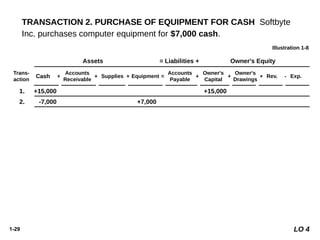
1. +15,000 +15,000
2. -7,000 +7,000
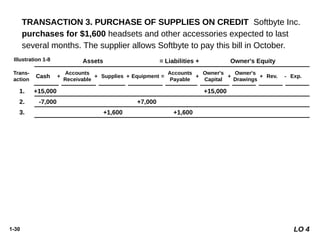
3. +1,600 +1,600
6. +1,500 +2,000 +3,500
$8,050 $1,400 $1,600 $7,000 $1,600 $15,000 $4,700 $1,950 $1,300
+ +
+
+
+ = - -
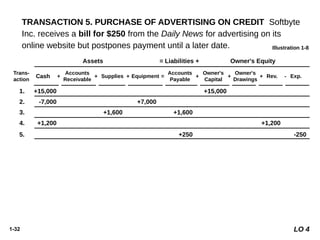
TRANSACTION 5. PURCHASE OF ADVERTISING ON CREDIT Softbyte
Inc. receives a bill for $250 from the Daily News for advertising on its
online website but postpones payment until a later date. Illustration 1-8
LO 4
Owner's
Capital
Owner's
Drawings
Rev. Exp.
+ -
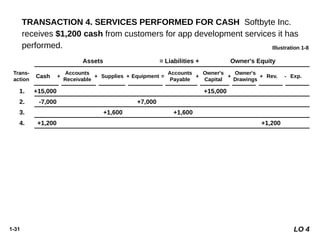
4. +1,200 +1,200
5. +250 -250
33.
1-33
8. -250 -250
9.+600 -600
10. -1,300 -1,300
7. -1,700 -600
-900
-200
Trans-
action
Cash
Accounts
Receivable
Supplies Equipment
Accounts
Payable
Assets = Liabilities + Owner's Equity
+ +
+
+
+ =
1. +15,000 +15,000
2. -7,000 +7,000
3. +1,600 +1,600
$8,050 $1,400 $1,600 $7,000 $1,600 $15,000 $4,700 $1,950 $1,300
+ +
+
+
+ = - -
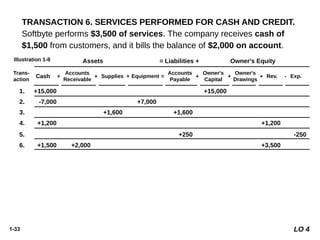
TRANSACTION 6. SERVICES PERFORMED FOR CASH AND CREDIT.
Softbyte performs $3,500 of services. The company receives cash of
$1,500 from customers, and it bills the balance of $2,000 on account.
Illustration 1-8
LO 4
Owner's
Capital
Owner's
Drawings
Rev. Exp.
+ -
4. +1,200 +1,200
6. +1,500 +2,000 +3,500
5. +250 -250
34.
1-34
8. -250 -250
9.+600 -600
10. -1,300 -1,300
Trans-
action
Cash
Accounts
Receivable
Supplies Equipment
Accounts
Payable
Assets = Liabilities + Owner's Equity
+ +
+
+
+ =
1. +15,000 +15,000
2. -7,000 +7,000
3. +1,600 +1,600
$8,050 $1,400 $1,600 $7,000 $1,600 $15,000 $4,700 $1,950 $1,300
+ +
+
+
+ = - -
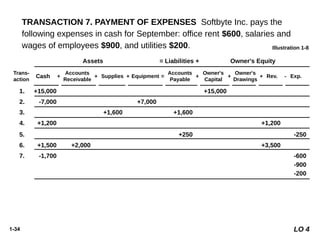
TRANSACTION 7. PAYMENT OF EXPENSES Softbyte Inc. pays the
following expenses in cash for September: office rent $600, salaries and
wages of employees $900, and utilities $200. Illustration 1-8
LO 4
Owner's
Capital
Owner's
Drawings
Rev. Exp.
+ -
4. +1,200 +1,200
7. -1,700 -600
-900
-200
6. +1,500 +2,000 +3,500
5. +250 -250
35.
1-35
8. -250 -250
9.+600 -600
10. -1,300 -1,300
Trans-
action
Cash
Accounts
Receivable
Supplies Equipment
Accounts
Payable
Assets = Liabilities + Owner's Equity
+ +
+
+
+ =
1. +15,000 +15,000
2. -7,000 +7,000
3. +1,600 +1,600
$8,050 $1,400 $1,600 $7,000 $1,600 $15,000 $4,700 $1,950 $1,300
+ +
+
+
+ = - -
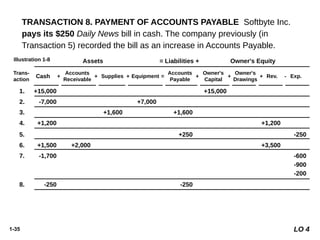
TRANSACTION 8. PAYMENT OF ACCOUNTS PAYABLE Softbyte Inc.
pays its $250 Daily News bill in cash. The company previously (in
Transaction 5) recorded the bill as an increase in Accounts Payable.
Illustration 1-8
LO 4
Owner's
Capital
Owner's
Drawings
Rev. Exp.
+ -
4. +1,200 +1,200
7. -1,700 -600
-900
-200
6. +1,500 +2,000 +3,500
5. +250 -250
36.
1-36
8. -250 -250
9.+600 -600
10. -1,300 -1,300
Trans-
action
Cash
Accounts
Receivable
Supplies Equipment
Accounts
Payable
Assets = Liabilities + Owner's Equity
+ +
+
+
+ =
1. +15,000 +15,000
2. -7,000 +7,000
3. +1,600 +1,600
$8,050 $1,400 $1,600 $7,000 $1,600 $15,000 $4,700 $1,950 $1,300
+ +
+
+
+ = - -
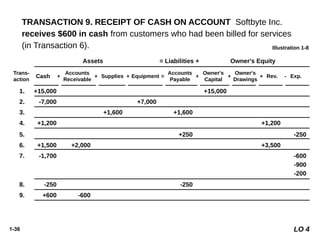
TRANSACTION 9. RECEIPT OF CASH ON ACCOUNT Softbyte Inc.
receives $600 in cash from customers who had been billed for services
(in Transaction 6). Illustration 1-8
LO 4
Owner's
Capital
Owner's
Drawings
Rev. Exp.
+ -
4. +1,200 +1,200
7. -1,700 -600
-900
-200
6. +1,500 +2,000 +3,500
5. +250 -250
37.
1-37
8. -250 -250
9.+600 -600
10. -1,300 -1,300
Trans-
action
Cash
Accounts
Receivable
Supplies Equipment
Accounts
Payable
Assets = Liabilities + Owner's Equity
+ +
+
+
+ =
1. +15,000 +15,000
2. -7,000 +7,000
3. +1,600 +1,600
$8,050 $1,400 $1,600 $7,000 $1,600 $15,000 $1,300 $4,700 $1,950
+ +
+
+
+ = - -
+$8050 +1400 +1600 +7000 = +1600 +15000 -1300 +4700 -1950
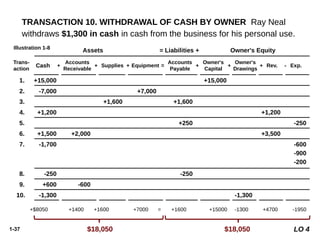
TRANSACTION 10. WITHDRAWAL OF CASH BY OWNER Ray Neal
withdraws $1,300 in cash in cash from the business for his personal use.
$18,050 $18,050
Illustration 1-8
LO 4
7. -1,700 -600
-900
-200
6. +1,500 +2,000 +3,500
5. +250 -250
Owner's
Capital
Owner's
Drawings
Rev. Exp.
+ -
4. +1,200 +1,200
38.
1-38
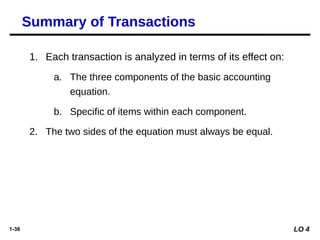
1. Each transactionis analyzed in terms of its effect on:
a. The three components of the basic accounting
equation.
b. Specific of items within each component.
2. The two sides of the equation must always be equal.
Summary of Transactions
LO 4
39.
1-39
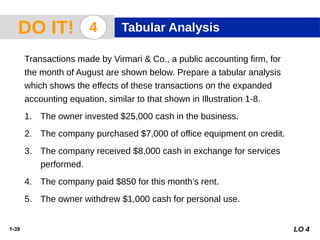
Transactions made byVirmari & Co., a public accounting firm, for
the month of August are shown below. Prepare a tabular analysis
which shows the effects of these transactions on the expanded
accounting equation, similar to that shown in Illustration 1-8.
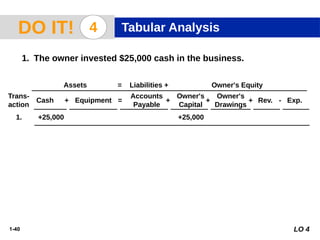
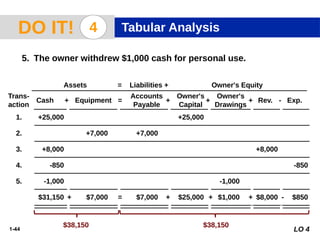
1. The owner invested $25,000 cash in the business.
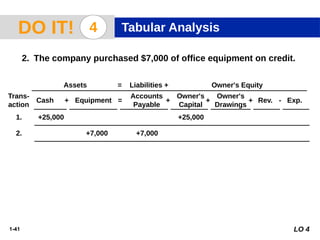
2. The company purchased $7,000 of office equipment on credit.
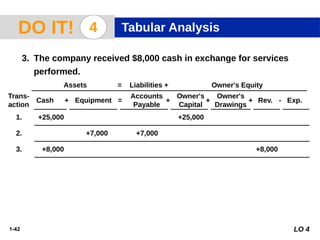
3. The company received $8,000 cash in exchange for services
performed.
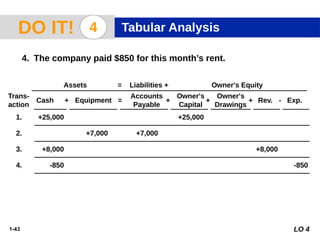
4. The company paid $850 for this month’s rent.
5. The owner withdrew $1,000 cash for personal use.
LO 4
DO IT! 4 Tabular Analysis
1-45
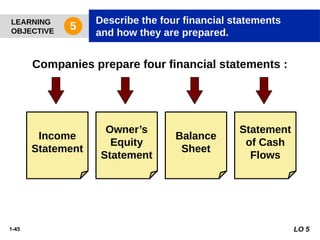
Companies prepare fourfinancial statements :
Balance
Sheet
Income
Statement
Statement
of Cash
Flows
Owner’s
Equity
Statement
LEARNING
OBJECTIVE
Describe the four financial statements
and how they are prepared.
5
LO 5
46.
1-46
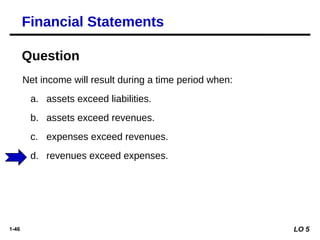
Financial Statements
Net incomewill result during a time period when:
a. assets exceed liabilities.
b. assets exceed revenues.
c. expenses exceed revenues.
d. revenues exceed expenses.
Question
LO 5
47.
1-47
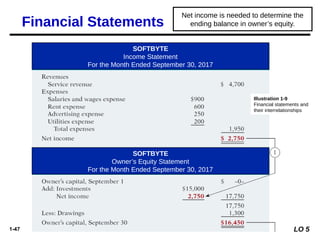
Net income isneeded to determine the
ending balance in owner’s equity.
Financial Statements
LO 5
Illustration 1-9
Financial statements and
their interrelationships
SOFTBYTE
Income Statement
For the Month Ended September 30, 2017
SOFTBYTE
Owner’s Equity Statement
For the Month Ended September 30, 2017
48.
1-48
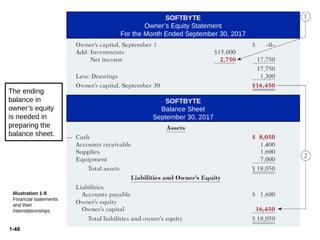
The ending
balance in
owner’sequity
is needed in
preparing the
balance sheet.
Illustration 1-9
Illustration 1-9
Financial statements
and their
interrelationships
SOFTBYTE
Owner’s Equity Statement
For the Month Ended September 30, 2017
SOFTBYTE
Balance Sheet
September 30, 2017
49.
1-49
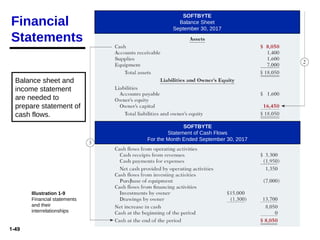
Balance sheet and
incomestatement
are needed to
prepare statement of
cash flows.
SOFTBYTE
Balance Sheet
September 30, 2017
SOFTBYTE
Statement of Cash Flows
For the Month Ended September 30, 2017
Illustration 1-9
Financial statements
and their
interrelationships
Financial
Statements
50.
1-50
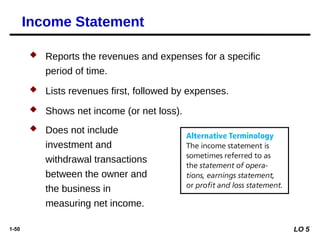
Reports therevenues and expenses for a specific
period of time.
Lists revenues first, followed by expenses.
Shows net income (or net loss).
Income Statement
LO 5
Does not include
investment and
withdrawal transactions
between the owner and
the business in
measuring net income.
51.
1-51
Reports thechanges in owner’s equity for a specific
period of time.
The time period is the same as that covered by the
income statement.
Owner’s Equity Statement
LO 5
52.
1-52
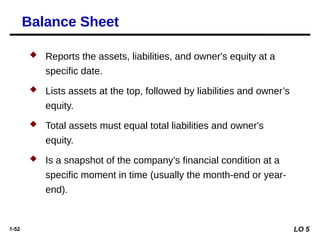
Reports theassets, liabilities, and owner's equity at a
specific date.
Lists assets at the top, followed by liabilities and owner’s
equity.
Total assets must equal total liabilities and owner's
equity.
Is a snapshot of the company’s financial condition at a
specific moment in time (usually the month-end or year-
end).
Balance Sheet
LO 5
53.
1-53
Information onthe cash receipts and payments for a
specific period of time.
Answers the following:
► Where did cash come from?
► What was cash used for?
► What was the change in the
cash balance?
Statement of Cash Flows
LO 5
54.
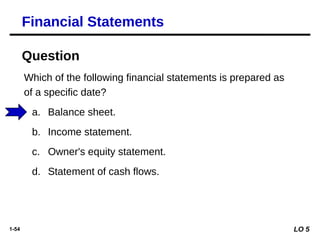
1-54
Which of thefollowing financial statements is prepared as
of a specific date?
a. Balance sheet.
b. Income statement.
c. Owner's equity statement.
d. Statement of cash flows.
Financial Statements
Question
LO 5
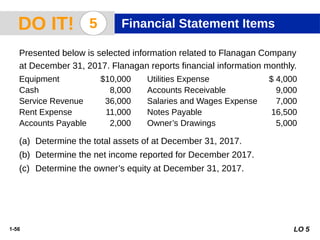
1-56 LO 5
DOIT! 5 Financial Statement Items
Presented below is selected information related to Flanagan Company
at December 31, 2017. Flanagan reports financial information monthly.
Equipment $10,000 Utilities Expense $ 4,000
Cash 8,000 Accounts Receivable 9,000
Service Revenue 36,000 Salaries and Wages Expense 7,000
Rent Expense 11,000 Notes Payable 16,500
Accounts Payable 2,000 Owner’s Drawings 5,000
(a) Determine the total assets of at December 31, 2017.
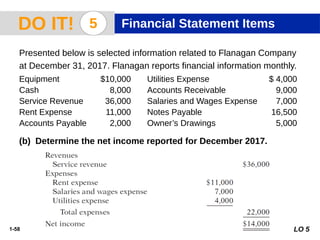
(b) Determine the net income reported for December 2017.
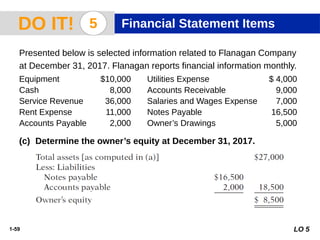
(c) Determine the owner’s equity at December 31, 2017.
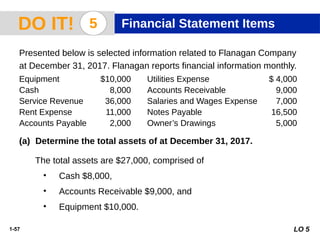
57.
1-57 LO 5
DOIT! 5 Financial Statement Items
Presented below is selected information related to Flanagan Company
at December 31, 2017. Flanagan reports financial information monthly.
Equipment $10,000 Utilities Expense $ 4,000
Cash 8,000 Accounts Receivable 9,000
Service Revenue 36,000 Salaries and Wages Expense 7,000
Rent Expense 11,000 Notes Payable 16,500
Accounts Payable 2,000 Owner’s Drawings 5,000
(a) Determine the total assets of at December 31, 2017.
The total assets are $27,000, comprised of
• Cash $8,000,
• Accounts Receivable $9,000, and
• Equipment $10,000.
58.
1-58 LO 5
DOIT! 5 Financial Statement Items
Presented below is selected information related to Flanagan Company
at December 31, 2017. Flanagan reports financial information monthly.
Equipment $10,000 Utilities Expense $ 4,000
Cash 8,000 Accounts Receivable 9,000
Service Revenue 36,000 Salaries and Wages Expense 7,000
Rent Expense 11,000 Notes Payable 16,500
Accounts Payable 2,000 Owner’s Drawings 5,000
(b) Determine the net income reported for December 2017.
59.
1-59 LO 5
DOIT! 5 Financial Statement Items
Presented below is selected information related to Flanagan Company
at December 31, 2017. Flanagan reports financial information monthly.
Equipment $10,000 Utilities Expense $ 4,000
Cash 8,000 Accounts Receivable 9,000
Service Revenue 36,000 Salaries and Wages Expense 7,000
Rent Expense 11,000 Notes Payable 16,500
Accounts Payable 2,000 Owner’s Drawings 5,000
(c) Determine the owner’s equity at December 31, 2017.
60.
1-60
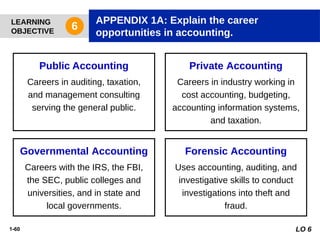
Forensic Accounting
Uses accounting,auditing, and
investigative skills to conduct
investigations into theft and
fraud.
Governmental Accounting
Careers with the IRS, the FBI,
the SEC, public colleges and
universities, and in state and
local governments.
Private Accounting
Careers in industry working in
cost accounting, budgeting,
accounting information systems,
and taxation.
Public Accounting
Careers in auditing, taxation,
and management consulting
serving the general public.
LEARNING
OBJECTIVE
APPENDIX 1A: Explain the career
opportunities in accounting.
6
LO 6
61.
1-61
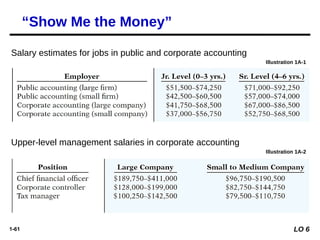
Salary estimates forjobs in public and corporate accounting
Illustration 1A-1
Upper-level management salaries in corporate accounting
Illustration 1A-2
LO 6
“Show Me the Money”
62.
1-62
Key Points
Following arethe key similarities and differences between GAAP and
IFRS as related to accounting fundamentals.
Similarities
The basic techniques for recording business transactions are the
same for U.S. and international companies.
Both international and U.S. accounting standards emphasize
transparency in financial reporting. Both sets of standards are
primarily driven by meeting the needs of investors and creditors.
LO 7
LEARNING
OBJECTIVE
Describe the impact of international accounting
standards on U.S. financial reporting.
7
63.
1-63
Key Points
Similarities
Thethree most common forms of business organizations,
proprietorships, partnerships, and corporations, are also found in
countries that use international accounting standards.
Differences
International standards are referred to as International Financial
Reporting Standards (IFRS), developed by the International
Accounting Standards Board. Accounting standards in the United
States are referred to as generally accepted accounting principles
(GAAP) and are developed by the Financial Accounting
Standards Board.
LO 7
64.
1-64
Key Points
Differences
IFRStends to be simpler in its accounting and disclosure
requirements; some people say it is more “principles-based.”
GAAP is more detailed; some people say it is more “rules-based.”
The internal control standards applicable to Sarbanes-Oxley
(SOX) apply only to large public companies listed on U.S.
exchanges. There is continuing debate as to whether non-U.S.
companies should have to comply with this extra layer of
regulation.
LO 7
65.
1-65
Looking to theFuture
Both the IASB and the FASB are hard at work developing standards that
will lead to the elimination of major differences in the way certain
transactions are accounted for and reported.
LO 7
66.
1-66
Which of thefollowing is not a reason why a single set of high-
quality international accounting standards would be beneficial?
a) Mergers and acquisition activity.
b) Financial markets.
c) Multinational corporations.
d) GAAP is widely considered to be a superior reporting system.
A Look at IFRS
IFRS Self-Test Questions
LO 7
67.
1-67
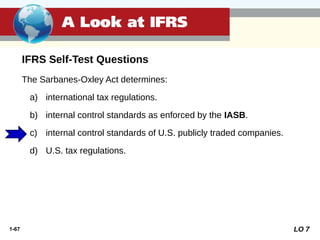
The Sarbanes-Oxley Actdetermines:
a) international tax regulations.
b) internal control standards as enforced by the IASB.
c) internal control standards of U.S. publicly traded companies.
d) U.S. tax regulations.
A Look at IFRS
IFRS Self-Test Questions
LO 7
68.
1-68
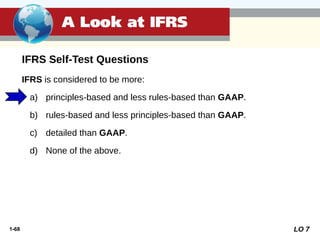
IFRS is consideredto be more:
a) principles-based and less rules-based than GAAP.
b) rules-based and less principles-based than GAAP.
c) detailed than GAAP.
d) None of the above.
A Look at IFRS
IFRS Self-Test Questions
LO 7





![ACT 201 ch0accounting 201 intro to 1[1].ppt](https://cdn.slidesharecdn.com/ss_thumbnails/act201ch011-250706073840-7f4e295a-thumbnail.jpg?width=640&height=640&fit=bounds)


