PRIDE AND PREJUDICE
BY: JANE AUSTIN
PREPARED BY: ABDUL RAZZAQUE
ROLL NO ENG2K22UK-4
SUMMARY
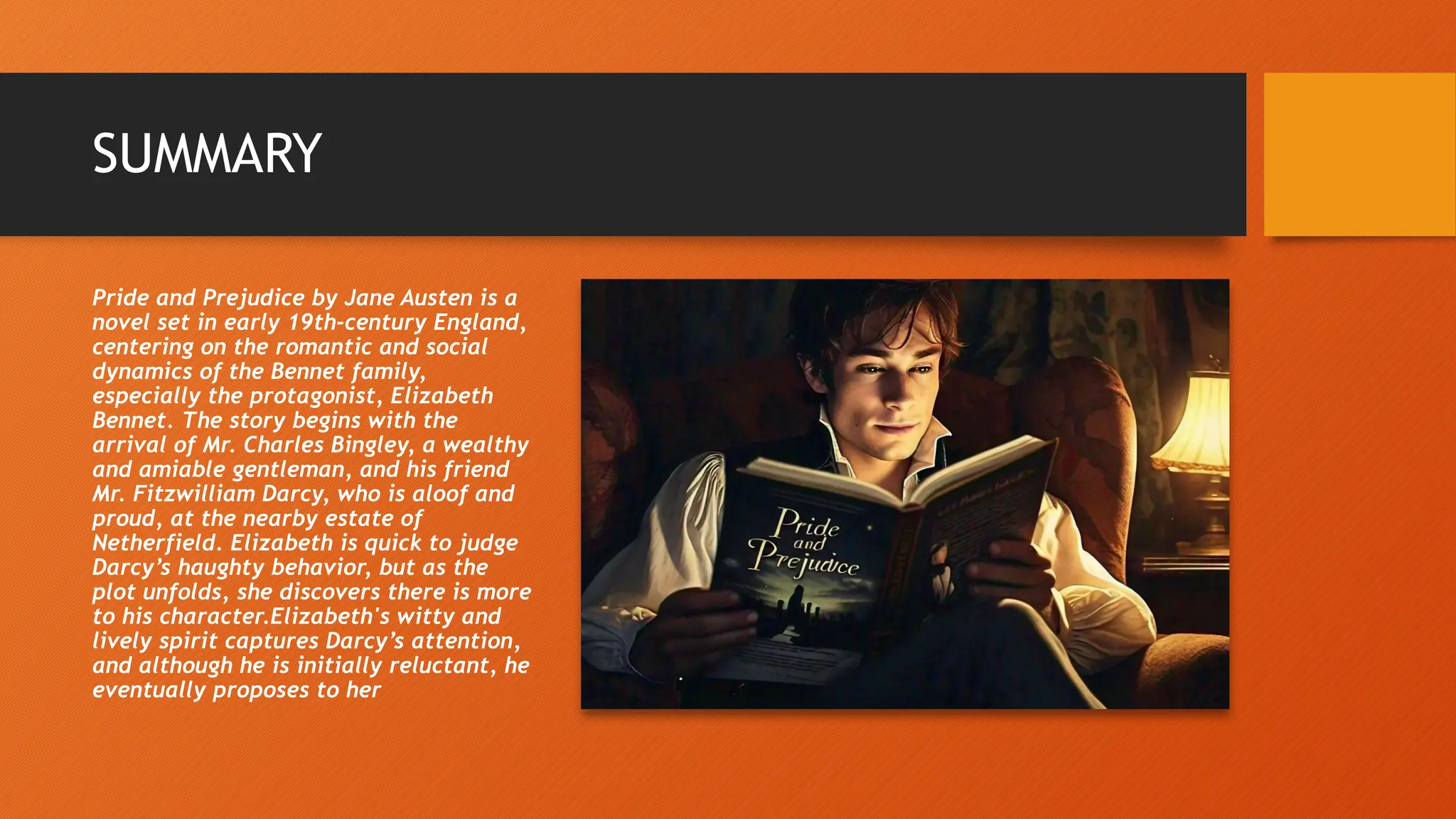
Pride and Prejudice by Jane Austen is a
novel set in early 19th-century England,
centering on the romantic and social
dynamics of the Bennet family,
especially the protagonist, Elizabeth
Bennet. The story begins with the
arrival of Mr. Charles Bingley, a wealthy
and amiable gentleman, and his friend
Mr. Fitzwilliam Darcy, who is aloof and
proud, at the nearby estate of
Netherfield. Elizabeth is quick to judge
Darcy’s haughty behavior, but as the
plot unfolds, she discovers there is more
to his character.Elizabeth's witty and
lively spirit captures Darcy’s attention,
and although he is initially reluctant, he
eventually proposes to her
However, his proposal is awkwardly expressed, highlighting his
sense of social superiority, and Elizabeth, offended, rejects him.
Soon after, Elizabeth learns of Darcy’s role in saving her
youngest sister, Lydia, from a scandal, revealing his generosity
and honorable nature.
• As misunderstandings are resolved and their feelings deepen,
Darcy’s initial pride and Elizabeth’s prejudices are broken
down. They both recognize each other’s worth,
THEMES
1. Pride and Prejudice: As the title suggests, these qualities are central to the
novel. Darcy’s pride in his social status and Elizabeth’s prejudice against his
initial arrogance create misunderstandings that they must overcome. Both
characters evolve by recognizing and addressing these flaws.
2. Social Class and Marriage: The novel critiques the social hierarchy and the
institution of marriage. Many characters, such as Charlotte Lucas, view marriage
as a practical necessity rather than a romantic choice. Austen highlights the
pressures on women to secure financial stability through marriage and questions
the moral compromises they often make to do so.
• 3. Love and Marriage: Austen portrays different types of marriages, contrasting
shallow, materialistic unions (Mr. Collins and Charlotte, Lydia and Wickham)
with deeper, mutual relationships (Elizabeth and Darcy, Jane and Bingley). True
love, Austen suggests, is rooted in respect, equality, and understanding.
4. Individual vs. Society: Elizabeth often defies social
expectations, challenging norms through her wit, independence,
and refusal to conform to societal pressures regarding marriage.
Her relationship with Darcy ultimately proves that individual
happiness can be achieved despite societal constraints.
• 5. Self-Discovery and Personal Growth: Elizabeth and Darcy’s
journey toward self-awareness and improvement is central to the
plot. Darcy learns humility, while Elizabeth learns to question her
initial judgments. Their growth allows them to form a stronger
relationship based on mutual respect.
CHARACTERIZATION
1. Elizabeth Bennet: The protagonist, Elizabeth is witty, intelligent, and independent. She challenges social norms
and values personal integrity and mutual respect over wealth and social standing. Her main flaw is her tendency to
judge hastily, especially regarding Darcy. Elizabeth’s journey is one of self-discovery, as she learns to see past her
prejudices.
2. Fitzwilliam Darcy: Darcy is initially portrayed as arrogant and proud due to his wealth and social class, leading to
widespread judgment, especially from Elizabeth. However, he’s also principled, caring, and honorable. Over time,
Darcy shows his true character by helping Elizabeth’s family, highlighting his humility and growth as he overcomes
his pride to earn Elizabeth’s love.
3. Jane Bennet: Elizabeth’s elder sister, Jane is gentle, kind-hearted, and reserved. Her optimism and tendency to
see the best in others sometimes make her vulnerable, yet she embodies idealized femininity of the time. Her love
for Mr. Bingley contrasts with Elizabeth and Darcy’s rocky beginning, showcasing the different dynamics of
relationships.
• 4. Charles Bingley: Darcy’s friend, Bingley is good-natured, sociable, and lacks Darcy’s sense of pride. Though
wealthy, he is less concerned with social standing, which makes him more accessible. His love for Jane Bennet
highlights his amiable personality, though he is easily influenced by Darcy and others.
5. Mr. Bennet: Elizabeth’s father, Mr. Bennet is sarcastic and detached, often using humor
to cope with his marriage and family life. Although he loves Elizabeth and Jane, he lacks
involvement in family matters and has a strained relationship with his wife, Mrs. Bennet.
6. Mrs. Bennet: Elizabeth’s mother is preoccupied with securing husbands for her
daughters, often making her seem superficial and embarrassing. Though her motives stem
from a real concern for her daughters’ futures, her lack of tact and social awareness
highlights the pressures on women to marry well.
7. George Wickham: Initially charming and likable, Wickham is revealed to be
manipulative and deceitful. He represents a foil to Darcy, as both come from the same
social class but possess opposite moral characters. His actions reveal the dangers of basing
judgments solely on appearances.
• 8. Lady Catherine de Bourgh: Darcy’s aristocratic aunt, Lady Catherine is proud,
domineering, and dismissive of those she deems inferior. She symbolizes the rigid,
elitist mindset of the upper class and serves as an obstacle to Elizabeth and Darcy’s
relationship.
THANK YOU

pride and prejudice by Jane austin RAZZAQUE.pptx

  • 1.
    PRIDE AND PREJUDICE BY:JANE AUSTIN PREPARED BY: ABDUL RAZZAQUE ROLL NO ENG2K22UK-4
  • 2.
    SUMMARY Pride and Prejudiceby Jane Austen is a novel set in early 19th-century England, centering on the romantic and social dynamics of the Bennet family, especially the protagonist, Elizabeth Bennet. The story begins with the arrival of Mr. Charles Bingley, a wealthy and amiable gentleman, and his friend Mr. Fitzwilliam Darcy, who is aloof and proud, at the nearby estate of Netherfield. Elizabeth is quick to judge Darcy’s haughty behavior, but as the plot unfolds, she discovers there is more to his character.Elizabeth's witty and lively spirit captures Darcy’s attention, and although he is initially reluctant, he eventually proposes to her
  • 3.
    However, his proposalis awkwardly expressed, highlighting his sense of social superiority, and Elizabeth, offended, rejects him. Soon after, Elizabeth learns of Darcy’s role in saving her youngest sister, Lydia, from a scandal, revealing his generosity and honorable nature. • As misunderstandings are resolved and their feelings deepen, Darcy’s initial pride and Elizabeth’s prejudices are broken down. They both recognize each other’s worth,
  • 4.
    THEMES 1. Pride andPrejudice: As the title suggests, these qualities are central to the novel. Darcy’s pride in his social status and Elizabeth’s prejudice against his initial arrogance create misunderstandings that they must overcome. Both characters evolve by recognizing and addressing these flaws. 2. Social Class and Marriage: The novel critiques the social hierarchy and the institution of marriage. Many characters, such as Charlotte Lucas, view marriage as a practical necessity rather than a romantic choice. Austen highlights the pressures on women to secure financial stability through marriage and questions the moral compromises they often make to do so. • 3. Love and Marriage: Austen portrays different types of marriages, contrasting shallow, materialistic unions (Mr. Collins and Charlotte, Lydia and Wickham) with deeper, mutual relationships (Elizabeth and Darcy, Jane and Bingley). True love, Austen suggests, is rooted in respect, equality, and understanding.
  • 5.
    4. Individual vs.Society: Elizabeth often defies social expectations, challenging norms through her wit, independence, and refusal to conform to societal pressures regarding marriage. Her relationship with Darcy ultimately proves that individual happiness can be achieved despite societal constraints. • 5. Self-Discovery and Personal Growth: Elizabeth and Darcy’s journey toward self-awareness and improvement is central to the plot. Darcy learns humility, while Elizabeth learns to question her initial judgments. Their growth allows them to form a stronger relationship based on mutual respect.
  • 6.
    CHARACTERIZATION 1. Elizabeth Bennet:The protagonist, Elizabeth is witty, intelligent, and independent. She challenges social norms and values personal integrity and mutual respect over wealth and social standing. Her main flaw is her tendency to judge hastily, especially regarding Darcy. Elizabeth’s journey is one of self-discovery, as she learns to see past her prejudices. 2. Fitzwilliam Darcy: Darcy is initially portrayed as arrogant and proud due to his wealth and social class, leading to widespread judgment, especially from Elizabeth. However, he’s also principled, caring, and honorable. Over time, Darcy shows his true character by helping Elizabeth’s family, highlighting his humility and growth as he overcomes his pride to earn Elizabeth’s love. 3. Jane Bennet: Elizabeth’s elder sister, Jane is gentle, kind-hearted, and reserved. Her optimism and tendency to see the best in others sometimes make her vulnerable, yet she embodies idealized femininity of the time. Her love for Mr. Bingley contrasts with Elizabeth and Darcy’s rocky beginning, showcasing the different dynamics of relationships. • 4. Charles Bingley: Darcy’s friend, Bingley is good-natured, sociable, and lacks Darcy’s sense of pride. Though wealthy, he is less concerned with social standing, which makes him more accessible. His love for Jane Bennet highlights his amiable personality, though he is easily influenced by Darcy and others.
  • 7.
    5. Mr. Bennet:Elizabeth’s father, Mr. Bennet is sarcastic and detached, often using humor to cope with his marriage and family life. Although he loves Elizabeth and Jane, he lacks involvement in family matters and has a strained relationship with his wife, Mrs. Bennet. 6. Mrs. Bennet: Elizabeth’s mother is preoccupied with securing husbands for her daughters, often making her seem superficial and embarrassing. Though her motives stem from a real concern for her daughters’ futures, her lack of tact and social awareness highlights the pressures on women to marry well. 7. George Wickham: Initially charming and likable, Wickham is revealed to be manipulative and deceitful. He represents a foil to Darcy, as both come from the same social class but possess opposite moral characters. His actions reveal the dangers of basing judgments solely on appearances. • 8. Lady Catherine de Bourgh: Darcy’s aristocratic aunt, Lady Catherine is proud, domineering, and dismissive of those she deems inferior. She symbolizes the rigid, elitist mindset of the upper class and serves as an obstacle to Elizabeth and Darcy’s relationship.
  • 8.