Ammar Hashim
Pressure ulcer
Patient - oriented management
Case presentation
• 75 years old male, with 2 months history of unstageable
pressure ulcer on the sacrum , secondary to immobility and
incontinence.
• Type 2 Diabetes- diagnosed at age 35, Hyperlipidemia , Diabetic
foot ulcers, Diabetic neuropathy.
• Right leg below knee amputation, 5 years ago- at age 70.
• The attending resident treated the patient with local wound
care , dressing , topical antibiotics but without SURGICAL
DEBRIDEMENT , justifying his decision as it is a mild stage !
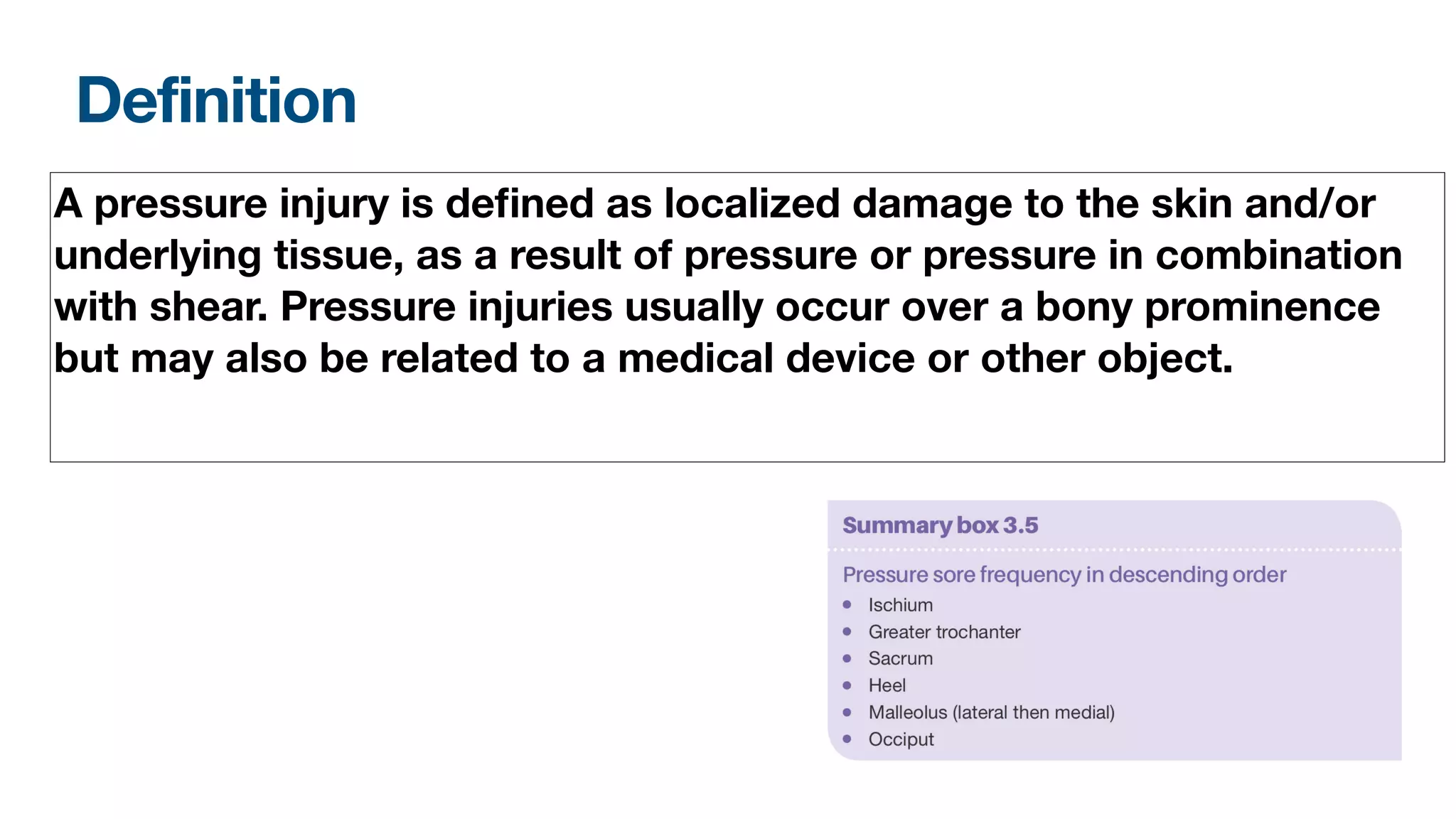
Definition
A pressure injury is de
fi
ned as localized damage to the skin and/or
underlying tissue, as a result of pressure or pressure in combination
with shear. Pressure injuries usually occur over a bony prominence
but may also be related to a medical device or other object.
Management Plan
Assessment : examination , risk factors ,classi
fi
cation , lab ,
imaging
Prevention
Non-operative treatment
Operative treatment
Risk factors
- stage
- Skin and surrounding
- Ischemic limb
- Infection : erythema, tenderness,
edema, purulence,
fl
uctuance,
crepitus,malodor
- Nutritional status
Examination
Pretreatment laboratory studies and imaging
• routine blood tests: albumin/pre-albumin for nutrition, in
fl
ammatory markers (FBE, CRP, ESR)
• swabs for microscopy and culture
• imaging: plain radiography, bone scan, MRI
• soft-tissue biopsy to rule out malignancy – i.e. Marjolins ulcer in chronic pressure sore,
although very rare
• bone biopsy if deep involvement to rule out osteomyelitis (will then need prolonged antibiotics).
• Albumin below 3.5 g/dL is associated with recurrence within 1 year
• Anemia, serum protein levels, and inflammatory markers have been shown to normalize after
surgical management of pressure sores, indicating that factors such as low serum albumin are
symptoms and not causes of the chronic process
Staging
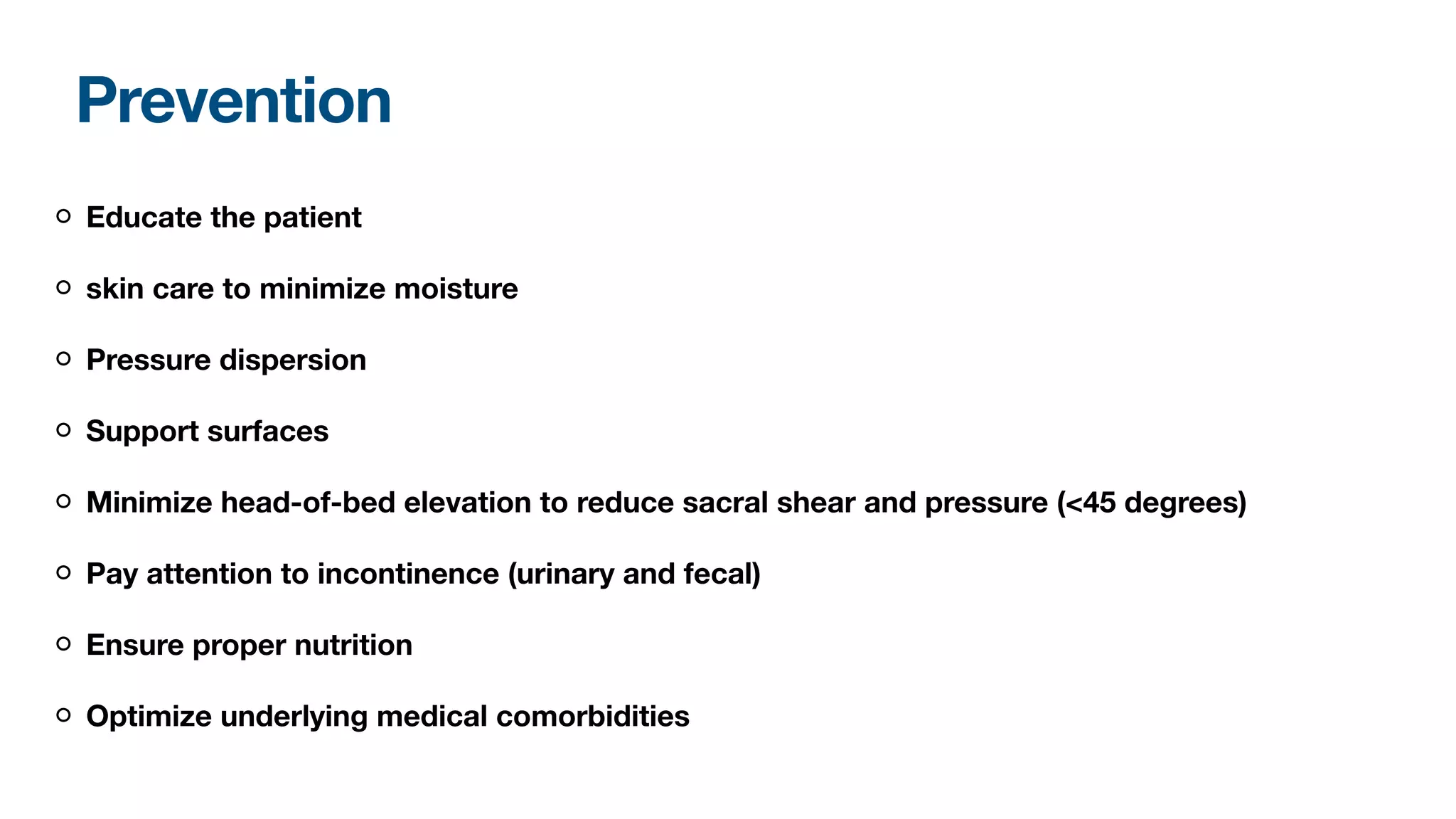
Prevention
Educate the patient
skin care to minimize moisture
Pressure dispersion
Support surfaces
Minimize head-of-bed elevation to reduce sacral shear and pressure (<45 degrees)
Pay attention to incontinence (urinary and fecal)
Ensure proper nutrition
Optimize underlying medical comorbidities
Pressure dispersion
• Padding of pressure points (operating room [OR], intensive-care unit [ICU], hospital bed)
• Pressure-relief behavior or alternate weight-bearing surfaces ▶ Kosiak’s principle: Tissue
tolerates increased pressure if interspersed with pressure-free periods ♦ Seated patients must be
lifted for 10 seconds every 10 minutes ♦ Supine patients must be turned every 2 hours
Support surfaces
• Static pads 26–28 ▶ At least 4 inches of foam is required to provide modest protection ▶
Cochrane review found that specific intraoperative surgical padding is effective at preventing
pressure ulcers ▶ Nonsurgical padding is less effective
• Alternating air cell mattresses ▶ Composed of air cells oriented perpendicularly to the patient ▶
May facilitate dispersal of accumulated metabolites through the vascular and lymphatic channels
• Low-air-loss mattresses ▶ Facilitate drying of the skin ▶ Exert less than 25 mm Hg of pressure
on any one point of the body
• Air-fluidized beds ▶ Patient floats on ceramic beads while warm-regulated air is forced through,
eliminating skin moisture ▶ Pressure is maintained at <20 mm Hg (capillary arterial pressure)
Non-operative
■ Relieve pressure
• Positional changes
• Proper mattress, cushion, or wheelchair
■ Control infection
■ Control extrinsic factors (shear, moisture, friction)
■ Debridement: Surgery versus topical enzymatic agent
■ Dressings
• Wet-to-dry saline dressing changes
• Dakin’s solution if Pseudomonas spp. suspected.
Dakin’s solution (sodium hypochlorite and boric acid) is toxic to healthy
tissue and should be used in dilute form (quarter strength) and only for a
limited period (e.g., 3 days).
• Silver sulfadiazine
• Other topicals (e.g., hydrogels, absorbent foams)
■ Osteomyelitis diagnosis critical to effective medical treatment
• Benchmark: Bone biopsy
• MRI, computed tomography (CT), and plain film may be used in
conjunction with physical examination for diagnosis34
■ Negative pressure wound therapy (NPWT)
• The role of NPWT in the treatment of pressure sores remains
controversial
• Effective for first-line treatment of stage III ulcers and some stage IV
ulcers35
• May bridge stage IV ulcers to surgery35,36
• Increase granulation tissue formation35
• Can be used to manage exudate and assist in wound
contraction35,36
• Systematic review showed no difference in wound surface area or
rate of healing with use of NPWT37
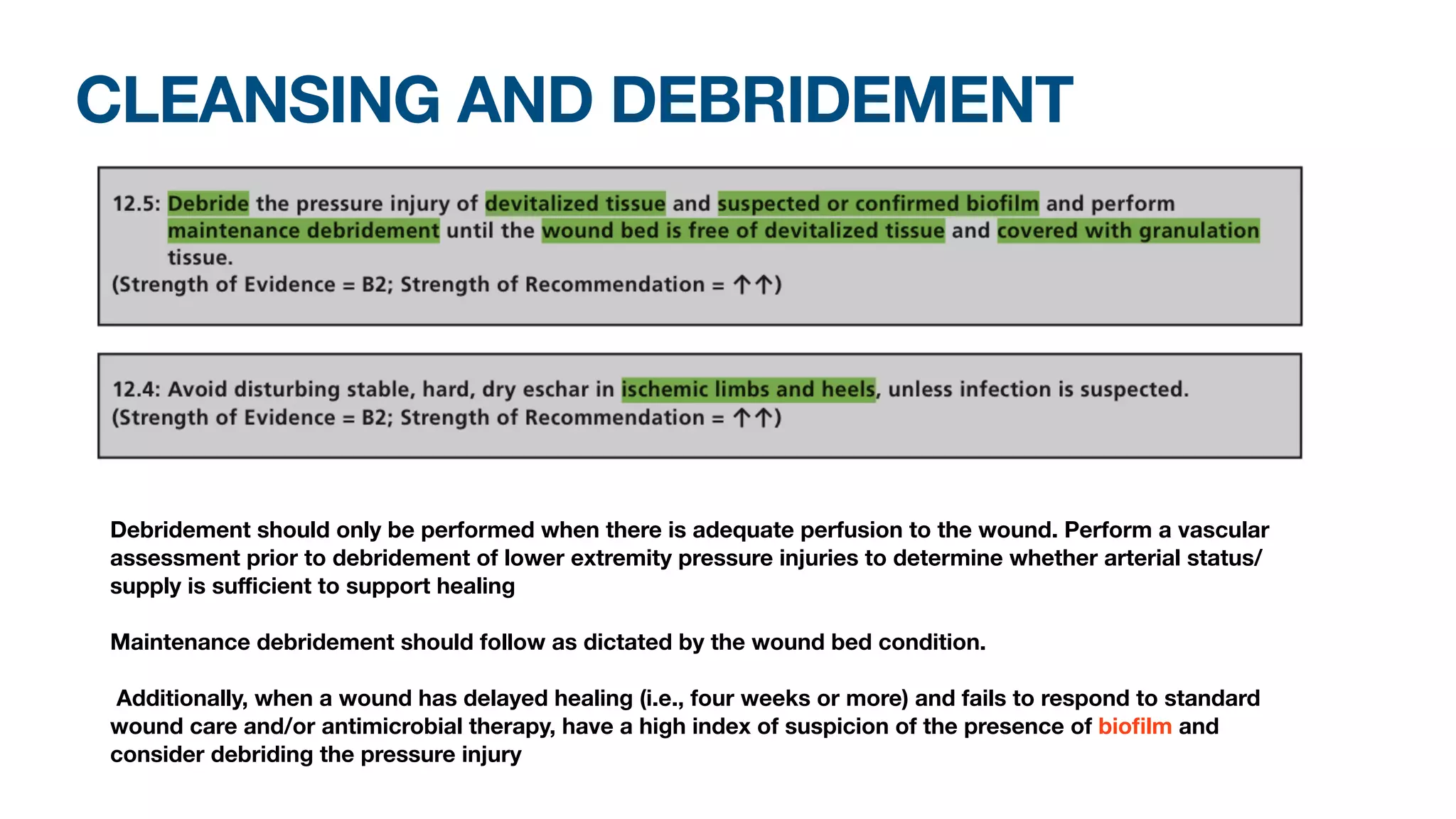
CLEANSING AND DEBRIDEMENT
Debridement should only be performed when there is adequate perfusion to the wound. Perform a vascular
assessment prior to debridement of lower extremity pressure injuries to determine whether arterial status/
supply is su
ffi
cient to support healing
Maintenance debridement should follow as dictated by the wound bed condition.
Additionally, when a wound has delayed healing (i.e., four weeks or more) and fails to respond to standard
wound care and/or antimicrobial therapy, have a high index of suspicion of the presence of bio
fi
lm and
consider debriding the pressure injury
Operative
■ Stage I and II pressure ulcers usually can
be managed nonsurgically
■ Stage III and IV pressure ulcers frequently
require surgical intervention
• Consider the patient’s ambulatory status to
help with proper flap selection
• Design flaps as large as possible with suture
lines away from area of direct pressure
Do not violate adjacent flap territories for
possible future flap coverage
GOALS OF RECONSTRUCTION
■ Debridement of all devitalized tissue
■ Complete excision of pseudobursa
■ Ostectomy of all devitalized or infected bone to clinically hard,
healthy, bleeding bone
■ Excellent hemostasis
■ Obliteration of dead space with well-vascularized tissue
■ Selection and creation of flaps that do not jeopardize future flap
coverage
■ Tension-free closure
■ Pressure off-loading of reconstructed area
Home messages
• Pressure ulcer management is a Multidisciplinary team
management
• Clinical assessment is an important step to guide the
management
• Management plan scheme should be always considered
• Debridement is not the only management rather than a part of
the management !
References :

Pressure ulcer.pdf

  • 1.
  • 2.
    Case presentation • 75years old male, with 2 months history of unstageable pressure ulcer on the sacrum , secondary to immobility and incontinence. • Type 2 Diabetes- diagnosed at age 35, Hyperlipidemia , Diabetic foot ulcers, Diabetic neuropathy. • Right leg below knee amputation, 5 years ago- at age 70. • The attending resident treated the patient with local wound care , dressing , topical antibiotics but without SURGICAL DEBRIDEMENT , justifying his decision as it is a mild stage !
  • 3.
    Definition A pressure injuryis de fi ned as localized damage to the skin and/or underlying tissue, as a result of pressure or pressure in combination with shear. Pressure injuries usually occur over a bony prominence but may also be related to a medical device or other object.
  • 6.
    Management Plan Assessment :examination , risk factors ,classi fi cation , lab , imaging Prevention Non-operative treatment Operative treatment
  • 7.
    Risk factors - stage -Skin and surrounding - Ischemic limb - Infection : erythema, tenderness, edema, purulence, fl uctuance, crepitus,malodor - Nutritional status Examination
  • 8.
    Pretreatment laboratory studiesand imaging • routine blood tests: albumin/pre-albumin for nutrition, in fl ammatory markers (FBE, CRP, ESR) • swabs for microscopy and culture • imaging: plain radiography, bone scan, MRI • soft-tissue biopsy to rule out malignancy – i.e. Marjolins ulcer in chronic pressure sore, although very rare • bone biopsy if deep involvement to rule out osteomyelitis (will then need prolonged antibiotics). • Albumin below 3.5 g/dL is associated with recurrence within 1 year • Anemia, serum protein levels, and inflammatory markers have been shown to normalize after surgical management of pressure sores, indicating that factors such as low serum albumin are symptoms and not causes of the chronic process
  • 9.
  • 10.
    Prevention Educate the patient skincare to minimize moisture Pressure dispersion Support surfaces Minimize head-of-bed elevation to reduce sacral shear and pressure (<45 degrees) Pay attention to incontinence (urinary and fecal) Ensure proper nutrition Optimize underlying medical comorbidities
  • 11.
    Pressure dispersion • Paddingof pressure points (operating room [OR], intensive-care unit [ICU], hospital bed) • Pressure-relief behavior or alternate weight-bearing surfaces ▶ Kosiak’s principle: Tissue tolerates increased pressure if interspersed with pressure-free periods ♦ Seated patients must be lifted for 10 seconds every 10 minutes ♦ Supine patients must be turned every 2 hours Support surfaces • Static pads 26–28 ▶ At least 4 inches of foam is required to provide modest protection ▶ Cochrane review found that specific intraoperative surgical padding is effective at preventing pressure ulcers ▶ Nonsurgical padding is less effective • Alternating air cell mattresses ▶ Composed of air cells oriented perpendicularly to the patient ▶ May facilitate dispersal of accumulated metabolites through the vascular and lymphatic channels • Low-air-loss mattresses ▶ Facilitate drying of the skin ▶ Exert less than 25 mm Hg of pressure on any one point of the body • Air-fluidized beds ▶ Patient floats on ceramic beads while warm-regulated air is forced through, eliminating skin moisture ▶ Pressure is maintained at <20 mm Hg (capillary arterial pressure)
  • 12.
    Non-operative ■ Relieve pressure •Positional changes • Proper mattress, cushion, or wheelchair ■ Control infection ■ Control extrinsic factors (shear, moisture, friction) ■ Debridement: Surgery versus topical enzymatic agent ■ Dressings • Wet-to-dry saline dressing changes • Dakin’s solution if Pseudomonas spp. suspected. Dakin’s solution (sodium hypochlorite and boric acid) is toxic to healthy tissue and should be used in dilute form (quarter strength) and only for a limited period (e.g., 3 days). • Silver sulfadiazine • Other topicals (e.g., hydrogels, absorbent foams) ■ Osteomyelitis diagnosis critical to effective medical treatment • Benchmark: Bone biopsy • MRI, computed tomography (CT), and plain film may be used in conjunction with physical examination for diagnosis34 ■ Negative pressure wound therapy (NPWT) • The role of NPWT in the treatment of pressure sores remains controversial • Effective for first-line treatment of stage III ulcers and some stage IV ulcers35 • May bridge stage IV ulcers to surgery35,36 • Increase granulation tissue formation35 • Can be used to manage exudate and assist in wound contraction35,36 • Systematic review showed no difference in wound surface area or rate of healing with use of NPWT37
  • 13.
    CLEANSING AND DEBRIDEMENT Debridementshould only be performed when there is adequate perfusion to the wound. Perform a vascular assessment prior to debridement of lower extremity pressure injuries to determine whether arterial status/ supply is su ffi cient to support healing Maintenance debridement should follow as dictated by the wound bed condition. Additionally, when a wound has delayed healing (i.e., four weeks or more) and fails to respond to standard wound care and/or antimicrobial therapy, have a high index of suspicion of the presence of bio fi lm and consider debriding the pressure injury
  • 17.
    Operative ■ Stage Iand II pressure ulcers usually can be managed nonsurgically ■ Stage III and IV pressure ulcers frequently require surgical intervention • Consider the patient’s ambulatory status to help with proper flap selection • Design flaps as large as possible with suture lines away from area of direct pressure Do not violate adjacent flap territories for possible future flap coverage GOALS OF RECONSTRUCTION ■ Debridement of all devitalized tissue ■ Complete excision of pseudobursa ■ Ostectomy of all devitalized or infected bone to clinically hard, healthy, bleeding bone ■ Excellent hemostasis ■ Obliteration of dead space with well-vascularized tissue ■ Selection and creation of flaps that do not jeopardize future flap coverage ■ Tension-free closure ■ Pressure off-loading of reconstructed area
  • 18.
    Home messages • Pressureulcer management is a Multidisciplinary team management • Clinical assessment is an important step to guide the management • Management plan scheme should be always considered • Debridement is not the only management rather than a part of the management !
  • 19.