Security and Privacy in
                        Emerging Aerospace Scenarios


                              Pierangela Samarati
                    Dipartimento di Tecnologie dell’Informazione
                           Università degli Studi di Milano
                             pierangela.samarati@unimi.it


                            ESTEL Conference presentation
                            Rome, Italy - December 21, 2011


c Pierangela Samarati                                              1/14
The modern Information Society

 • Computers, mobile smart devices, and space technology are at
   the basis of the modern Information Society for enhancing the
   quality of life
 • Space technology in ICT:
         ◦ provide communications
         ◦ provide broadcast services
         ◦ deliver services (e.g., e-learning, e-health, e-commerce) to remote
           regions
         ◦ observe the Earth (e.g., environmental monitoring, urban planning,
           disaster management)
         ◦ provide time and space localization (GPS)
         ◦ study near-Earth space and explore the solar system and the
           distant universe
         ◦ ...
c Pierangela Samarati                                                        2/14
Security in Aerospace Systems
Aerospace security

 • Guaranteeing security requires protecting the aerospace
   infrastructure (satellites, planes, ground stations),
   communications, and applications, to ensure:

         ◦ integrity of data and resources

         ◦ confidentiality of information (privacy)

         ◦ availability (no denial of services)


c Pierangela Samarati                                        4/14
Security techniques

 • Some protection can be achieved by applying classical
   techniques, e.g.:

         ◦ authentication of users and devices

         ◦ access control

         ◦ firewalls

         ◦ antiviruses and intrusion detection systems

         ◦ encryption for protecting data in storage and communications

 • In emerging scenarios there are new challenges, e.g.:

         ◦ integrity and privacy in data management

         ◦ privacy in location-based applications
c Pierangela Samarati                                                     5/14
Integrity and Privacy in Data Management
Integrity and privacy in data management

 • The evolution of technologies for data management applies also
   to satellite and aerospatial data stored and processed at base
   stations

 • Outsourcing data and services to external servers can provide

        + significant cost savings and service benefits

        + higher availability and more effective disaster protection than
          in-house operations
     =⇒ natural evolution to move to the cloud environment

 • In addition to classical challenges, a major problem is:
        − data are not under the data owner’s control


c Pierangela Samarati                                                       7/14
Privacy in outsourced and cloud environment

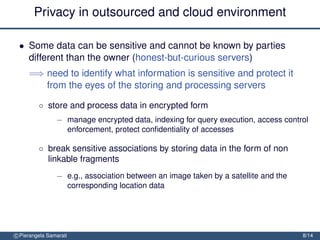
 • Some data can be sensitive and cannot be known by parties
   different than the owner (honest-but-curious servers)
     =⇒ need to identify what information is sensitive and protect it
        from the eyes of the storing and processing servers

         ◦ store and process data in encrypted form
                − manage encrypted data, indexing for query execution, access control
                  enforcement, protect confidentiality of accesses

         ◦ break sensitive associations by storing data in the form of non
           linkable fragments
                − e.g., association between an image taken by a satellite and the
                  corresponding location data


c Pierangela Samarati                                                               8/14
Integrity in outsourced and cloud environment

 • External lazy/malicious servers can misbehave
     =⇒ data in storage can be compromised (e.g., altered data,
        missed updates)

         ◦ digital signatures

         ◦ authenticated data structures

     =⇒ queries might be not performed properly returning an
        incorrect or incomplete result

         ◦ authenticated data structures (e.g., Merkle tree)

         ◦ probabilistic approaches (e.g., data replications, marker tuples)


c Pierangela Samarati                                                          9/14
Privacy in Location-based Applications
Location-based services in the Information Society

  • Location-based services are becoming part of our daily life

          ◦ positioning of objects and persons (e.g., car navigation via a GPS
            device)
          ◦ searching for information on objects or services on a map (e.g.,
            locating a specific supermarket)
          ◦ tagging resources with geographic information (e.g., geo-tags in
            Twitter)

      =⇒ may raise privacy concerns


c Pierangela Samarati                                                          11/14
Privacy issues in location services

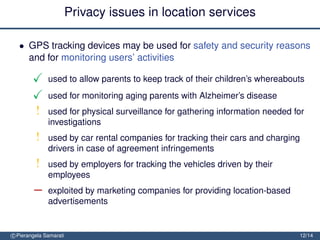
  • GPS tracking devices may be used for safety and security reasons
    and for monitoring users’ activities

              used to allow parents to keep track of their children’s whereabouts
              used for monitoring aging parents with Alzheimer’s disease
         !    used for physical surveillance for gathering information needed for
              investigations
         !    used by car rental companies for tracking their cars and charging
              drivers in case of agreement infringements
         !    used by employers for tracking the vehicles driven by their
              employees
        −     exploited by marketing companies for providing location-based
              advertisements


c Pierangela Samarati                                                          12/14
Privacy in location-based applications

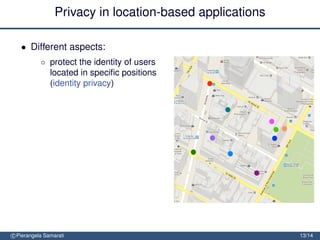
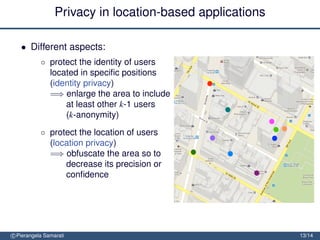
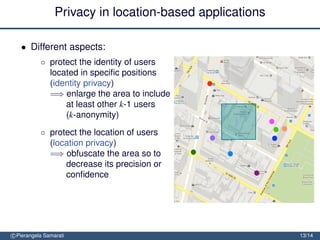
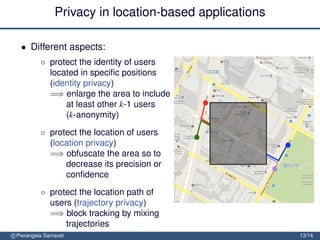
   • Different aspects:
           ◦ protect the identity of users
             located in specific positions
             (identity privacy)
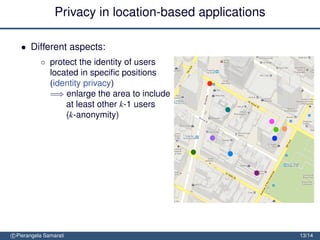
             =⇒ enlarge the area to include
                 at least other k-1 users
                 (k-anonymity)


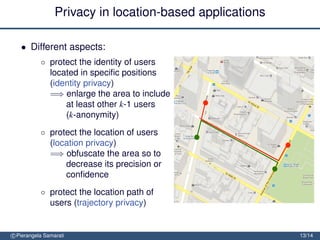
               protect the location of users (location privacy)
               =⇒ obfuscate the area so to
                   decrease its precision or
                   confidence


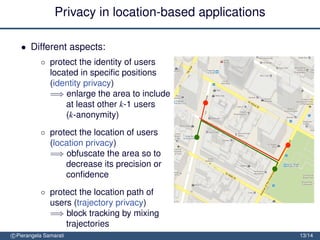
               protect the location path of users (trajectory privacy)

               =⇒ block tracking by mixing
                  trajectories
c Pierangela Samarati                                                    13/14
Privacy in location-based applications

   • Different aspects:
           ◦ protect the identity of users
             located in specific positions
             (identity privacy)
             =⇒ enlarge the area to include
                 at least other k-1 users
                 (k-anonymity)


               protect the location of users (location privacy)
               =⇒ obfuscate the area so to
                   decrease its precision or
                   confidence


               protect the location path of users (trajectory privacy)

               =⇒ block tracking by mixing
                  trajectories
c Pierangela Samarati                                                    13/14
Privacy in location-based applications

   • Different aspects:
           ◦ protect the identity of users
             located in specific positions
             (identity privacy)
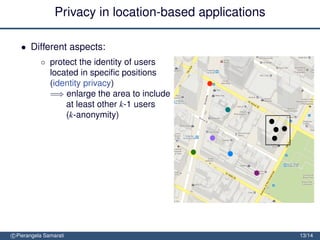
             =⇒ enlarge the area to include
                 at least other k-1 users
                 (k-anonymity)


               protect the location of users (location privacy)
               =⇒ obfuscate the area so to
                   decrease its precision or
                   confidence


               protect the location path of users (trajectory privacy)

               =⇒ block tracking by mixing
                  trajectories
c Pierangela Samarati                                                    13/14
Privacy in location-based applications

   • Different aspects:
           ◦ protect the identity of users
             located in specific positions
             (identity privacy)
             =⇒ enlarge the area to include
                 at least other k-1 users
                 (k-anonymity)
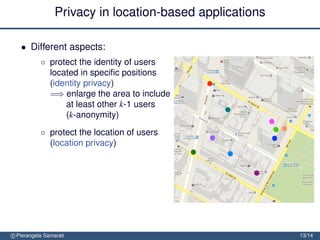
           ◦ protect the location of users
             (location privacy)
             =⇒ obfuscate the area so to
                 decrease its precision or
                 confidence


               protect the location path of users (trajectory privacy)

               =⇒ block tracking by mixing
                  trajectories
c Pierangela Samarati                                                    13/14
Privacy in location-based applications

   • Different aspects:
           ◦ protect the identity of users
             located in specific positions
             (identity privacy)
             =⇒ enlarge the area to include
                 at least other k-1 users
                 (k-anonymity)
           ◦ protect the location of users
             (location privacy)
             =⇒ obfuscate the area so to
                 decrease its precision or
                 confidence


               protect the location path of users (trajectory privacy)

               =⇒ block tracking by mixing
                  trajectories
c Pierangela Samarati                                                    13/14
Privacy in location-based applications

   • Different aspects:
           ◦ protect the identity of users
             located in specific positions
             (identity privacy)
             =⇒ enlarge the area to include
                 at least other k-1 users
                 (k-anonymity)
           ◦ protect the location of users
             (location privacy)
             =⇒ obfuscate the area so to
                 decrease its precision or
                 confidence


               protect the location path of users (trajectory privacy)

               =⇒ block tracking by mixing
                  trajectories
c Pierangela Samarati                                                    13/14
Privacy in location-based applications

   • Different aspects:
           ◦ protect the identity of users
             located in specific positions
             (identity privacy)
             =⇒ enlarge the area to include
                 at least other k-1 users
                 (k-anonymity)
           ◦ protect the location of users
             (location privacy)
             =⇒ obfuscate the area so to
                 decrease its precision or
                 confidence
           ◦ protect the location path of
             users (trajectory privacy)
             =⇒ block tracking by mixing
                 trajectories
c Pierangela Samarati                                     13/14
Privacy in location-based applications

   • Different aspects:
           ◦ protect the identity of users
             located in specific positions
             (identity privacy)
             =⇒ enlarge the area to include
                 at least other k-1 users
                 (k-anonymity)
           ◦ protect the location of users
             (location privacy)
             =⇒ obfuscate the area so to
                 decrease its precision or
                 confidence
           ◦ protect the location path of
             users (trajectory privacy)
             =⇒ block tracking by mixing
                 trajectories
c Pierangela Samarati                                     13/14
Privacy in location-based applications

   • Different aspects:
           ◦ protect the identity of users
             located in specific positions
             (identity privacy)
             =⇒ enlarge the area to include
                 at least other k-1 users
                 (k-anonymity)
           ◦ protect the location of users
             (location privacy)
             =⇒ obfuscate the area so to
                 decrease its precision or
                 confidence
           ◦ protect the location path of
             users (trajectory privacy)
             =⇒ block tracking by mixing
                 trajectories
c Pierangela Samarati                                     13/14
Conclusions

  • Space technology in ICT:

         + enable new services and applications enhancing the quality of life

         + promote social and economic development

          ◦ require addressing security and privacy issues to ensure
            correctness of applications and social acceptability


c Pierangela Samarati                                                       14/14

Security and Privacy in Emerging Aerospace Scenarios - Pierangela Samarati

  • 1.
    Security and Privacyin Emerging Aerospace Scenarios Pierangela Samarati Dipartimento di Tecnologie dell’Informazione Università degli Studi di Milano pierangela.samarati@unimi.it ESTEL Conference presentation Rome, Italy - December 21, 2011 c Pierangela Samarati 1/14
  • 2.
    The modern InformationSociety • Computers, mobile smart devices, and space technology are at the basis of the modern Information Society for enhancing the quality of life • Space technology in ICT: ◦ provide communications ◦ provide broadcast services ◦ deliver services (e.g., e-learning, e-health, e-commerce) to remote regions ◦ observe the Earth (e.g., environmental monitoring, urban planning, disaster management) ◦ provide time and space localization (GPS) ◦ study near-Earth space and explore the solar system and the distant universe ◦ ... c Pierangela Samarati 2/14
  • 3.
  • 4.
    Aerospace security •Guaranteeing security requires protecting the aerospace infrastructure (satellites, planes, ground stations), communications, and applications, to ensure: ◦ integrity of data and resources ◦ confidentiality of information (privacy) ◦ availability (no denial of services) c Pierangela Samarati 4/14
  • 5.
    Security techniques •Some protection can be achieved by applying classical techniques, e.g.: ◦ authentication of users and devices ◦ access control ◦ firewalls ◦ antiviruses and intrusion detection systems ◦ encryption for protecting data in storage and communications • In emerging scenarios there are new challenges, e.g.: ◦ integrity and privacy in data management ◦ privacy in location-based applications c Pierangela Samarati 5/14
  • 6.
    Integrity and Privacyin Data Management
  • 7.
    Integrity and privacyin data management • The evolution of technologies for data management applies also to satellite and aerospatial data stored and processed at base stations • Outsourcing data and services to external servers can provide + significant cost savings and service benefits + higher availability and more effective disaster protection than in-house operations =⇒ natural evolution to move to the cloud environment • In addition to classical challenges, a major problem is: − data are not under the data owner’s control c Pierangela Samarati 7/14
  • 8.
    Privacy in outsourcedand cloud environment • Some data can be sensitive and cannot be known by parties different than the owner (honest-but-curious servers) =⇒ need to identify what information is sensitive and protect it from the eyes of the storing and processing servers ◦ store and process data in encrypted form − manage encrypted data, indexing for query execution, access control enforcement, protect confidentiality of accesses ◦ break sensitive associations by storing data in the form of non linkable fragments − e.g., association between an image taken by a satellite and the corresponding location data c Pierangela Samarati 8/14
  • 9.
    Integrity in outsourcedand cloud environment • External lazy/malicious servers can misbehave =⇒ data in storage can be compromised (e.g., altered data, missed updates) ◦ digital signatures ◦ authenticated data structures =⇒ queries might be not performed properly returning an incorrect or incomplete result ◦ authenticated data structures (e.g., Merkle tree) ◦ probabilistic approaches (e.g., data replications, marker tuples) c Pierangela Samarati 9/14
  • 10.
  • 11.
    Location-based services inthe Information Society • Location-based services are becoming part of our daily life ◦ positioning of objects and persons (e.g., car navigation via a GPS device) ◦ searching for information on objects or services on a map (e.g., locating a specific supermarket) ◦ tagging resources with geographic information (e.g., geo-tags in Twitter) =⇒ may raise privacy concerns c Pierangela Samarati 11/14
  • 12.
    Privacy issues inlocation services • GPS tracking devices may be used for safety and security reasons and for monitoring users’ activities used to allow parents to keep track of their children’s whereabouts used for monitoring aging parents with Alzheimer’s disease ! used for physical surveillance for gathering information needed for investigations ! used by car rental companies for tracking their cars and charging drivers in case of agreement infringements ! used by employers for tracking the vehicles driven by their employees − exploited by marketing companies for providing location-based advertisements c Pierangela Samarati 12/14
  • 13.
    Privacy in location-basedapplications • Different aspects: ◦ protect the identity of users located in specific positions (identity privacy) =⇒ enlarge the area to include at least other k-1 users (k-anonymity) protect the location of users (location privacy) =⇒ obfuscate the area so to decrease its precision or confidence protect the location path of users (trajectory privacy) =⇒ block tracking by mixing trajectories c Pierangela Samarati 13/14
  • 14.
    Privacy in location-basedapplications • Different aspects: ◦ protect the identity of users located in specific positions (identity privacy) =⇒ enlarge the area to include at least other k-1 users (k-anonymity) protect the location of users (location privacy) =⇒ obfuscate the area so to decrease its precision or confidence protect the location path of users (trajectory privacy) =⇒ block tracking by mixing trajectories c Pierangela Samarati 13/14
  • 15.
    Privacy in location-basedapplications • Different aspects: ◦ protect the identity of users located in specific positions (identity privacy) =⇒ enlarge the area to include at least other k-1 users (k-anonymity) protect the location of users (location privacy) =⇒ obfuscate the area so to decrease its precision or confidence protect the location path of users (trajectory privacy) =⇒ block tracking by mixing trajectories c Pierangela Samarati 13/14
  • 16.
    Privacy in location-basedapplications • Different aspects: ◦ protect the identity of users located in specific positions (identity privacy) =⇒ enlarge the area to include at least other k-1 users (k-anonymity) ◦ protect the location of users (location privacy) =⇒ obfuscate the area so to decrease its precision or confidence protect the location path of users (trajectory privacy) =⇒ block tracking by mixing trajectories c Pierangela Samarati 13/14
  • 17.
    Privacy in location-basedapplications • Different aspects: ◦ protect the identity of users located in specific positions (identity privacy) =⇒ enlarge the area to include at least other k-1 users (k-anonymity) ◦ protect the location of users (location privacy) =⇒ obfuscate the area so to decrease its precision or confidence protect the location path of users (trajectory privacy) =⇒ block tracking by mixing trajectories c Pierangela Samarati 13/14
  • 18.
    Privacy in location-basedapplications • Different aspects: ◦ protect the identity of users located in specific positions (identity privacy) =⇒ enlarge the area to include at least other k-1 users (k-anonymity) ◦ protect the location of users (location privacy) =⇒ obfuscate the area so to decrease its precision or confidence protect the location path of users (trajectory privacy) =⇒ block tracking by mixing trajectories c Pierangela Samarati 13/14
  • 19.
    Privacy in location-basedapplications • Different aspects: ◦ protect the identity of users located in specific positions (identity privacy) =⇒ enlarge the area to include at least other k-1 users (k-anonymity) ◦ protect the location of users (location privacy) =⇒ obfuscate the area so to decrease its precision or confidence ◦ protect the location path of users (trajectory privacy) =⇒ block tracking by mixing trajectories c Pierangela Samarati 13/14
  • 20.
    Privacy in location-basedapplications • Different aspects: ◦ protect the identity of users located in specific positions (identity privacy) =⇒ enlarge the area to include at least other k-1 users (k-anonymity) ◦ protect the location of users (location privacy) =⇒ obfuscate the area so to decrease its precision or confidence ◦ protect the location path of users (trajectory privacy) =⇒ block tracking by mixing trajectories c Pierangela Samarati 13/14
  • 21.
    Privacy in location-basedapplications • Different aspects: ◦ protect the identity of users located in specific positions (identity privacy) =⇒ enlarge the area to include at least other k-1 users (k-anonymity) ◦ protect the location of users (location privacy) =⇒ obfuscate the area so to decrease its precision or confidence ◦ protect the location path of users (trajectory privacy) =⇒ block tracking by mixing trajectories c Pierangela Samarati 13/14
  • 22.
    Conclusions •Space technology in ICT: + enable new services and applications enhancing the quality of life + promote social and economic development ◦ require addressing security and privacy issues to ensure correctness of applications and social acceptability c Pierangela Samarati 14/14