1
Sexually Transmitted Diseases
(STD’s)
2
Common STD’s
• Chlamydia
• Gonorrhea
• Syphillis
• Trichomoniasis
• Pubic Lice
• Genital Herpes (HSV-2)
• Genital Warts (HPV)
3
Chlamydia
• Bacterial Infection (curable) - Chlamydia trachomatis.
• Affects the reproductive organs of both males and females.
• World wide occurrence is 3-4 million cases/year.
• Spread through unprotected oral, vaginal or anal sex.
• 70% of woman and 10% of men have no symptoms
• Symptoms generally appear within three weeks of infection.
4
• Female symptoms:
- Vaginal discharge or burning with urination
- Lower abdominal pain
- Low-grade fever
• Male symptoms:
- Discharge from the penis or burning with urination
- Burning and itching around the opening of the penis
- Pain and swelling in the testicles
- Low –grade fever
• Treatment: Azithromycin (drug of choice) and other antibiotics - Cefixime,
Erythromycin, Amoxicillin, Doxycycline
• Prokarium (London, UK based company) is in the process of developing
Chlamydia trachomatis vaccine.
5
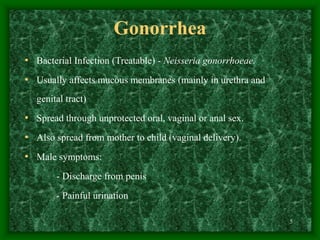
Gonorrhea
• Bacterial Infection (Treatable) - Neisseria gonorrhoeae.
• Usually affects mucous membranes (mainly in urethra and
genital tract)
• Spread through unprotected oral, vaginal or anal sex.
• Also spread from mother to child (vaginal delivery).
• Male symptoms:
- Discharge from penis
- Painful urination
6
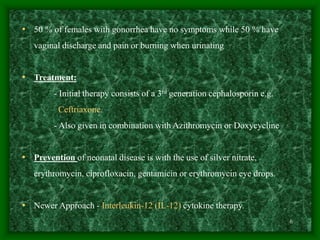
• 50 % of females with gonorrhea have no symptoms while 50 % have
vaginal discharge and pain or burning when urinating
• Treatment:
- Initial therapy consists of a 3rd generation cephalosporin e.g.
Ceftriaxone.
- Also given in combination with Azithromycin or Doxycycline
• Prevention of neonatal disease is with the use of silver nitrate,
erythromycin, ciprofloxacin, gentamicin or erythromycin eye drops.
• Newer Approach - Interleukin-12 (IL-12) cytokine therapy.
7
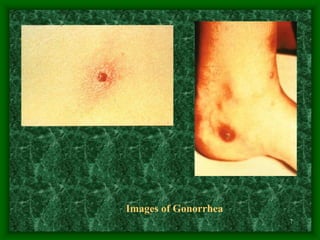
Images of Gonorrhea
8
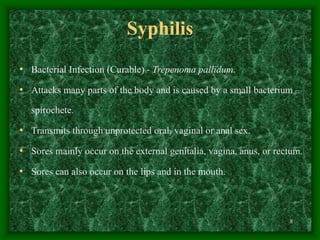
Syphilis
• Bacterial Infection (Curable) - Trepenoma pallidum.
• Attacks many parts of the body and is caused by a small bacterium –
spirochete.
• Transmits through unprotected oral, vaginal or anal sex.
• Sores mainly occur on the external genitalia, vagina, anus, or rectum.
• Sores can also occur on the lips and in the mouth.
9
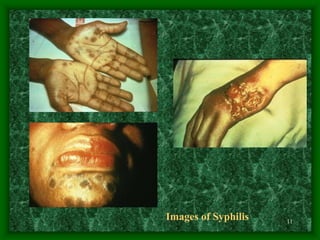
• Primary syphilis: Chancre
- Penetrate mucous membranes of genital tract, oral cavity, rectal mucosa
- Forms a chancre: small ulcer at site of inoculation
- Persists for 4-6 weeks and heals even without treatment
• Secondary syphilis: Systemic infection with skin rash & enlarged lymph nodes
- Begins several months after chancre has healed
- Persist for several weeks then subsides even without treatment
• Tertiary syphilis: Late destructive lesions in internal organs
- Late manifestations of the disease may appear 20 years after initial infection
- Organisms remain active, causing irreparable organ damage (scarring of aortic valve;
degeneration of fiber tracts in spinal cord; mental destruction; paralysis)
10
• Congenital Syphilis
- Transmission of disease from mother to child
- May cause death of fetus
• Treatment:
- Penicillin (Drug of Choice)
- Other antibiotics Doxycycline, Tetracycline, Ceftriaxone, Azithromycin
• Prevention:
- Safe sex with condoms may help prevent transmission
11
Images of Syphilis
12
Genital Herpes (HSV-2)
• Virus Infection (Incurable) - Herpes Simplex Type 2 Virus
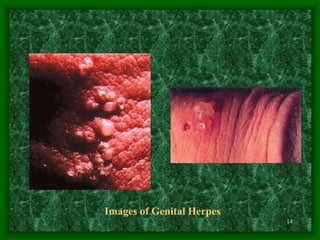
• “Outbreaks” of blisters and ulcers.
• Herpes infection is of two types:
- Type 1: infects oral mucous membrane (80% of infections).
- Type 2: infects genital tract (80% of infections).
• Transmission via vaginal, oral and anal sex.
• Transmission of virus can also occur through fingers.
• Herpes simplex remains in body for life.
13
• Symptoms:
* Most common symptom is blister
- First (primary) outbreak occurs within a few weeks of contact
- May continue for a couple weeks
- May feel painful, itchy, burning
* Flu-like symptoms (headache, fever, swollen lymph glands, muscle
aches, etc)
* Burning during urination
• Treatment: Symptoms are treatable only
- Antiretroviral drugs e.g. aciclovir, famciclovir and valaciclovir.
- Keep affected area clean, Wash hands
- Refrain from sexual activity until outbreak is gone
- Condoms may help prevent herpes transmission
14
Images of Genital Herpes
15
Genital Warts (HPV)
• Virus Infection (Incurable) - Human Papilloma Virus (HPV)
• Human Papilloma Virus (HPV)
* A group of many viruses
* 200+ strains
* 40+ HPV forms can be sexually transmitted
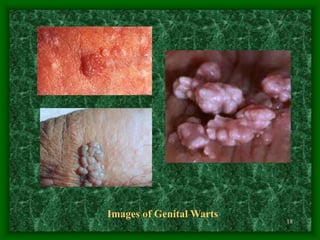
• Characteristics of Warts:
- Pink or reddish warts.
- Cauliflower like tops that appear on the genitals, the vagina, or the
cervix one to three months after infection from HPV.
16
• Transmission via vaginal, oral and anal sex.
• Warts may cause itching, burning and some pain.
• Approx. 30 of the HPV strains cause cervical cancer.
• HPV may also increase risk of vulvar, anal, penile and oral cancers.
• Genital warts may disappear on their own.
• Topical ointments/creams provided by physician.
• Freezing/burning/laser treatments for smaller warts
17
• Treatment: Prescription medicines include:
- Podofilox for external warts (to stop the wart cells from growing).
- Imiquimod (boosts the body’s immune system so it can fight HPV).
- Green tea extract (sinecatechins) ointment for external warts.
- Interferon, an antiviral medicine, may be injected into genital warts
• Procedures: A dermatologist may perform one of these procedures:
- Cryosurgery (freeze off the warts with liquid nitrogen).
- Excision (cut out the warts).
- Electrocautery (destroy the warts with an electric current).
- Laser treatment (destroy the warts with laser light).
• Prevention:
* Refrain from sexual activity until warts are gone
* Condoms may help prevent HPV transmission
* HPV Vaccines
- Gardasil (FDA approved for males & females, age 9-26 yrs)
- Cervarix (FDA approved for females, aged 10-25)
18
Images of Genital Warts
19
Trichomoniasis
• Parasitic Infection (Curable) - Trichomonas vaginalis
• Sometimes called “trich” - a parasite that can be passed from person
to person during sexual intercourse.
• Occurs in vagina of women.
• Trichomoniasis is a common cause of Vaginitis.
• Transmitted to the baby during delivery.
• Also occur in the urethra in men with no symptoms usually.
20
• Symptoms:
1. Female Symptoms:
- Itching and burning at the opening of the vagina and vulva.
- Painful and frequent urination
- Heavy, unpleasant smelling greenish, yellow discharge
2. Male symptoms:
Usually nothing, or discomfort in urethra, inflamed head of the penis.
• Treatment:
- Metronidazole (Oral antibiotic)
• Prevention:
- Safe and Protected sex with partner
- Using male/ female condoms
21
Pubic Lice
• Parasitic Infection (Curable): Phthirus pubis
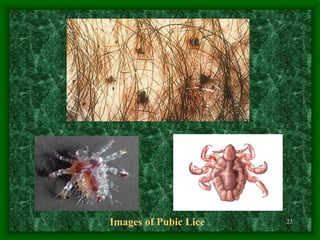
• Pubic lice are called “crabs” because they look like crabs.
• They are tiny insects that can crawl from the pubic hair of one person to
the pubic hair of another person.
• They usually attack the sexual (pubic) areas of the body.
• Also found in under arms, eyelashes, moustaches.
• Spread through direct physical contact or close body contact with an
infected person.
• Symptoms:
- Persisting itch in the genital, rectal area.
22
• Treatment:
- Decontaminating yourself, your clothes, and your bedding.
- Medications include:
Malathion: topical lotion
Ivermectin: two-pill oral dose
Lindane: toxic to lice
• Prevention:
- Avoid sharing clothes, bedding, or towels with anyone having public lice.
- Sexual contact - avoided until treatment is complete and successful.
23
Images of Pubic Lice
24
Thanks
for
Understanding

presentation_stds_1491848400_223793.ppt

  • 1.
  • 2.
    2 Common STD’s • Chlamydia •Gonorrhea • Syphillis • Trichomoniasis • Pubic Lice • Genital Herpes (HSV-2) • Genital Warts (HPV)
  • 3.
    3 Chlamydia • Bacterial Infection(curable) - Chlamydia trachomatis. • Affects the reproductive organs of both males and females. • World wide occurrence is 3-4 million cases/year. • Spread through unprotected oral, vaginal or anal sex. • 70% of woman and 10% of men have no symptoms • Symptoms generally appear within three weeks of infection.
  • 4.
    4 • Female symptoms: -Vaginal discharge or burning with urination - Lower abdominal pain - Low-grade fever • Male symptoms: - Discharge from the penis or burning with urination - Burning and itching around the opening of the penis - Pain and swelling in the testicles - Low –grade fever • Treatment: Azithromycin (drug of choice) and other antibiotics - Cefixime, Erythromycin, Amoxicillin, Doxycycline • Prokarium (London, UK based company) is in the process of developing Chlamydia trachomatis vaccine.
  • 5.
    5 Gonorrhea • Bacterial Infection(Treatable) - Neisseria gonorrhoeae. • Usually affects mucous membranes (mainly in urethra and genital tract) • Spread through unprotected oral, vaginal or anal sex. • Also spread from mother to child (vaginal delivery). • Male symptoms: - Discharge from penis - Painful urination
  • 6.
    6 • 50 %of females with gonorrhea have no symptoms while 50 % have vaginal discharge and pain or burning when urinating • Treatment: - Initial therapy consists of a 3rd generation cephalosporin e.g. Ceftriaxone. - Also given in combination with Azithromycin or Doxycycline • Prevention of neonatal disease is with the use of silver nitrate, erythromycin, ciprofloxacin, gentamicin or erythromycin eye drops. • Newer Approach - Interleukin-12 (IL-12) cytokine therapy.
  • 7.
  • 8.
    8 Syphilis • Bacterial Infection(Curable) - Trepenoma pallidum. • Attacks many parts of the body and is caused by a small bacterium – spirochete. • Transmits through unprotected oral, vaginal or anal sex. • Sores mainly occur on the external genitalia, vagina, anus, or rectum. • Sores can also occur on the lips and in the mouth.
  • 9.
    9 • Primary syphilis:Chancre - Penetrate mucous membranes of genital tract, oral cavity, rectal mucosa - Forms a chancre: small ulcer at site of inoculation - Persists for 4-6 weeks and heals even without treatment • Secondary syphilis: Systemic infection with skin rash & enlarged lymph nodes - Begins several months after chancre has healed - Persist for several weeks then subsides even without treatment • Tertiary syphilis: Late destructive lesions in internal organs - Late manifestations of the disease may appear 20 years after initial infection - Organisms remain active, causing irreparable organ damage (scarring of aortic valve; degeneration of fiber tracts in spinal cord; mental destruction; paralysis)
  • 10.
    10 • Congenital Syphilis -Transmission of disease from mother to child - May cause death of fetus • Treatment: - Penicillin (Drug of Choice) - Other antibiotics Doxycycline, Tetracycline, Ceftriaxone, Azithromycin • Prevention: - Safe sex with condoms may help prevent transmission
  • 11.
  • 12.
    12 Genital Herpes (HSV-2) •Virus Infection (Incurable) - Herpes Simplex Type 2 Virus • “Outbreaks” of blisters and ulcers. • Herpes infection is of two types: - Type 1: infects oral mucous membrane (80% of infections). - Type 2: infects genital tract (80% of infections). • Transmission via vaginal, oral and anal sex. • Transmission of virus can also occur through fingers. • Herpes simplex remains in body for life.
  • 13.
    13 • Symptoms: * Mostcommon symptom is blister - First (primary) outbreak occurs within a few weeks of contact - May continue for a couple weeks - May feel painful, itchy, burning * Flu-like symptoms (headache, fever, swollen lymph glands, muscle aches, etc) * Burning during urination • Treatment: Symptoms are treatable only - Antiretroviral drugs e.g. aciclovir, famciclovir and valaciclovir. - Keep affected area clean, Wash hands - Refrain from sexual activity until outbreak is gone - Condoms may help prevent herpes transmission
  • 14.
  • 15.
    15 Genital Warts (HPV) •Virus Infection (Incurable) - Human Papilloma Virus (HPV) • Human Papilloma Virus (HPV) * A group of many viruses * 200+ strains * 40+ HPV forms can be sexually transmitted • Characteristics of Warts: - Pink or reddish warts. - Cauliflower like tops that appear on the genitals, the vagina, or the cervix one to three months after infection from HPV.
  • 16.
    16 • Transmission viavaginal, oral and anal sex. • Warts may cause itching, burning and some pain. • Approx. 30 of the HPV strains cause cervical cancer. • HPV may also increase risk of vulvar, anal, penile and oral cancers. • Genital warts may disappear on their own. • Topical ointments/creams provided by physician. • Freezing/burning/laser treatments for smaller warts
  • 17.
    17 • Treatment: Prescriptionmedicines include: - Podofilox for external warts (to stop the wart cells from growing). - Imiquimod (boosts the body’s immune system so it can fight HPV). - Green tea extract (sinecatechins) ointment for external warts. - Interferon, an antiviral medicine, may be injected into genital warts • Procedures: A dermatologist may perform one of these procedures: - Cryosurgery (freeze off the warts with liquid nitrogen). - Excision (cut out the warts). - Electrocautery (destroy the warts with an electric current). - Laser treatment (destroy the warts with laser light). • Prevention: * Refrain from sexual activity until warts are gone * Condoms may help prevent HPV transmission * HPV Vaccines - Gardasil (FDA approved for males & females, age 9-26 yrs) - Cervarix (FDA approved for females, aged 10-25)
  • 18.
  • 19.
    19 Trichomoniasis • Parasitic Infection(Curable) - Trichomonas vaginalis • Sometimes called “trich” - a parasite that can be passed from person to person during sexual intercourse. • Occurs in vagina of women. • Trichomoniasis is a common cause of Vaginitis. • Transmitted to the baby during delivery. • Also occur in the urethra in men with no symptoms usually.
  • 20.
    20 • Symptoms: 1. FemaleSymptoms: - Itching and burning at the opening of the vagina and vulva. - Painful and frequent urination - Heavy, unpleasant smelling greenish, yellow discharge 2. Male symptoms: Usually nothing, or discomfort in urethra, inflamed head of the penis. • Treatment: - Metronidazole (Oral antibiotic) • Prevention: - Safe and Protected sex with partner - Using male/ female condoms
  • 21.
    21 Pubic Lice • ParasiticInfection (Curable): Phthirus pubis • Pubic lice are called “crabs” because they look like crabs. • They are tiny insects that can crawl from the pubic hair of one person to the pubic hair of another person. • They usually attack the sexual (pubic) areas of the body. • Also found in under arms, eyelashes, moustaches. • Spread through direct physical contact or close body contact with an infected person. • Symptoms: - Persisting itch in the genital, rectal area.
  • 22.
    22 • Treatment: - Decontaminatingyourself, your clothes, and your bedding. - Medications include: Malathion: topical lotion Ivermectin: two-pill oral dose Lindane: toxic to lice • Prevention: - Avoid sharing clothes, bedding, or towels with anyone having public lice. - Sexual contact - avoided until treatment is complete and successful.
  • 23.
  • 24.