INTRODUCTION
• Human developmentis lifelong process of
physical, behavioral, cognitive and
emotional growth and changes.
• The assessment of growth and development
is very helpful in finding out the state of
health and nutrition of a child. Continuous
normal growth and development indicate a
good state of health and nutrition of a child.
Abnormal growth or growth failure is a
symptom of disease.
4.
DEFINATION
• ‘‘Growth isthe objective manifestation
of hypertrophy and hyperplasia of the
organism constituent tissues and is
determined by post-natal body size’’.
-JUAN
COMAS
5.
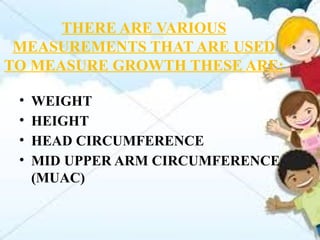
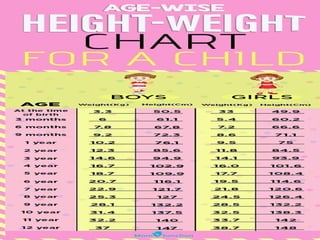
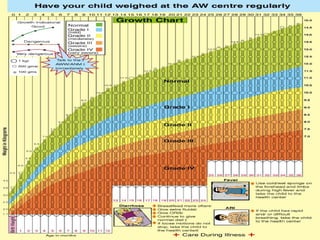
THERE ARE VARIOUS
MEASUREMENTSTHAT ARE USED
TO MEASURE GROWTH THESE ARE:
• WEIGHT
• HEIGHT
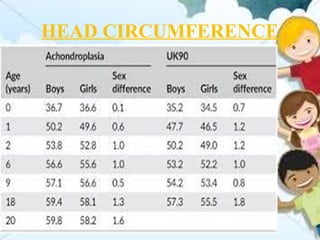
• HEAD CIRCUMFERENCE
• MID UPPER ARM CIRCUMFERENCE
(MUAC)
DEFINATION
• ‘‘Development meansthe qualitative
changes’’.
–
HARLOCK
• ‘‘Development is that direction, which is
continuously revealed in individual in the
form of improving changes. This occurs
in all individual from embryonic stage to
old age stage.’’
-JAMES DREVER
14.
THE FACTORS THATPROMOTE
DEVELOPMENT:
GOOD NUTRITION: Good nutrition is essential
for normal growth and development. The brain is
not fully developed at birth. Good nutrition in the
first 6 months of life is extremely important.
Malnutrition in this period may inhibit the growth
of the brain. As a result of impaired brain growth,
the child may suffer for the rest of life if the child
does not get enough good food. A malnourished
child is often tired, apathetic and not interested in
learning new things.
15.
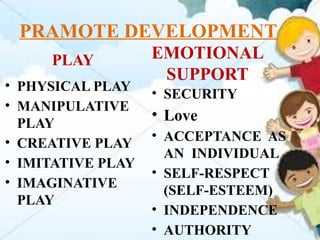
PRAMOTE DEVELOPMENT
PLAY
• PHYSICALPLAY
• MANIPULATIVE
PLAY
• CREATIVE PLAY
• IMITATIVE PLAY
• IMAGINATIVE
PLAY
EMOTIONAL
SUPPORT
• SECURITY
• Love
• ACCEPTANCE AS
AN INDIVIDUAL
• SELF-RESPECT
(SELF-ESTEEM)
• INDEPENDENCE
• AUTHORITY
INTRODUCTION
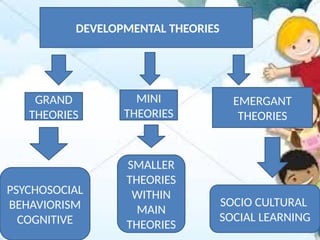
• Psychologists anddevelopment researchers
have proposed a number of different theories
to describe and explain the process and stages
that children go through as they develop.
• Some tend to focus on the developmental
milestones, or specific achievements that
children reach by a certain age. Other focus
on specific aspects of child development such
as personality, cognition, and moral growth.
• Theories have been devised to study the
development of children.
21.
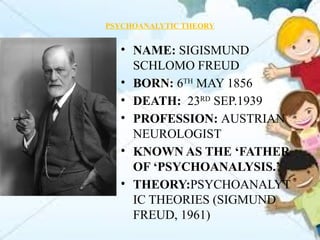
PSYCHOANALYTIC THEORY
• NAME:SIGISMUND
SCHLOMO FREUD
• BORN: 6TH
MAY 1856
• DEATH: 23RD
SEP.1939
• PROFESSION: AUSTRIAN
NEUROLOGIST
• KNOWN AS THE ‘FATHER
OF ‘PSYCHOANALYSIS.’
• THEORY:PSYCHOANALYT
IC THEORIES (SIGMUND
FREUD, 1961)
28.
CRITICS
• Freud’s theoryexplains the concepts
of love, hate, childhood, family
relation, civilization, sexuality,
fantasy, conflicting emotions, etc.
• Freud’s ideas have since been met
with criticism, because of his singular
focus on sexually as the main driver
of human personality development
29.
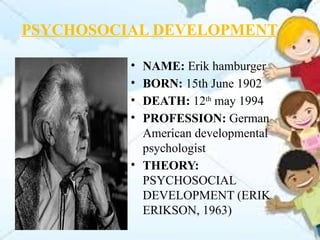
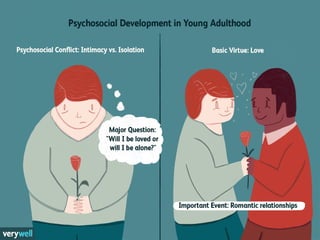
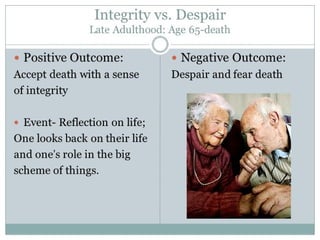
PSYCHOSOCIAL DEVELOPMENT
• NAME:Erik hamburger
• BORN: 15th June 1902
• DEATH: 12th
may 1994
• PROFESSION: German
American developmental
psychologist
• THEORY:
PSYCHOSOCIAL
DEVELOPMENT (ERIK
ERIKSON, 1963)
39.
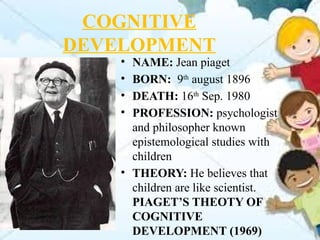
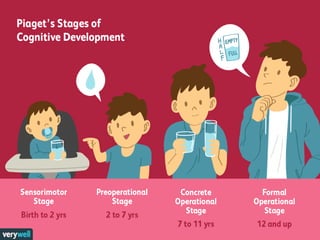
COGNITIVE
DEVELOPMENT
• NAME: Jeanpiaget
• BORN: 9th
august 1896
• DEATH: 16th
Sep. 1980
• PROFESSION: psychologist
and philosopher known
epistemological studies with
children
• THEORY: He believes that
children are like scientist.
PIAGET’S THEOTY OF
COGNITIVE
DEVELOPMENT (1969)
44.
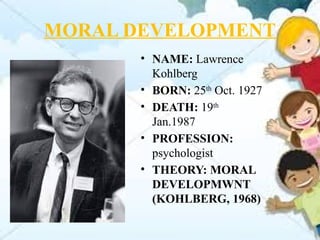
MORAL DEVELOPMENT
• NAME:Lawrence
Kohlberg
• BORN: 25th
Oct. 1927
• DEATH: 19th
Jan.1987
• PROFESSION:
psychologist
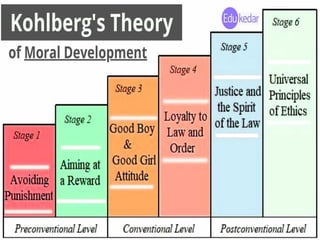
• THEORY: MORAL
DEVELOPMWNT
(KOHLBERG, 1968)
46.
PRE – CONVENTIONALSTAGE:
Pre operational level of cognitive
development and intuitive though,
and it has three substrates. Children
oriented to good/bad, right/wrong and
express it in physical or pleasurable
action. This stage is known as
punishment- orientation stage. They
view the world in a selfish, egocentric
way, with no real understanding of
right and wrong.
47.
CONVENTIONAL LEVEL STAGE:
Thislevel broadens the scope of human
wants and need. Children in this level are
concerned about being accepted by other
and living up to their expectations. This
stage begins about the age 10 but lasts
well into adulthood their lives. At this
stage children are concerned with
conformity and loyalty which is often
called as the ‘good boy/ good girl’ stage.
They understand the concept of trust,
loyalty, and gratitude.
48.
POST CONVENTIONAL STAGE:
•At this level individual has reached the
cognitive stage of formal operation.
correct behavior tend to be defined in
terms of general individual rights and
standards that gave been examined and
agreed on by the entire society. The most
advanced level of moral development is
one in which self- chosen ethical
principles guide decisions of conscience.
It is believed that few persons reach this
stage of moral reasoning.
49.
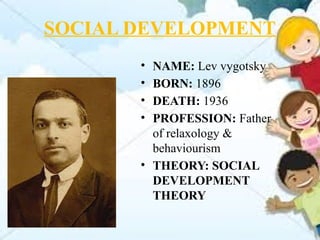
SOCIAL DEVELOPMENT
• NAME:Lev vygotsky
• BORN: 1896
• DEATH: 1936
• PROFESSION: Father
of relaxology &
behaviourism
• THEORY: SOCIAL
DEVELOPMENT
THEORY
50.
Social emotionaldevelopment helps shape a child
into what he will become later in life by teaching
proper reaction to emotional matters. Vygotsky
believed to development a lifelong process
dependent on social interaction and that social
learning actually leads to cognitive development.
Vygotsky theory was an attempt to explain
consciousness as the end product of socialization.
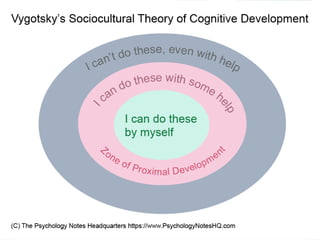
The social development theory includes three
major concept, these are comprised of the role of
social interaction in cognitive development, the
more knowledge and the zone of proximal
development.
52.
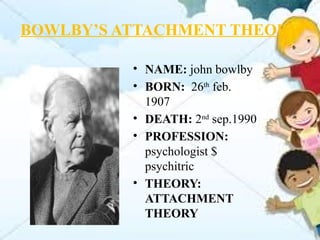
BOWLBY’S ATTACHMENT THEORY
•NAME: john bowlby
• BORN: 26th
feb.
1907
• DEATH: 2nd
sep.1990
• PROFESSION:
psychologist $
psychitric
• THEORY:
ATTACHMENT
THEORY
54.
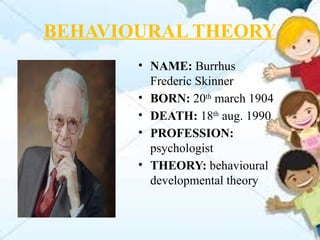
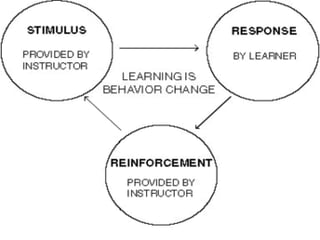
BEHAVIOURAL THEORY
• NAME:Burrhus
Frederic Skinner
• BORN: 20th
march 1904
• DEATH: 18th
aug. 1990
• PROFESSION:
psychologist
• THEORY: behavioural
developmental theory
57.
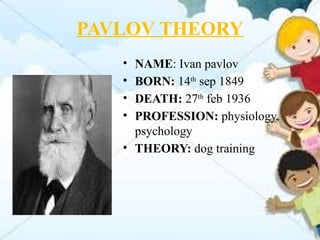
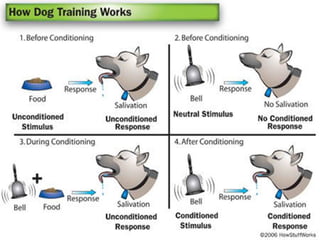
PAVLOV THEORY
• NAME:Ivan pavlov
• BORN: 14th
sep 1849
• DEATH: 27th
feb 1936
• PROFESSION: physiology,
psychology
• THEORY: dog training
59.
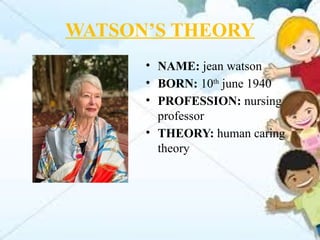
WATSON’S THEORY
• NAME:jean watson
• BORN: 10th
june 1940
• PROFESSION: nursing
professor
• THEORY: human caring
theory
60.
• Watson’s theorywas based on Nightingale’s healing
environment concept. Watson’s goal for the theory
is to move nursing from the belief that the human
body is a machine to the belief that the
“interdependent nature of a world and the spiritual
nature of humans is of paramount importance”
Watson defines health as harmony, and illness as
disharmony within the mind, body, and spirit.
Watson’s theory has continued to evolve in regards
to her concepts. The main components of her
original theory are: transpersonal caring
relationship; ten curative factors; and caring
moment.
62.
These components definedher original
concept of transpersonal caring which was
defined as a human-to-human
connectedness occurring in a nurse-patient
encounter wherein each is touched by the
human center of the other” In Watson’s
updated theory new dimensions evolved
and included the concept that “the caring-
healing modalities potentiate harmony,
wholeness, and comfort, and promote inner
healing by releasing some of the
disharmony and blocked energy that
interfere with the natural healing processes.
63.
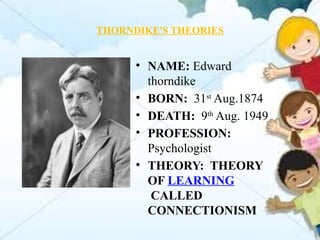
THORNDIKE'S THEORIES
• NAME:Edward
thorndike
• BORN: 31st
Aug.1874
• DEATH: 9th
Aug. 1949
• PROFESSION:
Psychologist
• THEORY: THEORY
OF LEARNING
CALLED
CONNECTIONISM
64.
• Thorndike's lawof effect was a forerunner to the
concept of reinforcement that was the source for
Skinner's method to behaviorism. Thorndike's
studies also influenced kindergarten teachers
because he thought that children had the nor- mal
inclination to create habits.
• He believed that appropriate habits should be
reinforced at an early age, whereas bad ones should
be repressed during the children's early years in
order that they do not have to unlearn them. Habit
training became an important component in the
kindergarten classrooms during the first quarter of
the twentieth century.
66.
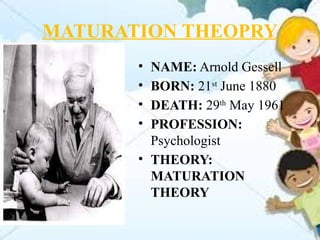
MATURATION THEOPRY
• NAME:Arnold Gessell
• BORN: 21st
June 1880
• DEATH: 29th
May 1961
• PROFESSION:
Psychologist
• THEORY:
MATURATION
THEORY
68.
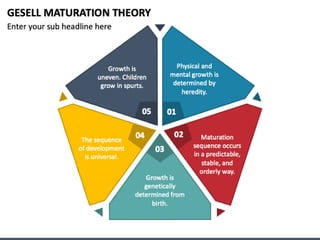
Gesell believedin a child-centered approach to
raising children. He urged parents to recognize
the genetic schedule that babies are born with,
pointing out that it is the product of over three
million years of biological evolution He
observed that babies appeared to know what
they needed and what they were ready to do &
learn.
He directed parents to look to the children
themselves for cues on how to help the child
develop as an individual, and to set aside their
own expectations of what the baby “ought” to
be doing,particularly in the first year of life.
69.
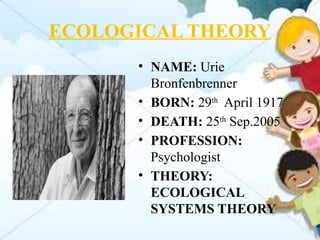
ECOLOGICAL THEORY
• NAME:Urie
Bronfenbrenner
• BORN: 29th
April 1917
• DEATH: 25th
Sep.2005
• PROFESSION:
Psychologist
• THEORY:
ECOLOGICAL
SYSTEMS THEORY
70.
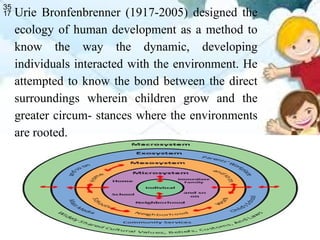
Urie Bronfenbrenner(1917-2005) designed the
ecology of human development as a method to
know the way the dynamic, developing
individuals interacted with the environment. He
attempted to know the bond between the direct
surroundings wherein children grow and the
greater circum- stances where the environments
are rooted.
71.
Bront fenbrenner concentratedon the
children's understandings of their
environments. It is imperative to recognize
those disruptive variations in the children's
views of their surroundings. For instance,
in an environment (e.g., school, home,
peer group sites) considering its physical
and material features, children experience
an array of activities, roles, and
interpersonal associations, which affect
their development.
72.
Bronfenbrenner's theory hasimpacted the
social policy in child development and
early childhood education. This impact
includes both the classroom and family
environments. The family, school,
community, and culture are all connected
to one another. Frequently, the one method
to definitely impact the children's
development is to pursue enhancements in
the community and society as well as the
provisions that several social agencies
offer for children's development.
73.
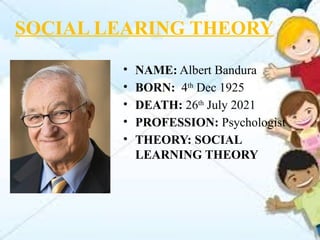
SOCIAL LEARING THEORY
•NAME: Albert Bandura
• BORN: 4th
Dec 1925
• DEATH: 26th
July 2021
• PROFESSION: Psychologist
• THEORY: SOCIAL
LEARNING THEORY
75.
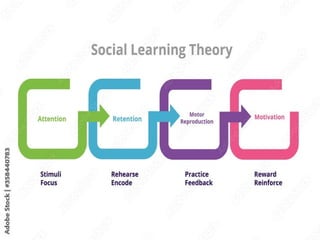
What Are TheImplications For Social Learning
Theory On Teachers And Student Learning?
• Certainly, this theory can be used to teach
positive behaviors to students. Teachers can
use positive role models to increase desired
behaviors and thus change the culture of a
school. Not only will individual students
benefit from positive role models in and out
of the classroom, but the entire class and
student body will do so.
76.
• In conclusion,observation plays a very
powerful role in learning. It not only
helps teach students but helps them to
successfully understand, retain, and
apply their learning to their lives so they
can learn and achieve even more. For
this, we thank Albert Bandura for his
Social Learning Theory contribution.
79.
ROLE OF NURSE
•To assess a person’s condition better
• To provide proper guidance according to
development history
• To / for early detection of child’s pattern
of development
• To ensure adequate surveillance of
developmental process
• To helps to assess domains: ?