Econometrics II
By : Habtamu Legese (Asst.Prof)
1
Chapter One
Regression on Dummy Variables
Habtamu Legese (Ass.Prof)
2
1.1 The nature of dummy variables
•In regression analysis the dependent variable is
frequently influenced not only by variables that can be
readily quantified on some well-defined scale.
•(e.g., sex, race, colour, religion, nationality, wars,
earthquakes, strikes, political upheavals, and
changes in government economic policy).
3
Cont.
•For example, holding all other factors constant, female
daily wage workers are found to earn less than their
male counterparts, and nonwhites are found to earn
less than whites.
•This pattern may result from sex or racial discrimination,
but whatever the reason, qualitative variables such as sex
and race do influence the dependent variable and clearly
should be included among the explanatory variables.
4
Cont.
•Qualitative variables usually indicate the presence or
absence of a “quality” or an attribute, such as male or
female, black or white, or Christian or Muslim.
•One method of “quantifying” such attributes is by
constructing artificial variables that take on values of 1
or 0, 0 indicating the absence of an attribute and 1
indicating the presence (or possession) of that attribute.
5
Cont.
• For example, 1 may indicate that a person is a male, and 0
may designate a female; or 1 may indicate that a person is a
college graduate, and 0 that he is not, and so on.
• Variables that assume such 0 and 1 values are called dummy
variables.
• Alternative names are indicator variables, binary variables,
categorical variables, and dichotomous variables.
6
Cont.
• Dummy variables can be used in regression models just as
easily as quantitative variables. As a matter of fact, a
regression model may contain explanatory variables that are
exclusively dummy, or qualitative, in nature.
7
Cont.
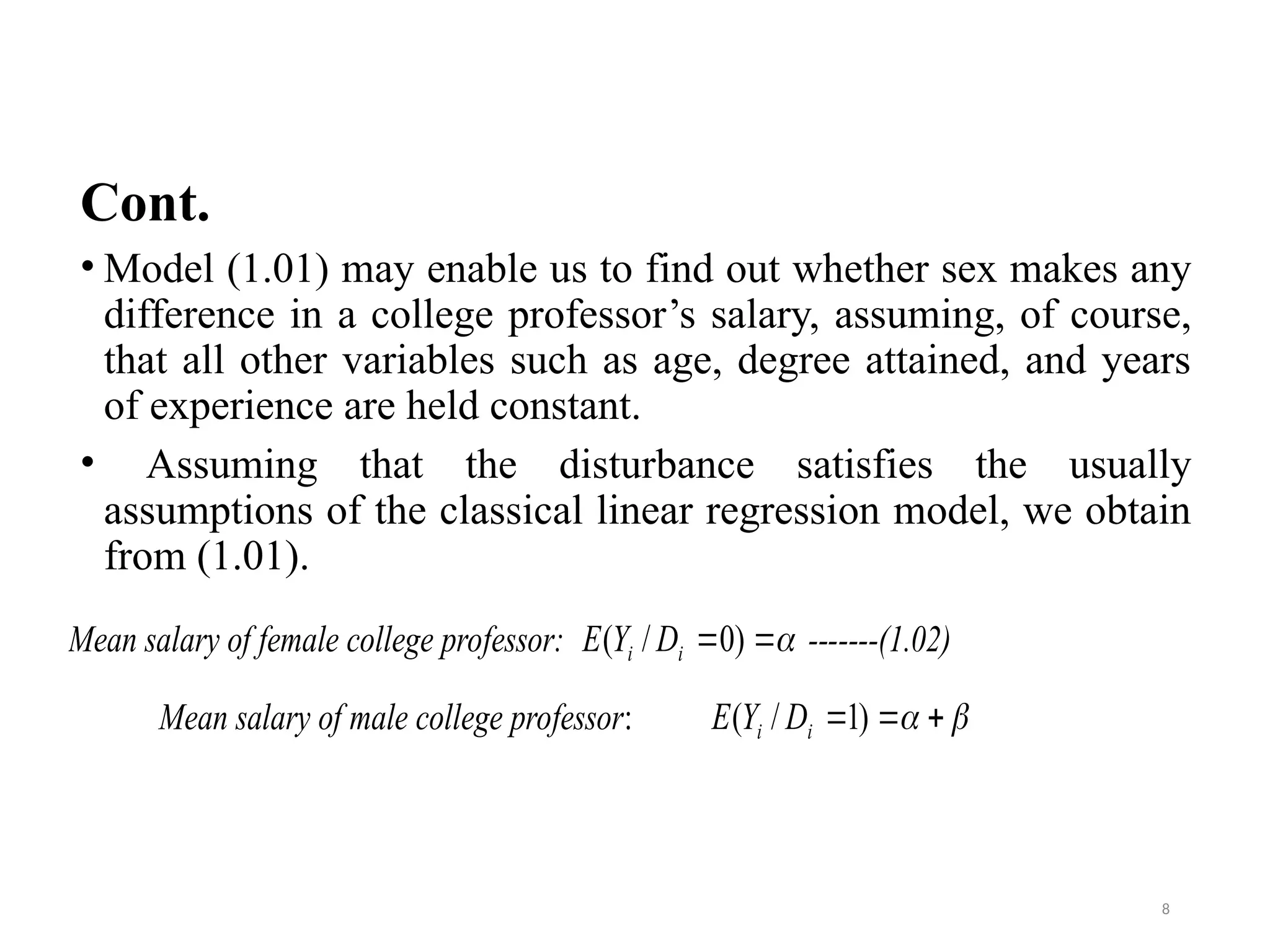
• Model (1.01) may enable us to find out whether sex makes any
difference in a college professor’s salary, assuming, of course,
that all other variables such as age, degree attained, and years
of experience are held constant.
• Assuming that the disturbance satisfies the usually
assumptions of the classical linear regression model, we obtain
from (1.01).
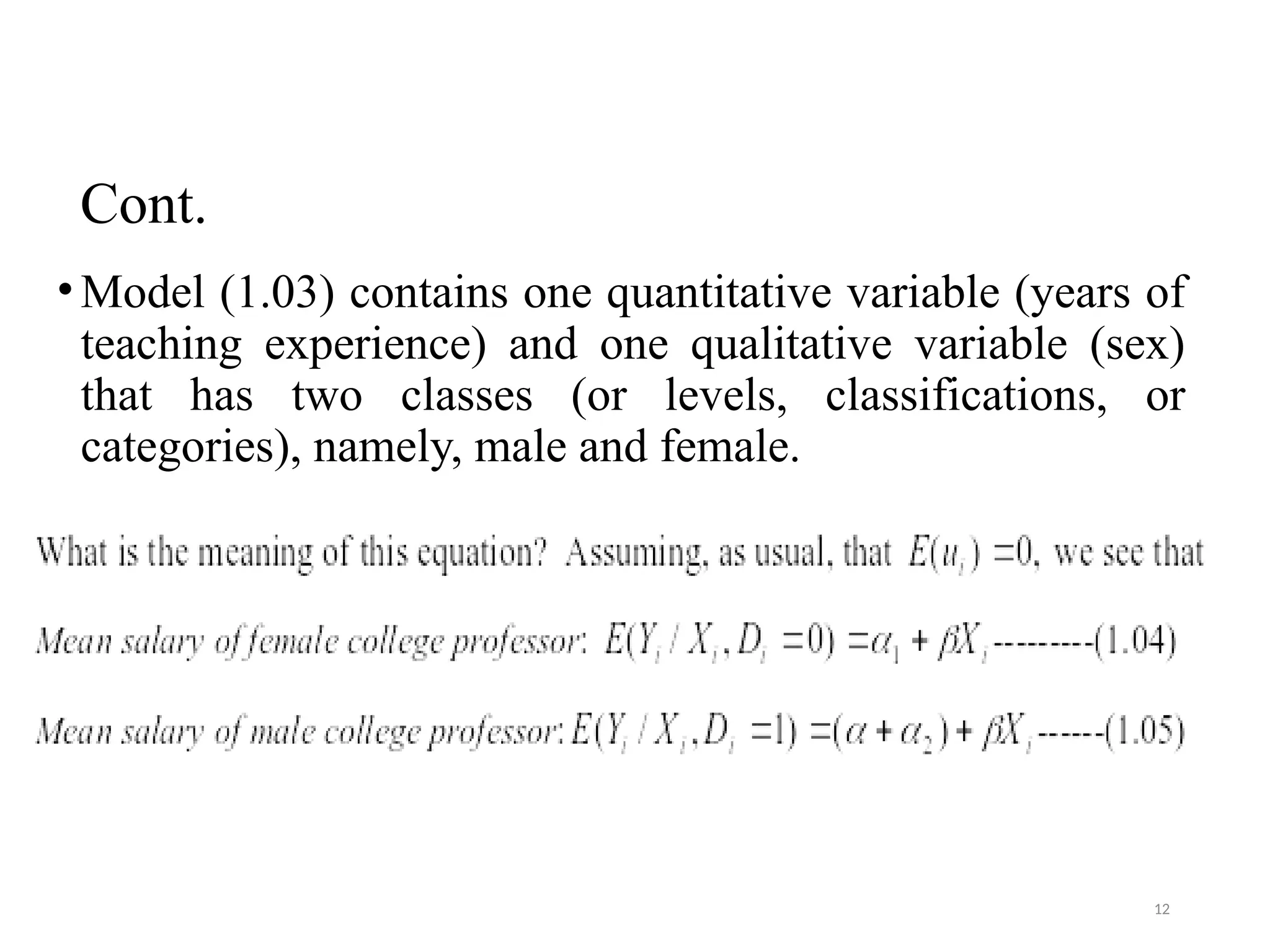
Mean salary of female college professor: -------(1.02)
Mean salary of male college professor:


 )
0
/
( i
i D
Y
E

 

 )
1
/
( i
i D
Y
E
8
Assumptions of the Classical Linear Regression Model:
1. The regression model is linear, correctly specified, and has an additive
error term.
2. The error term has a zero population mean.
3. All explanatory variables are uncorrelated with the error term
4. Observations of the error term are uncorrelated with each other (no serial
correlation).
5. The error term has a constant variance (no heteroskedasticity).
6. No perfect multicollinearity
7. The error term is normally distributed (not required).
9
Cont.
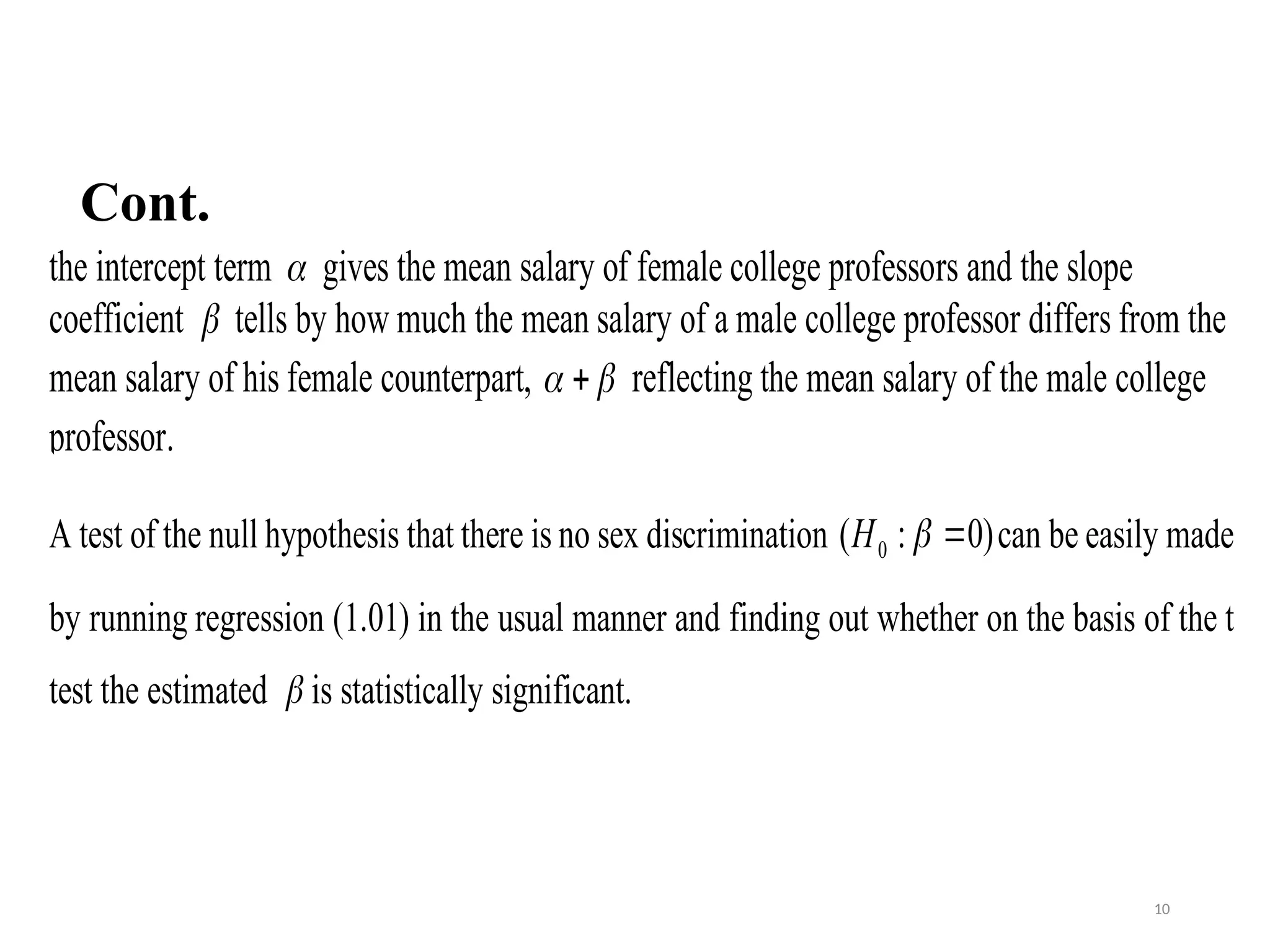
the intercept term gives the mean salary of female college professors and the slope
coefficient tells by how much the mean salary of a male college professor differs from the
mean salary of his female counterpart, reflecting the mean salary of the male college
professor.



 
A test of the null hypothesis that there is no sex discrimination can be easily made
by running regression (1.01) in the usual manner and finding out whether on the basis of the t
test the estimated is statistically significant.
)
0
:
( 0 

H

10
A. Dummy Independent Variable Models
1.2 Regression on one quantitative variable and one qualitative
variable with two classes, or categories
11
Cont.
•Model (1.03) contains one quantitative variable (years of
teaching experience) and one qualitative variable (sex)
that has two classes (or levels, classifications, or
categories), namely, male and female.
12
Cont.
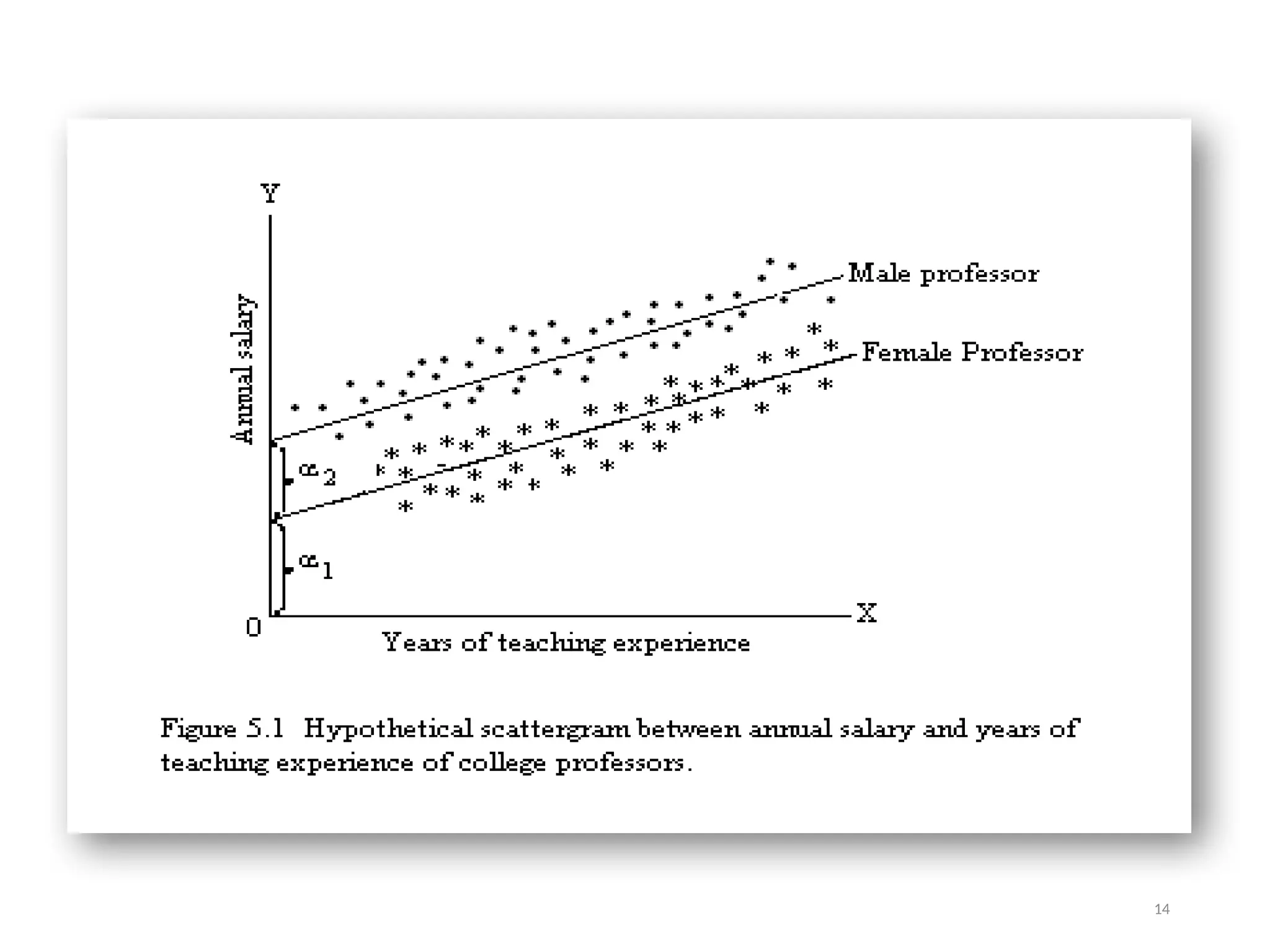
• Geometrically, we have the situation shown in fig. 1.1 (for
illustration, it is assumed that ). In words, model 1.01
postulates that the male and female college professors’ salary
functions in relation to the years of teaching experience have
the same slope but different intercepts.
• In other words, it is assumed that the level of the male
professor’s mean salary is different from that of the female
professor’s mean salary (by but the rate of change in the
mean annual salary by years of experience is the same for both
sexes.
13
14
Cont.
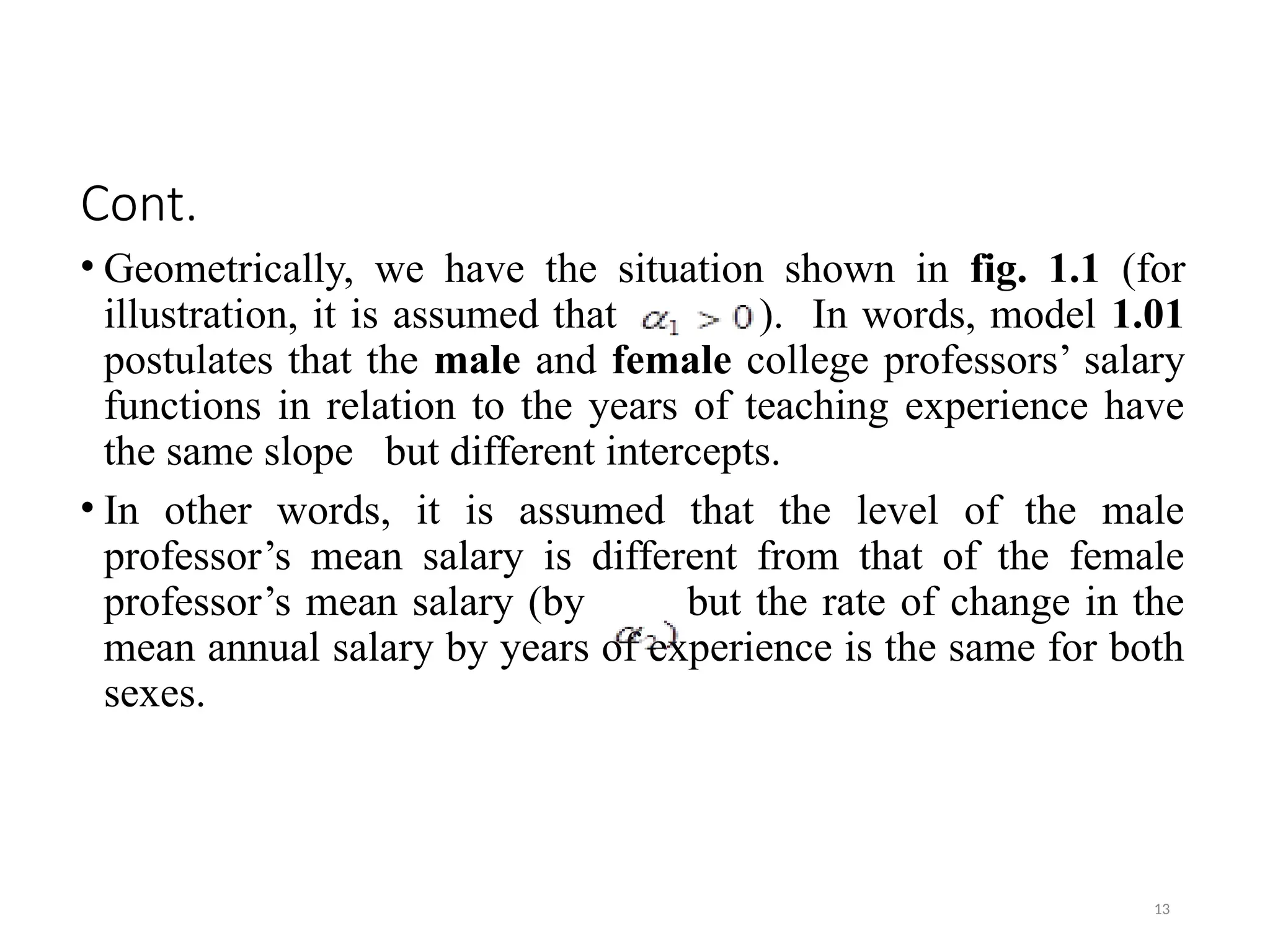
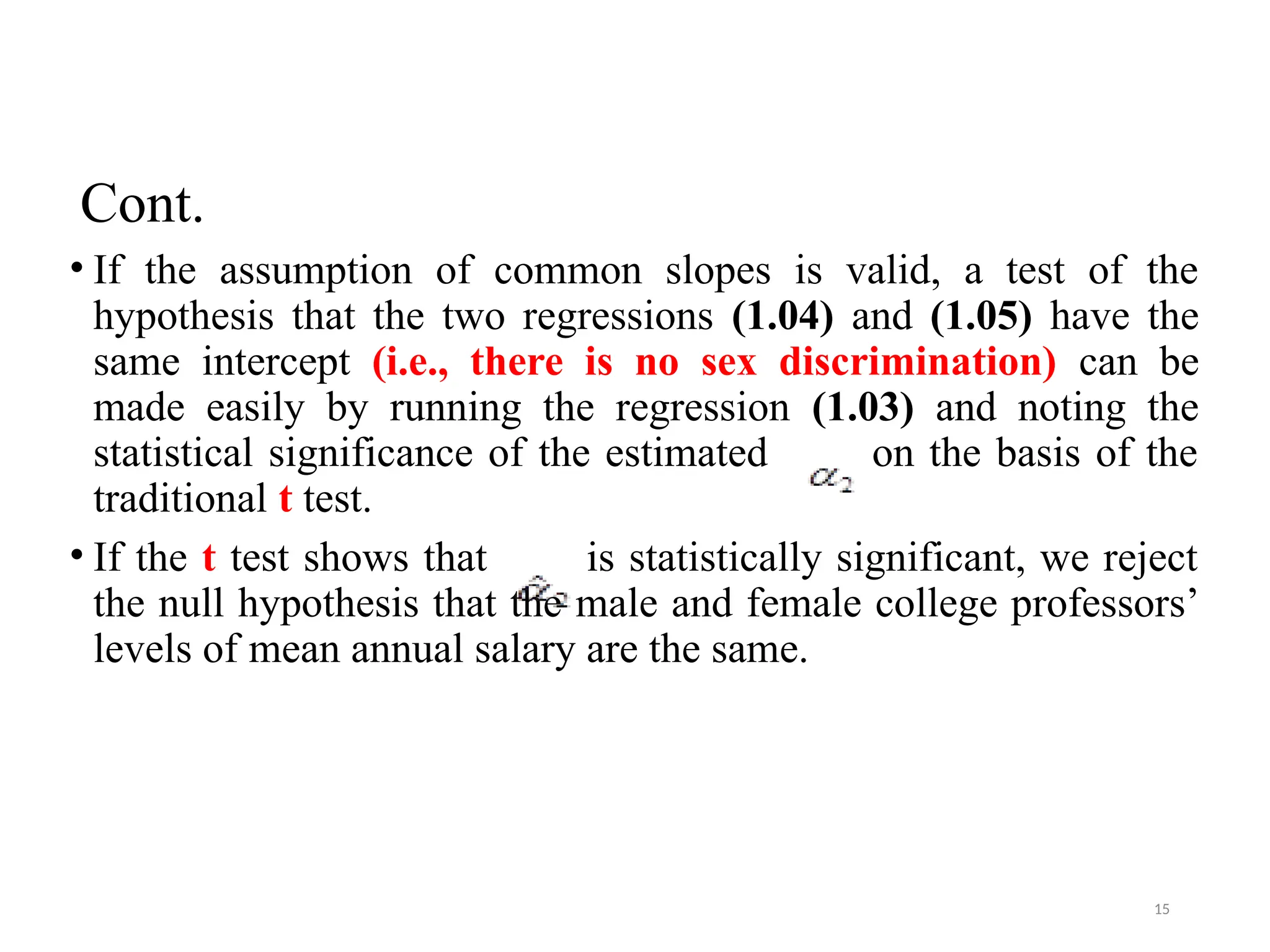
• If the assumption of common slopes is valid, a test of the
hypothesis that the two regressions (1.04) and (1.05) have the
same intercept (i.e., there is no sex discrimination) can be
made easily by running the regression (1.03) and noting the
statistical significance of the estimated on the basis of the
traditional t test.
• If the t test shows that is statistically significant, we reject
the null hypothesis that the male and female college professors’
levels of mean annual salary are the same.
15
Cont.
• Before proceeding further, note the following features of the
dummy variable regression model considered previously
1. To distinguish the two categories, male and female, we have
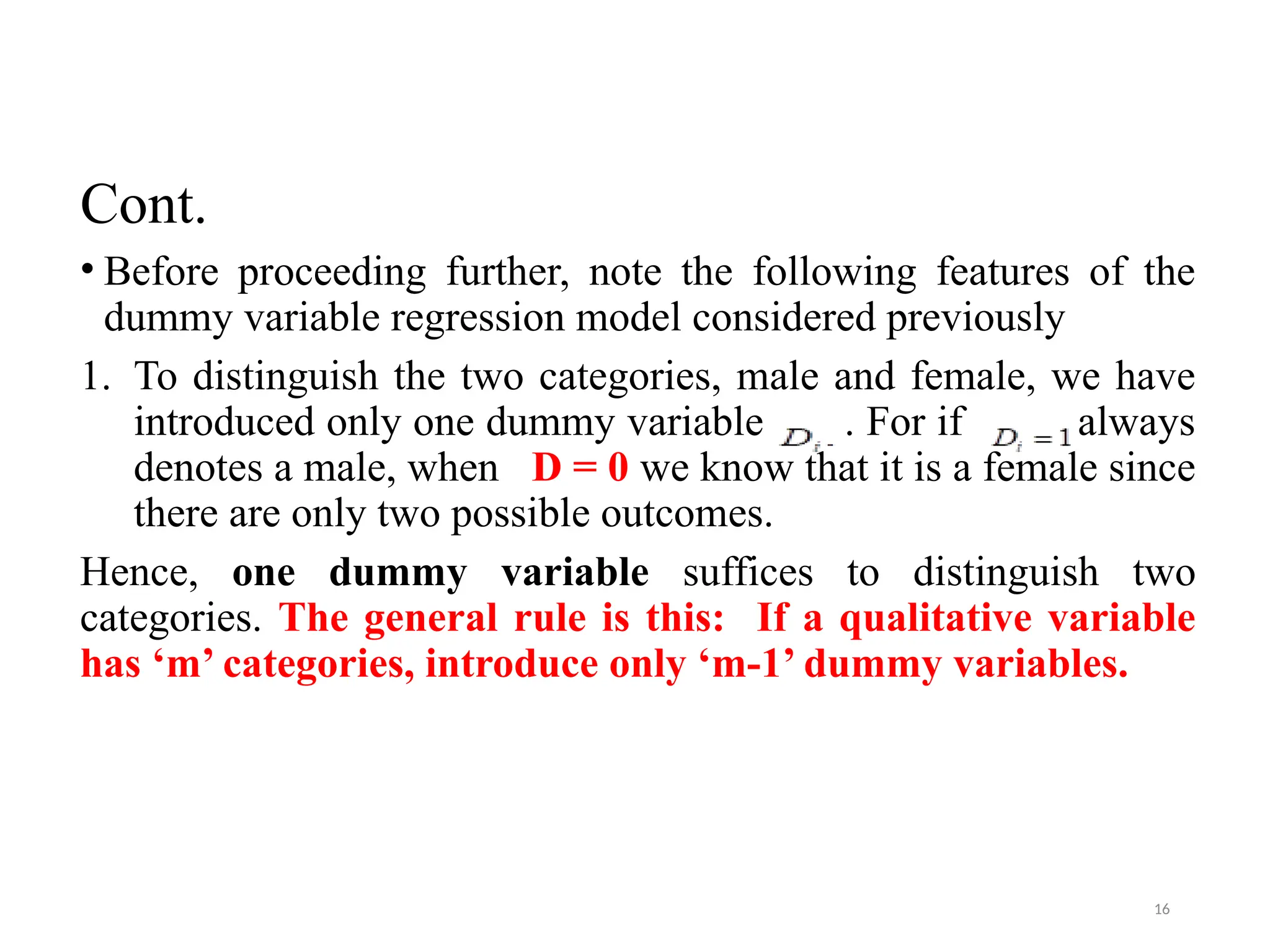
introduced only one dummy variable . For if always
denotes a male, when D = 0 we know that it is a female since
there are only two possible outcomes.
Hence, one dummy variable suffices to distinguish two
categories. The general rule is this: If a qualitative variable
has ‘m’ categories, introduce only ‘m-1’ dummy variables.
16
Cont.
• In our example, sex has two categories, and hence we
introduced only a single dummy variable. If this rule is not
followed, we shall fall into what might be called the dummy
variable trap, that is, the situation of perfect multicollinearity.
2. The assignment of 1 and 0 values to two categories, such as
male and female, is arbitrary in the sense that in our example we
could have assigned D = 1 for female and D = 0 for male.
17
Cont.
3. The group, category, or classification that is assigned the
value of 0 is often referred to as the base, benchmark, control,
comparison, reference, or omitted category. It is the base in
the sense that comparisons are made with that category.
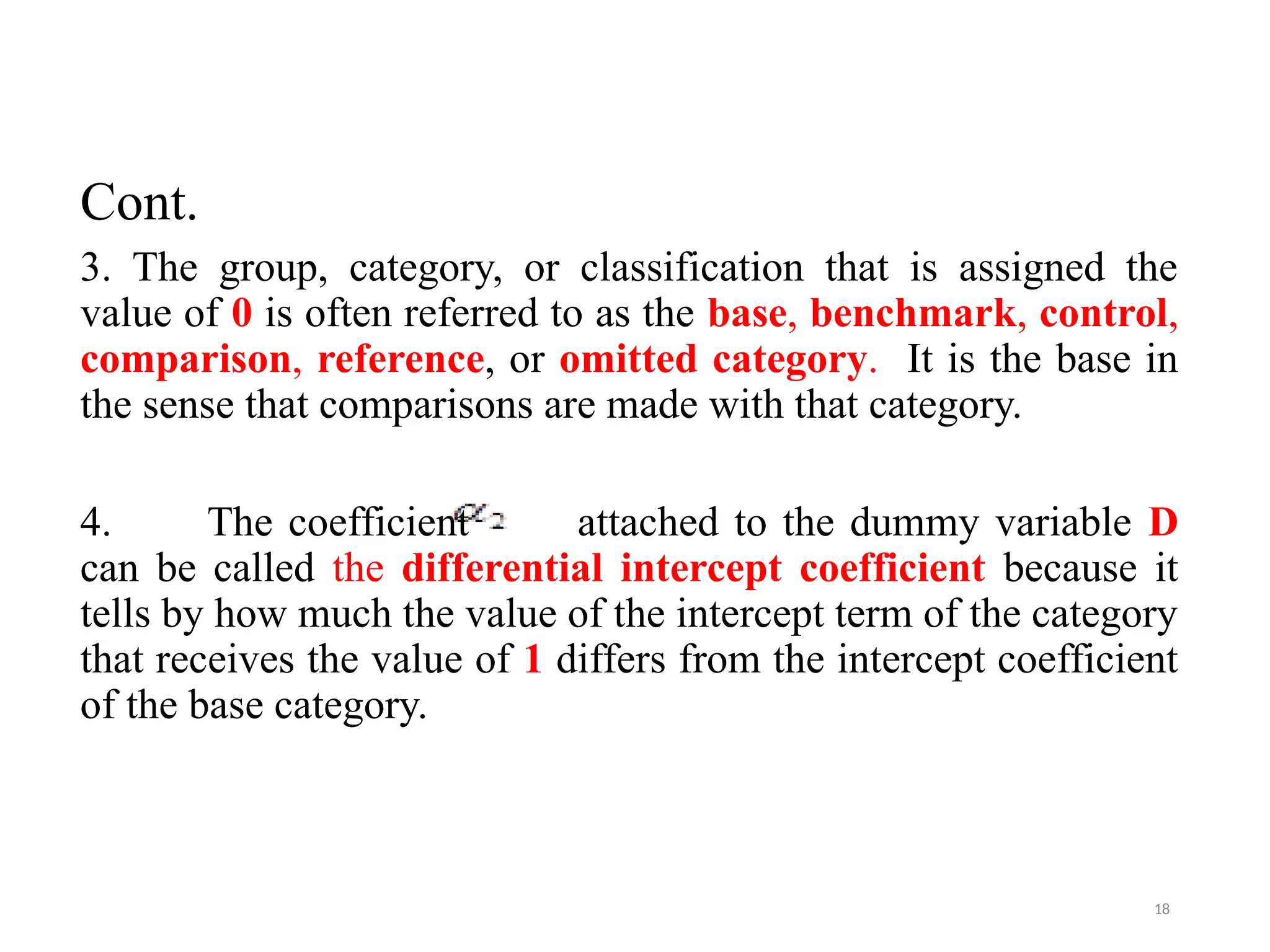
4. The coefficient attached to the dummy variable D
can be called the differential intercept coefficient because it
tells by how much the value of the intercept term of the category
that receives the value of 1 differs from the intercept coefficient
of the base category.
18
What is dummy variable ?
• In statistics and econometrics, particularly in regression analysis,
a dummy variable is one that takes only the value 0 or 1 to
indicate the absence or presence of some categorical effect that
may be expected to shift the outcome.
19
What is the purpose of dummy variables?
• Dummy variables are useful because they enable us to use a
single regression equation to represent multiple groups.
• This means that we don't need to write out separate equation
models for each subgroup.
• The dummy variables act like 'switches' that turn various
parameters on and off in an equation.
20
How do you determine the number of dummy
variables?
• The first step in this process is to decide the number of dummy
variables.
• This is easy; it's simply k-1, where k is the number of levels of
the original variable.
• You could also create dummy variables for all levels in the
original variable, and simply drop one from each analysis.
21
Is 0 male or female?
• In the case of gender, there is typically no natural reason to code
the variable female = 0, male = 1, versus male = 0, female = 1.
• However, convention may suggest one coding is more familiar
to a reader; or choosing a coding that makes the regression
coefficient positive may ease interpretation.
22
Can dummy variables be 1 and 2?
• Technically, dummy variables are dichotomous,
quantitative variables.
• Their range of values is small; they can take on only two
quantitative values.
• As a practical matter, regression results are easiest to interpret
when dummy variables are limited to two specific
values, 1 or 0.
23
Why do we drop one dummy variable?
24
1.3 Regression on one quantitative variable and one qualitative variable with more than
two classes
• Suppose that, on the basis of the cross-sectional data, we
want to regress the annual expenditure on health care by
an individual on the income and education of the
individual.
• Since the variable education is qualitative in nature,
suppose we consider three mutually exclusive levels of
education: less than high school, high school, and
college.
25
Cont.
• Now, unlike the previous case, we have more than two categories
of the qualitative variable education.
• Therefore, following the rule that the number of dummies be
one less than the number of categories of the variable, we should
introduce two dummies to take care of the three levels of
education.
•Assuming that the three educational groups have a
common slope but different intercepts in the regression
of annual expenditure on health care on annual income,
we can use the following model:
26
Cont.
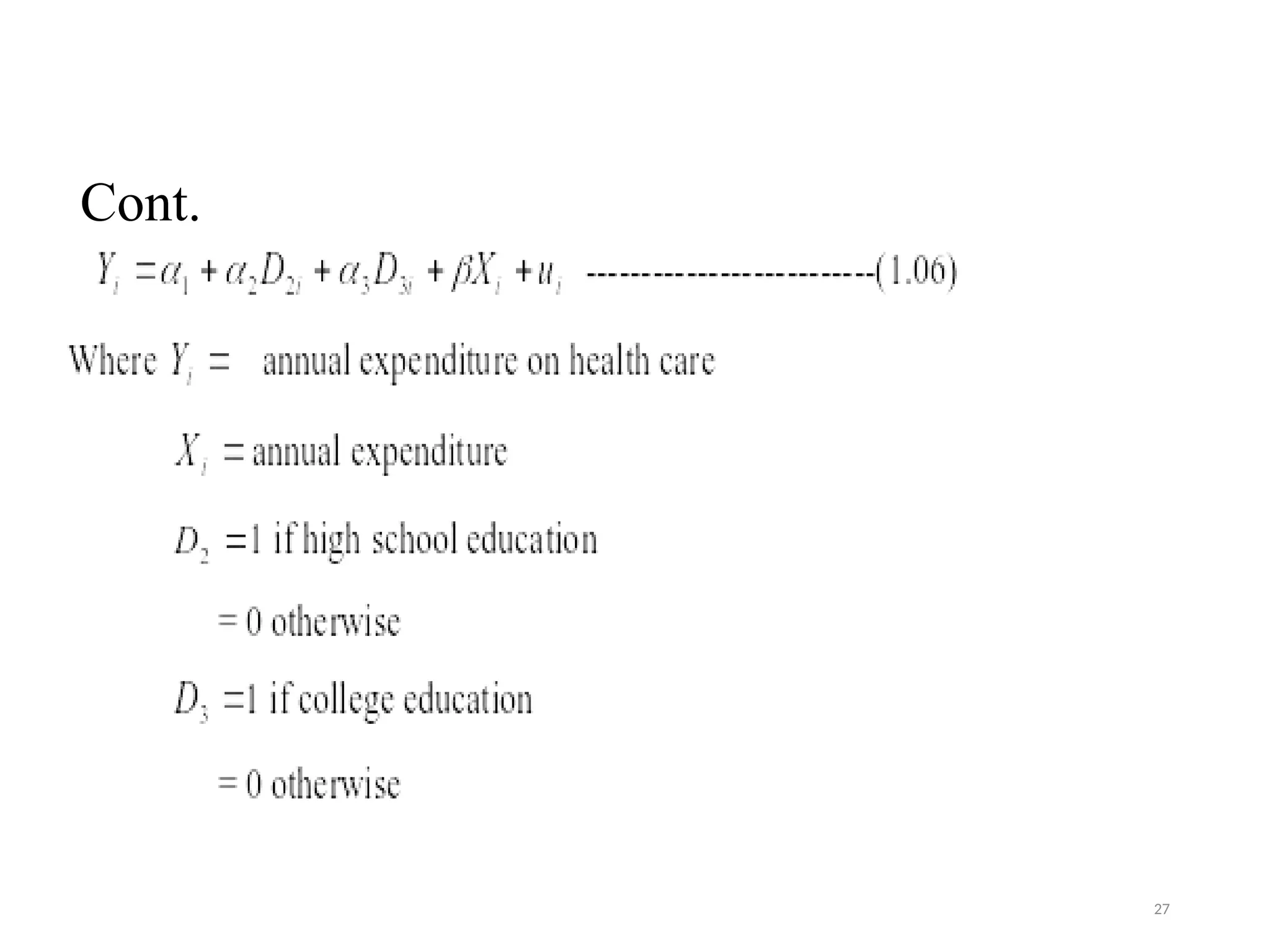
27
Cont.
• Note that in the preceding assignment of the dummy variables
we are arbitrarily treating the “less than high school
education” category as the base category. Therefore, the
intercept will reflect the intercept for this category.
• The differential intercepts and tell by how much the
intercepts of the other two categories differ from the intercept
of the base category, which can be readily checked as follows:
28
Cont.
• Assuming , we obtain from (1.06)
• which are, respectively the mean health care expenditure
functions for the three levels of education, namely, less
than high school, high school, and college.
i
i
i X
X
D
D
Y
E 
 


 1
3
2 )
,
0
,
0
|
(
i
i
i X
X
D
D
Y
E 

 



 )
(
)
,
0
,
1
|
( 2
1
3
2
i
i
i X
X
D
D
Y
E 

 



 )
(
)
,
1
,
0
|
( 3
1
3
2
29
Cont.
• Geometrically, the situation is shown in fig 1.2 (for illustrative
purposes it is assumed that ).
30
1.4 Regression on one quantitative variable and two qualitative variables
The technique of dummy variable can be easily extended to
handle more than one qualitative variable.
Let us revert to the college professors’ salary regression (1.03),
but now assume that in addition to years of teaching
experience and sex the skin color of the teacher is also an
important determinant of salary.
For simplicity, assume that colour has two categories: black
and white
31
Cont.
•We can now write (1.03) as:
i
i
i
i
i u
X
D
D
Y 



 


 3
3
2
2
1 ----------(1.07)
Where 
i
Y annual salary

i
X years of teaching experience
1
2 
D if female
=0 otherwise
1
3 
D if white
=0 otherwise
32
Cont.
• Notice that each of the two qualitative variables, sex and color,
has two categories and hence needs one dummy variable for
each. Note also that the omitted, or base, category now is
“black female professor”.
33
Cont.
Assuming 0
)
( 
i
u
E , we can obtain the following regression from (1.07)
Mean salary for black female professor:
i
i
i X
X
D
D
Y
E 
 


 1
3
2 )
,
0
,
0
|
(
Mean salary for black male professor:
i
i
i X
X
D
D
Y
E 

 



 )
(
)
,
0
,
1
|
( 2
1
3
2
Mean salary for white female professor:
i
i
i X
X
D
D
Y
E 

 



 )
(
)
,
1
,
0
|
( 3
1
3
2
Mean salary for white male professor:
i
i
i X
X
D
D
Y
E 


 




 )
(
)
,
1
,
1
|
( 3
2
1
3
2
34
Cont.
• Once again, it is assumed that the preceding regressions differ
only in the intercept coefficient but not in the slope coefficient.
• An OLS estimation of (1.07) will enable us to test a variety of
hypotheses. Thus, if is statistically significant, it will mean
that colour does affect a professor’s salary.
• Similarly, if is statistically significant, it will mean that sex
also affects a professor’s salary. If both these differential
intercepts are statistically significant, it would mean sex as
well as colour is an important determinant of professors’
salaries.
35
Cont.
• From the preceding discussion it follows that we can extend
our model to include more than one quantitative variable and
more than two qualitative variables.
• The only precaution to be taken is that the number of dummies
for each qualitative variable should be one less than the
number of categories of that variable.
36
1.5 Interaction effects
• Consider the following model:
i
i
i
i
i u
X
D
D
Y 



 


 3
3
2
2
1 ----------------------------(1.08)
where 
i
Y annual expenditure on clothing

i
X Income
1
2 
D if female
= 0 if male
1
3 
D if college graduate
= 0 otherwise
37
Cont.
• The implicit assumption in this model is that the differential
effect of the sex dummy is constant across the two levels of
education and the differential effect of the education dummy
is also constant across the two sexes.
• That is, if, say, the mean expenditure on clothing is higher for
females than males this is so whether they are college
graduates or not. Likewise, if, say, college graduates on the
average spend more on clothing than non-college graduates, this
is so whether they are female or males.
38
Cont.
• In many applications, such an assumption may be untenable. A
female college graduate may spend more on clothing than a
male graduate.
• In other words, there may be interaction between the two
qualitative variables and therefore their effect on mean Y
may not be simply additive as in (1.08) but multiplicative as
well, as in the following model:
i
i
i
i
i
i
i u
X
D
D
D
D
Y 




 



 )
( 3
2
4
3
3
2
2
1 -----------------(4.09)
39
Cont.
• From (4.09) we obtain
• which is the mean clothing expenditure of graduate females.
Notice that
• differential effect of being a female
• differential effect of being a college graduate
• differential effect of being a female graduate
i
i
i X
X
D
D
Y
E 



 





 )
(
)
,
1
,
1
|
( 4
3
2
1
3
2 ------------(4.10)
40
Cont.
• If are all positive, the average clothing
expenditure of females is higher than the base category (which
here is male non-graduate), but it is much more so if the females
also happen to be graduates.
• This shows how the interaction dummy modifies the effect of the
two attributes considered individually.
• Whether the coefficient of the interaction dummy is statistically
significant can be tested by the usual t test. Omitting a significant
interaction term will lead to a specification bias.
41
Cont.
The importance of interactions among
dummy variables
 Help us to get influential variables
 To avoid misspecification bias
42
Slope indicator variables
The interaction between dummy variables and
quantitative variables. They affect only slope,
i.e, it does not affect intercept.
It help us to captures the interaction effect of
dummy and quantitative variables on
dependent variables
Look at the following example
The price of condominium house can be explained
as a function of its characteristics such as its size,
location, number of bedrooms, age, floor and so on.
43
Cont.
 is the value of an additional number of bed
rooms.
is the value of land alone
 We can use dummy variable and indicator
variable interchangeable.
For our discussion, let us assume that the
number bed room of the house measured in
numbers, nbdr, is the only relevant variable in
determining house price.
prhou  0  1nbdr  ui

1
 
0
44
Cont.
We make the reference group, non
desirable group.
Instead of assuming that the effect of location on
house price causes a change in the intercept.
Let us assume that the change is in the slope of
the relationship.

0 if not desirable neibourhood
prhou  0 neib  1nbdr  ui
neib 
1if desirable neibourhood
45
Cont.
We can allow for a change in a slope by
including in the model an additional
explanatory variable that is equal to the
product of an indicator variable and
continuous variable.
In our model, the slope of the relationship is
the value of an additional number of bed
rooms.
If we assume 1 value for homes in desirable
neibourhood, and 0 other wise; we can specify
our model as follows:
prhou  0  1nbdr  (nbdr * neib)  ui
46
Cont.
The new variable (nbdr*neib) is the product of the
number of bedroom and the indicator variables, is
called an interaction variable as it captures the
interaction of location and number of bedroom on
condominium house prices.
Or it is called a slope –indicator variable or a slope
dummy variable, b/c it allows for the change in the
slope of the relationship.
The slope indicator variable takes a value equal to
nbdr for houses in the desirable neibourhood, when
neib = 1, and it is 0 for homes in other
neighbourhoods.
47
A slope indicator variable is treated as just like
any other explanatory variable in a regression
model.
Cont.
 0
1
   
  
 when
 
nbdr


  1 nbdr   nbdr    when D
 1
D  0
E ( prhou )

 
0
Inthedesirable neighbourhood, the price
per additional number of bedrooms of a house is
1  
Inthenon desirable neighbourhood, the
price
per additional number of bedrooms of a house is 1 .
If   0 price per additional number of bedrooms
is higher in the more desirable neighbourhood. 48

Cont.
w hen D 
0

1


The effect of including a slope indicator
variable also can be see by using calculus.
The partial derivatives of expected house
price with respect to number of bed rooms
E ( prhou )

1   when D  1
(nbdr )
If 0
prhou
nbdr
0

E( prhou)  0  (1 
)nbdr
E( prhou)  0 
1nbdr
1
slope  

slope 
1
49
Cont.
If we assume that house location affects both the
intercept and the slope, then both can be
incorporated into a single model.
The model specification will be:
prhou  0 neib  1nbdr  (nbdr * neib)  ui
 0
1
   
  
 when
E ( prhou
 
nbdr


) 
 (  0   )  (  1 
 ) nbdr    when D  1
D  0
50
Some Important Uses of Dummy Variable
51
Cont.
52
Cont.
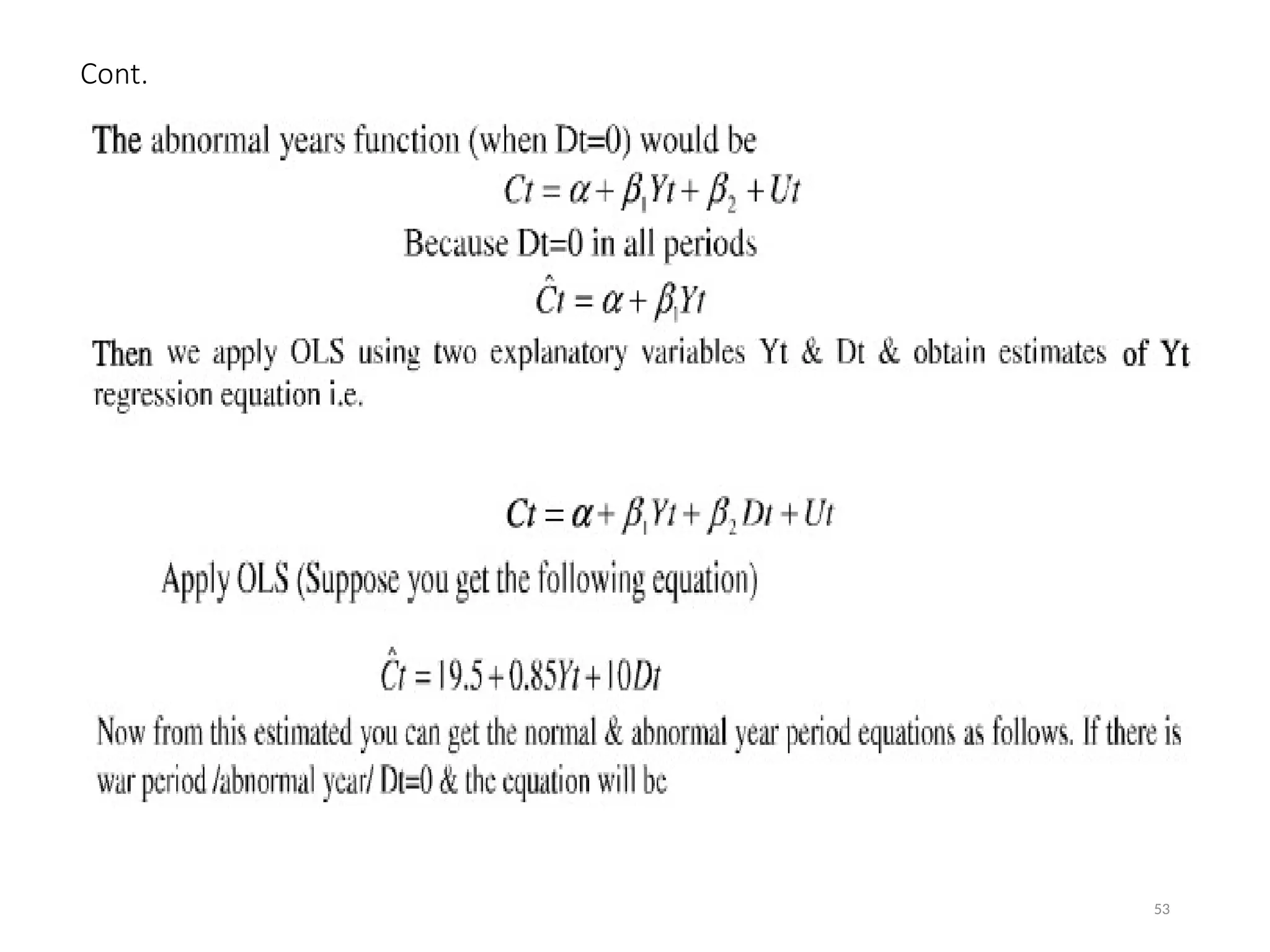
53
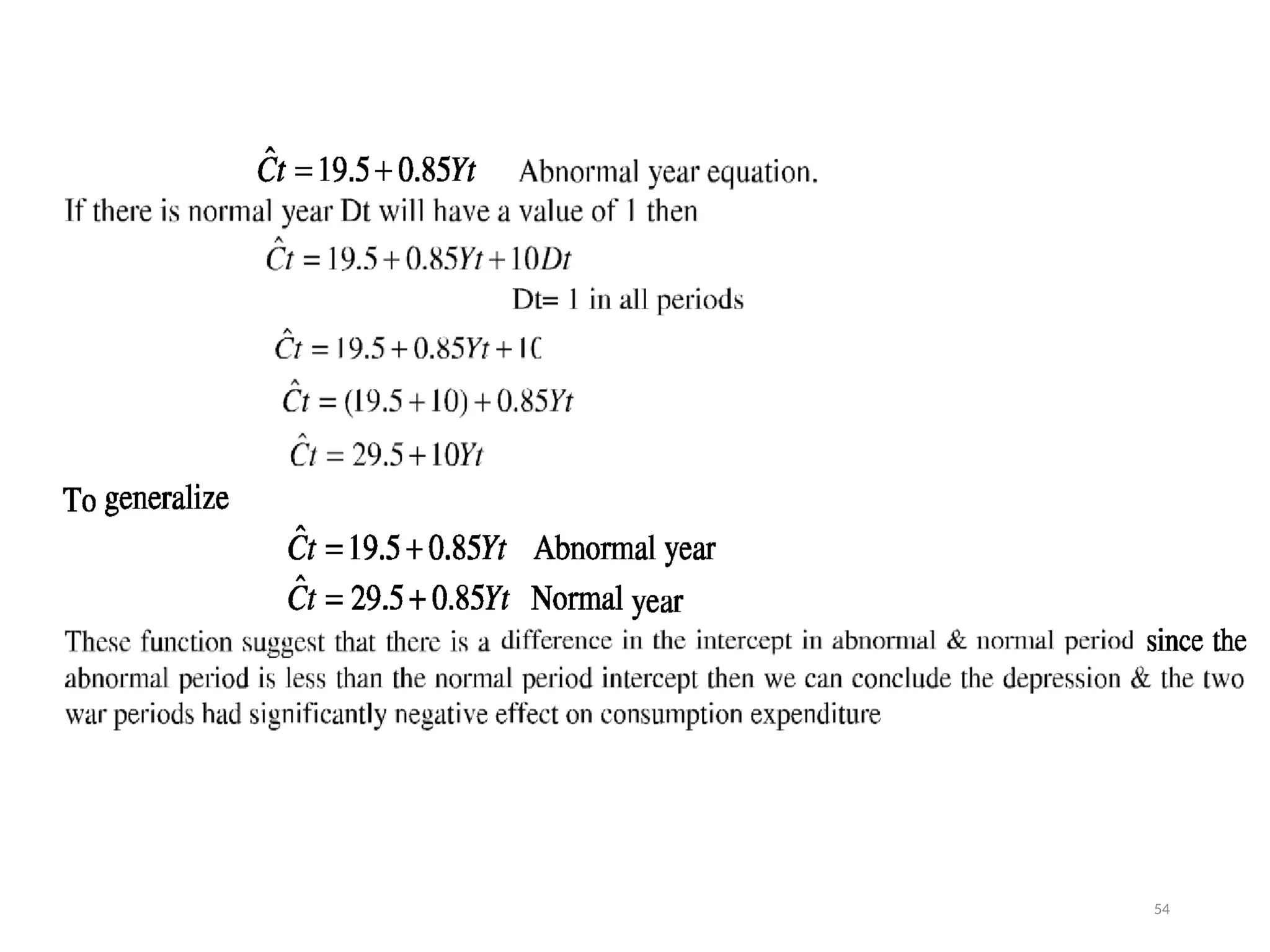
54
Cont.
55
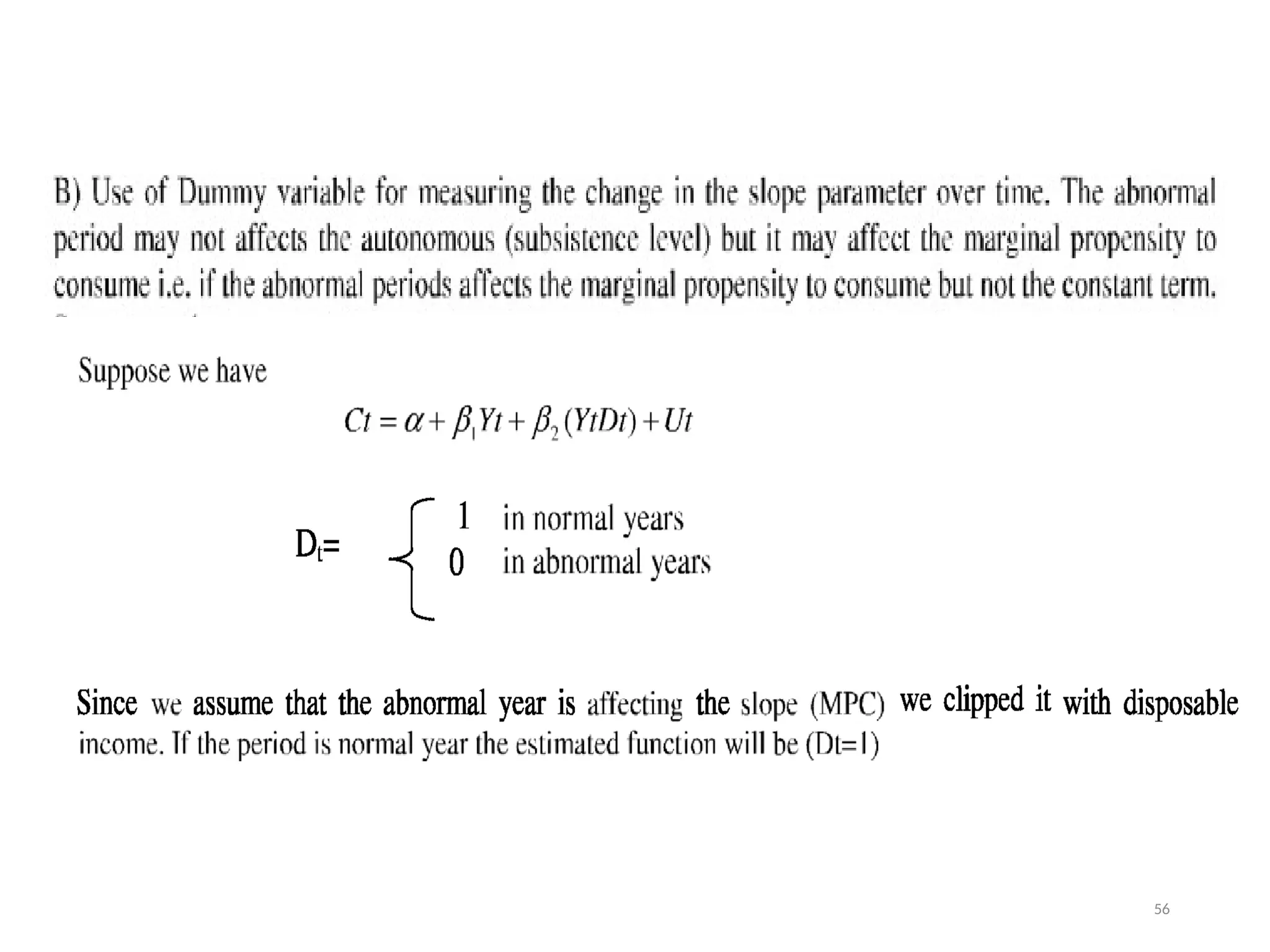
56
57
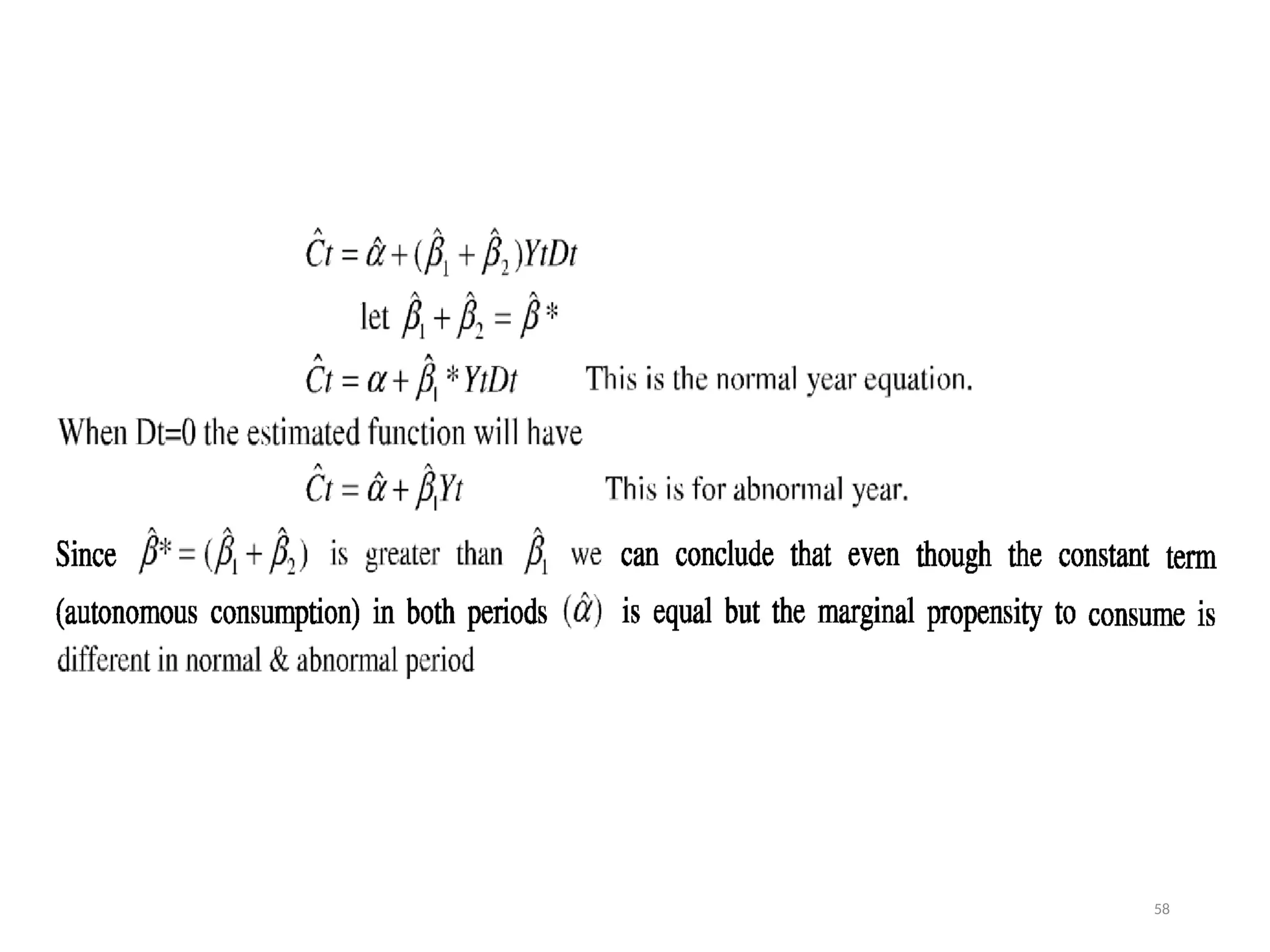
58
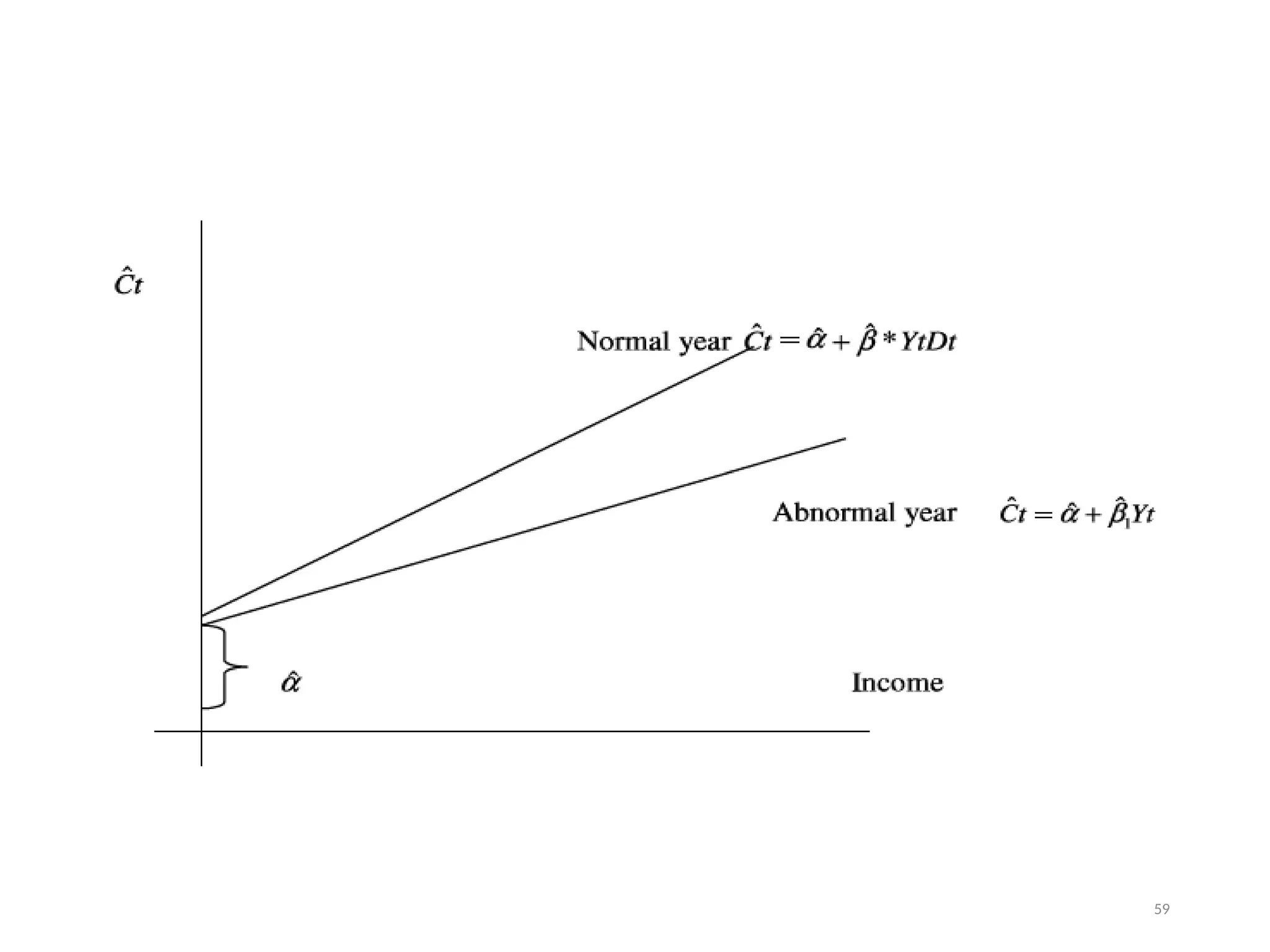
59
Cont.
60
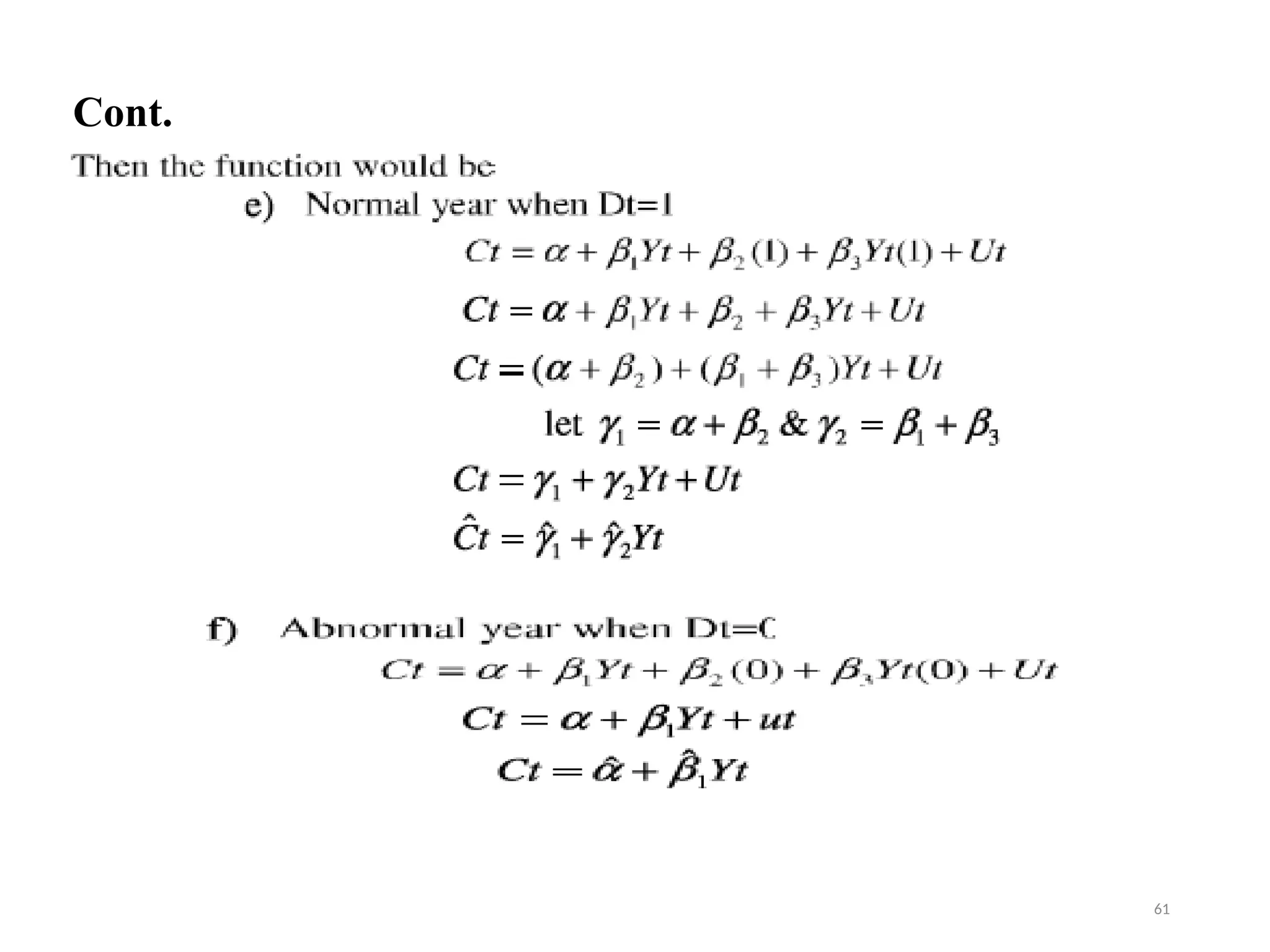
Cont.
61
Testing for structural stability will help us to find
out whether two or more regressions are different,
where the difference may be in the intercepts or
the slopes or both.
Suppose we are interested in estimating a
simple saving function that relates domestic
household savings (S) with gross domestic
product (Y) for Ethiopia.
Suppose further that, at a certain point of
time, a series of economic reforms have been
introduced.
Structural Stability
62
Cont.
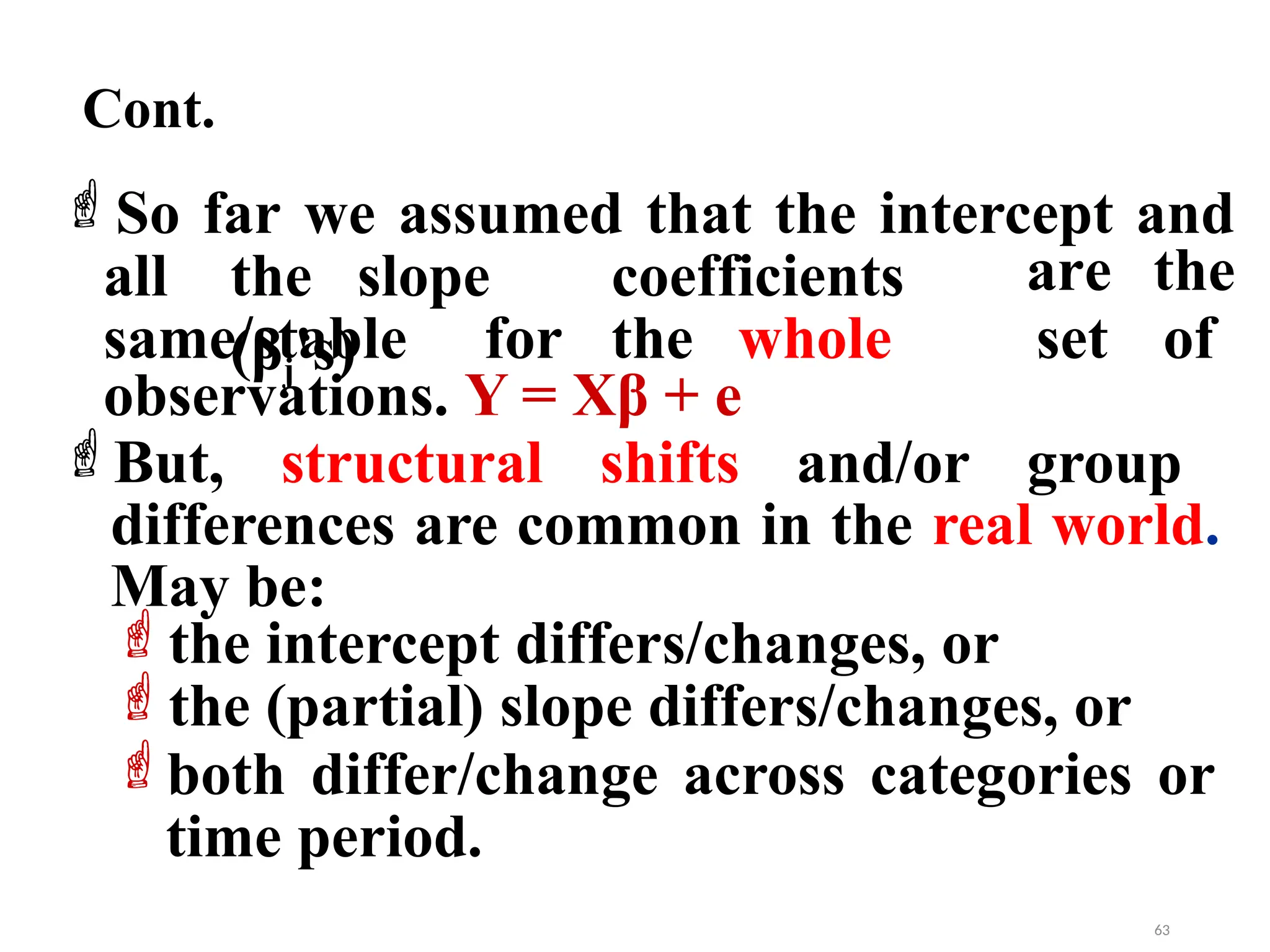
So far we assumed that the intercept and
all the slope coefficients
(βj's)
same/stable for the whole
are the
set of
observations. Y = Xβ + e
But, structural shifts and/or group
differences are common in the real world.
May be:
the intercept differs/changes, or
the (partial) slope differs/changes, or
both differ/change across categories or
time period.
63
 The hypothesis here is that such reforms might have
considerably influenced the savings - income
relationship, that is, the relationship between savings
and income might be different in the post reform
period as compared to that in the pre-reform period.
 If this hypothesis is true, then we say a structural
change has happened.
 H0: Economic reforms might not have influenced the
savings and national income relationship
 H1: Economic reforms might have influenced the
savings and national income relationship
 How do we check if this is so?
Cont.
64
Cont.

1if post  reform ( 1991)
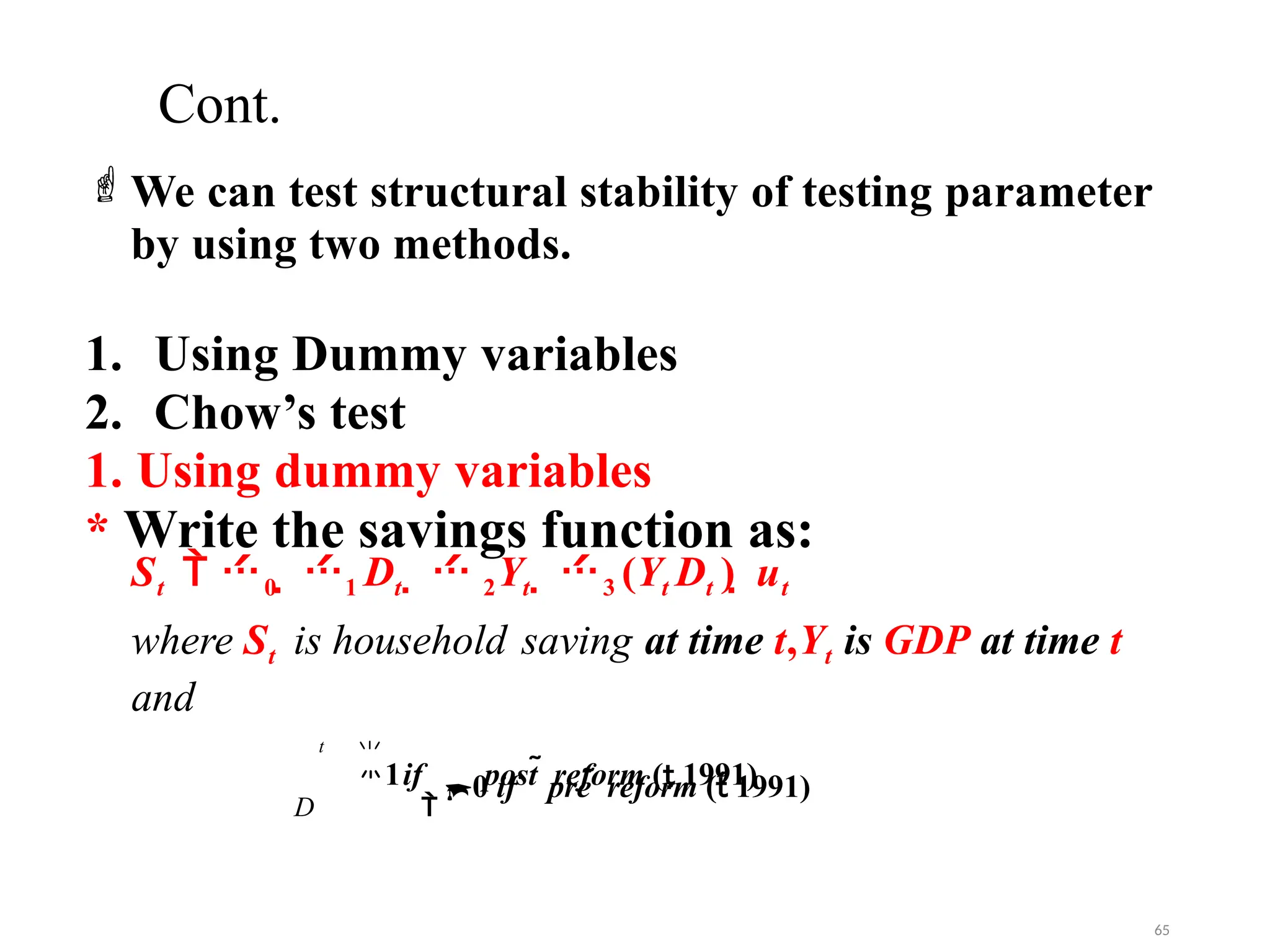
We can test structural stability of testing parameter
by using two methods.
1. Using Dummy variables
2. Chow’s test
1. Using dummy variables
* Write the savings function as:
St  0  1 Dt   2Yt  3 (Yt Dt )  ut
where St is household saving at time t,Yt is GDP at time t
and
D 
0 if pre  reform ( 1991)
t
65
Cont.
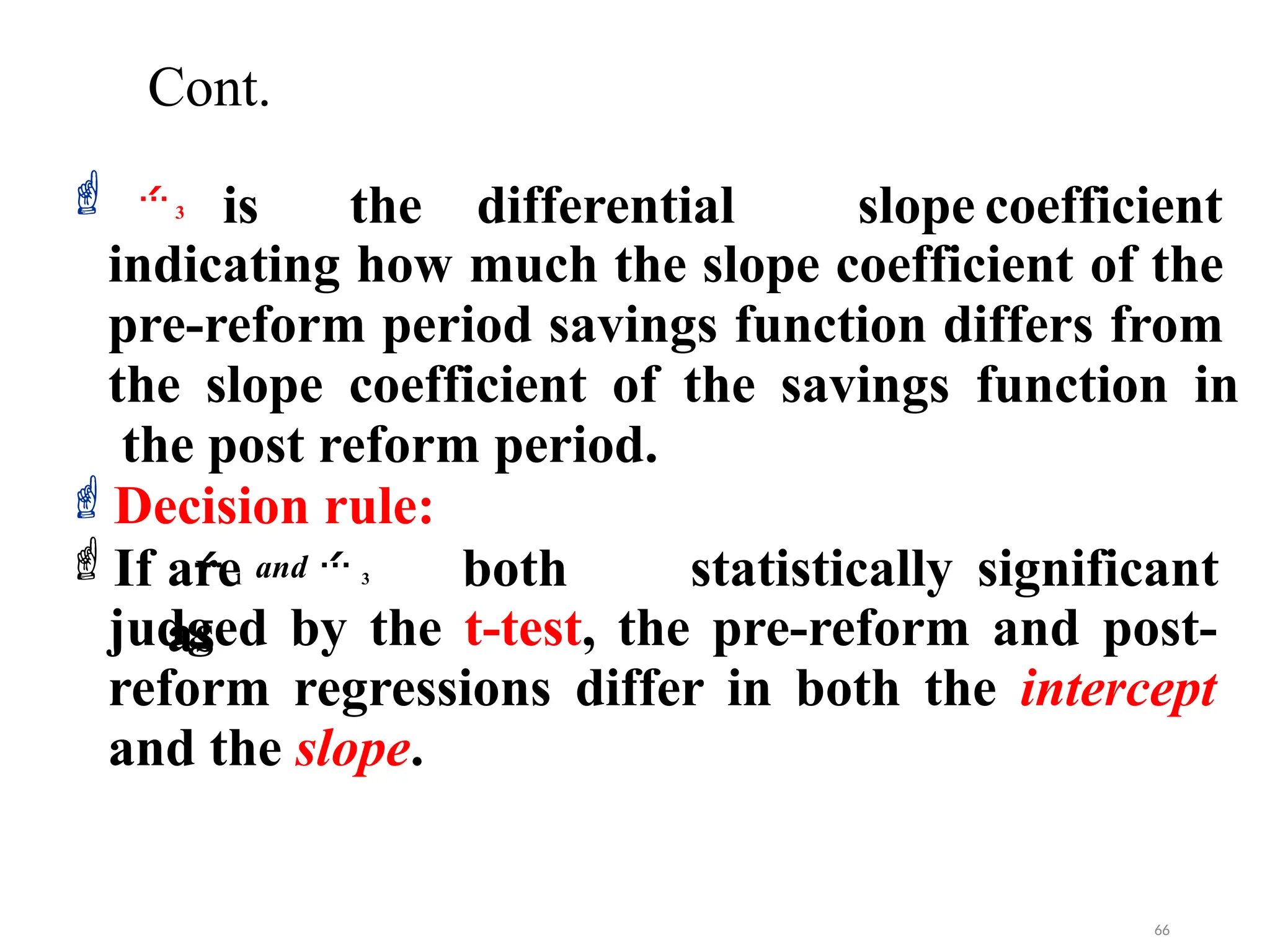
is the differential slope coefficient
indicating how much the slope coefficient of the
pre-reform period savings function differs from
the slope coefficient of the savings function in
the post reform period.
Decision rule:
If are both statistically significant
as
judged by the t-test, the pre-reform and post-
reform regressions differ in both the intercept
and the slope.
 1 and  3
3
 
66
If only
pre-reform and post-reform regressions differ
only in the intercept (meaning the marginal
propensity to save (MPS) is the same for pre-
reform and post-reform periods).
two regressions differ only in the slope (MPS).
Check
structural
stability for the f/
wing
regression result:
Cont.
1
 is statistically significant,
then the
3
If only  is statistically significant, then
the
t
t
 2.616285 Yˆ  0.5298177 (Yˆ
Dˆ )
t t t
Sˆ  20.76005 
5.9991 Dˆ
67
Cont.
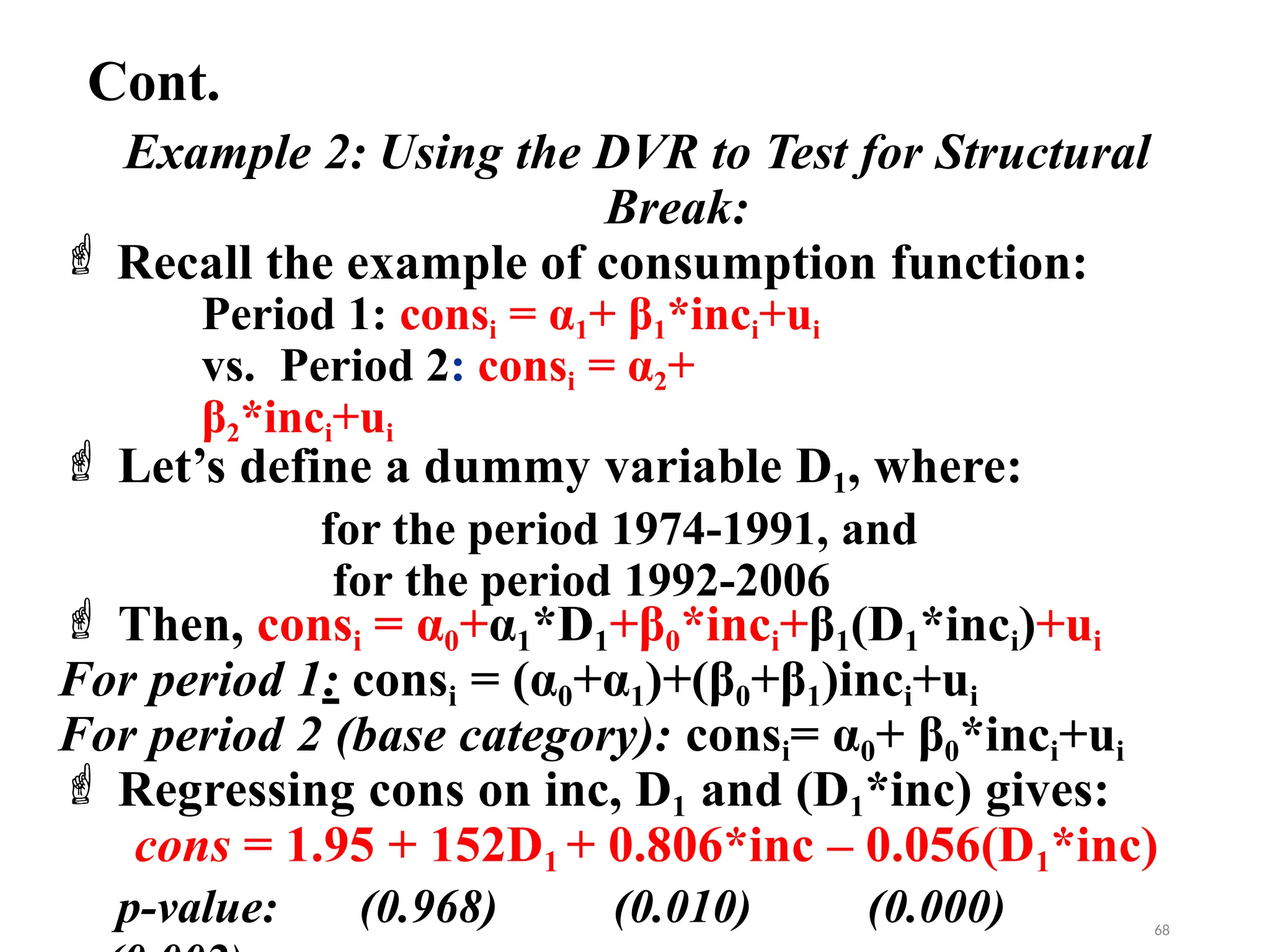
Example 2: Using the DVR to Test for Structural
Break:
 Recall the example of consumption function:
Period 1: consi = α1+ β1*inci+ui
vs. Period 2: consi = α2+
β2*inci+ui
 Let’s define a dummy variable D1, where:
for the period 1974-1991, and
for the period 1992-2006
 Then, consi = α0+α1*D1+β0*inci+β1(D1*inci)+ui
For period 1: consi = (α0+α1)+(β0+β1)inci+ui
For period 2 (base category): consi= α0+ β0*inci+ui
 Regressing cons on inc, D1 and (D1*inc) gives:
cons = 1.95 + 152D1 + 0.806*inc – 0.056(D1*inc)
p-value: (0.968) (0.010) (0.000) 68
Cont.
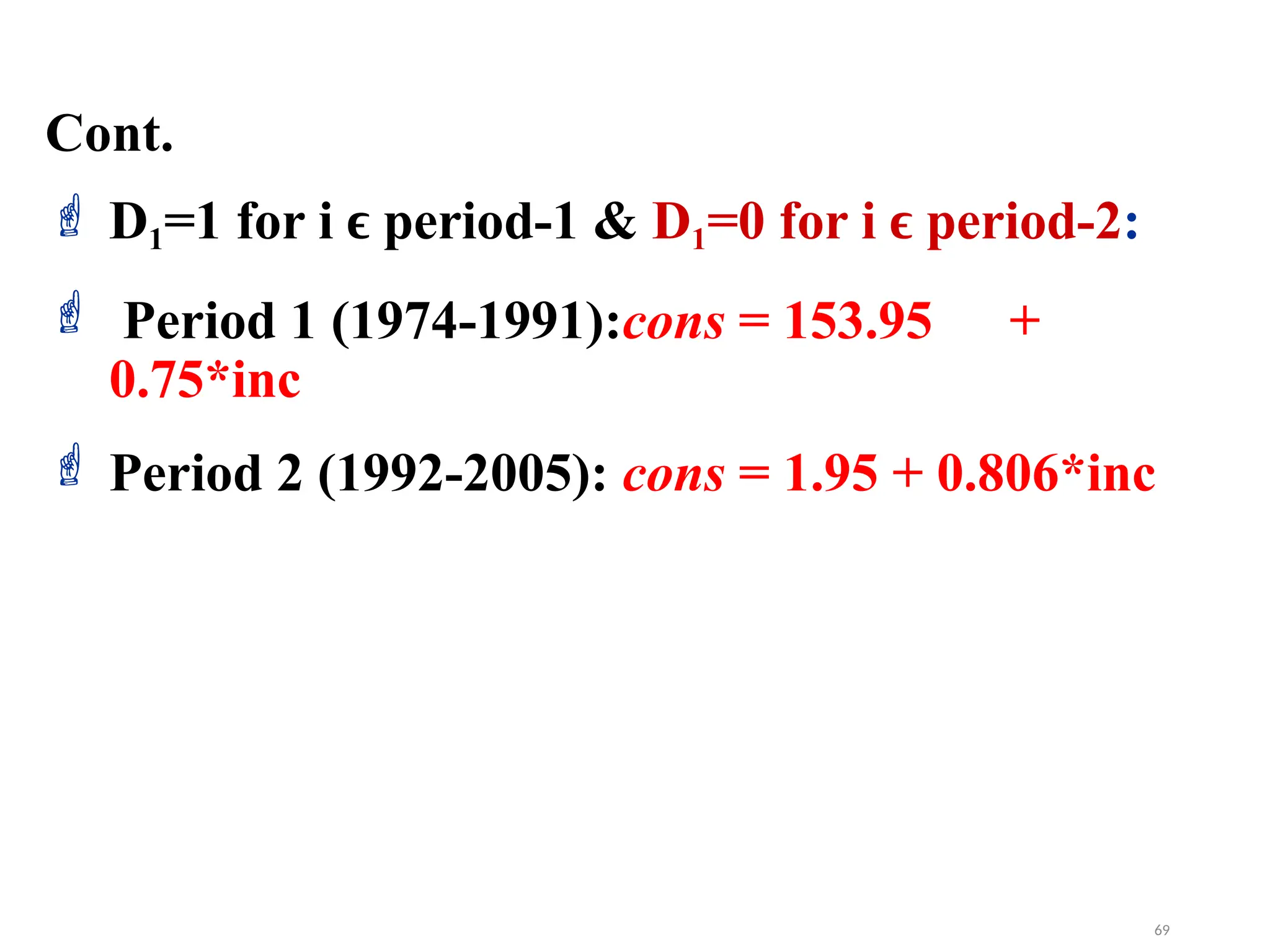
 D1=1 for i ϵ period-1 & D1=0 for i ϵ period-2:
 Period 1 (1974-1991):cons = 153.95 +
0.75*inc
 Period 2 (1992-2005): cons = 1.95 + 0.806*inc
69
2. Chow’s test
 One approach for testing the presence of structural change (structural
instability) is by means of Chow’s test. The steps involved in this
procedure:
 Step 1: Estimate the regression equation for the whole period (pre-
reform plus post-reform periods) and find the error sum of
squares ( ESSR ) or RRSS.
 Step 2: Estimate equation (model) using the available data in the pre-
reform period (say, of size n1), and find the error sum of squares (ESS1)
or RSS1
 Step 3: Estimate equation (model) using the available data in the post-
reform period (say, of size n2), and find the error sum of squares (ESS2) or
RSS2.
 Step 4: Calculate RSSUR= RSS1+RSS2.
 Step 5: Calculate the Chow test statistic
 Where k is number of estimated regression
coefficients and intercept
U 1
2
c
RSS /(n  n
 2k)
(RSSR  RSSU ) / k
F

70

is the critical value from
the t-
distribution with k (in our case k =2) and n1+n2-
2k degrees of freedom from a given significance
level,
 Decision rule: Reject the null hypothesis
of identical intercepts and slopes for the
pre-reform
and post reform periods, that is
 i.e, Rejecting H0 means there is a
structural change.
Cont.

H

if Fc Ftb.
 2
4
0
3
0


 

 
F

(k,n1 n2 2k )
71
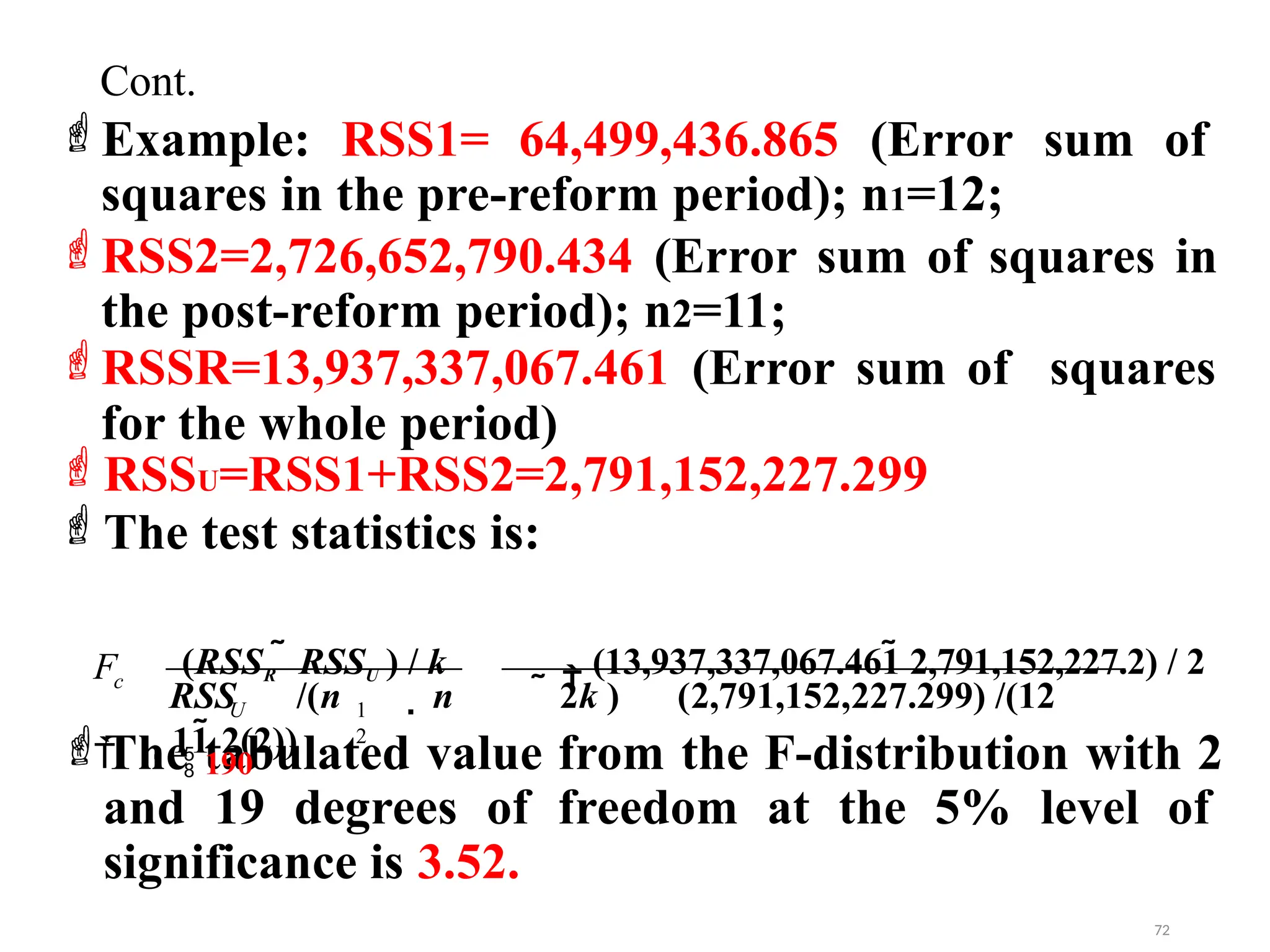
Example: RSS1= 64,499,436.865 (Error sum of
squares in the pre-reform period); n1=12;
RSS2=2,726,652,790.434 (Error sum of squares in
the post-reform period); n2=11;
RSSR=13,937,337,067.461 (Error sum of squares
for the whole period)
RSSU=RSS1+RSS2=2,791,152,227.299
The test statistics is:
The tabulated value from the F-distribution with 2
and 19 degrees of freedom at the 5% level of
significance is 3.52.
RSS /(n  n  2k ) (2,791,152,227.299) /(12
11 2(2))
F

U 1
2
(RSSR  RSSU ) / k

(13,937,337,067.461 2,791,152,227.2) / 2
 190
c
72
Cont.
73
Decision: Since the calculated value of F exceeds
the tabulated value, we reject the null hypothesis
of identical intercepts and slopes for the pre-
reform and post reform periods at the 5% level of
significance.
Hence, we can conclude that there is a structural
break.
Cont.
74
Draw backs:
Chow’s test does not tell us whether the difference
(change) in the slope only, in the intercept only or
in both the intercept and the slope.
The Chow Tests
Using an F-test to determine whether a single
regression is more efficient than two/more separate
regressions on sub-samples.
Cont.
75
The stages in running the Chow test are:
1. Run 2 separate regressions (say, before & after war
or policy reform, …) & save RSS's: RSS1 & RSS2.
RSS1 has n1–(K+1) df & RSS2 has n2–(K+1) df.
RSS1 + RSS2 = URSS with n1+n2–2(K+1) df.
2. Estimate pooled model (under H0: β's are stable).
RSS from this model is RRSS with n–(K+1)
df where n = n1+n2.
3. The test-statistic (under H0):
4. Find the critical value: FK+1,n-2(K+1) from table.
5. If Fcal>Ftab, reject H0 of stable parameters
(and favour Ha: there is structural break).
Cont.
U R S S
F
[ n  2 ( K  1 ) ]
[ R R S S  U R S S ]

( K  1 )
c a l
76
e.g.: we have the following results from
estimation of real consumption from real
disposable income:
i. For the period 1974-1991: consi = α1+β1*inci+ui
Consumption = 153.95 + 0.75*Income
p-value: (0.000) (0.000)
RSS = 4340.26114; R2 = 0.9982
ii. For the period 1992-2006: consi = α2+ β2*inci+ui
Consumption = 1.95 + 0.806*Income
p-value: (0.975) (0.000)
RSS = 10706.2127; R2 = 0.9949
iii. For the period 1974-2006: consi = α+ β*inci+ui
Consumption = 77.64 + 0.79*Income
t-ratio: (4.96)(155.56)
RSS = 22064.6663; R2 = 0.9987
Cont.
77
1. URSS = RSS1 + RSS2 = 15064.474
2. RRSS = 22064.6663
K = 1 and K + 1 = 2; n1 = 18, n2 = 15, n = 33.
3.
Thus,
4.ThetabulatedvaluefromtheF-distributionwith2 and29degreesof
freedomatthe5%levelof significanceis3.33.
5.Reject H0 at α=1%. Thus, there is structural break.
The pooled consumption model is an
inadequate specification; we should run separate
regressions.
The above method of calculating the Chow
test breaks down if either n1 < K+1 or n2 < K+1.
Solution: use Chow’s second (predictive) test!
29
15064.474
cal
[22064.6663  15064.474]
F  2  6.7632981
Cont.
78
If, for instance, n2 < K+1, then the F-statistic will be
altered as follows:
One way of correcting for unequal 2 is to use
dummy variable regression with robust standard
errors.
RSS1
n2
1
n1  (K  1)
 The Chow test tells if the parameters
differon average, but not which parameters
differ.
 Also, it requires that all groups have the same 2.
This assumption is questionable: if parameters can
be different, then so can the variances be.
[RRSS RSS ]
Fcal

Cont.
79
Using Dummy variables vs Chow’s test
Comparing the two methods, it is preferable to use
the method of dummy variables regression.
 This is because with the method of DVR:
1. We run only one regression.
2.We can test whether the change is in
the intercept only, in the slope only, or
in both.
80
Dummy dependent variable
(Qualitative Response Model)
Qualitative Response Model shows situations in
which the dependent variable in a regression
equation simply represents a discrete choice
assuming only a limited number of values
Such a model is called
Limited dependent variable
Discrete dependent variable
Qualitative response
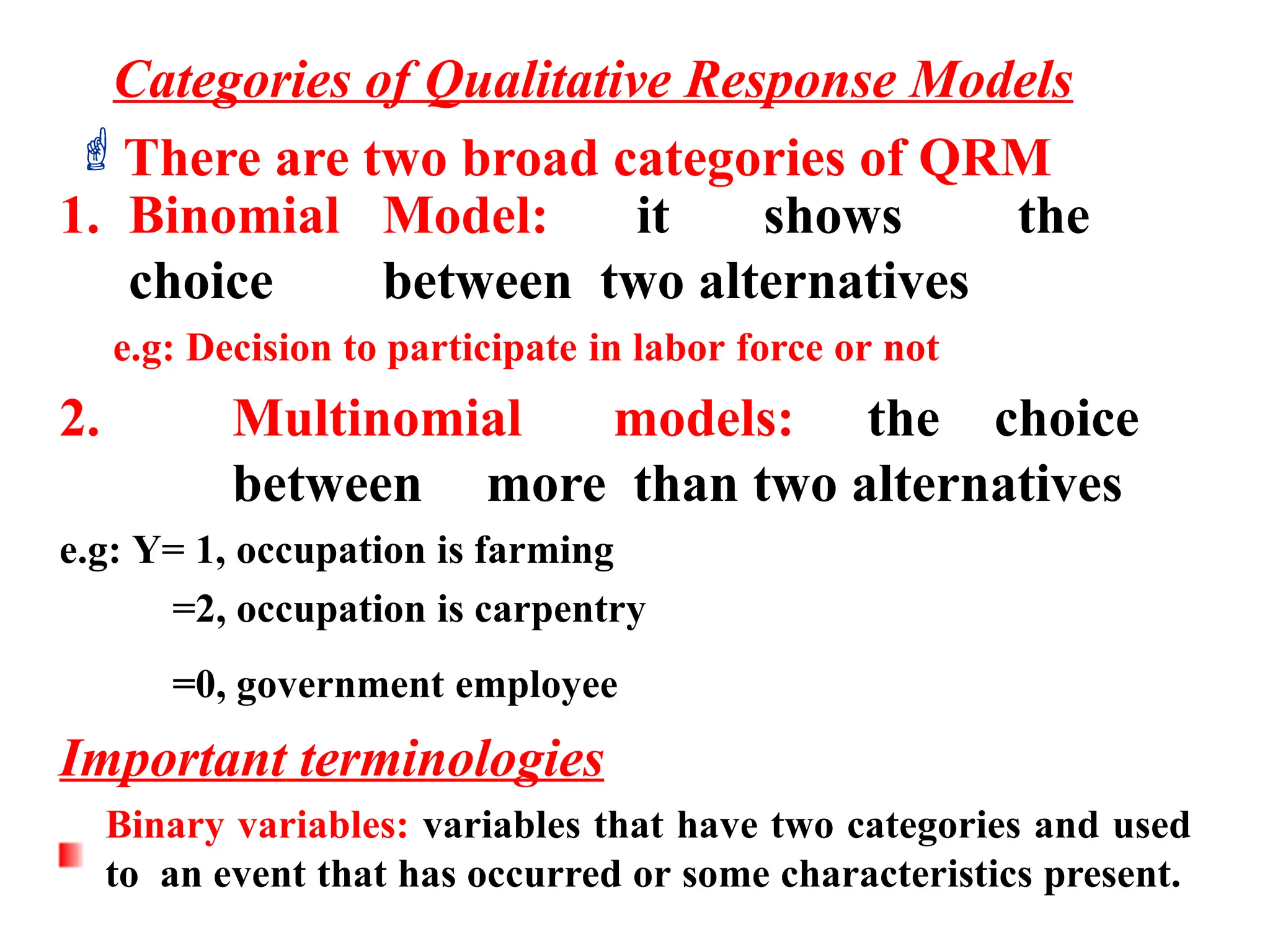
1. Binomial Model: it shows the
choice between two alternatives
e.g: Decision to participate in labor force or not
2. Multinomial models: the choice
between more than two alternatives
e.g: Y= 1, occupation is farming
=2, occupation is carpentry
=0, government employee
Important terminologies
Binary variables: variables that have two categories and used
to an event that has occurred or some characteristics present.
Categories of Qualitative Response Models
There are two broad categories of QRM
Cont.
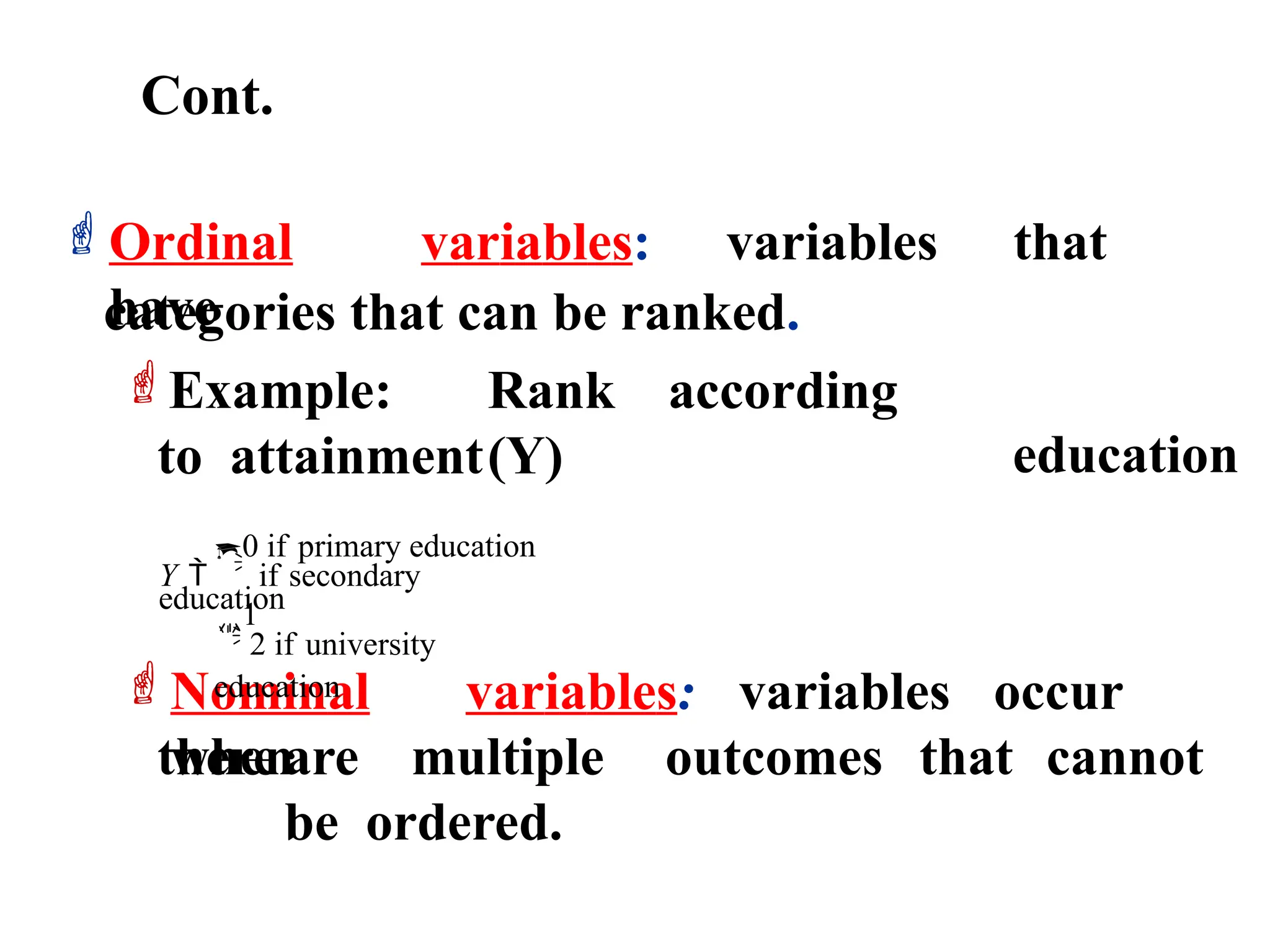
categories that can be ranked.
Ordinal variables: variables that
have
education
Example: Rank according
to attainment(Y)
thereare multiple outcomes that cannot
be ordered.

Nominal variables: variables occur
when
 2 if university
education
0 if primary education
Y  
if secondary
education
1
Cont.
Example: Occupation can be grouped
as farming, fishing, carpentry etc.
Count variables: indicate the number of
times some event has occurred.
Example: How many years of education
you have attend?
In all of the above situations, the
variables are discrete valued.

 3 if government
employee

2 if
carpentry
0 if farming
1 if
fishermen
Y 

N.B: Numbers are
assigned arbitrarily
Qualitative Choice Analysis
In such cases instead of standard regression
models, we apply different methods of modeling
and analyzing discrete data.
Qualitative choice models may be used when a
decision maker faces a choice among:
Finite number of choices
The choices are mutually exclusive (the
person chooses only one of the alternatives)
The choices are exhaustive (all possible
alternatives are included)
Cont.
Throughout our discussion we shall restrict
ourselves to cases of qualitative choice where the
set of alternatives is binary.
For the sake of convenience the dependent
variable is given a value of 0 or 1.
Example: Suppose the choice is whether to
work or not. The discrete dependent variable
we are working with will assume only two
values 0 and 1: Yi 

0 if i th
individual is notworking
1if i th
individual is working
where i = 1, 2, …, n.
Cont.
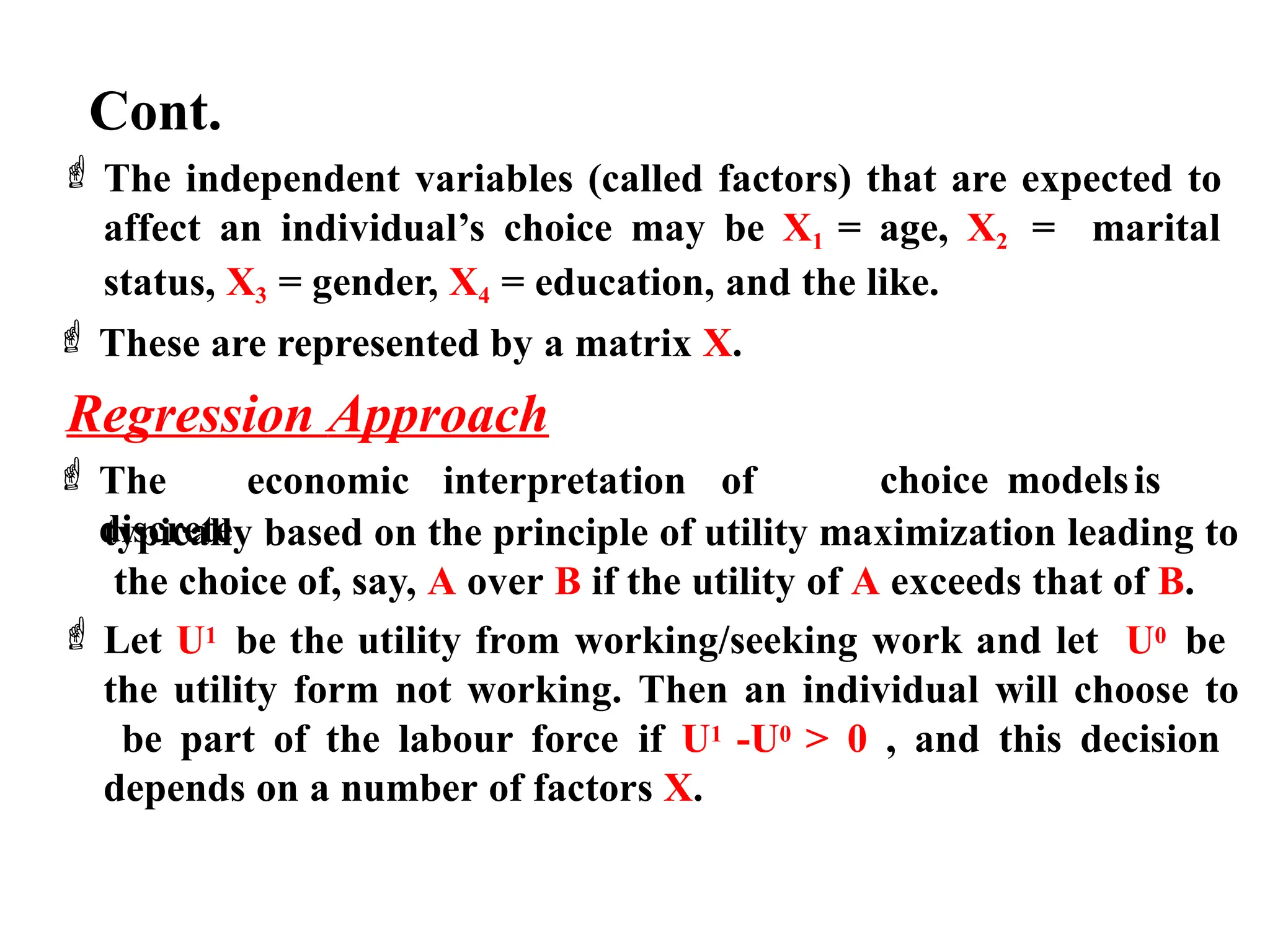
 The independent variables (called factors) that are expected to
affect an individual’s choice may be X1 = age, X2 = marital
status, X3 = gender, X4 = education, and the like.
 These are represented by a matrix X.
Regression Approach
 The economic interpretation of
discrete
choice modelsis
typically based on the principle of utility maximization leading to
the choice of, say, A over B if the utility of A exceeds that of B.
 Let U1 be the utility from working/seeking work and let U0 be
the utility form not working. Then an individual will choose to
be part of the labour force if U1 -U0 > 0 , and this decision
depends on a number of factors X.
Cont.
ith
The probability that the individual
chooses
alternative 1th (i.e. works) given his/
her individual characteristics, Xi is:
( measures the
impact of changes in X (say, age , marital status,
gender, education, occupation, and the like) on the
probability of labor force participation.
ith
 The probability that the individual
chooses
i  pr (Yi  1 / X i ) 
Pr[( U  U 1
The vector of parameters
 0 ]  G ( X i ,
 )
o
)
i
  (1, 2 ,....,k )
alternative 0 (i.e. not to work) is given by:
pr(Y  0 / X ) 1  1 Pr[(U1
Uo
)  0] 1
G(X , )
i i i i i
Cont.
form of
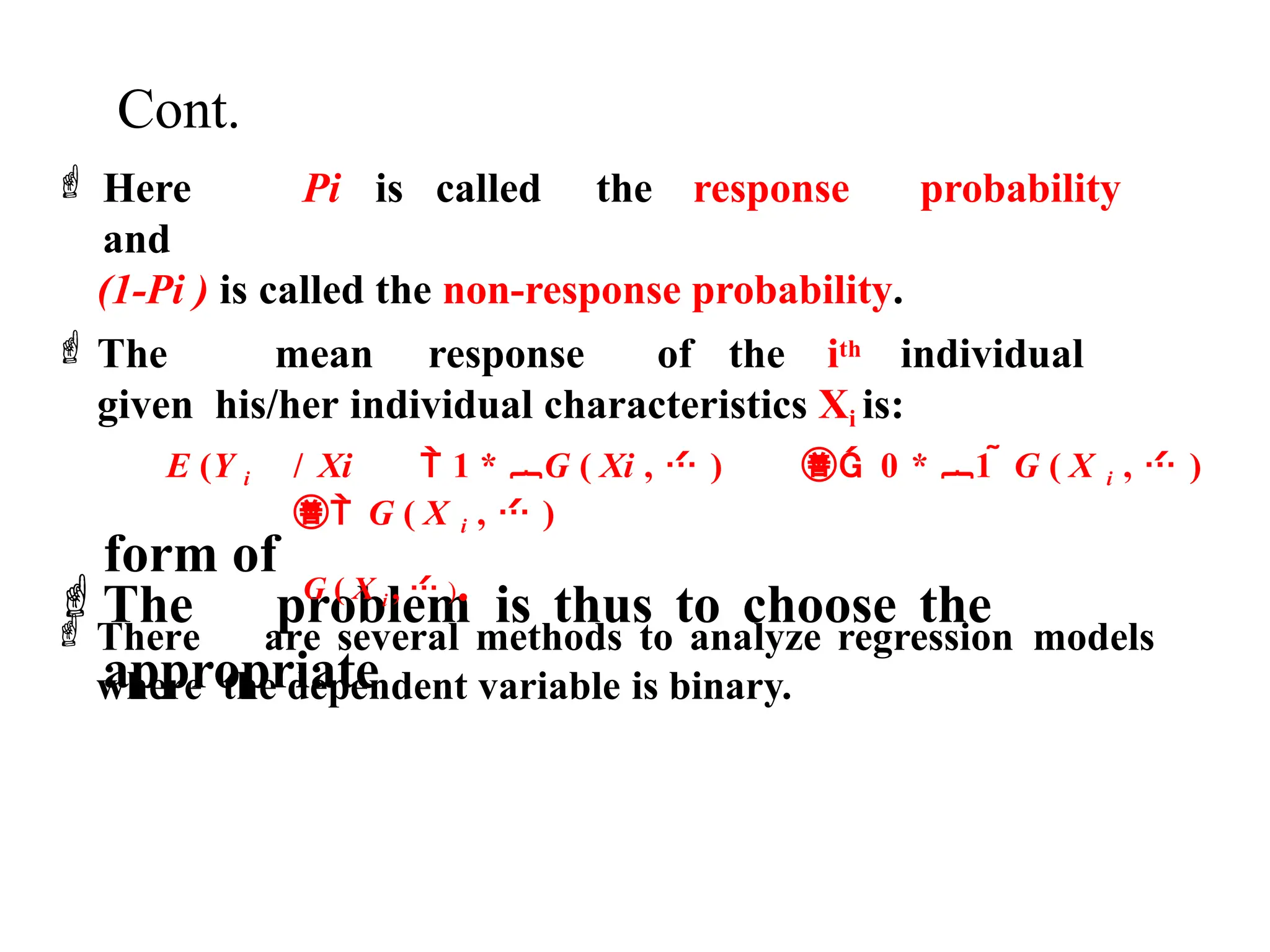
 Here Pi is called the response probability
and
(1-Pi ) is called the non-response probability.
 The mean response of the ith individual
given his/her individual characteristics Xi is:
E (Y i / Xi  1 * G ( Xi ,  )  0 * 1  G ( X i ,  )
 G ( X i ,  )
The problem is thus to choose the
appropriate
G ( X i ,  ).
 There are several methods to analyze regression models
where the dependent variable is binary.
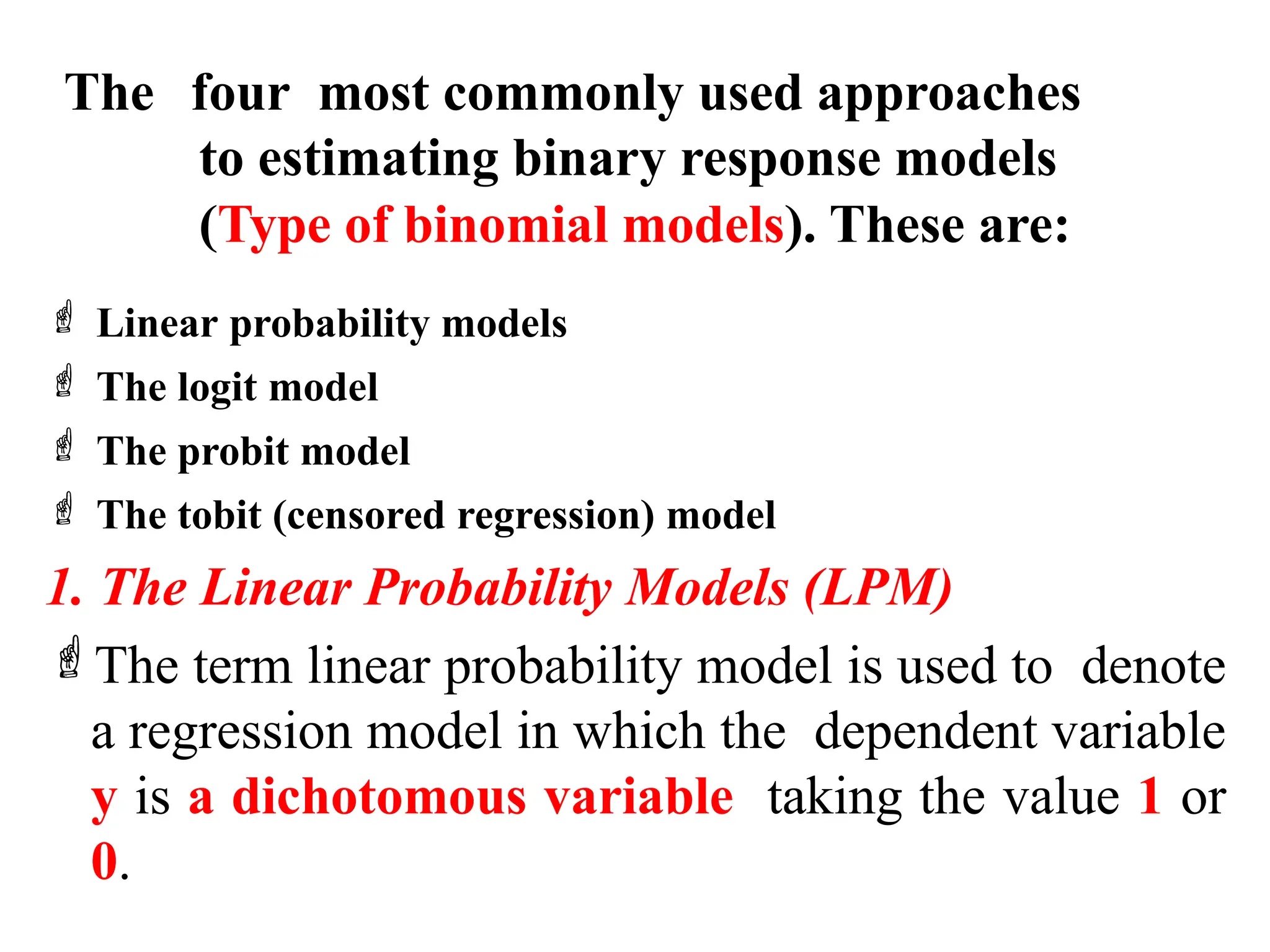
The four most commonly used approaches
to estimating binary response models
(Type of binomial models). These are:
 Linear probability models
 The logit model
 The probit model
 The tobit (censored regression) model
1. The Linear Probability Models (LPM)
The term linear probability model is used to denote
a regression model in which the dependent variable
y is a dichotomous variable taking the value 1 or
0.
Linear Probability Models
Inthe 1960’s and early
1970’s
probability model was widely
used
the
linear
mainly
because it is a model that can be easily estimated
using multiple regression analysis.
A “limited dependent variable" y is one
which takes a limited set of values. The most
common y 0,1 ; Multinomial:
y0,1,2,...,k ;

.
cases are: Binary:
;Integer: Integer:
y0,1,2,... y 
The traditional approach to the estimation of limited
dependent variable models is parametric maximum
likelihood.
R
Linear Probability Models
A parametric model is constructed, allowing the
construction of the likelihood function.
A more modern approach is semi-parametric,
eliminating the dependence on a parametric
distributional assumption. We will limit our
discuss to parametric approach.
When we use a linear regression model to
estimate probabilities, we call the model the
linear probability model.
The linear probability model is the regression
model applied to a binary dependent variable.
Linear Probability Models
The linear probability model defines G(X i ,  )  X i 
The regression model when Y is a
binary
variable is thus, Y 
0
Where Y takes only two value: 0 & 1, and
 j cannot be interpreted as the change in Y given a
one-unit increase in Xj,, holding all other factors
constant rather Y changes either from 0 to 1 or from
1 to 0.
If we assume that the zero conditional mean
assumption holds, that is, E()0 , then we have, as
always,
 1 X1  2 X 2  ...  k Xk    X 

Linear Probability Models
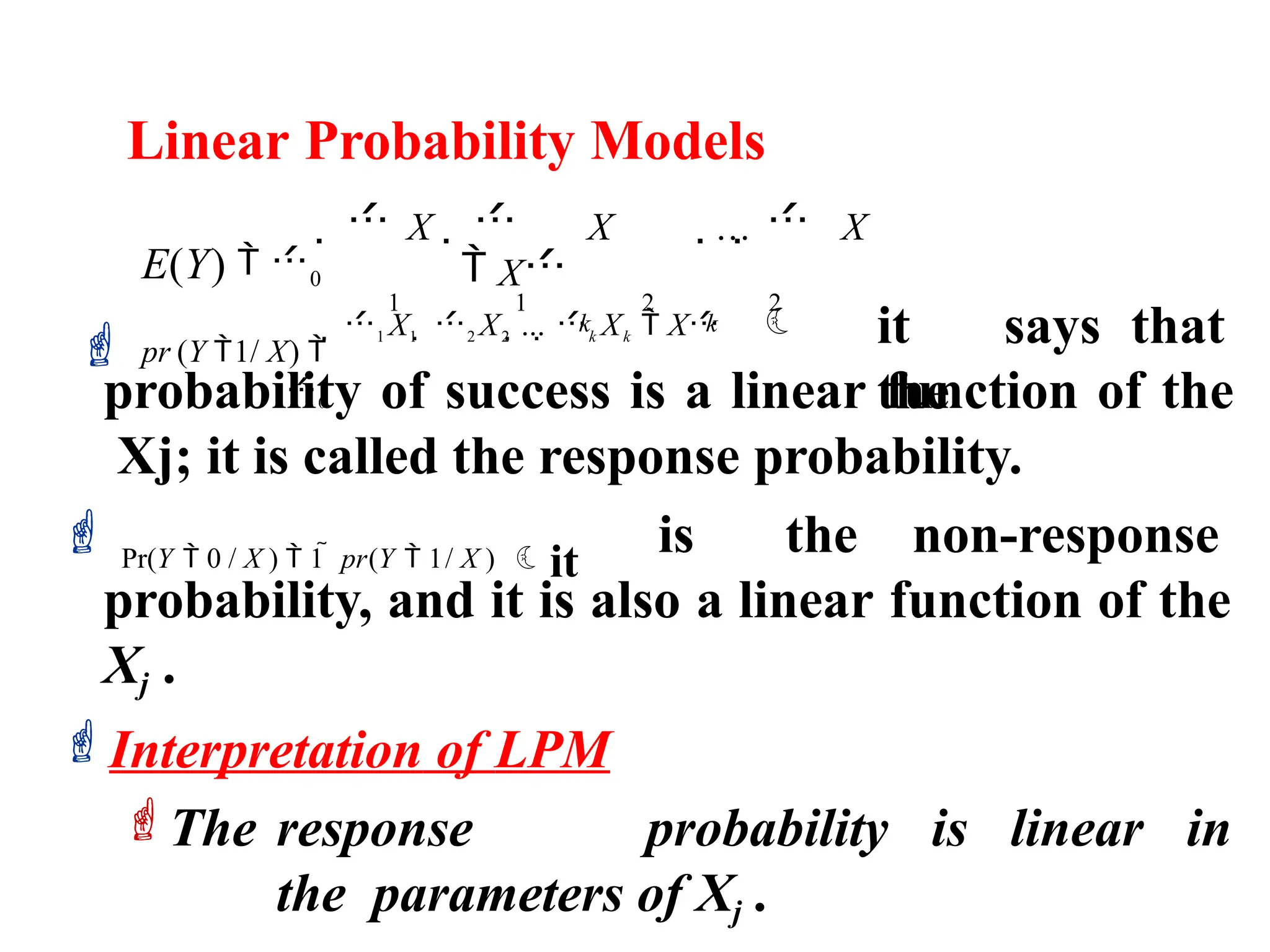
 it says that
the
probability of success is a linear function of the
Xj; it is called the response probability.
 Pr(Y  0 / X )  1  pr(Y  1/ X ) it
is the non-response
probability, and it is also a linear function of the
Xj .
Interpretation of LPM
The response probability is linear in
the parameters of Xj .
 1 X1  2 X2 ... k Xk  X
  X   X ...  X
 X
1 1 2 2
k k
E(Y)  0
 pr (Y 1/ X) 
0
Cont.
Example: Suppose that from hypothetical data of
house ownership and income and thus, the LPM
estimated by OLS (on home ownership) is given as
follows:
The above regression is interpreted as follows
The intercept of –0.9457 gives the “probability” that a family
with zero income will own a house. Since this value is
negative, and since probability cannot be negative, we treat
this value as zero.
The slope value of 0.1021 means that for a unit change in
income, on the average the probability of owning a house
increases by 0.1021 or about 10 percent. This is so whether the
income level is increased or not. This seems patently
unrealistic. In reality one would expect that Pi is non-linearly
related to Xi.
Cont.
measures the change in the
probability of
success whenXj changes, holding
otherfactors fixed.
Advantages of LPM:
Easy interpret; it is too
simple.
Drawbacks of LPM:
to estimate
and
1. The dependent variable
is discrete
while the
independent
variable is the combination of discrete and continuous
variables.
2. Usually we arbitrarily (or for convenience) use 0 and 1 for Yi .
If we use other values for Yi , say 3 and 4, will also change even
if the vector of factors Xi remains unchanged.
j


Cont.
3. Error term assumes only two values.
If Yi=1 then  i with the Probability,
Pi;
 If Yi=0 then    X  with Probability, 1-Pi;
i i
The variance of the disturbance terms depends
on the X’s and is thus not constant.; i.e., error
term is not normally distributed.
Now by definition
since
E( i ) 
0by
assumption. Therefore, usingthe preceding
probability distribution of we obtain:
 1  X i 
Var(i )  [E( i  E( i )]
 E( )
2 2
i
Cont.
This shows that the variance
of heteroscedastic because
it depends
Ui is
on
the
E( / Xi ) (1 Xi)Pi (Xi )(1Pi )  Pi 
Xi
conditional expectation of Y, which, of course,
depends on the value taken by X.
Thus, the OLS estimator of  is inefficient and
the standard errors are biased, resulting in
incorrect test.
4. The expectation (mean) of conditional on the
exogenous variables Xi is non sense.
Setting this mean to zero as in
the classical regression
analysis
Cont.
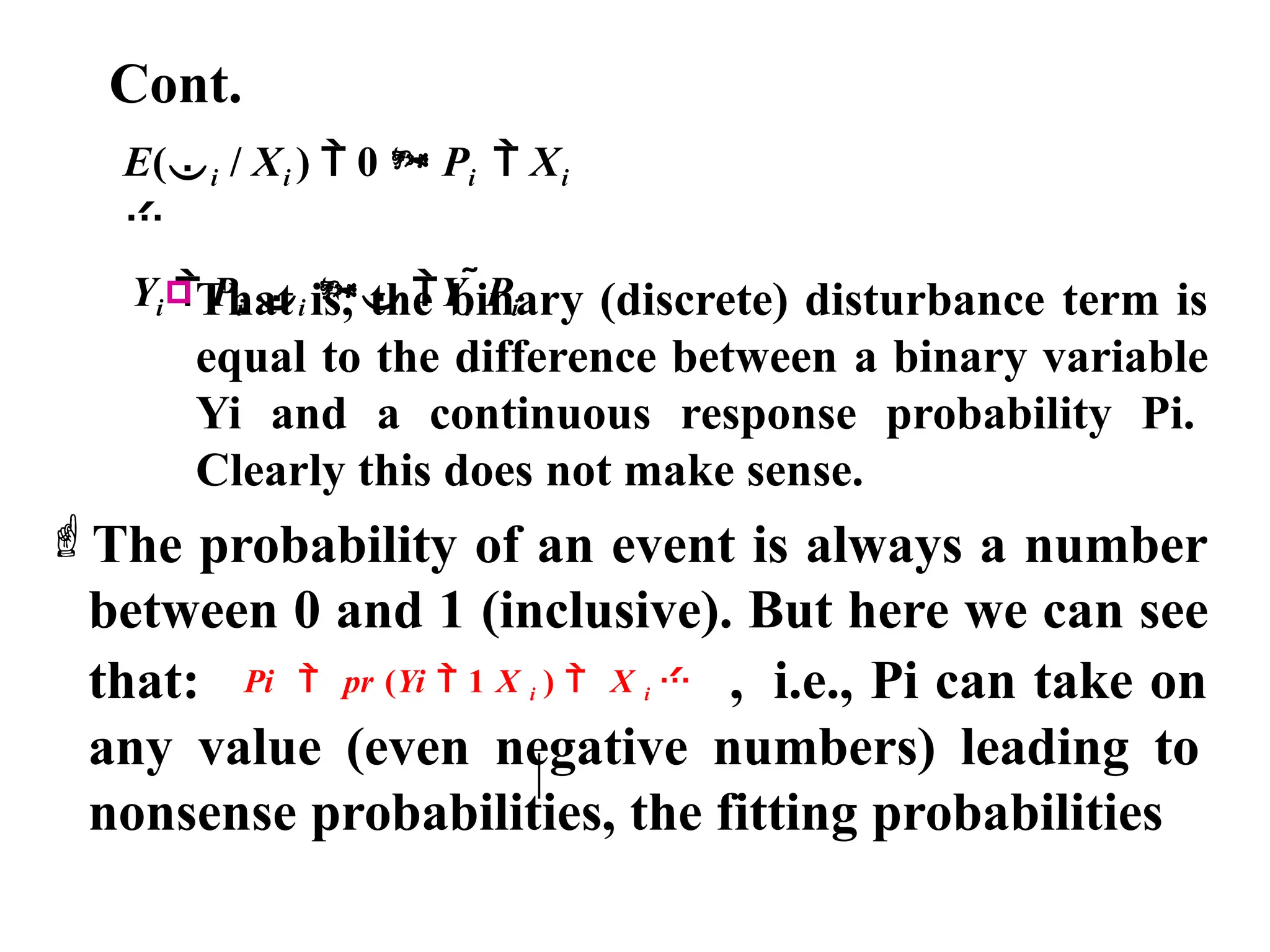
E(i / Xi )  0  Pi  Xi

Yi  Pi i  Yi Pi
That is, the binary (discrete) disturbance term is
equal to the difference between a binary variable
Yi and a continuous response probability Pi.
Clearly this does not make sense.
The probability of an event is always a number
between 0 and 1 (inclusive). But here we can see
that: Pi  pr (Yi  1 X i )  X i  , i.e., Pi can take on
any value (even negative numbers) leading to
nonsense probabilities, the fitting probabilities
Cont.
5. Non-Sensical Predictions
The LPM produces predicted values outside the
normal range of probabilities (0,1). It predicts
value of Y that are negative and greater than 1.
This is the real problem with the OLS
estimation of the LPM.
6. Non-normality of Ui
Although OLS does not require the disturbance (U’s) to be
normally distributed, we assumed them to be so distributed
for the purpose of statistical inference, that is, hypothesis
testing, etc. But the assumption of normality for Ui is no
longer tenable for the LPMs because like Yi, Ui takes on only
two values.
Cont.
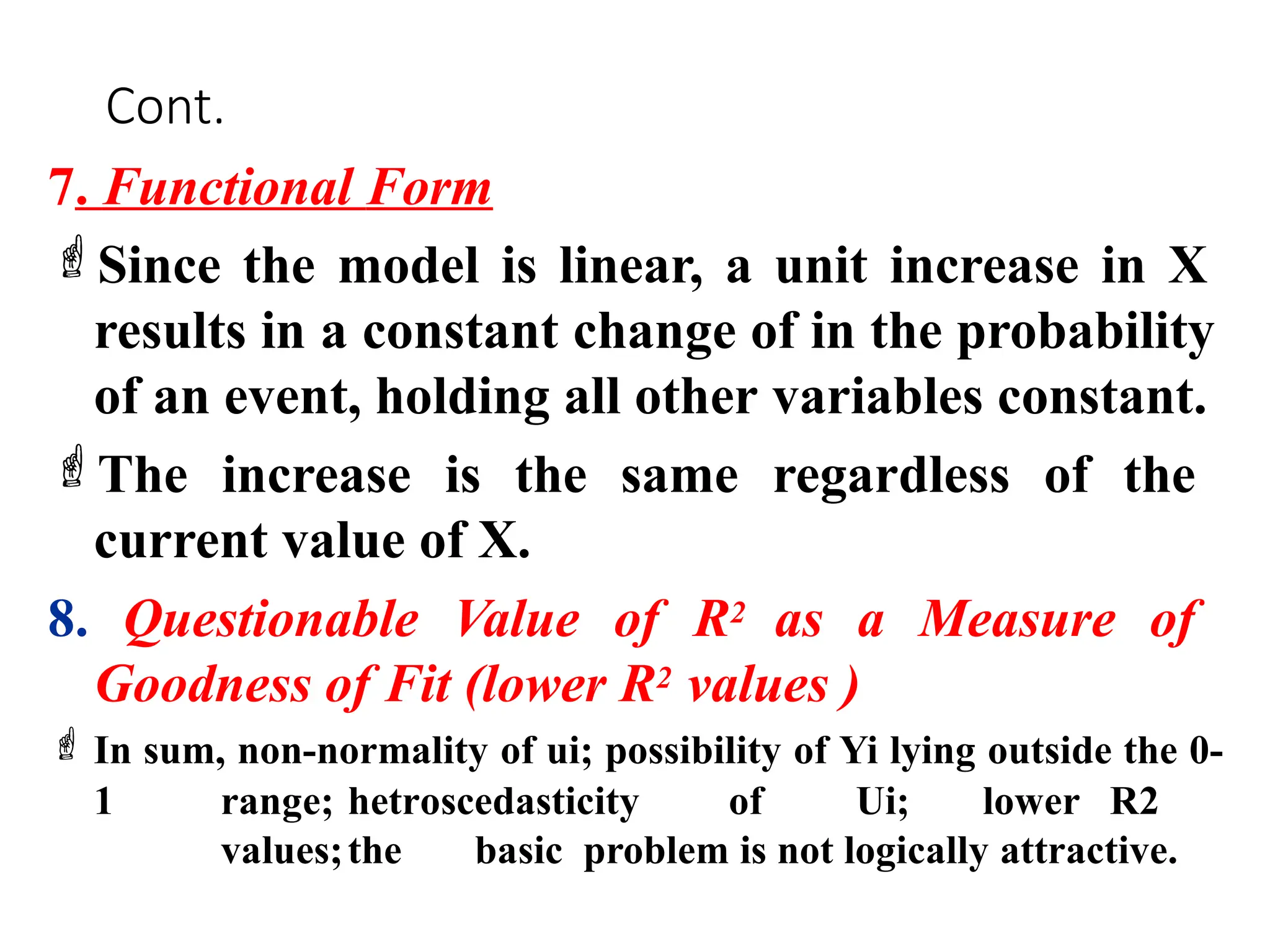
7. Functional Form
Since the model is linear, a unit increase in X
results in a constant change of in the probability
of an event, holding all other variables constant.
The increase is the same regardless of the
current value of X.
8. Questionable Value of R2 as a Measure of
Goodness of Fit (lower R2 values )
 In sum, non-normality of ui; possibility of Yi lying outside the 0-
1 range; hetroscedasticity of Ui; lower R2
values;the basic problem is not logically attractive.
Linear Probability Models
b/c the above mentioned problems, the LPM
model is not recommend for empirical works.
Therefore, what we need is a (probability)
model that has the following two features:
As Xi increases, Pi = E(Y = 1/X) increases but
never steps outside the 0-1 interval.
The relationship between Pi and Xi is non-
linear, that is, “ one which approaches zero at
slower and slower rates as Xi gets small and
approaches one at slower and slower rates as
X gets very large”
Linear Probability Models
The above S-shaped curve is very much similar with
the cumulative distribution function (CDF) of a
random variable.
the CDF of a random variable X is simply the
probability that it takes a value less than or equal to x0,
were x0 is some specified numerical value of X.
 In short, F(X), the CDF of X, is F(X = x0) = P(X  x0).
Linear Probability Models
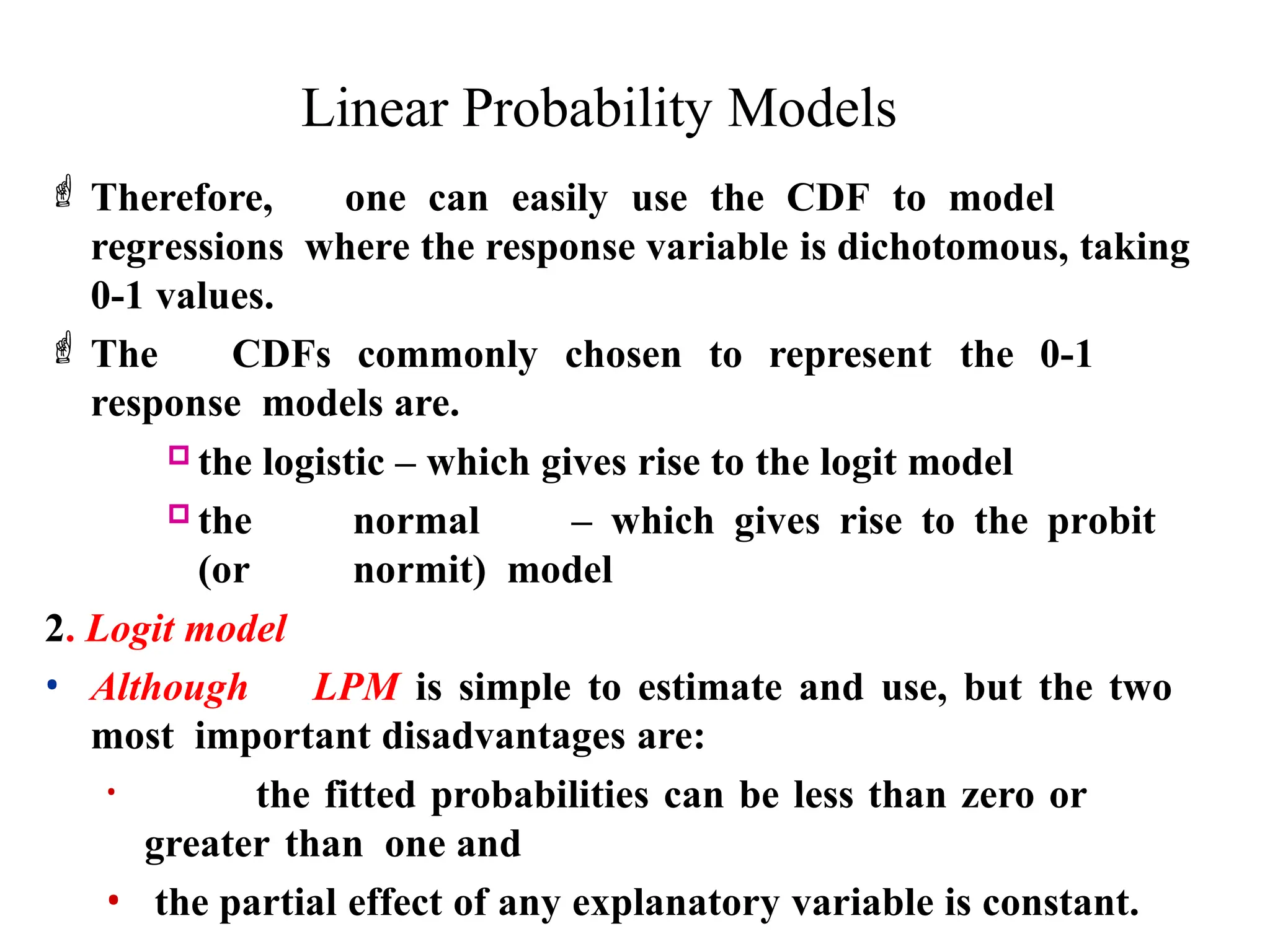
 Therefore, one can easily use the CDF to model
regressions where the response variable is dichotomous, taking
0-1 values.
 The CDFs commonly chosen to represent the 0-1
response models are.
 the logistic – which gives rise to the logit model
 the normal – which gives rise to the probit
(or normit) model
2. Logit model
• Although LPM is simple to estimate and use, but the two
most important disadvantages are:
• the fitted probabilities can be less than zero or
greater than one and
• the partial effect of any explanatory variable is constant.
Logit model
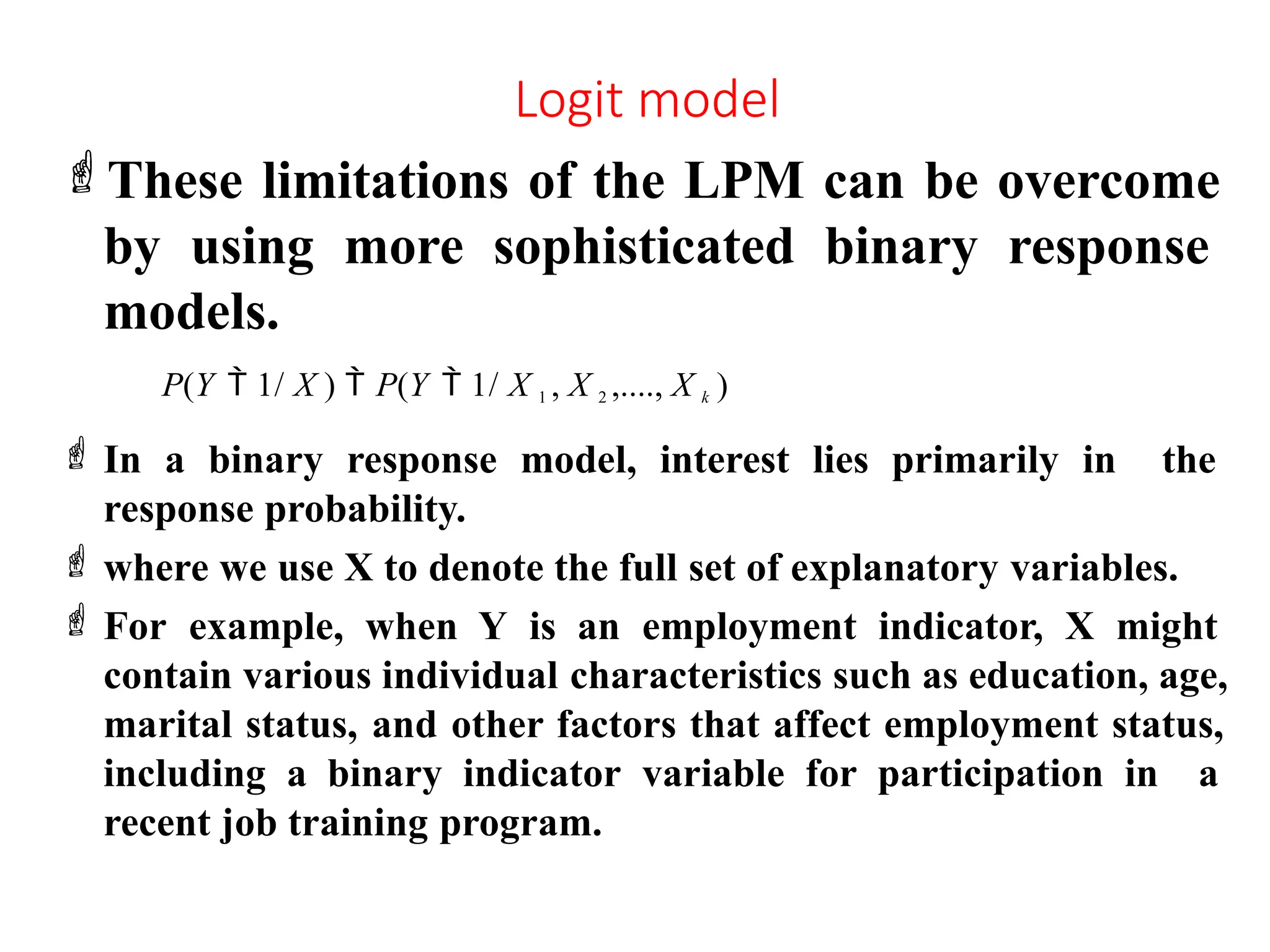
These limitations of the LPM can be overcome
by using more sophisticated binary response
models.
P(Y  1/ X )  P(Y  1/ X 1 , X 2 ,...., X k )
 In a binary response model, interest lies primarily in the
response probability.
 where we use X to denote the full set of explanatory variables.
 For example, when Y is an employment indicator, X might
contain various individual characteristics such as education, age,
marital status, and other factors that affect employment status,
including a binary indicator variable for participation in a
recent job training program.
Logit model
Inthe LPM, we assume that the
response probability is linear in a set of
parameters, j .
To avoid the LPM limitations, consider a class
of binary response models of the form.
P(Y  1/ X )  G(0  1 X1  2 X 2  ....  k X k )  G( X )
Where G is a function taking on values strictly
between 0 & 1: 0  G ( z)  1, for all real numbers z.
This ensures that the estimated
response probabilities are strictly between zero
and one.
Logit model
Various nonlinear functions have been
suggested for the function G in order to make
sure that the probabilities are between zero and
one.
In the logit model, G is the logistic function:
which is between zero and one for all real
numbers z. This is the cumulative distribution
function (cdf) for a standard logistic random
variable.
e X
1  e X
  ( z )

[1  exp( z )]
exp( z
)
G ( z )

Logit model
the response probability P(Y =1/X) is evaluated
as:
the non
response
probability P(Y =0/X)
is
evaluated as:
Note that: both response and non- response
probabilities lie in the interval [0 , 1] , and
hence, are interpretable.
Odd ratio: the ratio of the response probabilities
(Pi) to the non response probabilities (1-Pi).
1  e X
e
X
P  P (Y  1 X )

eX

1
1 P  P(Y  0 X) 1 
1 eX
1 eX
Logit model
For the logit model, the odds ratio is given by:
The natural logarithm of the
odds
ratio(log-
odds ratio) is:
L(the log of the odds ratio) is linear in X as well
as  (the parameters). L is called the logit and
hence the name logit model is given to it.
k k

X

X

X
1
1 e X

P(Y 1 X )
 1 e X
eX

1 P P(Y 
0 X )
P 3 3
2
2
 e  e
...e
0
1
 eX

e

P
)

1

P
Li

ln(
0 1X1 2 X2 ...k
Xk
Logit model
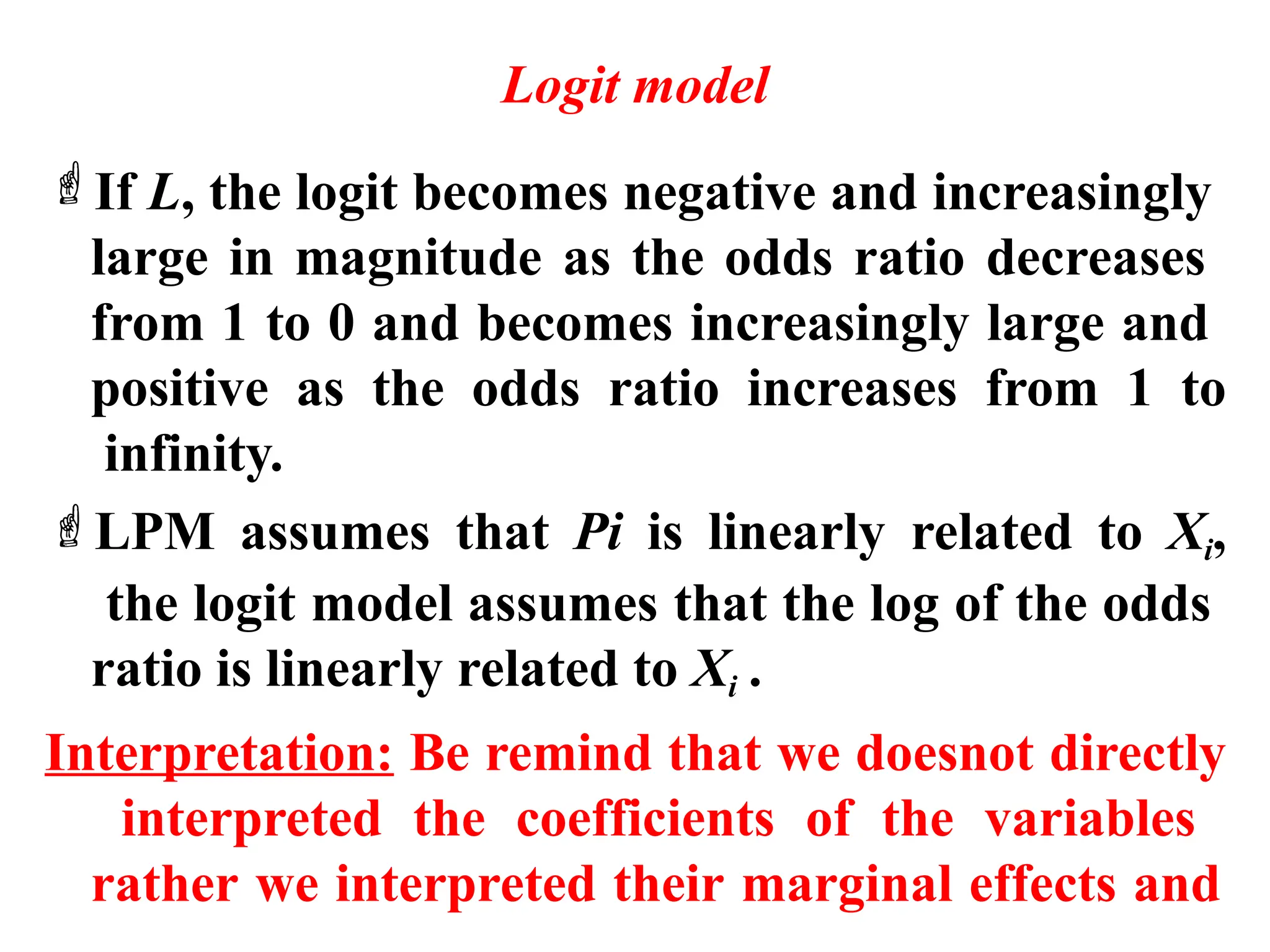
Thus, the log-odds ratio is a linear function
of the explanatory variables.
For the LPM it is Pi, which is assumed to be a
linear function of the explanatory variables.
Features of logit model
 As P goes from 0 to 1 (i.e., as Z varies from −∞ to +∞), the logit L
goes from −∞ to +∞. That is, although the probabilities (of
necessity) lie between 0 and 1, the logits are not so bounded.
 Although L is linear in X, the probabilities themselves are not.
This property is in contrast with the LPM model where the
probabilities increase linearly with X.
Logit model
If L, the logit becomes negative and increasingly
large in magnitude as the odds ratio decreases
from 1 to 0 and becomes increasingly large and
positive as the odds ratio increases from 1 to
infinity.
LPM assumes that Pi is linearly related to Xi,
the logit model assumes that the log of the odds
ratio is linearly related to Xi .
Interpretation: Be remind that we doesnot directly
interpreted the coefficients of the variables
rather we interpreted their marginal effects and
Logit model
β2, the slope, measures the change in L for a
unit change in X, that is, it tells how the log-
odds in favor of owning a house change as
income changes by a unit, say, birr 1000.
The intercept, β1 is the value of the logodds in
favor of owning a house if income is zero.
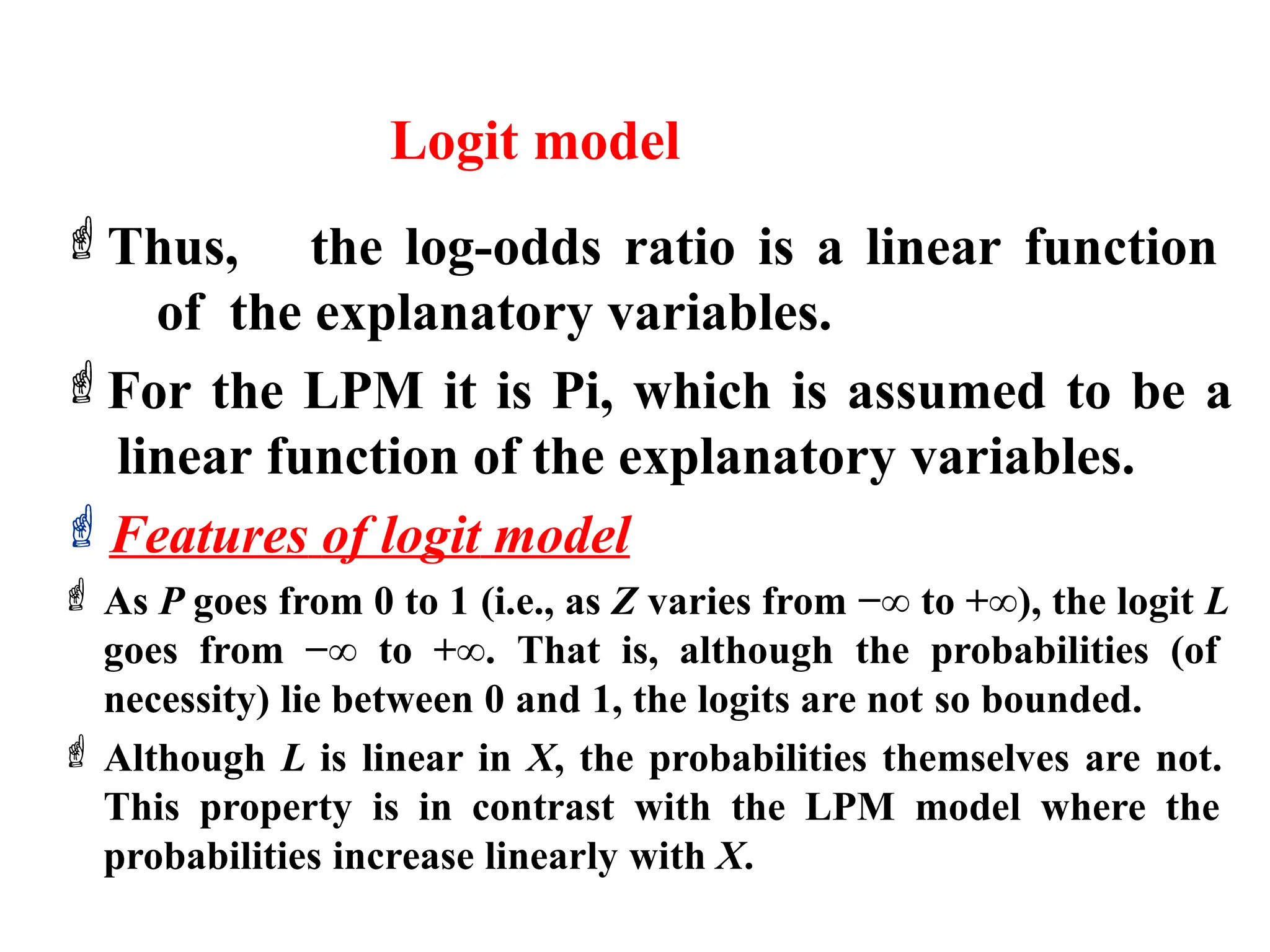
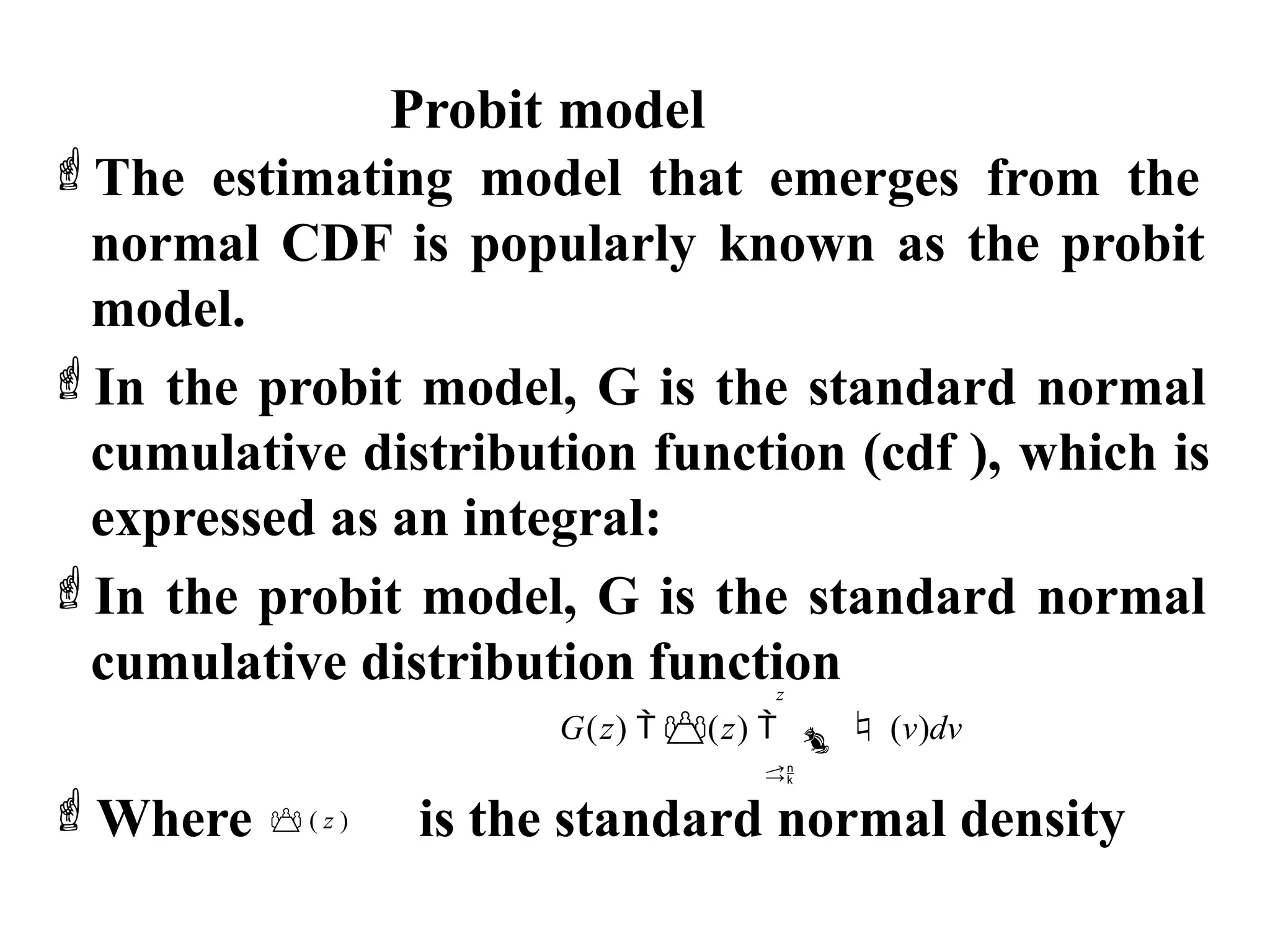
Probit model
The estimating model that emerges from the
normal CDF is popularly known as the probit
model.
In the probit model, G is the standard normal
cumulative distribution function (cdf ), which is
expressed as an integral:
In the probit model, G is the standard normal
cumulative distribution function
z
G(z)  (z)   (v)dv

Where  ( z ) is the standard normal density
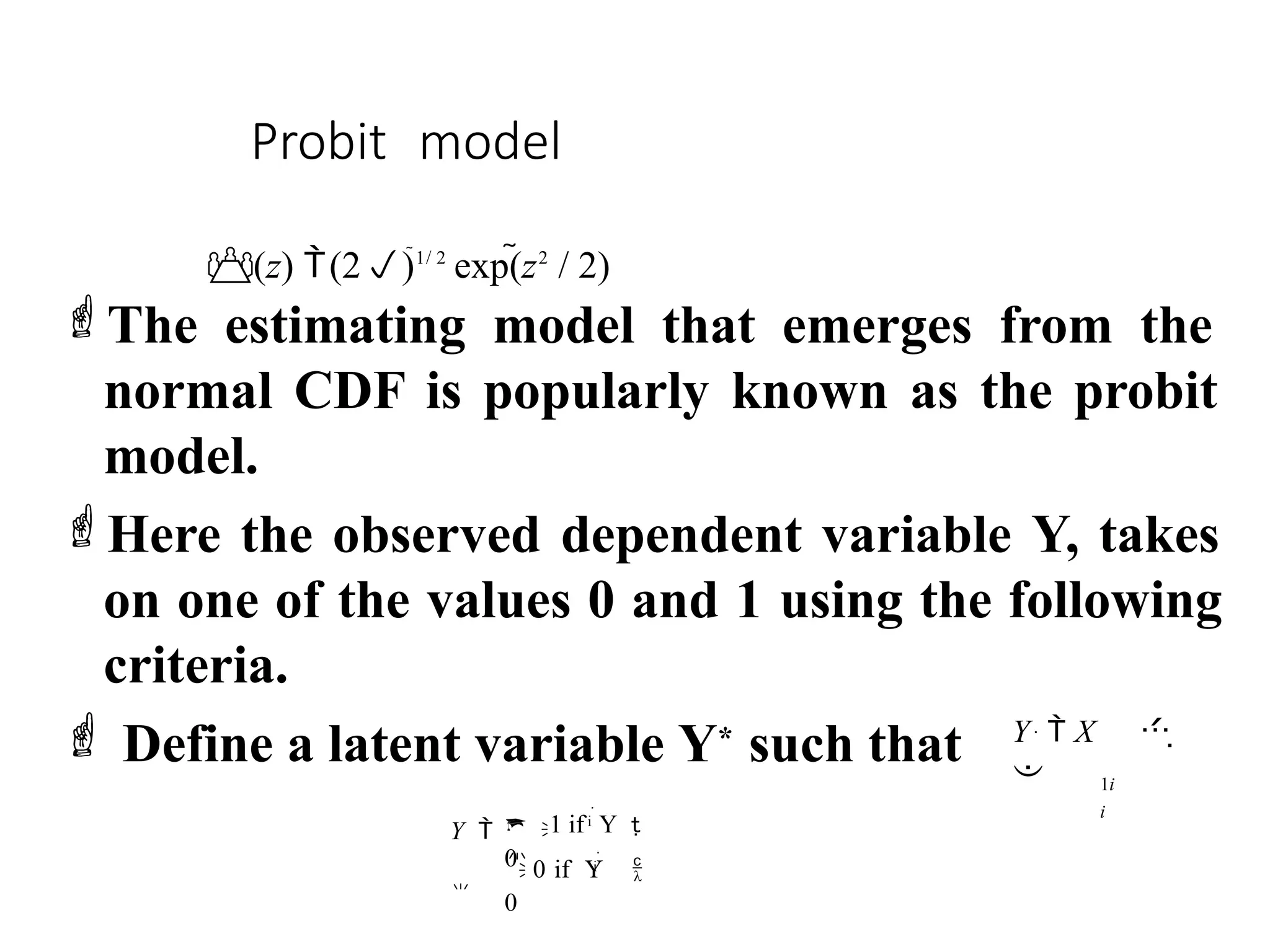
Probit model
(z) (2)1/ 2
exp(z2
/ 2)
The estimating model that emerges from the
normal CDF is popularly known as the probit
model.
Here the observed dependent variable Y, takes
on one of the values 0 and 1 using the following
criteria.
 Define a latent variable Y* such that Y 
 X  

1i
i



 0 if Y 
0
1 if Y 
0 i
i
Y 

Probit model
The latent variable Y* is continuous (- < Y*
<
).
It generates the observed binary variable Y.
An observed variable, Y can be observed in two
states:
if an event occurs it takes a value of 1
if an event does not occur it takes a value of 0
The latent variable is assumed to be a linear
function of the observed X’s through the
Probit model
However, since the latent dependent variable is
unobserved the model cannot be estimated using
OLS.
either the probit or the logit
model
Maximization of the likelihood function
for
is
accomplished by nonlinear estimation methods.
Maximum likelihood can be used instead.
Most often, the choice is between normal errors
and logistic errors, resulting in the probit
(normit) and logit models, respectively.
Probit model
The coefficients derived from the maximum
likelihood (ML) function will be the coefficients
for the probit model, if we assume a normal
distribution.
If we assume that the appropriate distribution
of the error term is a logistic distribution, the
coefficients that we get from the ML function
will be the coefficient of the logit model.
In both cases, as with the LPM, it is assumed
that E[i/Xi] = 0
Probit model
In the probit model, it is assumed that Var
(i/Xi) = 1; In the logit model, it is assumed that
Var (i/Xi) = 2
3 .
Hence, the estimates of the parameters ( ’s)
from the two models are not directly
comparable.
But as Amemiya suggests, a logit estimate of a
parameter multiplied by 0.625 gives a fairly
good approximation of the probit estimate of the
same parameter.
Probit
model
Similarly
the
coefficients of LPMand
logit
models are related as follows:
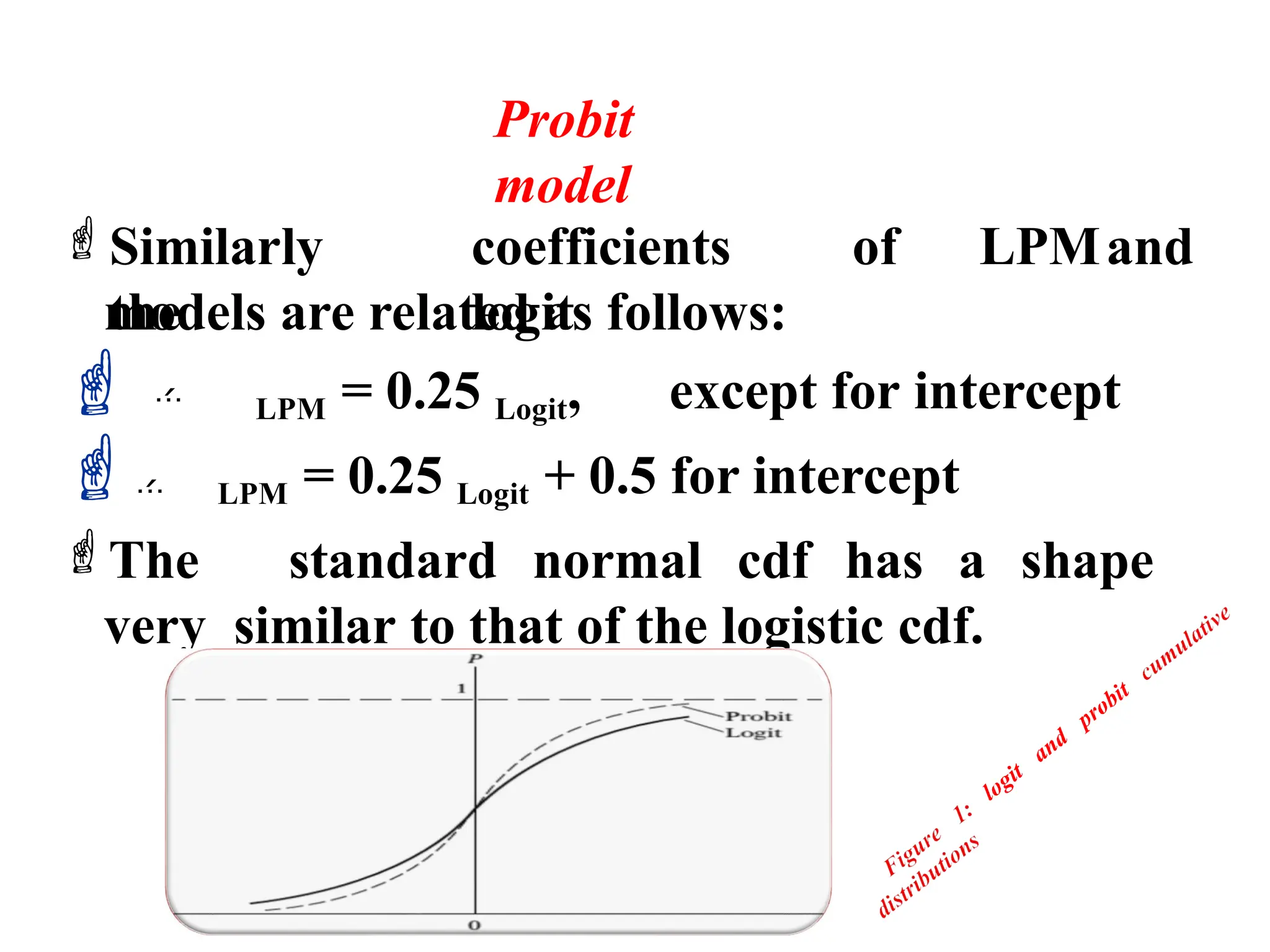
  LPM = 0.25 Logit, except for intercept
 LPM = 0.25 Logit + 0.5 for intercept
The standard normal cdf has a shape
very similar to that of the logistic cdf.
Probit model
The estimating model that emerges from the
normal CDF is popularly known as the probit
model, although sometimes it is also known as
the normit model.
Note that both the probit and the logit models
are estimated by Maximum Likelihood
Estimation.
Probit Model
Interpreting the Probit and Logit Model Estimates
The coefficients give the signs of the partial effects of
each Xj on the response probability, and the statistical
significance of Xj is determined by whether we can
reject H0: Bj=0 at a sufficiently small significance level.
However, the magnitude of the estimated parameters
(dZ/dX) has no particular interpretation. We care
about the magnitude of dProb(Y)/dX.
From the computer output for a probit or logit
estimation, you can interpret the statistical significance
and sign of each coefficient directly.
Probit model
In the linear regression model, the slope
coefficient measures the change in the average
value of the regressand for a unit change in the
value of a regressor, with all other variables
held constant.
In the LPM, the slope coefficient measures
directly the change in the probability of an event
occurring as the result of a unit change in the
value of a regressor, with the effect of all other
variables held constant.
Probit model
In the logit model the slope coefficient of a
variable gives the change in the log of the odds
associated with a unit change in that variable,
again holding all other variables constant.
But as noted previously, for the logit model the
rate of change in the probability of an event
happening is given by βj Pi(1 − Pi ), where βj is
the (partial regression) coefficient of the jth
regressor. But in evaluating Pi , all the variables
included in the analysis are involved.
Probit model
In the probit model, as we saw earlier, the rate of
change in the probability is somewhat complicated
and is given by βj f (Zi ), where f (Zi) is the density
function of the standard normal variable and Zi =
β1 + β2X2i + · · · +βkXki , that is, the regression
model used in the analysis.
Thus, in both the logit and probit models all the
regressors are involved in computing the changes in
probability,whereas in the LPM only
the
jth
regressor is involved. This difference may
be one reason for the early popularity of
the LPM model.
Probit vs logit model
Is logit or probit model is preferable?
In most applications the models are quite similar, the main
difference being that the logistic distribution has slightly
fatter tails.
 That is to say, the conditional probability Pi approaches
zero or one at a slower rate in logit than in probit.
 Therefore, there is no compelling reason to choose one
over the other.
In practice many researchers choose the logit model
because of its comparative mathematical simplicity.
The standard normal cdf has a shape very similar to that of
the logistic cdf.
Probit vs logit model
The probit and logit models differ in the
specification of the distribution of the error term
u.
The difference between the specification and
the linear probability model is that in the linaer
probability model we analyses the dichotomous
variables as they are, where as we assume the
existence of an underlying latent variable for
which we observe a dichotomous realization.
Probit vs logit model
The probit model and the logit model are not
directly comparable. The reason is that,
although the standard logistic (the basis of logit)
and the standard normal distributions (the basis
of probit) both have a mean value of zero, their
variances are different; 1 for the standard
normal (as we already know) and π2/3 for the
logistic distribution, where π ≈ 22/7.
Therefore, if you multiply the probit coefficient
by about 1.81 (which is approximately = π/√ 3),
you will get approximately the logit coefficient.
Probit vs logit model
The R2’s for the linear probability model are
significantly lower than those for the logit and
probit models. Alternative ways of comparing
the models would be:
To calculate the sum of squared
deviations from predicted probabilities
To compare the percentages correctly
predicted
To look at the derivatives of the probabilities
with respect to a particular independent
variable.
Tobit Model
An extension of the probit model is the tobit model
developed by James Tobin.
Let us consider the home ownership example.
Suppose we want to find out the amount of money the
consumer spends in buying a house in relation to his or
her income and other economic variables.
If a consumer does not purchase a house, obviously we
have no data on housing expenditure for such
consumers; we have such data only on consumers who
actually purchase a house.
Cont.
Thus, consumers are divided into two groups, one
consisting of say, N1 consumers about whom we have
information on the regressors (say income, interest rate
etc) as well as the regresand ( amount of expenditure
on housing) and another consisting of say, N2
consumers about whom we have information only on
the regressors but on not the regressand.
A sample in which information on regressand is
available only for some observations is known as a
censored sample. Therefore, the tobit model is also
known as a censored regression model.
Cont.
Mathematically, we can express the tobit model
as
Where RHS= right hand side
The method of maximum likelihood can be used
to estimate the parameters of such models.
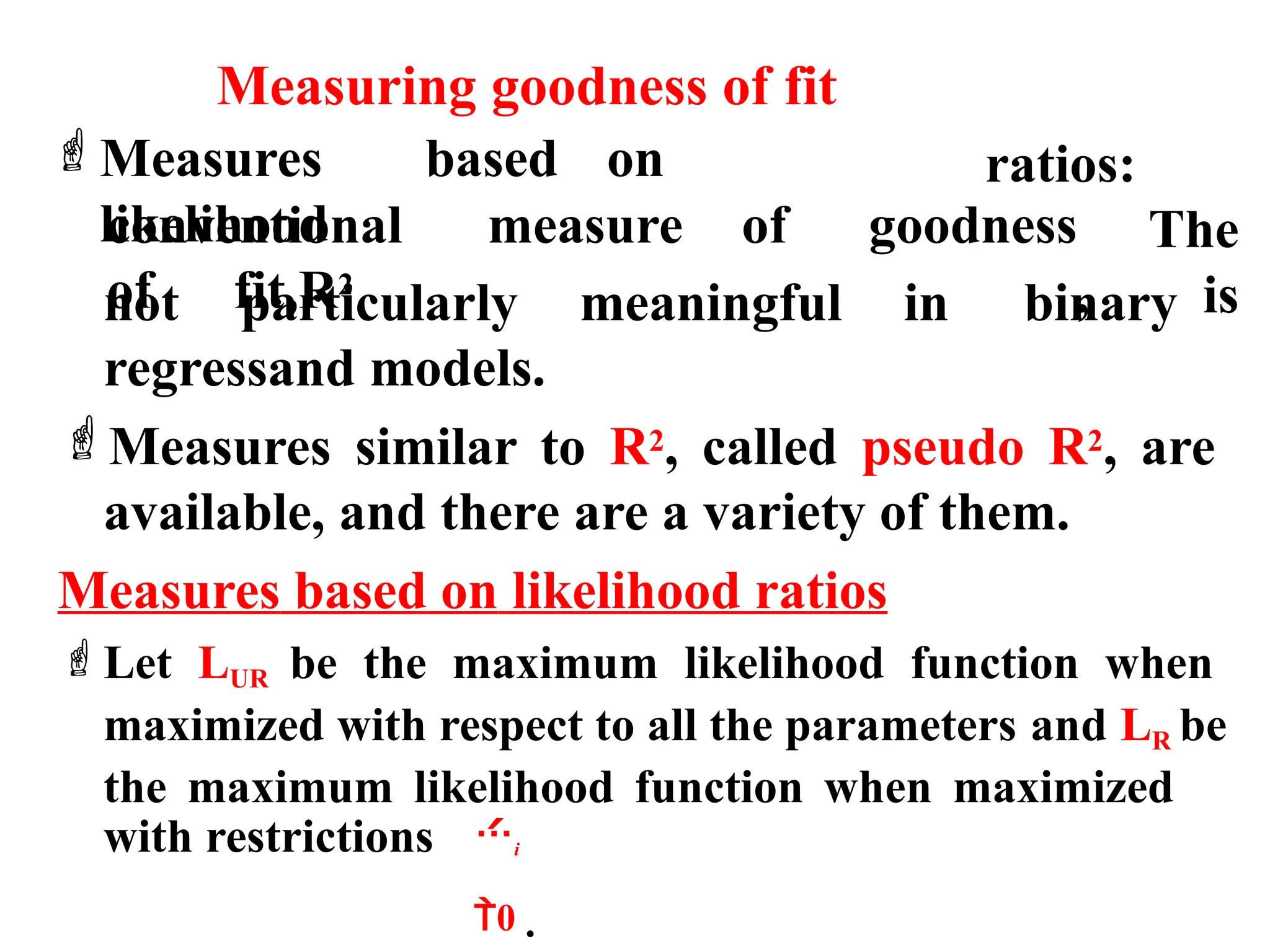
Measuring goodness of fit
The conventional measure of goodness of fit,R2 ,
is not particularly meaningful in binary
regressand models. Measures similar to R2,


0,
otherwise
0
1
1i
   X  ui if
RHS  0
i
Y

Measuring goodness of fit
Measures based on
likelihood
conventional measure of goodness
of fit,R2
ratios:
The
, is
not particularly meaningful in binary
regressand models.
Measures similar to R2, called pseudo R2, are
available, and there are a variety of them.
Measures based on likelihood ratios
Let LUR be the maximum likelihood function when
maximized with respect to all the parameters and LR be
the maximum likelihood function when maximized
with restrictions i
0 .
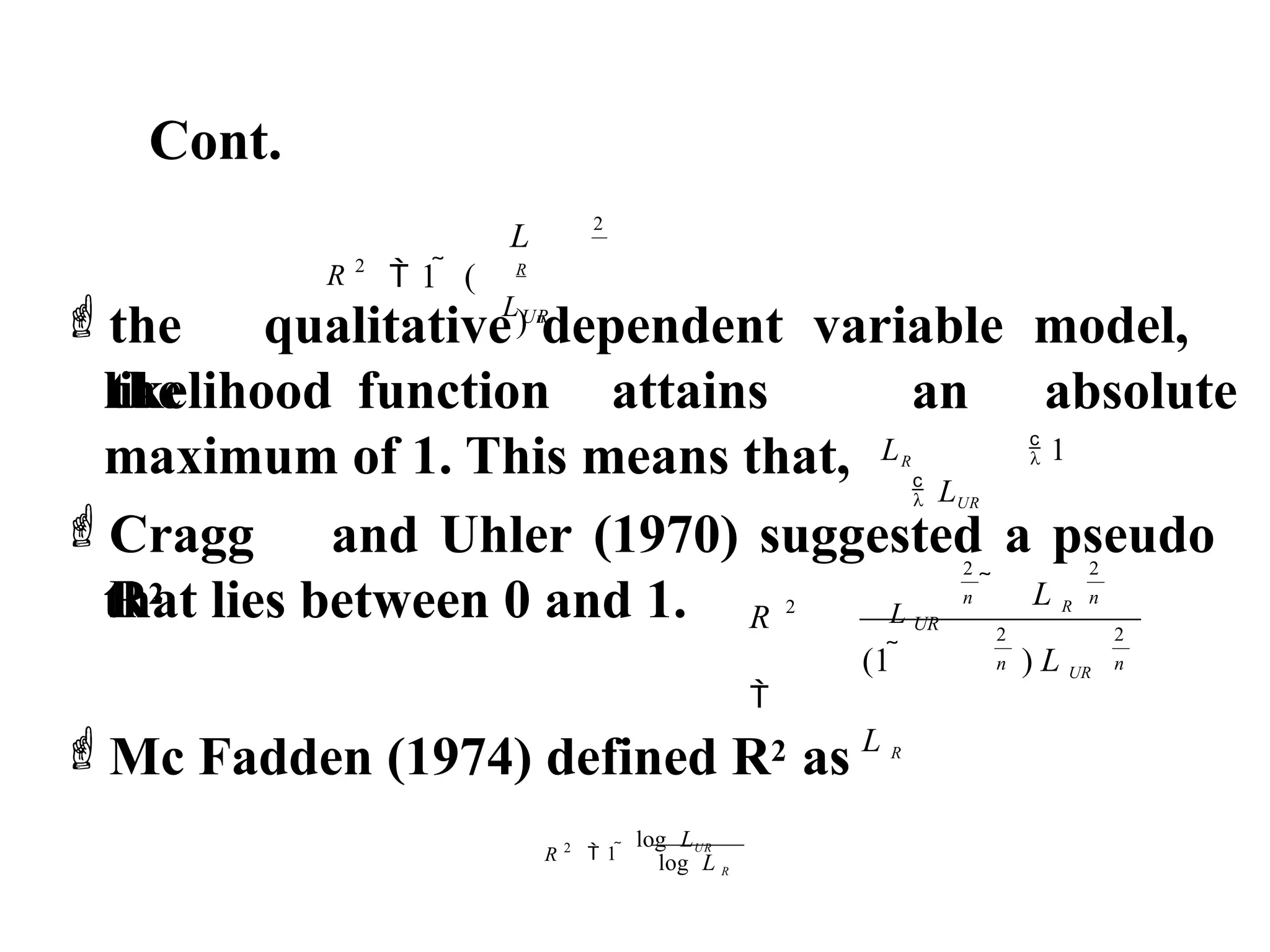
Cont.
the qualitative dependent variable model,
the
likelihood function attains
maximum of 1. This means that,
Cragg and Uhler (1970) suggested a pseudo
R2
that lies between 0 and 1.
Mc Fadden (1974) defined R2 as
LUR
L
R 2
2
 1  ( R
) n
absolute
 1
an
LR
 LUR
) L UR
(1 
L R
2
n
 L R
2
n
L UR
2
n
2
n
2
R

log L R
 1 
log LUR
R 2
Cont.
Another goodness-of-fit measure that is usually
reported is the so-called percent correctly
predicted, which is computed as follows. For
each i, we compute the estimated probabilit y
that Yi takes on the value one, .
times the predicted matches the actual Yi
(which we know to be zero or one) is the percent
correctly predicted.
Yˆ
i
Yˆi
If Yˆi>0.5 the prediction of Yi is unity, and if Yˆi<0
Yi is predicted to be zero. The percentage
of


0 if Yˆ 
0.5
Yˆi 
i

1 if Yˆ i 
0.5
total number of observations
CountR 2

number of correct predictions
Brainstorm questions
1. Why LPM is not recommendable for empirical
analysis?
2. Drive logodds ratio.
3. For logit and probit model we can use
OLS estimators.
4. For logit and probit model we
can use
maximum likelihood estimators.
5. The variance that logit
model
assume
is
where as probit model assumes 1.

2
2
Thank You

Presentation1.econometrics 2 by habtamuu

  • 1.
    Econometrics II By :Habtamu Legese (Asst.Prof) 1
  • 2.
    Chapter One Regression onDummy Variables Habtamu Legese (Ass.Prof) 2
  • 3.
    1.1 The natureof dummy variables •In regression analysis the dependent variable is frequently influenced not only by variables that can be readily quantified on some well-defined scale. •(e.g., sex, race, colour, religion, nationality, wars, earthquakes, strikes, political upheavals, and changes in government economic policy). 3
  • 4.
    Cont. •For example, holdingall other factors constant, female daily wage workers are found to earn less than their male counterparts, and nonwhites are found to earn less than whites. •This pattern may result from sex or racial discrimination, but whatever the reason, qualitative variables such as sex and race do influence the dependent variable and clearly should be included among the explanatory variables. 4
  • 5.
    Cont. •Qualitative variables usuallyindicate the presence or absence of a “quality” or an attribute, such as male or female, black or white, or Christian or Muslim. •One method of “quantifying” such attributes is by constructing artificial variables that take on values of 1 or 0, 0 indicating the absence of an attribute and 1 indicating the presence (or possession) of that attribute. 5
  • 6.
    Cont. • For example,1 may indicate that a person is a male, and 0 may designate a female; or 1 may indicate that a person is a college graduate, and 0 that he is not, and so on. • Variables that assume such 0 and 1 values are called dummy variables. • Alternative names are indicator variables, binary variables, categorical variables, and dichotomous variables. 6
  • 7.
    Cont. • Dummy variablescan be used in regression models just as easily as quantitative variables. As a matter of fact, a regression model may contain explanatory variables that are exclusively dummy, or qualitative, in nature. 7
  • 8.
    Cont. • Model (1.01)may enable us to find out whether sex makes any difference in a college professor’s salary, assuming, of course, that all other variables such as age, degree attained, and years of experience are held constant. • Assuming that the disturbance satisfies the usually assumptions of the classical linear regression model, we obtain from (1.01). Mean salary of female college professor: -------(1.02) Mean salary of male college professor:    ) 0 / ( i i D Y E      ) 1 / ( i i D Y E 8
  • 9.
    Assumptions of theClassical Linear Regression Model: 1. The regression model is linear, correctly specified, and has an additive error term. 2. The error term has a zero population mean. 3. All explanatory variables are uncorrelated with the error term 4. Observations of the error term are uncorrelated with each other (no serial correlation). 5. The error term has a constant variance (no heteroskedasticity). 6. No perfect multicollinearity 7. The error term is normally distributed (not required). 9
  • 10.
    Cont. the intercept termgives the mean salary of female college professors and the slope coefficient tells by how much the mean salary of a male college professor differs from the mean salary of his female counterpart, reflecting the mean salary of the male college professor.      A test of the null hypothesis that there is no sex discrimination can be easily made by running regression (1.01) in the usual manner and finding out whether on the basis of the t test the estimated is statistically significant. ) 0 : ( 0   H  10
  • 11.
    A. Dummy IndependentVariable Models 1.2 Regression on one quantitative variable and one qualitative variable with two classes, or categories 11
  • 12.
    Cont. •Model (1.03) containsone quantitative variable (years of teaching experience) and one qualitative variable (sex) that has two classes (or levels, classifications, or categories), namely, male and female. 12
  • 13.
    Cont. • Geometrically, wehave the situation shown in fig. 1.1 (for illustration, it is assumed that ). In words, model 1.01 postulates that the male and female college professors’ salary functions in relation to the years of teaching experience have the same slope but different intercepts. • In other words, it is assumed that the level of the male professor’s mean salary is different from that of the female professor’s mean salary (by but the rate of change in the mean annual salary by years of experience is the same for both sexes. 13
  • 14.
  • 15.
    Cont. • If theassumption of common slopes is valid, a test of the hypothesis that the two regressions (1.04) and (1.05) have the same intercept (i.e., there is no sex discrimination) can be made easily by running the regression (1.03) and noting the statistical significance of the estimated on the basis of the traditional t test. • If the t test shows that is statistically significant, we reject the null hypothesis that the male and female college professors’ levels of mean annual salary are the same. 15
  • 16.
    Cont. • Before proceedingfurther, note the following features of the dummy variable regression model considered previously 1. To distinguish the two categories, male and female, we have introduced only one dummy variable . For if always denotes a male, when D = 0 we know that it is a female since there are only two possible outcomes. Hence, one dummy variable suffices to distinguish two categories. The general rule is this: If a qualitative variable has ‘m’ categories, introduce only ‘m-1’ dummy variables. 16
  • 17.
    Cont. • In ourexample, sex has two categories, and hence we introduced only a single dummy variable. If this rule is not followed, we shall fall into what might be called the dummy variable trap, that is, the situation of perfect multicollinearity. 2. The assignment of 1 and 0 values to two categories, such as male and female, is arbitrary in the sense that in our example we could have assigned D = 1 for female and D = 0 for male. 17
  • 18.
    Cont. 3. The group,category, or classification that is assigned the value of 0 is often referred to as the base, benchmark, control, comparison, reference, or omitted category. It is the base in the sense that comparisons are made with that category. 4. The coefficient attached to the dummy variable D can be called the differential intercept coefficient because it tells by how much the value of the intercept term of the category that receives the value of 1 differs from the intercept coefficient of the base category. 18
  • 19.
    What is dummyvariable ? • In statistics and econometrics, particularly in regression analysis, a dummy variable is one that takes only the value 0 or 1 to indicate the absence or presence of some categorical effect that may be expected to shift the outcome. 19
  • 20.
    What is thepurpose of dummy variables? • Dummy variables are useful because they enable us to use a single regression equation to represent multiple groups. • This means that we don't need to write out separate equation models for each subgroup. • The dummy variables act like 'switches' that turn various parameters on and off in an equation. 20
  • 21.
    How do youdetermine the number of dummy variables? • The first step in this process is to decide the number of dummy variables. • This is easy; it's simply k-1, where k is the number of levels of the original variable. • You could also create dummy variables for all levels in the original variable, and simply drop one from each analysis. 21
  • 22.
    Is 0 maleor female? • In the case of gender, there is typically no natural reason to code the variable female = 0, male = 1, versus male = 0, female = 1. • However, convention may suggest one coding is more familiar to a reader; or choosing a coding that makes the regression coefficient positive may ease interpretation. 22
  • 23.
    Can dummy variablesbe 1 and 2? • Technically, dummy variables are dichotomous, quantitative variables. • Their range of values is small; they can take on only two quantitative values. • As a practical matter, regression results are easiest to interpret when dummy variables are limited to two specific values, 1 or 0. 23
  • 24.
    Why do wedrop one dummy variable? 24
  • 25.
    1.3 Regression onone quantitative variable and one qualitative variable with more than two classes • Suppose that, on the basis of the cross-sectional data, we want to regress the annual expenditure on health care by an individual on the income and education of the individual. • Since the variable education is qualitative in nature, suppose we consider three mutually exclusive levels of education: less than high school, high school, and college. 25
  • 26.
    Cont. • Now, unlikethe previous case, we have more than two categories of the qualitative variable education. • Therefore, following the rule that the number of dummies be one less than the number of categories of the variable, we should introduce two dummies to take care of the three levels of education. •Assuming that the three educational groups have a common slope but different intercepts in the regression of annual expenditure on health care on annual income, we can use the following model: 26
  • 27.
  • 28.
    Cont. • Note thatin the preceding assignment of the dummy variables we are arbitrarily treating the “less than high school education” category as the base category. Therefore, the intercept will reflect the intercept for this category. • The differential intercepts and tell by how much the intercepts of the other two categories differ from the intercept of the base category, which can be readily checked as follows: 28
  • 29.
    Cont. • Assuming ,we obtain from (1.06) • which are, respectively the mean health care expenditure functions for the three levels of education, namely, less than high school, high school, and college. i i i X X D D Y E       1 3 2 ) , 0 , 0 | ( i i i X X D D Y E         ) ( ) , 0 , 1 | ( 2 1 3 2 i i i X X D D Y E         ) ( ) , 1 , 0 | ( 3 1 3 2 29
  • 30.
    Cont. • Geometrically, thesituation is shown in fig 1.2 (for illustrative purposes it is assumed that ). 30
  • 31.
    1.4 Regression onone quantitative variable and two qualitative variables The technique of dummy variable can be easily extended to handle more than one qualitative variable. Let us revert to the college professors’ salary regression (1.03), but now assume that in addition to years of teaching experience and sex the skin color of the teacher is also an important determinant of salary. For simplicity, assume that colour has two categories: black and white 31
  • 32.
    Cont. •We can nowwrite (1.03) as: i i i i i u X D D Y          3 3 2 2 1 ----------(1.07) Where  i Y annual salary  i X years of teaching experience 1 2  D if female =0 otherwise 1 3  D if white =0 otherwise 32
  • 33.
    Cont. • Notice thateach of the two qualitative variables, sex and color, has two categories and hence needs one dummy variable for each. Note also that the omitted, or base, category now is “black female professor”. 33
  • 34.
    Cont. Assuming 0 ) (  i u E, we can obtain the following regression from (1.07) Mean salary for black female professor: i i i X X D D Y E       1 3 2 ) , 0 , 0 | ( Mean salary for black male professor: i i i X X D D Y E         ) ( ) , 0 , 1 | ( 2 1 3 2 Mean salary for white female professor: i i i X X D D Y E         ) ( ) , 1 , 0 | ( 3 1 3 2 Mean salary for white male professor: i i i X X D D Y E           ) ( ) , 1 , 1 | ( 3 2 1 3 2 34
  • 35.
    Cont. • Once again,it is assumed that the preceding regressions differ only in the intercept coefficient but not in the slope coefficient. • An OLS estimation of (1.07) will enable us to test a variety of hypotheses. Thus, if is statistically significant, it will mean that colour does affect a professor’s salary. • Similarly, if is statistically significant, it will mean that sex also affects a professor’s salary. If both these differential intercepts are statistically significant, it would mean sex as well as colour is an important determinant of professors’ salaries. 35
  • 36.
    Cont. • From thepreceding discussion it follows that we can extend our model to include more than one quantitative variable and more than two qualitative variables. • The only precaution to be taken is that the number of dummies for each qualitative variable should be one less than the number of categories of that variable. 36
  • 37.
    1.5 Interaction effects •Consider the following model: i i i i i u X D D Y          3 3 2 2 1 ----------------------------(1.08) where  i Y annual expenditure on clothing  i X Income 1 2  D if female = 0 if male 1 3  D if college graduate = 0 otherwise 37
  • 38.
    Cont. • The implicitassumption in this model is that the differential effect of the sex dummy is constant across the two levels of education and the differential effect of the education dummy is also constant across the two sexes. • That is, if, say, the mean expenditure on clothing is higher for females than males this is so whether they are college graduates or not. Likewise, if, say, college graduates on the average spend more on clothing than non-college graduates, this is so whether they are female or males. 38
  • 39.
    Cont. • In manyapplications, such an assumption may be untenable. A female college graduate may spend more on clothing than a male graduate. • In other words, there may be interaction between the two qualitative variables and therefore their effect on mean Y may not be simply additive as in (1.08) but multiplicative as well, as in the following model: i i i i i i i u X D D D D Y            ) ( 3 2 4 3 3 2 2 1 -----------------(4.09) 39
  • 40.
    Cont. • From (4.09)we obtain • which is the mean clothing expenditure of graduate females. Notice that • differential effect of being a female • differential effect of being a college graduate • differential effect of being a female graduate i i i X X D D Y E             ) ( ) , 1 , 1 | ( 4 3 2 1 3 2 ------------(4.10) 40
  • 41.
    Cont. • If areall positive, the average clothing expenditure of females is higher than the base category (which here is male non-graduate), but it is much more so if the females also happen to be graduates. • This shows how the interaction dummy modifies the effect of the two attributes considered individually. • Whether the coefficient of the interaction dummy is statistically significant can be tested by the usual t test. Omitting a significant interaction term will lead to a specification bias. 41
  • 42.
    Cont. The importance ofinteractions among dummy variables  Help us to get influential variables  To avoid misspecification bias 42
  • 43.
    Slope indicator variables Theinteraction between dummy variables and quantitative variables. They affect only slope, i.e, it does not affect intercept. It help us to captures the interaction effect of dummy and quantitative variables on dependent variables Look at the following example The price of condominium house can be explained as a function of its characteristics such as its size, location, number of bedrooms, age, floor and so on. 43
  • 44.
    Cont.  is thevalue of an additional number of bed rooms. is the value of land alone  We can use dummy variable and indicator variable interchangeable. For our discussion, let us assume that the number bed room of the house measured in numbers, nbdr, is the only relevant variable in determining house price. prhou  0  1nbdr  ui  1   0 44
  • 45.
    Cont. We make thereference group, non desirable group. Instead of assuming that the effect of location on house price causes a change in the intercept. Let us assume that the change is in the slope of the relationship.  0 if not desirable neibourhood prhou  0 neib  1nbdr  ui neib  1if desirable neibourhood 45
  • 46.
    Cont. We can allowfor a change in a slope by including in the model an additional explanatory variable that is equal to the product of an indicator variable and continuous variable. In our model, the slope of the relationship is the value of an additional number of bed rooms. If we assume 1 value for homes in desirable neibourhood, and 0 other wise; we can specify our model as follows: prhou  0  1nbdr  (nbdr * neib)  ui 46
  • 47.
    Cont. The new variable(nbdr*neib) is the product of the number of bedroom and the indicator variables, is called an interaction variable as it captures the interaction of location and number of bedroom on condominium house prices. Or it is called a slope –indicator variable or a slope dummy variable, b/c it allows for the change in the slope of the relationship. The slope indicator variable takes a value equal to nbdr for houses in the desirable neibourhood, when neib = 1, and it is 0 for homes in other neighbourhoods. 47
  • 48.
    A slope indicatorvariable is treated as just like any other explanatory variable in a regression model. Cont.  0 1         when   nbdr     1 nbdr   nbdr    when D  1 D  0 E ( prhou )    0 Inthedesirable neighbourhood, the price per additional number of bedrooms of a house is 1   Inthenon desirable neighbourhood, the price per additional number of bedrooms of a house is 1 . If   0 price per additional number of bedrooms is higher in the more desirable neighbourhood. 48
  • 49.
     Cont. w hen D 0  1   The effect of including a slope indicator variable also can be see by using calculus. The partial derivatives of expected house price with respect to number of bed rooms E ( prhou )  1   when D  1 (nbdr ) If 0 prhou nbdr 0  E( prhou)  0  (1  )nbdr E( prhou)  0  1nbdr 1 slope    slope  1 49
  • 50.
    Cont. If we assumethat house location affects both the intercept and the slope, then both can be incorporated into a single model. The model specification will be: prhou  0 neib  1nbdr  (nbdr * neib)  ui  0 1         when E ( prhou   nbdr   )   (  0   )  (  1   ) nbdr    when D  1 D  0 50
  • 51.
    Some Important Usesof Dummy Variable 51
  • 52.
  • 53.
  • 54.
  • 55.
  • 56.
  • 57.
  • 58.
  • 59.
  • 60.
  • 61.
  • 62.
    Testing for structuralstability will help us to find out whether two or more regressions are different, where the difference may be in the intercepts or the slopes or both. Suppose we are interested in estimating a simple saving function that relates domestic household savings (S) with gross domestic product (Y) for Ethiopia. Suppose further that, at a certain point of time, a series of economic reforms have been introduced. Structural Stability 62
  • 63.
    Cont. So far weassumed that the intercept and all the slope coefficients (βj's) same/stable for the whole are the set of observations. Y = Xβ + e But, structural shifts and/or group differences are common in the real world. May be: the intercept differs/changes, or the (partial) slope differs/changes, or both differ/change across categories or time period. 63
  • 64.
     The hypothesishere is that such reforms might have considerably influenced the savings - income relationship, that is, the relationship between savings and income might be different in the post reform period as compared to that in the pre-reform period.  If this hypothesis is true, then we say a structural change has happened.  H0: Economic reforms might not have influenced the savings and national income relationship  H1: Economic reforms might have influenced the savings and national income relationship  How do we check if this is so? Cont. 64
  • 65.
    Cont.  1if post reform ( 1991) We can test structural stability of testing parameter by using two methods. 1. Using Dummy variables 2. Chow’s test 1. Using dummy variables * Write the savings function as: St  0  1 Dt   2Yt  3 (Yt Dt )  ut where St is household saving at time t,Yt is GDP at time t and D  0 if pre  reform ( 1991) t 65
  • 66.
    Cont. is the differentialslope coefficient indicating how much the slope coefficient of the pre-reform period savings function differs from the slope coefficient of the savings function in the post reform period. Decision rule: If are both statistically significant as judged by the t-test, the pre-reform and post- reform regressions differ in both the intercept and the slope.  1 and  3 3   66
  • 67.
    If only pre-reform andpost-reform regressions differ only in the intercept (meaning the marginal propensity to save (MPS) is the same for pre- reform and post-reform periods). two regressions differ only in the slope (MPS). Check structural stability for the f/ wing regression result: Cont. 1  is statistically significant, then the 3 If only  is statistically significant, then the t t  2.616285 Yˆ  0.5298177 (Yˆ Dˆ ) t t t Sˆ  20.76005  5.9991 Dˆ 67
  • 68.
    Cont. Example 2: Usingthe DVR to Test for Structural Break:  Recall the example of consumption function: Period 1: consi = α1+ β1*inci+ui vs. Period 2: consi = α2+ β2*inci+ui  Let’s define a dummy variable D1, where: for the period 1974-1991, and for the period 1992-2006  Then, consi = α0+α1*D1+β0*inci+β1(D1*inci)+ui For period 1: consi = (α0+α1)+(β0+β1)inci+ui For period 2 (base category): consi= α0+ β0*inci+ui  Regressing cons on inc, D1 and (D1*inc) gives: cons = 1.95 + 152D1 + 0.806*inc – 0.056(D1*inc) p-value: (0.968) (0.010) (0.000) 68
  • 69.
    Cont.  D1=1 fori ϵ period-1 & D1=0 for i ϵ period-2:  Period 1 (1974-1991):cons = 153.95 + 0.75*inc  Period 2 (1992-2005): cons = 1.95 + 0.806*inc 69
  • 70.
    2. Chow’s test One approach for testing the presence of structural change (structural instability) is by means of Chow’s test. The steps involved in this procedure:  Step 1: Estimate the regression equation for the whole period (pre- reform plus post-reform periods) and find the error sum of squares ( ESSR ) or RRSS.  Step 2: Estimate equation (model) using the available data in the pre- reform period (say, of size n1), and find the error sum of squares (ESS1) or RSS1  Step 3: Estimate equation (model) using the available data in the post- reform period (say, of size n2), and find the error sum of squares (ESS2) or RSS2.  Step 4: Calculate RSSUR= RSS1+RSS2.  Step 5: Calculate the Chow test statistic  Where k is number of estimated regression coefficients and intercept U 1 2 c RSS /(n  n  2k) (RSSR  RSSU ) / k F  70
  • 71.
     is the criticalvalue from the t- distribution with k (in our case k =2) and n1+n2- 2k degrees of freedom from a given significance level,  Decision rule: Reject the null hypothesis of identical intercepts and slopes for the pre-reform and post reform periods, that is  i.e, Rejecting H0 means there is a structural change. Cont.  H  if Fc Ftb.  2 4 0 3 0        F  (k,n1 n2 2k ) 71
  • 72.
    Example: RSS1= 64,499,436.865(Error sum of squares in the pre-reform period); n1=12; RSS2=2,726,652,790.434 (Error sum of squares in the post-reform period); n2=11; RSSR=13,937,337,067.461 (Error sum of squares for the whole period) RSSU=RSS1+RSS2=2,791,152,227.299 The test statistics is: The tabulated value from the F-distribution with 2 and 19 degrees of freedom at the 5% level of significance is 3.52. RSS /(n  n  2k ) (2,791,152,227.299) /(12 11 2(2)) F  U 1 2 (RSSR  RSSU ) / k  (13,937,337,067.461 2,791,152,227.2) / 2  190 c 72 Cont.
  • 73.
  • 74.
    Decision: Since thecalculated value of F exceeds the tabulated value, we reject the null hypothesis of identical intercepts and slopes for the pre- reform and post reform periods at the 5% level of significance. Hence, we can conclude that there is a structural break. Cont. 74
  • 75.
    Draw backs: Chow’s testdoes not tell us whether the difference (change) in the slope only, in the intercept only or in both the intercept and the slope. The Chow Tests Using an F-test to determine whether a single regression is more efficient than two/more separate regressions on sub-samples. Cont. 75
  • 76.
    The stages inrunning the Chow test are: 1. Run 2 separate regressions (say, before & after war or policy reform, …) & save RSS's: RSS1 & RSS2. RSS1 has n1–(K+1) df & RSS2 has n2–(K+1) df. RSS1 + RSS2 = URSS with n1+n2–2(K+1) df. 2. Estimate pooled model (under H0: β's are stable). RSS from this model is RRSS with n–(K+1) df where n = n1+n2. 3. The test-statistic (under H0): 4. Find the critical value: FK+1,n-2(K+1) from table. 5. If Fcal>Ftab, reject H0 of stable parameters (and favour Ha: there is structural break). Cont. U R S S F [ n  2 ( K  1 ) ] [ R R S S  U R S S ]  ( K  1 ) c a l 76
  • 77.
    e.g.: we havethe following results from estimation of real consumption from real disposable income: i. For the period 1974-1991: consi = α1+β1*inci+ui Consumption = 153.95 + 0.75*Income p-value: (0.000) (0.000) RSS = 4340.26114; R2 = 0.9982 ii. For the period 1992-2006: consi = α2+ β2*inci+ui Consumption = 1.95 + 0.806*Income p-value: (0.975) (0.000) RSS = 10706.2127; R2 = 0.9949 iii. For the period 1974-2006: consi = α+ β*inci+ui Consumption = 77.64 + 0.79*Income t-ratio: (4.96)(155.56) RSS = 22064.6663; R2 = 0.9987 Cont. 77
  • 78.
    1. URSS =RSS1 + RSS2 = 15064.474 2. RRSS = 22064.6663 K = 1 and K + 1 = 2; n1 = 18, n2 = 15, n = 33. 3. Thus, 4.ThetabulatedvaluefromtheF-distributionwith2 and29degreesof freedomatthe5%levelof significanceis3.33. 5.Reject H0 at α=1%. Thus, there is structural break. The pooled consumption model is an inadequate specification; we should run separate regressions. The above method of calculating the Chow test breaks down if either n1 < K+1 or n2 < K+1. Solution: use Chow’s second (predictive) test! 29 15064.474 cal [22064.6663  15064.474] F  2  6.7632981 Cont. 78
  • 79.
    If, for instance,n2 < K+1, then the F-statistic will be altered as follows: One way of correcting for unequal 2 is to use dummy variable regression with robust standard errors. RSS1 n2 1 n1  (K  1)  The Chow test tells if the parameters differon average, but not which parameters differ.  Also, it requires that all groups have the same 2. This assumption is questionable: if parameters can be different, then so can the variances be. [RRSS RSS ] Fcal  Cont. 79
  • 80.
    Using Dummy variablesvs Chow’s test Comparing the two methods, it is preferable to use the method of dummy variables regression.  This is because with the method of DVR: 1. We run only one regression. 2.We can test whether the change is in the intercept only, in the slope only, or in both. 80
  • 81.
    Dummy dependent variable (QualitativeResponse Model) Qualitative Response Model shows situations in which the dependent variable in a regression equation simply represents a discrete choice assuming only a limited number of values Such a model is called Limited dependent variable Discrete dependent variable Qualitative response
  • 82.
    1. Binomial Model:it shows the choice between two alternatives e.g: Decision to participate in labor force or not 2. Multinomial models: the choice between more than two alternatives e.g: Y= 1, occupation is farming =2, occupation is carpentry =0, government employee Important terminologies Binary variables: variables that have two categories and used to an event that has occurred or some characteristics present. Categories of Qualitative Response Models There are two broad categories of QRM
  • 83.
    Cont. categories that canbe ranked. Ordinal variables: variables that have education Example: Rank according to attainment(Y) thereare multiple outcomes that cannot be ordered.  Nominal variables: variables occur when  2 if university education 0 if primary education Y   if secondary education 1
  • 84.
    Cont. Example: Occupation canbe grouped as farming, fishing, carpentry etc. Count variables: indicate the number of times some event has occurred. Example: How many years of education you have attend? In all of the above situations, the variables are discrete valued.   3 if government employee  2 if carpentry 0 if farming 1 if fishermen Y   N.B: Numbers are assigned arbitrarily
  • 85.
    Qualitative Choice Analysis Insuch cases instead of standard regression models, we apply different methods of modeling and analyzing discrete data. Qualitative choice models may be used when a decision maker faces a choice among: Finite number of choices The choices are mutually exclusive (the person chooses only one of the alternatives) The choices are exhaustive (all possible alternatives are included)
  • 86.
    Cont. Throughout our discussionwe shall restrict ourselves to cases of qualitative choice where the set of alternatives is binary. For the sake of convenience the dependent variable is given a value of 0 or 1. Example: Suppose the choice is whether to work or not. The discrete dependent variable we are working with will assume only two values 0 and 1: Yi   0 if i th individual is notworking 1if i th individual is working where i = 1, 2, …, n.
  • 87.
    Cont.  The independentvariables (called factors) that are expected to affect an individual’s choice may be X1 = age, X2 = marital status, X3 = gender, X4 = education, and the like.  These are represented by a matrix X. Regression Approach  The economic interpretation of discrete choice modelsis typically based on the principle of utility maximization leading to the choice of, say, A over B if the utility of A exceeds that of B.  Let U1 be the utility from working/seeking work and let U0 be the utility form not working. Then an individual will choose to be part of the labour force if U1 -U0 > 0 , and this decision depends on a number of factors X.
  • 88.
    Cont. ith The probability thatthe individual chooses alternative 1th (i.e. works) given his/ her individual characteristics, Xi is: ( measures the impact of changes in X (say, age , marital status, gender, education, occupation, and the like) on the probability of labor force participation. ith  The probability that the individual chooses i  pr (Yi  1 / X i )  Pr[( U  U 1 The vector of parameters  0 ]  G ( X i ,  ) o ) i   (1, 2 ,....,k ) alternative 0 (i.e. not to work) is given by: pr(Y  0 / X ) 1  1 Pr[(U1 Uo )  0] 1 G(X , ) i i i i i
  • 89.
    Cont. form of  HerePi is called the response probability and (1-Pi ) is called the non-response probability.  The mean response of the ith individual given his/her individual characteristics Xi is: E (Y i / Xi  1 * G ( Xi ,  )  0 * 1  G ( X i ,  )  G ( X i ,  ) The problem is thus to choose the appropriate G ( X i ,  ).  There are several methods to analyze regression models where the dependent variable is binary.
  • 90.
    The four mostcommonly used approaches to estimating binary response models (Type of binomial models). These are:  Linear probability models  The logit model  The probit model  The tobit (censored regression) model 1. The Linear Probability Models (LPM) The term linear probability model is used to denote a regression model in which the dependent variable y is a dichotomous variable taking the value 1 or 0.
  • 91.
    Linear Probability Models Inthe1960’s and early 1970’s probability model was widely used the linear mainly because it is a model that can be easily estimated using multiple regression analysis. A “limited dependent variable" y is one which takes a limited set of values. The most common y 0,1 ; Multinomial: y0,1,2,...,k ;  . cases are: Binary: ;Integer: Integer: y0,1,2,... y  The traditional approach to the estimation of limited dependent variable models is parametric maximum likelihood. R
  • 92.
    Linear Probability Models Aparametric model is constructed, allowing the construction of the likelihood function. A more modern approach is semi-parametric, eliminating the dependence on a parametric distributional assumption. We will limit our discuss to parametric approach. When we use a linear regression model to estimate probabilities, we call the model the linear probability model. The linear probability model is the regression model applied to a binary dependent variable.
  • 93.
    Linear Probability Models Thelinear probability model defines G(X i ,  )  X i  The regression model when Y is a binary variable is thus, Y  0 Where Y takes only two value: 0 & 1, and  j cannot be interpreted as the change in Y given a one-unit increase in Xj,, holding all other factors constant rather Y changes either from 0 to 1 or from 1 to 0. If we assume that the zero conditional mean assumption holds, that is, E()0 , then we have, as always,  1 X1  2 X 2  ...  k Xk    X  
  • 94.
    Linear Probability Models it says that the probability of success is a linear function of the Xj; it is called the response probability.  Pr(Y  0 / X )  1  pr(Y  1/ X ) it is the non-response probability, and it is also a linear function of the Xj . Interpretation of LPM The response probability is linear in the parameters of Xj .  1 X1  2 X2 ... k Xk  X   X   X ...  X  X 1 1 2 2 k k E(Y)  0  pr (Y 1/ X)  0
  • 95.
    Cont. Example: Suppose thatfrom hypothetical data of house ownership and income and thus, the LPM estimated by OLS (on home ownership) is given as follows: The above regression is interpreted as follows The intercept of –0.9457 gives the “probability” that a family with zero income will own a house. Since this value is negative, and since probability cannot be negative, we treat this value as zero. The slope value of 0.1021 means that for a unit change in income, on the average the probability of owning a house increases by 0.1021 or about 10 percent. This is so whether the income level is increased or not. This seems patently unrealistic. In reality one would expect that Pi is non-linearly related to Xi.
  • 96.
    Cont. measures the changein the probability of success whenXj changes, holding otherfactors fixed. Advantages of LPM: Easy interpret; it is too simple. Drawbacks of LPM: to estimate and 1. The dependent variable is discrete while the independent variable is the combination of discrete and continuous variables. 2. Usually we arbitrarily (or for convenience) use 0 and 1 for Yi . If we use other values for Yi , say 3 and 4, will also change even if the vector of factors Xi remains unchanged. j  
  • 97.
    Cont. 3. Error termassumes only two values. If Yi=1 then  i with the Probability, Pi;  If Yi=0 then    X  with Probability, 1-Pi; i i The variance of the disturbance terms depends on the X’s and is thus not constant.; i.e., error term is not normally distributed. Now by definition since E( i )  0by assumption. Therefore, usingthe preceding probability distribution of we obtain:  1  X i  Var(i )  [E( i  E( i )]  E( ) 2 2 i
  • 98.
    Cont. This shows thatthe variance of heteroscedastic because it depends Ui is on the E( / Xi ) (1 Xi)Pi (Xi )(1Pi )  Pi  Xi conditional expectation of Y, which, of course, depends on the value taken by X. Thus, the OLS estimator of  is inefficient and the standard errors are biased, resulting in incorrect test. 4. The expectation (mean) of conditional on the exogenous variables Xi is non sense. Setting this mean to zero as in the classical regression analysis
  • 99.
    Cont. E(i / Xi)  0  Pi  Xi  Yi  Pi i  Yi Pi That is, the binary (discrete) disturbance term is equal to the difference between a binary variable Yi and a continuous response probability Pi. Clearly this does not make sense. The probability of an event is always a number between 0 and 1 (inclusive). But here we can see that: Pi  pr (Yi  1 X i )  X i  , i.e., Pi can take on any value (even negative numbers) leading to nonsense probabilities, the fitting probabilities
  • 100.
    Cont. 5. Non-Sensical Predictions TheLPM produces predicted values outside the normal range of probabilities (0,1). It predicts value of Y that are negative and greater than 1. This is the real problem with the OLS estimation of the LPM. 6. Non-normality of Ui Although OLS does not require the disturbance (U’s) to be normally distributed, we assumed them to be so distributed for the purpose of statistical inference, that is, hypothesis testing, etc. But the assumption of normality for Ui is no longer tenable for the LPMs because like Yi, Ui takes on only two values.
  • 101.
    Cont. 7. Functional Form Sincethe model is linear, a unit increase in X results in a constant change of in the probability of an event, holding all other variables constant. The increase is the same regardless of the current value of X. 8. Questionable Value of R2 as a Measure of Goodness of Fit (lower R2 values )  In sum, non-normality of ui; possibility of Yi lying outside the 0- 1 range; hetroscedasticity of Ui; lower R2 values;the basic problem is not logically attractive.
  • 102.
    Linear Probability Models b/cthe above mentioned problems, the LPM model is not recommend for empirical works. Therefore, what we need is a (probability) model that has the following two features: As Xi increases, Pi = E(Y = 1/X) increases but never steps outside the 0-1 interval. The relationship between Pi and Xi is non- linear, that is, “ one which approaches zero at slower and slower rates as Xi gets small and approaches one at slower and slower rates as X gets very large”
  • 103.
    Linear Probability Models Theabove S-shaped curve is very much similar with the cumulative distribution function (CDF) of a random variable. the CDF of a random variable X is simply the probability that it takes a value less than or equal to x0, were x0 is some specified numerical value of X.  In short, F(X), the CDF of X, is F(X = x0) = P(X  x0).
  • 104.
    Linear Probability Models Therefore, one can easily use the CDF to model regressions where the response variable is dichotomous, taking 0-1 values.  The CDFs commonly chosen to represent the 0-1 response models are.  the logistic – which gives rise to the logit model  the normal – which gives rise to the probit (or normit) model 2. Logit model • Although LPM is simple to estimate and use, but the two most important disadvantages are: • the fitted probabilities can be less than zero or greater than one and • the partial effect of any explanatory variable is constant.
  • 105.
    Logit model These limitationsof the LPM can be overcome by using more sophisticated binary response models. P(Y  1/ X )  P(Y  1/ X 1 , X 2 ,...., X k )  In a binary response model, interest lies primarily in the response probability.  where we use X to denote the full set of explanatory variables.  For example, when Y is an employment indicator, X might contain various individual characteristics such as education, age, marital status, and other factors that affect employment status, including a binary indicator variable for participation in a recent job training program.
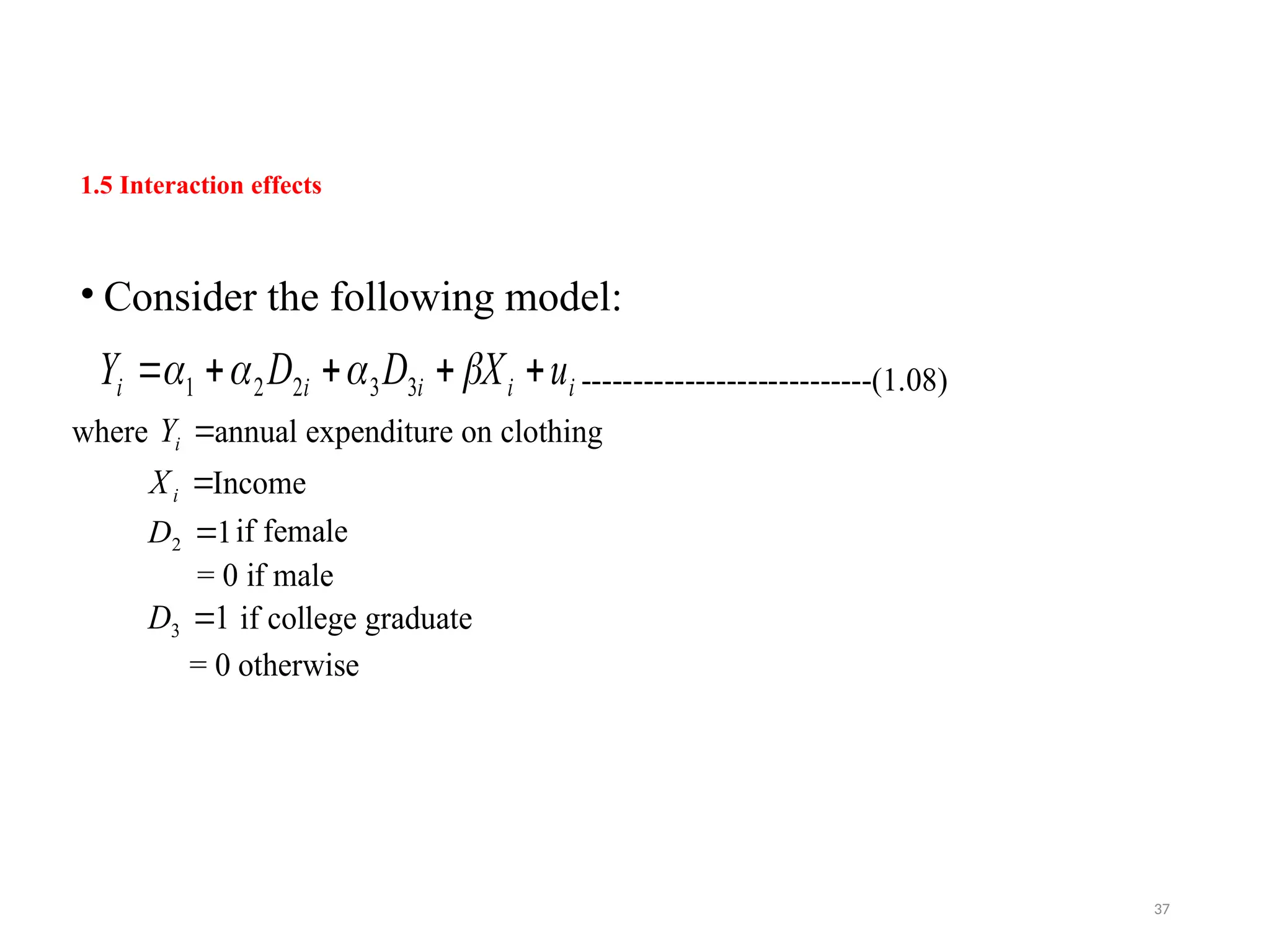
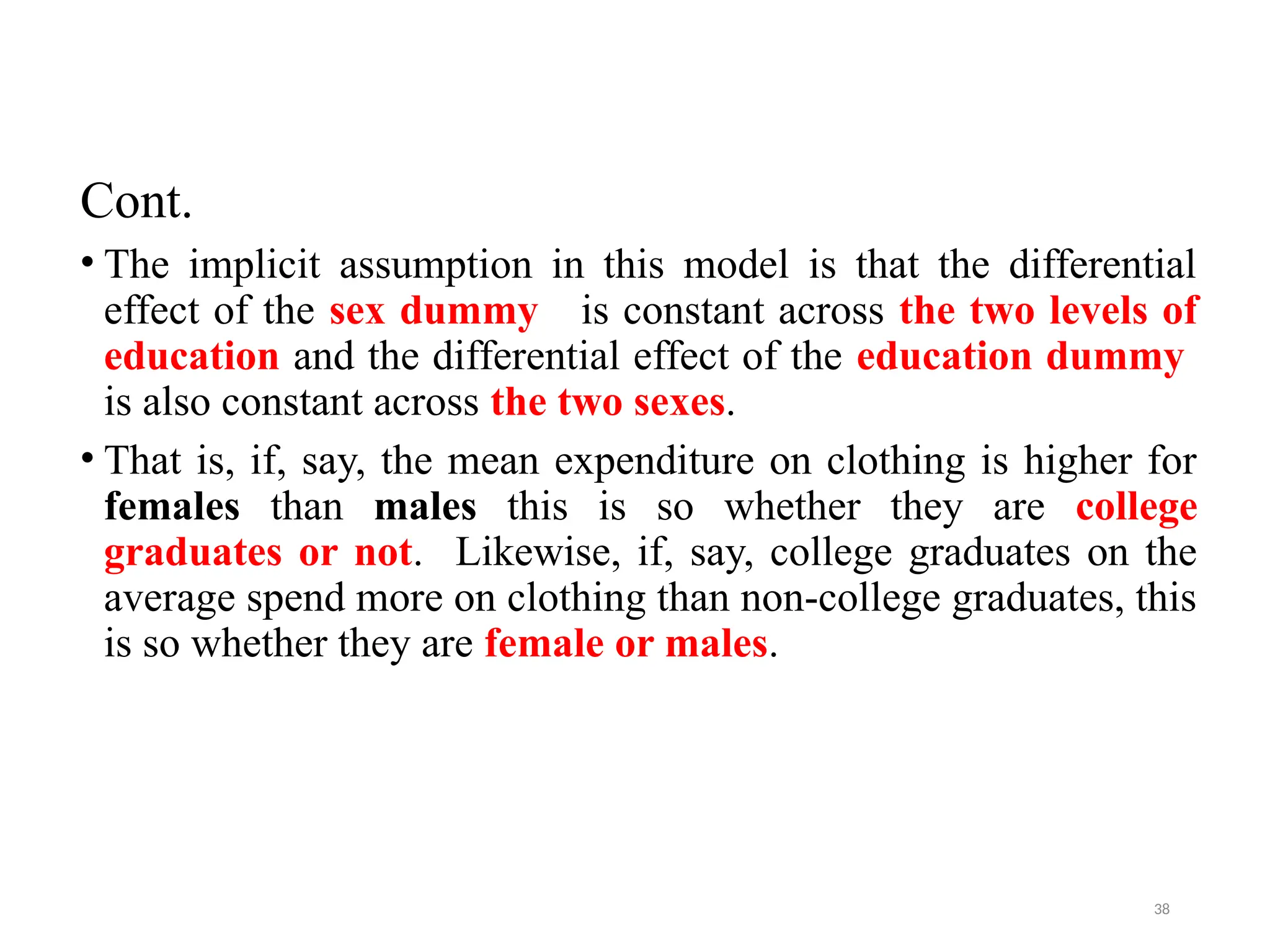
  • 106.
    Logit model Inthe LPM,we assume that the response probability is linear in a set of parameters, j . To avoid the LPM limitations, consider a class of binary response models of the form. P(Y  1/ X )  G(0  1 X1  2 X 2  ....  k X k )  G( X ) Where G is a function taking on values strictly between 0 & 1: 0  G ( z)  1, for all real numbers z. This ensures that the estimated response probabilities are strictly between zero and one.
  • 107.
    Logit model Various nonlinearfunctions have been suggested for the function G in order to make sure that the probabilities are between zero and one. In the logit model, G is the logistic function: which is between zero and one for all real numbers z. This is the cumulative distribution function (cdf) for a standard logistic random variable. e X 1  e X   ( z )  [1  exp( z )] exp( z ) G ( z ) 
  • 108.
    Logit model the responseprobability P(Y =1/X) is evaluated as: the non response probability P(Y =0/X) is evaluated as: Note that: both response and non- response probabilities lie in the interval [0 , 1] , and hence, are interpretable. Odd ratio: the ratio of the response probabilities (Pi) to the non response probabilities (1-Pi). 1  e X e X P  P (Y  1 X )  eX  1 1 P  P(Y  0 X) 1  1 eX 1 eX
  • 109.
    Logit model For thelogit model, the odds ratio is given by: The natural logarithm of the odds ratio(log- odds ratio) is: L(the log of the odds ratio) is linear in X as well as  (the parameters). L is called the logit and hence the name logit model is given to it. k k  X  X  X 1 1 e X  P(Y 1 X )  1 e X eX  1 P P(Y  0 X ) P 3 3 2 2  e  e ...e 0 1  eX  e  P )  1  P Li  ln( 0 1X1 2 X2 ...k Xk
  • 110.
    Logit model Thus, thelog-odds ratio is a linear function of the explanatory variables. For the LPM it is Pi, which is assumed to be a linear function of the explanatory variables. Features of logit model  As P goes from 0 to 1 (i.e., as Z varies from −∞ to +∞), the logit L goes from −∞ to +∞. That is, although the probabilities (of necessity) lie between 0 and 1, the logits are not so bounded.  Although L is linear in X, the probabilities themselves are not. This property is in contrast with the LPM model where the probabilities increase linearly with X.
  • 111.
    Logit model If L,the logit becomes negative and increasingly large in magnitude as the odds ratio decreases from 1 to 0 and becomes increasingly large and positive as the odds ratio increases from 1 to infinity. LPM assumes that Pi is linearly related to Xi, the logit model assumes that the log of the odds ratio is linearly related to Xi . Interpretation: Be remind that we doesnot directly interpreted the coefficients of the variables rather we interpreted their marginal effects and
  • 112.
    Logit model β2, theslope, measures the change in L for a unit change in X, that is, it tells how the log- odds in favor of owning a house change as income changes by a unit, say, birr 1000. The intercept, β1 is the value of the logodds in favor of owning a house if income is zero.
  • 113.
    Probit model The estimatingmodel that emerges from the normal CDF is popularly known as the probit model. In the probit model, G is the standard normal cumulative distribution function (cdf ), which is expressed as an integral: In the probit model, G is the standard normal cumulative distribution function z G(z)  (z)   (v)dv  Where  ( z ) is the standard normal density
  • 114.
    Probit model (z) (2)1/2 exp(z2 / 2) The estimating model that emerges from the normal CDF is popularly known as the probit model. Here the observed dependent variable Y, takes on one of the values 0 and 1 using the following criteria.  Define a latent variable Y* such that Y   X    1i i     0 if Y  0 1 if Y  0 i i Y  
  • 115.
    Probit model The latentvariable Y* is continuous (- < Y* < ). It generates the observed binary variable Y. An observed variable, Y can be observed in two states: if an event occurs it takes a value of 1 if an event does not occur it takes a value of 0 The latent variable is assumed to be a linear function of the observed X’s through the
  • 116.
    Probit model However, sincethe latent dependent variable is unobserved the model cannot be estimated using OLS. either the probit or the logit model Maximization of the likelihood function for is accomplished by nonlinear estimation methods. Maximum likelihood can be used instead. Most often, the choice is between normal errors and logistic errors, resulting in the probit (normit) and logit models, respectively.
  • 117.
    Probit model The coefficientsderived from the maximum likelihood (ML) function will be the coefficients for the probit model, if we assume a normal distribution. If we assume that the appropriate distribution of the error term is a logistic distribution, the coefficients that we get from the ML function will be the coefficient of the logit model. In both cases, as with the LPM, it is assumed that E[i/Xi] = 0
  • 118.
    Probit model In theprobit model, it is assumed that Var (i/Xi) = 1; In the logit model, it is assumed that Var (i/Xi) = 2 3 . Hence, the estimates of the parameters ( ’s) from the two models are not directly comparable. But as Amemiya suggests, a logit estimate of a parameter multiplied by 0.625 gives a fairly good approximation of the probit estimate of the same parameter.
  • 119.
    Probit model Similarly the coefficients of LPMand logit modelsare related as follows:   LPM = 0.25 Logit, except for intercept  LPM = 0.25 Logit + 0.5 for intercept The standard normal cdf has a shape very similar to that of the logistic cdf.
  • 120.
    Probit model The estimatingmodel that emerges from the normal CDF is popularly known as the probit model, although sometimes it is also known as the normit model. Note that both the probit and the logit models are estimated by Maximum Likelihood Estimation.
  • 121.
    Probit Model Interpreting theProbit and Logit Model Estimates The coefficients give the signs of the partial effects of each Xj on the response probability, and the statistical significance of Xj is determined by whether we can reject H0: Bj=0 at a sufficiently small significance level. However, the magnitude of the estimated parameters (dZ/dX) has no particular interpretation. We care about the magnitude of dProb(Y)/dX. From the computer output for a probit or logit estimation, you can interpret the statistical significance and sign of each coefficient directly.
  • 122.
    Probit model In thelinear regression model, the slope coefficient measures the change in the average value of the regressand for a unit change in the value of a regressor, with all other variables held constant. In the LPM, the slope coefficient measures directly the change in the probability of an event occurring as the result of a unit change in the value of a regressor, with the effect of all other variables held constant.
  • 123.
    Probit model In thelogit model the slope coefficient of a variable gives the change in the log of the odds associated with a unit change in that variable, again holding all other variables constant. But as noted previously, for the logit model the rate of change in the probability of an event happening is given by βj Pi(1 − Pi ), where βj is the (partial regression) coefficient of the jth regressor. But in evaluating Pi , all the variables included in the analysis are involved.
  • 124.
    Probit model In theprobit model, as we saw earlier, the rate of change in the probability is somewhat complicated and is given by βj f (Zi ), where f (Zi) is the density function of the standard normal variable and Zi = β1 + β2X2i + · · · +βkXki , that is, the regression model used in the analysis. Thus, in both the logit and probit models all the regressors are involved in computing the changes in probability,whereas in the LPM only the jth regressor is involved. This difference may be one reason for the early popularity of the LPM model.
  • 125.
    Probit vs logitmodel Is logit or probit model is preferable? In most applications the models are quite similar, the main difference being that the logistic distribution has slightly fatter tails.  That is to say, the conditional probability Pi approaches zero or one at a slower rate in logit than in probit.  Therefore, there is no compelling reason to choose one over the other. In practice many researchers choose the logit model because of its comparative mathematical simplicity. The standard normal cdf has a shape very similar to that of the logistic cdf.
  • 126.
    Probit vs logitmodel The probit and logit models differ in the specification of the distribution of the error term u. The difference between the specification and the linear probability model is that in the linaer probability model we analyses the dichotomous variables as they are, where as we assume the existence of an underlying latent variable for which we observe a dichotomous realization.
  • 127.
    Probit vs logitmodel The probit model and the logit model are not directly comparable. The reason is that, although the standard logistic (the basis of logit) and the standard normal distributions (the basis of probit) both have a mean value of zero, their variances are different; 1 for the standard normal (as we already know) and π2/3 for the logistic distribution, where π ≈ 22/7. Therefore, if you multiply the probit coefficient by about 1.81 (which is approximately = π/√ 3), you will get approximately the logit coefficient.
  • 128.
    Probit vs logitmodel The R2’s for the linear probability model are significantly lower than those for the logit and probit models. Alternative ways of comparing the models would be: To calculate the sum of squared deviations from predicted probabilities To compare the percentages correctly predicted To look at the derivatives of the probabilities with respect to a particular independent variable.
  • 129.
    Tobit Model An extensionof the probit model is the tobit model developed by James Tobin. Let us consider the home ownership example. Suppose we want to find out the amount of money the consumer spends in buying a house in relation to his or her income and other economic variables. If a consumer does not purchase a house, obviously we have no data on housing expenditure for such consumers; we have such data only on consumers who actually purchase a house.
  • 130.
    Cont. Thus, consumers aredivided into two groups, one consisting of say, N1 consumers about whom we have information on the regressors (say income, interest rate etc) as well as the regresand ( amount of expenditure on housing) and another consisting of say, N2 consumers about whom we have information only on the regressors but on not the regressand. A sample in which information on regressand is available only for some observations is known as a censored sample. Therefore, the tobit model is also known as a censored regression model.
  • 131.
    Cont. Mathematically, we canexpress the tobit model as Where RHS= right hand side The method of maximum likelihood can be used to estimate the parameters of such models. Measuring goodness of fit The conventional measure of goodness of fit,R2 , is not particularly meaningful in binary regressand models. Measures similar to R2,   0, otherwise 0 1 1i    X  ui if RHS  0 i Y 
  • 132.
    Measuring goodness offit Measures based on likelihood conventional measure of goodness of fit,R2 ratios: The , is not particularly meaningful in binary regressand models. Measures similar to R2, called pseudo R2, are available, and there are a variety of them. Measures based on likelihood ratios Let LUR be the maximum likelihood function when maximized with respect to all the parameters and LR be the maximum likelihood function when maximized with restrictions i 0 .
  • 133.
    Cont. the qualitative dependentvariable model, the likelihood function attains maximum of 1. This means that, Cragg and Uhler (1970) suggested a pseudo R2 that lies between 0 and 1. Mc Fadden (1974) defined R2 as LUR L R 2 2  1  ( R ) n absolute  1 an LR  LUR ) L UR (1  L R 2 n  L R 2 n L UR 2 n 2 n 2 R  log L R  1  log LUR R 2
  • 134.
    Cont. Another goodness-of-fit measurethat is usually reported is the so-called percent correctly predicted, which is computed as follows. For each i, we compute the estimated probabilit y that Yi takes on the value one, . times the predicted matches the actual Yi (which we know to be zero or one) is the percent correctly predicted. Yˆ i Yˆi If Yˆi>0.5 the prediction of Yi is unity, and if Yˆi<0 Yi is predicted to be zero. The percentage of   0 if Yˆ  0.5 Yˆi  i  1 if Yˆ i  0.5 total number of observations CountR 2  number of correct predictions
  • 135.
    Brainstorm questions 1. WhyLPM is not recommendable for empirical analysis? 2. Drive logodds ratio. 3. For logit and probit model we can use OLS estimators. 4. For logit and probit model we can use maximum likelihood estimators. 5. The variance that logit model assume is where as probit model assumes 1.  2 2
  • 136.