ANALISA LOGGING
SUMUR
Pertemuan Ke-1
Basic Well Log
oleh :
BAGUS ADHITYA
Email: adhityabagus20@gmail.com
Phone: +628567123079
Definition
 According to 4th Edition of J.A.Jackson’s
Glossary of Geology:
Log  A continuous record as a function of
depth, usually graphic and plotted to scale on a
narrow paper strip, of observations made on the
rocks and fluids of the geologic section exposed
in the well-bore.
Well Log History
 The first electrical log was introduced in 1927 in France using
stationed resistivity method.
 The first commercial electrical resistivity tool in 1929 was
used in Venezuela, USA and Indonesia.
 SP was run along with resistivity first time in 1931
 Schlumberger developed the first continuous recording in
1931
 GR and Neutron logs was started in 1941
 Microresistivity array dipmeter and lateralog were first time
introduced in 1950’s
 The first induction tool was used in 1956 followed by
Formation tester in 1957, Fomation Density in 1960’s,
Electromagnetic tool in 1978 and most of Imaging logs were
developed in 1980’s
 Advanced formation tester was commercialized in early
1990’s
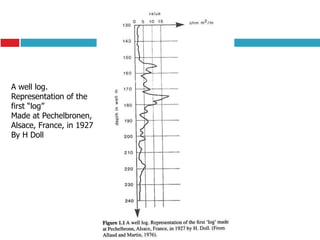
A well log.
Representation of the
first “log”
Made at Pechelbronen,
Alsace, France, in 1927
By H Doll
USES OF LOGS Geophysicist
• As a Geophysicist what do you look for?
• '' Are the tops where you predicted?
• '' Are the potential zones porous as you have
assumed from seismic data?
USES OF LOGS Geologist
• The Geologist may ask:
• '' What depths are the formation tops?
• '' Is the environment suitable for accumulation of
Hydrocarbons?
• '' Is there evidence of Hydrocarbon in this well?
• '' Are Hydrocarbons present in commercial
quantities?
• '' How good a well is ti?
• '' What are the reserves?
• '' Could the formation be commercial?
USES OF LOGS Drilling
Engineer
• " What is the hole volume for cementing?
• " Are there any Key-Seats or severe Dog-legs
in the well?
• " Where can you get a good packer seat for
testing?
• “Rate of Penetration of Drill Bit (ROP)
• Analysis of Drill Cutting and Drilling Mud
• Gain or Losses of Drilling Mud
USES OF LOGS Reservoir
Engineer
• The Reservoir Engineer needs to know:
• " How thick is the pay zone?
• " How Homogeneous is the section?
• " What is the volume of Hydrocarbon per cubic
metre?
• " Will the well pay-out?
USES OF LOGS Production
Engineer
• The Production Engineer is more concerned
with:
• " Where should the well be completed (in what
zone(s))?
• " What kind of production rate can be
expected?
• " Will there be any water production?
• " How should the well be completed?
Sources of
Information
LOGGING COSTING
 Expensive; 5-10% of total well cost
 Onshore wells (cheaper), a minimum set is run
 Offshore (expensive), full sets of logs are run
 Its run even if hydrocarbons are not found
 Hard gained information
Wireline vs LWD
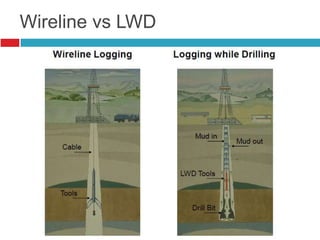
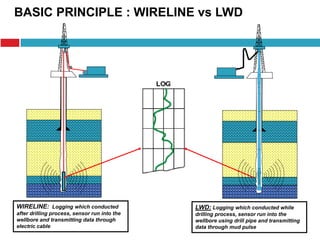
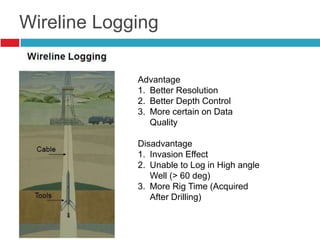
WIRELINE: Logging which conducted
after drilling process, sensor run into the
wellbore and transmitting data through
electric cable
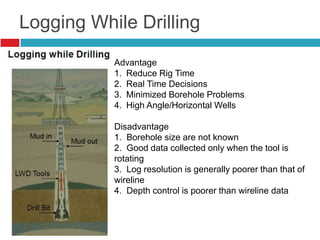
LWD: Logging which conducted while
drilling process, sensor run into the
wellbore using drill pipe and transmitting
data through mud pulse
BASIC PRINCIPLE : WIRELINE vs LWD
Wireline Logging
Advantage
1. Better Resolution
2. Better Depth Control
3. More certain on Data
Quality
Disadvantage
1. Invasion Effect
2. Unable to Log in High angle
Well (> 60 deg)
3. More Rig Time (Acquired
After Drilling)
Logging While Drilling
Advantage
1. Reduce Rig Time
2. Real Time Decisions
3. Minimized Borehole Problems
4. High Angle/Horizontal Wells
Disadvantage
1. Borehole size are not known
2. Good data collected only when the tool is
rotating
3. Log resolution is generally poorer than that of
wireline
4. Depth control is poorer than wireline data
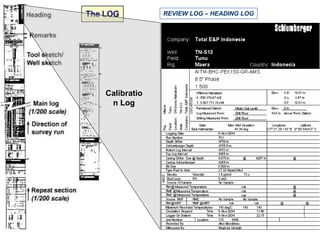
REVIEW LOG – HEADING LOG
Calibratio
n Log
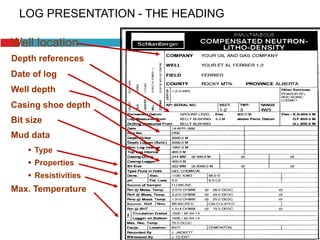
LOG PRESENTATION - THE HEADING
Well location
Depth references
Well depth
Date of log
Casing shoe depth
Bit size
Mud data
 Type
 Properties
 Resistivities
Max. Temperature
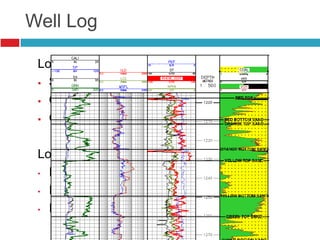
Well Log
Log Lithology
 SP Log
 Caliper Log
 GR Log
Log Resistivity
• ILS
• ILM
• ILD
Log Porosity
 RHOB
 NPHI
 DT
TERIMA KASIH

Presentation1 - Basic Well Log (Revisi) MHW.pptx

  • 1.
    ANALISA LOGGING SUMUR Pertemuan Ke-1 BasicWell Log oleh : BAGUS ADHITYA Email: adhityabagus20@gmail.com Phone: +628567123079
  • 2.
    Definition  According to4th Edition of J.A.Jackson’s Glossary of Geology: Log  A continuous record as a function of depth, usually graphic and plotted to scale on a narrow paper strip, of observations made on the rocks and fluids of the geologic section exposed in the well-bore.
  • 3.
    Well Log History The first electrical log was introduced in 1927 in France using stationed resistivity method.  The first commercial electrical resistivity tool in 1929 was used in Venezuela, USA and Indonesia.  SP was run along with resistivity first time in 1931  Schlumberger developed the first continuous recording in 1931  GR and Neutron logs was started in 1941  Microresistivity array dipmeter and lateralog were first time introduced in 1950’s  The first induction tool was used in 1956 followed by Formation tester in 1957, Fomation Density in 1960’s, Electromagnetic tool in 1978 and most of Imaging logs were developed in 1980’s  Advanced formation tester was commercialized in early 1990’s
  • 5.
    A well log. Representationof the first “log” Made at Pechelbronen, Alsace, France, in 1927 By H Doll
  • 6.
    USES OF LOGSGeophysicist • As a Geophysicist what do you look for? • '' Are the tops where you predicted? • '' Are the potential zones porous as you have assumed from seismic data?
  • 7.
    USES OF LOGSGeologist • The Geologist may ask: • '' What depths are the formation tops? • '' Is the environment suitable for accumulation of Hydrocarbons? • '' Is there evidence of Hydrocarbon in this well? • '' Are Hydrocarbons present in commercial quantities? • '' How good a well is ti? • '' What are the reserves? • '' Could the formation be commercial?
  • 8.
    USES OF LOGSDrilling Engineer • " What is the hole volume for cementing? • " Are there any Key-Seats or severe Dog-legs in the well? • " Where can you get a good packer seat for testing? • “Rate of Penetration of Drill Bit (ROP) • Analysis of Drill Cutting and Drilling Mud • Gain or Losses of Drilling Mud
  • 9.
    USES OF LOGSReservoir Engineer • The Reservoir Engineer needs to know: • " How thick is the pay zone? • " How Homogeneous is the section? • " What is the volume of Hydrocarbon per cubic metre? • " Will the well pay-out?
  • 10.
    USES OF LOGSProduction Engineer • The Production Engineer is more concerned with: • " Where should the well be completed (in what zone(s))? • " What kind of production rate can be expected? • " Will there be any water production? • " How should the well be completed?
  • 11.
  • 12.
    LOGGING COSTING  Expensive;5-10% of total well cost  Onshore wells (cheaper), a minimum set is run  Offshore (expensive), full sets of logs are run  Its run even if hydrocarbons are not found  Hard gained information
  • 14.
  • 15.
    WIRELINE: Logging whichconducted after drilling process, sensor run into the wellbore and transmitting data through electric cable LWD: Logging which conducted while drilling process, sensor run into the wellbore using drill pipe and transmitting data through mud pulse BASIC PRINCIPLE : WIRELINE vs LWD
  • 16.
    Wireline Logging Advantage 1. BetterResolution 2. Better Depth Control 3. More certain on Data Quality Disadvantage 1. Invasion Effect 2. Unable to Log in High angle Well (> 60 deg) 3. More Rig Time (Acquired After Drilling)
  • 17.
    Logging While Drilling Advantage 1.Reduce Rig Time 2. Real Time Decisions 3. Minimized Borehole Problems 4. High Angle/Horizontal Wells Disadvantage 1. Borehole size are not known 2. Good data collected only when the tool is rotating 3. Log resolution is generally poorer than that of wireline 4. Depth control is poorer than wireline data
  • 18.
    REVIEW LOG –HEADING LOG Calibratio n Log
  • 19.
    LOG PRESENTATION -THE HEADING Well location Depth references Well depth Date of log Casing shoe depth Bit size Mud data  Type  Properties  Resistivities Max. Temperature
  • 20.
    Well Log Log Lithology SP Log  Caliper Log  GR Log Log Resistivity • ILS • ILM • ILD Log Porosity  RHOB  NPHI  DT
  • 21.