NAME: SADMIN SHAMIM 
ID# 1321685
Banking Sector Development and Economic 
Growth in Lebanon
 Ali Awdeh 
 Faculty of Economics and Business 
Administration, Department of Finance 
 The Lebanese University, Hadath, Lebanon 
 E-mail: ali.awdeh@ul.edu.lb
 The causality relationship between economic 
growth and financial development has been a 
controversial issue 
 well-functioning banks spur technological 
innovation by offering funding to 
entrepreneurs who successfully implement 
innovative products 
 Consequently, financial markets in Lebanon 
play a moderate role in developing economic 
activities compared to the banking sector
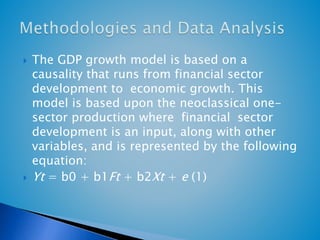
 The GDP growth model is based on a 
causality that runs from financial sector 
development to economic growth. This 
model is based upon the neoclassical one-sector 
production where financial sector 
development is an input, along with other 
variables, and is represented by the following 
equation: 
 Yt = b0 + b1Ft + b2Xt + e (1)
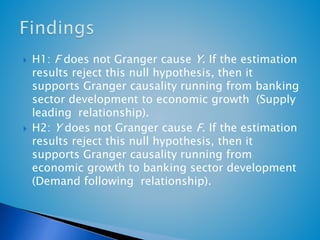
 H1: F does not Granger cause Y. If the estimation 
results reject this null hypothesis, then it 
supports Granger causality running from banking 
sector development to economic growth (Supply 
leading relationship). 
 H2: Y does not Granger cause F. If the estimation 
results reject this null hypothesis, then it 
supports Granger causality running from 
economic growth to banking sector development 
(Demand following relationship).
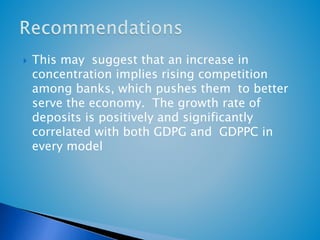
 This may suggest that an increase in 
concentration implies rising competition 
among banks, which pushes them to better 
serve the economy. The growth rate of 
deposits is positively and significantly 
correlated with both GDPG and GDPPC in 
every model
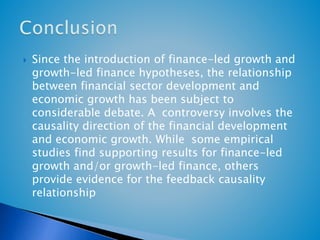
 Since the introduction of finance-led growth and 
growth-led finance hypotheses, the relationship 
between financial sector development and 
economic growth has been subject to 
considerable debate. A controversy involves the 
causality direction of the financial development 
and economic growth. While some empirical 
studies find supporting results for finance-led 
growth and/or growth-led finance, others 
provide evidence for the feedback causality 
relationship

Presentation1

  • 1.
    NAME: SADMIN SHAMIM ID# 1321685
  • 2.
    Banking Sector Developmentand Economic Growth in Lebanon
  • 3.
     Ali Awdeh  Faculty of Economics and Business Administration, Department of Finance  The Lebanese University, Hadath, Lebanon  E-mail: ali.awdeh@ul.edu.lb
  • 4.
     The causalityrelationship between economic growth and financial development has been a controversial issue  well-functioning banks spur technological innovation by offering funding to entrepreneurs who successfully implement innovative products  Consequently, financial markets in Lebanon play a moderate role in developing economic activities compared to the banking sector
  • 5.
     The GDPgrowth model is based on a causality that runs from financial sector development to economic growth. This model is based upon the neoclassical one-sector production where financial sector development is an input, along with other variables, and is represented by the following equation:  Yt = b0 + b1Ft + b2Xt + e (1)
  • 6.
     H1: Fdoes not Granger cause Y. If the estimation results reject this null hypothesis, then it supports Granger causality running from banking sector development to economic growth (Supply leading relationship).  H2: Y does not Granger cause F. If the estimation results reject this null hypothesis, then it supports Granger causality running from economic growth to banking sector development (Demand following relationship).
  • 7.
     This maysuggest that an increase in concentration implies rising competition among banks, which pushes them to better serve the economy. The growth rate of deposits is positively and significantly correlated with both GDPG and GDPPC in every model
  • 8.
     Since theintroduction of finance-led growth and growth-led finance hypotheses, the relationship between financial sector development and economic growth has been subject to considerable debate. A controversy involves the causality direction of the financial development and economic growth. While some empirical studies find supporting results for finance-led growth and/or growth-led finance, others provide evidence for the feedback causality relationship