MicroRNA responsive to sex differentiation in
dioecious cucurbit Coccinia grandis.
By:
Dr. Jatindra Nath Mohanty
Center for Biotechnology, Siksha ‘O’Anusandhan (Deemed to be University )
National workshop on "Emerging Trends in Life Sciences for
Sustainable Development
Rama Devi Women's University,
Bhoinagar, Bhubaneswar, Odisha
India.751022.
Presented at
Coccinia grandis
 Coccinia grandis as a model plant for sex evolution.
 Although Coccinia grandis has a distinct (XY) sex
determination system, there is no information about the
elements/factors controlling sex expression
 No information on the gene(s) controlling floral
development, maintenance of dioecy and elongation of
male chromosomes.
 In my previous transcriptome profiling of the floral buds
in C. grandis, we identified 1410 DEGs associated with
floral organ development, transcriptional regulation and
methyletransferase activity (Mohanty et al., 2017; GENE,
626: 395-406).
 Out of them 48 of the C. grandis DE genes were predicted
to have complementary binding sites for multiple
miRNAs.
 From that data also we identified a male specific marker
gene cgY1
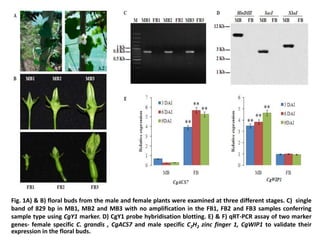
Fig. 1A) & B) floral buds from the male and female plants were examined at three different stages. C) single
band of 829 bp in MB1, MB2 and MB3 with no amplification in the FB1, FB2 and FB3 samples conferring
sample type using CgY1 marker. D) CgY1 probe hybridisation blotting. E) & F) qRT-PCR assay of two marker
genes- female specific C. grandis , CgACS7 and male specific C2H2 zinc finger 1, CgWIP1 to validate their
expression in the floral buds.
MIR genePol II
AAAAA
Pol II transcription
CBP80
CBP20
DCL1
Pri-miRNA
Pre-miRNA
DCL1
CH3
CH3 miRNA/miRNA* duplex
H
E
N
1
CH3 CH3
HST1
AGO1
AAAAA
AGO1AGO1
RISC RISC
PTGSSQN
HSP90
Cleavage or Translational inhibition
microRNA: Biogenesis and Function
Methodology
Extract RNA
Construction of
small RNA library
Sequencing
using Illumina
HISeq 2000
Prediction &
Functional annotation
of miRNA
Northern
hybridization
Down stream
analysis
MB FB
Total read 47372221 (100%) 50278748 (100%)
Clean read 43689271 (92.2%) 46728646 (92.9%)
Unique reads (>16 bp) 6726640(15.39%) 6990743(14.96%)
sRNA reads mapped on Rfam database
siRNA 235432 (3.49%) 274681 (3.92%)
piRNA 23624 (0.35%) 25842 (0.37%)
snRNA 4263 (0.063%) 5122 (0.073%)
snoRNA 3098 (0.046% 4821 (0.068%)
tRNA 68166 (1.01%) 73568 (1.05%)
rRNA 272664 (4.05%) 357840 (5.11%)
Other RNAs 1062 (0.015%) 1178 (0.016%)
Unannotated (for miRNA identification) 5786232 (86.01%) 5790482 (82.83%)
Results
Small RNA statistics in male(MB) and female(FB) buds of C.grandis. (A)Size distribution of small
RNAs. (B) Distribution of known and novel miRNAs in the MB and FB tissues (C) Known miRNA
family members in the male and female buds of C.grandis. (D) Pie chart showng the distribution of
the first 5’endnucleotides of the C.grandis miRNA. (E) Frequency of the known miRNA read counts
in the MB and FB tissues of C.grandis
Expression analysis of identified miRNA in male (MB) and female (FB) bud of C.grandis. (A)
Differential expression of known miRNAs in MB and FB, (B) Differential expression of novel miRNAs
in MB and FB, (C) Differential expression of male and female biase miRNAs. Upregulated miRNAs
are represented by redbars while the down regulated miRNAs are represented by green bars.
Gene ontology (GO) analysis using the Blast2Go program to determine the
potential functions of the targets in the miRNA-gene regulatory networks.
Expression pattern of differentially expressed miRNAs and
their target genes as obtained through qRT-PCR analysis
miRNA induced cleavage of predicted targets
Conclusion
 sRNA-Seq profiling detected 142 miRNAs from the floral buds of C. grandis.
and Comparative profiling revealed 41 miRNAs as differentially expressed.
106 targets were predicted for 35 DE miRNAs involved in flower
organogenesis, transcription regulation and DNA methylation.
16 miRNAs and their targets demonstrated reciprocal expression in three bud
stages of male and female.
8 conserved and 8 novel miRNAs were identified as fundamental to sex
variability in C. grandis.
Presentation slide

Presentation slide

  • 1.
    MicroRNA responsive tosex differentiation in dioecious cucurbit Coccinia grandis. By: Dr. Jatindra Nath Mohanty Center for Biotechnology, Siksha ‘O’Anusandhan (Deemed to be University ) National workshop on "Emerging Trends in Life Sciences for Sustainable Development Rama Devi Women's University, Bhoinagar, Bhubaneswar, Odisha India.751022. Presented at
  • 2.
    Coccinia grandis  Cocciniagrandis as a model plant for sex evolution.  Although Coccinia grandis has a distinct (XY) sex determination system, there is no information about the elements/factors controlling sex expression  No information on the gene(s) controlling floral development, maintenance of dioecy and elongation of male chromosomes.  In my previous transcriptome profiling of the floral buds in C. grandis, we identified 1410 DEGs associated with floral organ development, transcriptional regulation and methyletransferase activity (Mohanty et al., 2017; GENE, 626: 395-406).  Out of them 48 of the C. grandis DE genes were predicted to have complementary binding sites for multiple miRNAs.  From that data also we identified a male specific marker gene cgY1
  • 3.
    Fig. 1A) &B) floral buds from the male and female plants were examined at three different stages. C) single band of 829 bp in MB1, MB2 and MB3 with no amplification in the FB1, FB2 and FB3 samples conferring sample type using CgY1 marker. D) CgY1 probe hybridisation blotting. E) & F) qRT-PCR assay of two marker genes- female specific C. grandis , CgACS7 and male specific C2H2 zinc finger 1, CgWIP1 to validate their expression in the floral buds.
  • 4.
    MIR genePol II AAAAA PolII transcription CBP80 CBP20 DCL1 Pri-miRNA Pre-miRNA DCL1 CH3 CH3 miRNA/miRNA* duplex H E N 1 CH3 CH3 HST1 AGO1 AAAAA AGO1AGO1 RISC RISC PTGSSQN HSP90 Cleavage or Translational inhibition microRNA: Biogenesis and Function
  • 5.
    Methodology Extract RNA Construction of smallRNA library Sequencing using Illumina HISeq 2000 Prediction & Functional annotation of miRNA Northern hybridization Down stream analysis
  • 6.
    MB FB Total read47372221 (100%) 50278748 (100%) Clean read 43689271 (92.2%) 46728646 (92.9%) Unique reads (>16 bp) 6726640(15.39%) 6990743(14.96%) sRNA reads mapped on Rfam database siRNA 235432 (3.49%) 274681 (3.92%) piRNA 23624 (0.35%) 25842 (0.37%) snRNA 4263 (0.063%) 5122 (0.073%) snoRNA 3098 (0.046% 4821 (0.068%) tRNA 68166 (1.01%) 73568 (1.05%) rRNA 272664 (4.05%) 357840 (5.11%) Other RNAs 1062 (0.015%) 1178 (0.016%) Unannotated (for miRNA identification) 5786232 (86.01%) 5790482 (82.83%) Results
  • 7.
    Small RNA statisticsin male(MB) and female(FB) buds of C.grandis. (A)Size distribution of small RNAs. (B) Distribution of known and novel miRNAs in the MB and FB tissues (C) Known miRNA family members in the male and female buds of C.grandis. (D) Pie chart showng the distribution of the first 5’endnucleotides of the C.grandis miRNA. (E) Frequency of the known miRNA read counts in the MB and FB tissues of C.grandis
  • 8.
    Expression analysis ofidentified miRNA in male (MB) and female (FB) bud of C.grandis. (A) Differential expression of known miRNAs in MB and FB, (B) Differential expression of novel miRNAs in MB and FB, (C) Differential expression of male and female biase miRNAs. Upregulated miRNAs are represented by redbars while the down regulated miRNAs are represented by green bars.
  • 10.
    Gene ontology (GO)analysis using the Blast2Go program to determine the potential functions of the targets in the miRNA-gene regulatory networks.
  • 12.
    Expression pattern ofdifferentially expressed miRNAs and their target genes as obtained through qRT-PCR analysis
  • 13.
    miRNA induced cleavageof predicted targets
  • 14.
    Conclusion  sRNA-Seq profilingdetected 142 miRNAs from the floral buds of C. grandis. and Comparative profiling revealed 41 miRNAs as differentially expressed. 106 targets were predicted for 35 DE miRNAs involved in flower organogenesis, transcription regulation and DNA methylation. 16 miRNAs and their targets demonstrated reciprocal expression in three bud stages of male and female. 8 conserved and 8 novel miRNAs were identified as fundamental to sex variability in C. grandis.