

@OECD_local www.linkedin.com/company/oecd-local www.oecd.org/cfe
FINANCING SMES AND ENTREPRENEURS 2022:
AN OECD SCOREBOARD
29 March 2022
© OECD | Centre for Entrepreneurship, SMEs, Regions and Cities | @OECD_Local |
Overview
2
1. The Scoreboard in a nutshell
2. How did SME finance weather the COVID-19 crisis?
3. Will recovery packages boost SME finance?
4. Policy implications and the way forward
© OECD | Centre for Entrepreneurship, SMEs, Regions and Cities | @OECD_Local |
The SME and entrepreneurship finance
Scoreboard
3
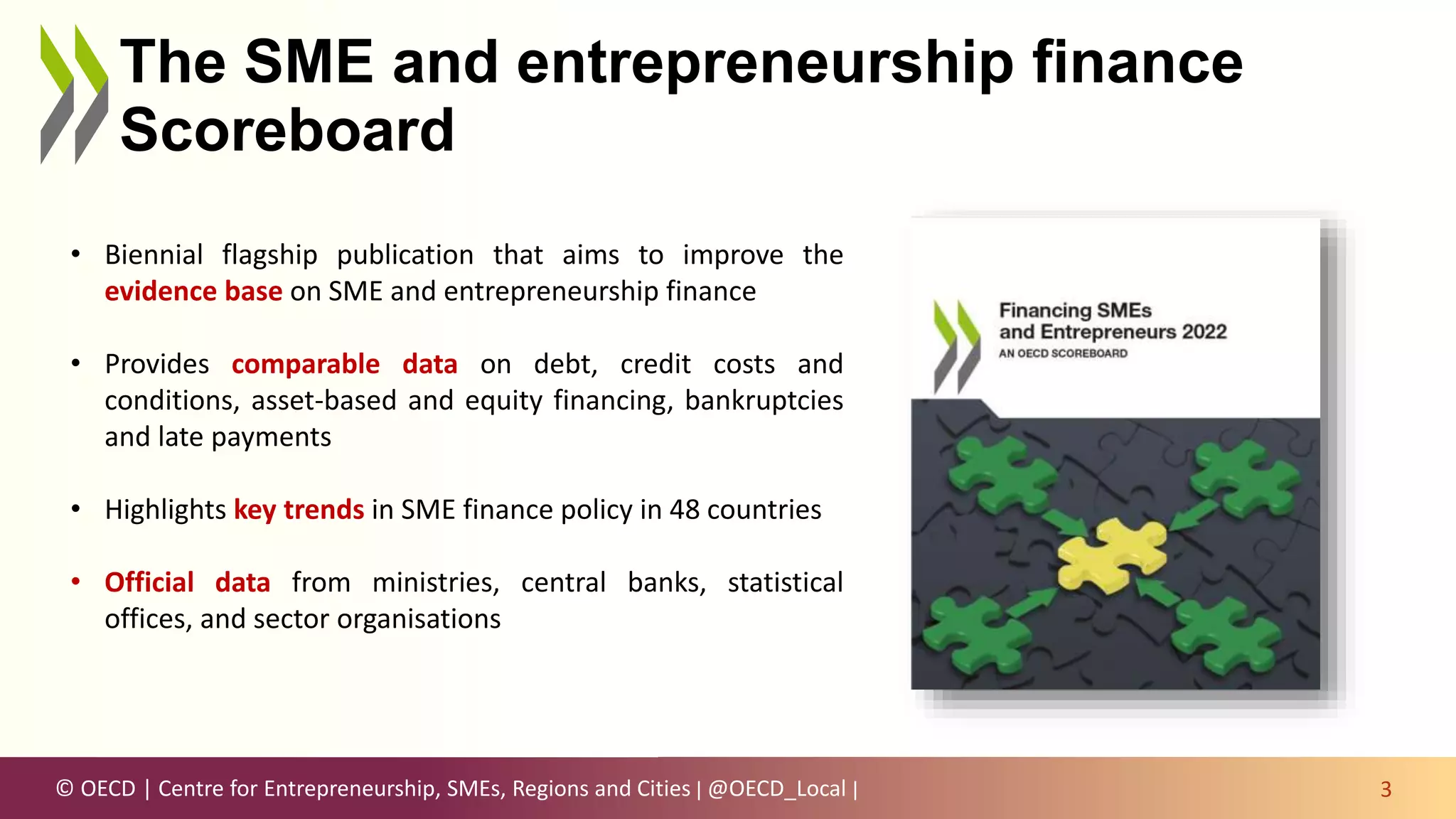
• Biennial flagship publication that aims to improve the
evidence base on SME and entrepreneurship finance
• Provides comparable data on debt, credit costs and
conditions, asset-based and equity financing, bankruptcies
and late payments
• Highlights key trends in SME finance policy in 48 countries
• Official data from ministries, central banks, statistical
offices, and sector organisations
© OECD | Centre for Entrepreneurship, SMEs, Regions and Cities | @OECD_Local |
How did SME finance
weather the COVID-19
crisis?
© OECD | Centre for Entrepreneurship, SMEs, Regions and Cities | @OECD_Local |
The global environment has been – and remains -
challenging
5
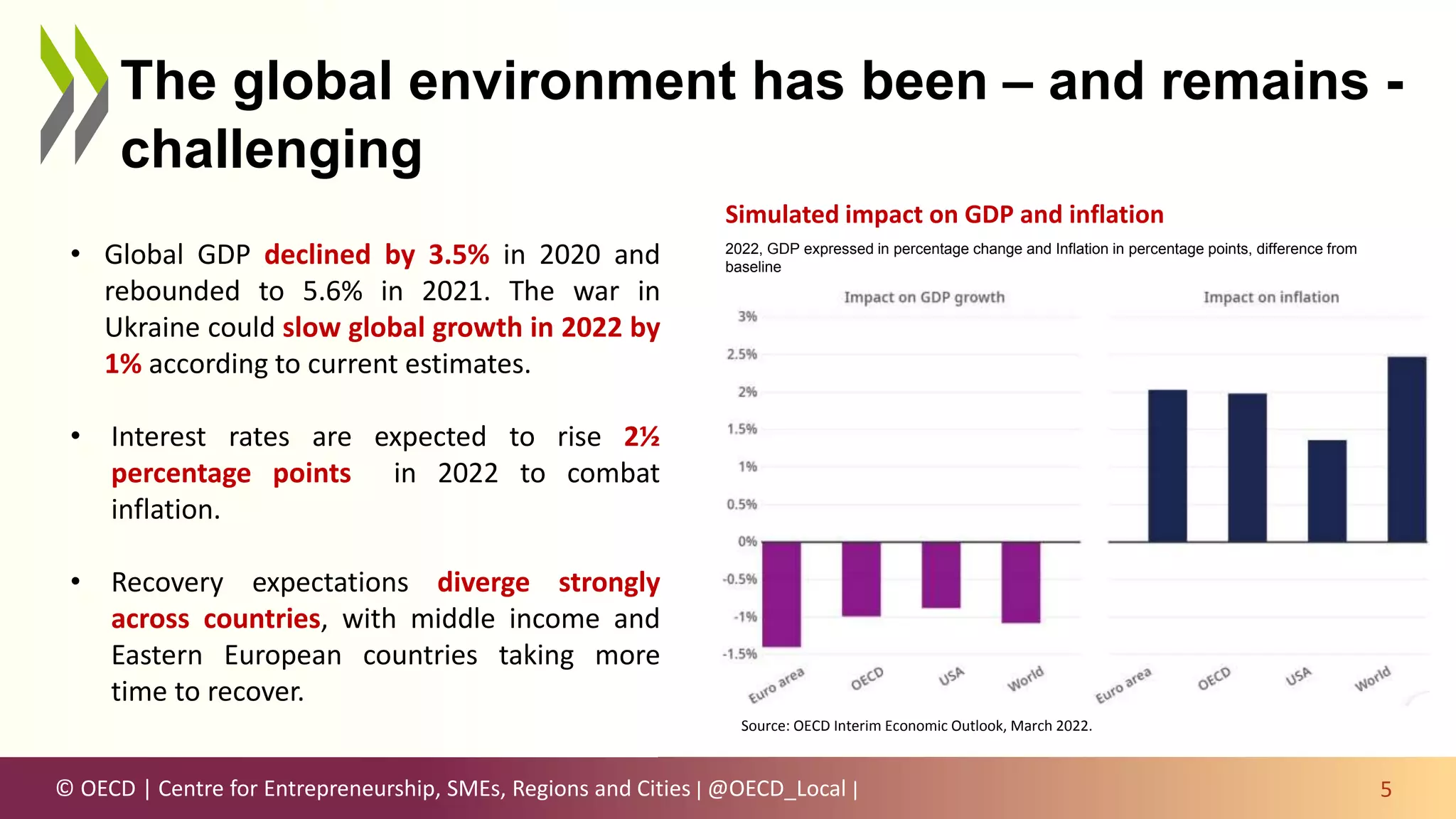
• Global GDP declined by 3.5% in 2020 and
rebounded to 5.6% in 2021. The war in
Ukraine could slow global growth in 2022 by
1% according to current estimates.
• Interest rates are expected to rise 2½
percentage points in 2022 to combat
inflation.
• Recovery expectations diverge strongly
across countries, with middle income and
Eastern European countries taking more
time to recover.
Source: OECD Interim Economic Outlook, March 2022.
Simulated impact on GDP and inflation
2022, GDP expressed in percentage change and Inflation in percentage points, difference from
baseline
© OECD | Centre for Entrepreneurship, SMEs, Regions and Cities | @OECD_Local |
SMEs were particularly hard hit and often turned
to credit
6
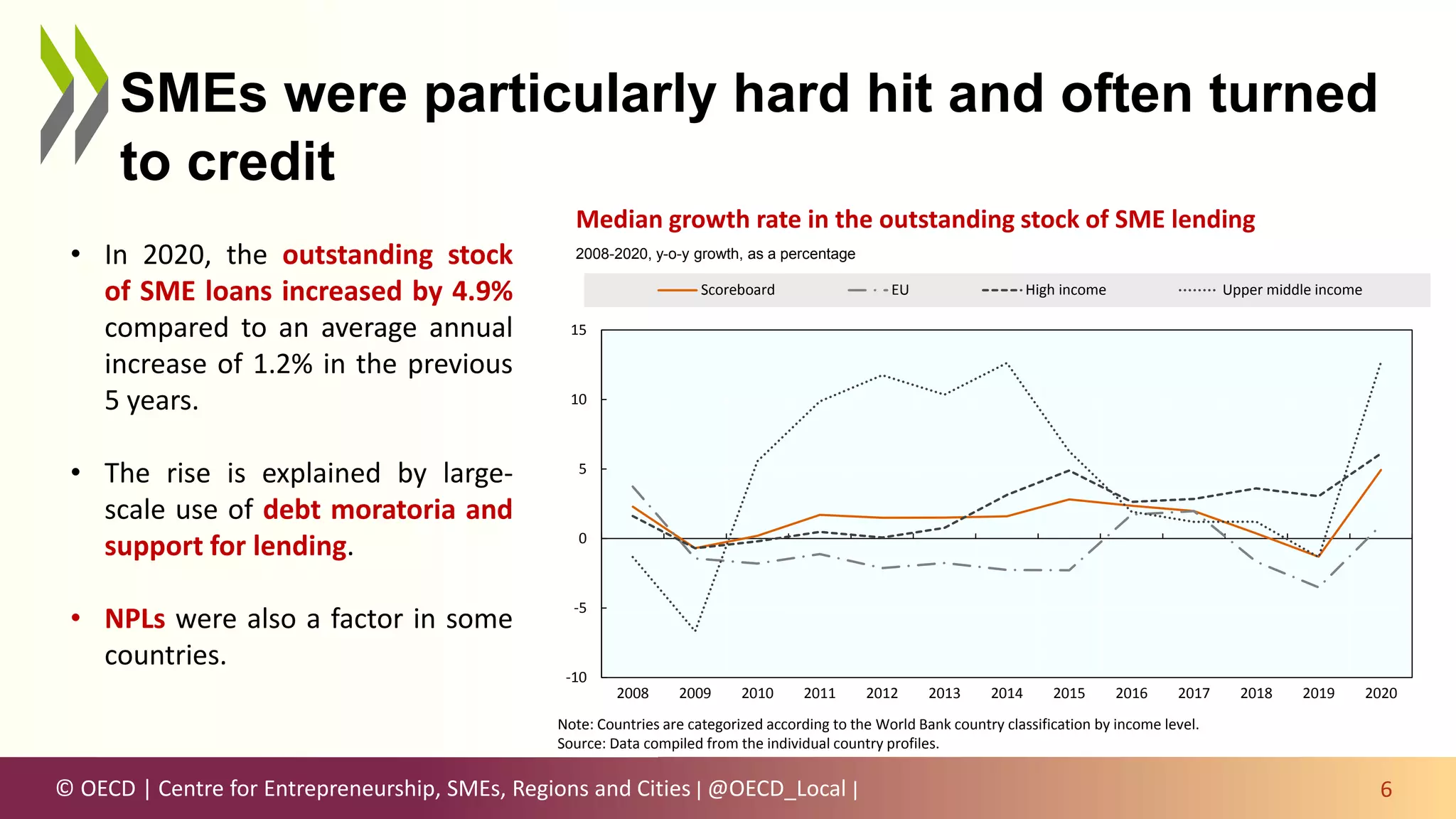
Median growth rate in the outstanding stock of SME lending
2008-2020, y-o-y growth, as a percentage
Note: Countries are categorized according to the World Bank country classification by income level.
Source: Data compiled from the individual country profiles.
-10
-5
0
5
10
15
2008 2009 2010 2011 2012 2013 2014 2015 2016 2017 2018 2019 2020
Scoreboard EU High income Upper middle income
• In 2020, the outstanding stock
of SME loans increased by 4.9%
compared to an average annual
increase of 1.2% in the previous
5 years.
• The rise is explained by large-
scale use of debt moratoria and
support for lending.
• NPLs were also a factor in some
countries.
© OECD | Centre for Entrepreneurship, SMEs, Regions and Cities | @OECD_Local |
New SME lending showed divergent trends
across countries
7
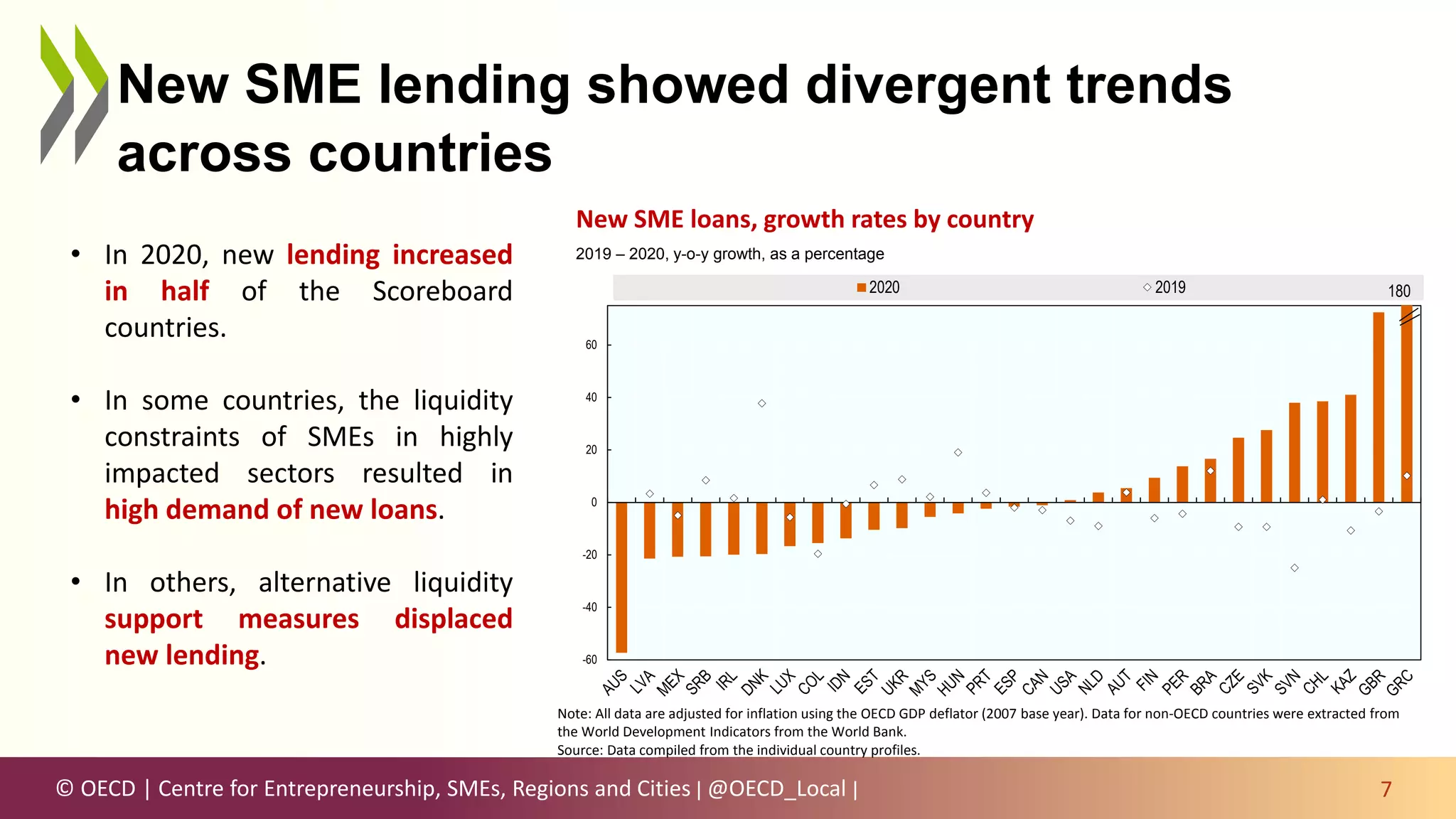
New SME loans, growth rates by country
2019 – 2020, y-o-y growth, as a percentage
Note: All data are adjusted for inflation using the OECD GDP deflator (2007 base year). Data for non-OECD countries were extracted from
the World Development Indicators from the World Bank.
Source: Data compiled from the individual country profiles.
-60
-40
-20
0
20
40
60
2020 2019 180
• In 2020, new lending increased
in half of the Scoreboard
countries.
• In some countries, the liquidity
constraints of SMEs in highly
impacted sectors resulted in
high demand of new loans.
• In others, alternative liquidity
support measures displaced
new lending.
© OECD | Centre for Entrepreneurship, SMEs, Regions and Cities | @OECD_Local |
Overall, credit conditions were advantageous for
SMEs during the pandemic
SME interest rates, growth rate by country
2019 – 2020, Nominal rates, percentage points
Note: All data are adjusted for inflation using the OECD GDP deflator (2007 base year). Data for non-OECD countries were extracted
from the World Development Indicators from the World Bank
Source: Data compiled from the individual country profiles.
-4
-3
-2
-1
0
1
2
3
2020 2019
-19 -5
• In 2020, interest rates declined
in 34 out of 42 countries.
• In the remaining 8 countries, the
increase is less than 1
percentage point.
• This decline reflects monetary
policy interventions, as well as
the significant recourse to
government-subsidized lending
© OECD | Centre for Entrepreneurship, SMEs, Regions and Cities | @OECD_Local |
Lending was strongly supported by government
use of guarantees in 2020
9
Government loan guarantees
2008-2020, y-o-y growth, as a percentage
Source: Data compiled from the individual country profiles.
-30
-10
10
30
50
70
90
110
130
150
2008 2009 2010 2011 2012 2013 2014 2015 2016 2017 2018 2019 2020
Scoreboard High income Upper middle income OECD EU
159
• Credit guarantees were used in
all 27 countries providing data
for this indicator.
• The Scoreboard median
increased by 110% in 2020
(compared to an increase of
0.32% in 2019).
© OECD | Centre for Entrepreneurship, SMEs, Regions and Cities | @OECD_Local |
Bankruptcy rates declined in the majority of
countries
10
SME bankruptcies, growth rate by country
2019 – 2020, y-o-y, as a percentage
Source: Data compiled from the individual country profiles.
-60
-40
-20
0
20
40
60
80
2020 2019 368.6
• In 2020, public support
measures contributed to a sharp
decline in bankruptcies.
• This indicator declined in 26 out
of 32 Scoreboard countries.
• The median bankruptcy rate
declined by 11.7%, a decline
never registered before in the
history of the Scoreboard.
© OECD | Centre for Entrepreneurship, SMEs, Regions and Cities | @OECD_Local |
Trends in alternative sources
of finance
© OECD | Centre for Entrepreneurship, SMEs, Regions and Cities | @OECD_Local |
Asset-based financing declined in 2020, in part due
to substitution effects
12
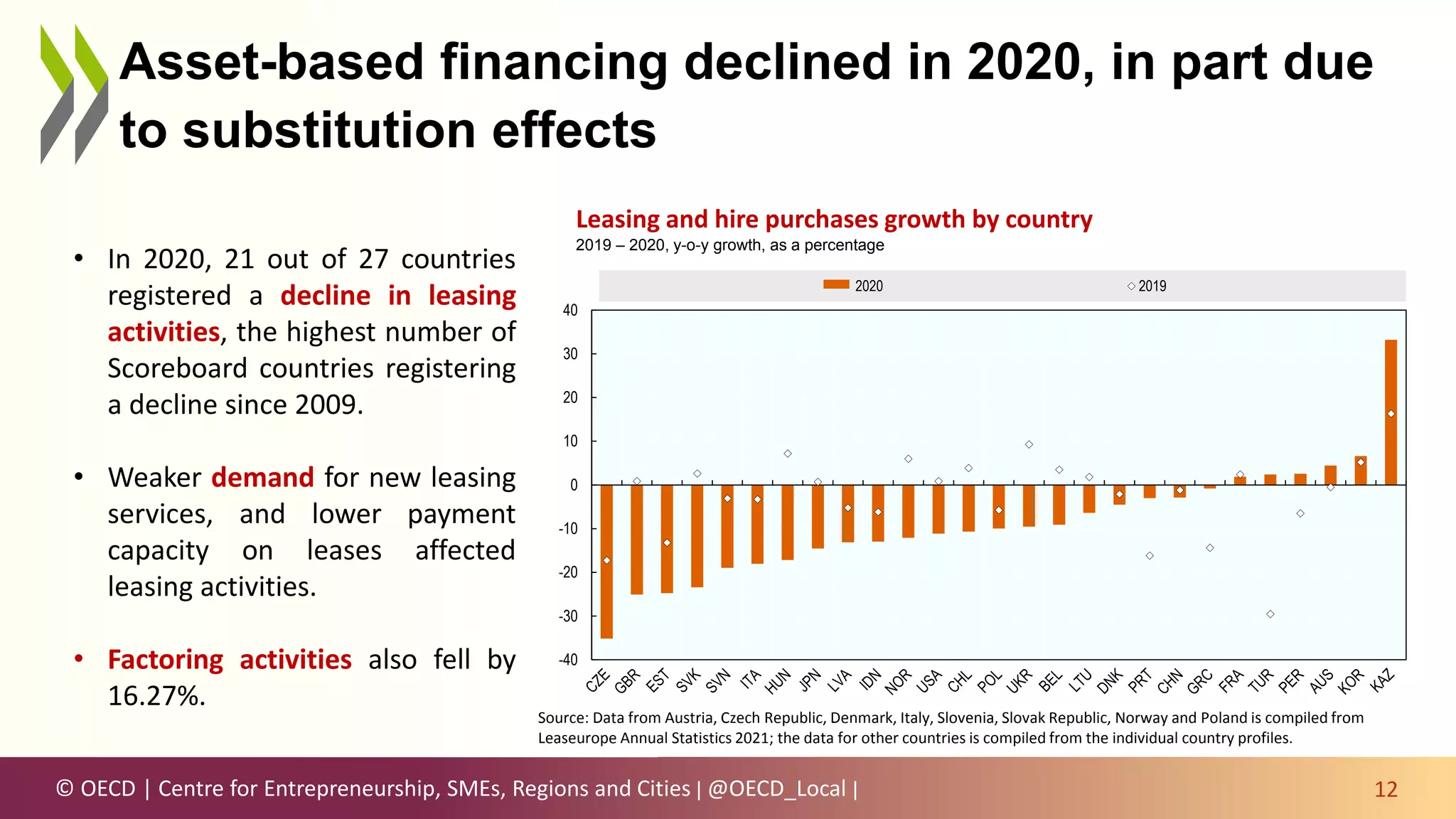
Leasing and hire purchases growth by country
2019 – 2020, y-o-y growth, as a percentage
Source: Data from Austria, Czech Republic, Denmark, Italy, Slovenia, Slovak Republic, Norway and Poland is compiled from
Leaseurope Annual Statistics 2021; the data for other countries is compiled from the individual country profiles.
-40
-30
-20
-10
0
10
20
30
40
2020 2019
• In 2020, 21 out of 27 countries
registered a decline in leasing
activities, the highest number of
Scoreboard countries registering
a decline since 2009.
• Weaker demand for new leasing
services, and lower payment
capacity on leases affected
leasing activities.
• Factoring activities also fell by
16.27%.
© OECD | Centre for Entrepreneurship, SMEs, Regions and Cities | @OECD_Local |
Equity financing was resilient, growing in both 2020
and 2021, with some fluctuation in early stage financing
13
Venture capital investments, growth rate by country
2019 – 2020, y-o-y growth, as a percentage
Source: OECD Entrepreneurship at a Glance, and data compiled from the individual country profiles when the information
was not otherwise provided.
• Half of the countries that
provided data for this indicator
registered positive growth in
2020.
• Seed and early stage capital
experienced a decline in 2020
while later stages increased.
• However, in 2021, early stage VC
rebounded.
-105
-55
-5
45
95
145
195
2020 2019
428
© OECD | Centre for Entrepreneurship, SMEs, Regions and Cities | @OECD_Local |
Will recovery packages
boost SME financing?
© OECD | Centre for Entrepreneurship, SMEs, Regions and Cities | @OECD_Local |
SMEs are a less explicit focus in recovery packages…
15
Source: Global Recovery Observatory (O’Callaghan, 2020[47])
Share of SME related policies in the total value
announced in rescue and recovery packages
March 2020 to October 2021, value announced for policies in USD
billions and as a percentage
• The SME orientation in COVID-19 policy
responses declined from the rescue to recovery
phases.
• Only around 2% of total funding in recovery
packages targets SMEs, compared to more than
25% in crisis rescue packages.
• In absolute terms, spending on SME-related
policies dropped from USD 3 862.02 billion in
the rescue packages to USD 78.15 billion in
recovery packages.
[CELLRANGE]
[CELLRANGE]
[CELLRANGE]
[CELLRANGE]
[CELLRANGE]
[CELLRANGE]
0%
10%
20%
30%
40%
50%
60%
70%
80%
90%
100%
Rescue Recovery Total
Share of SME related policies Share of other policies
Value tags in USD billion
© OECD | Centre for Entrepreneurship, SMEs, Regions and Cities | @OECD_Local |
… across all policy domains
16
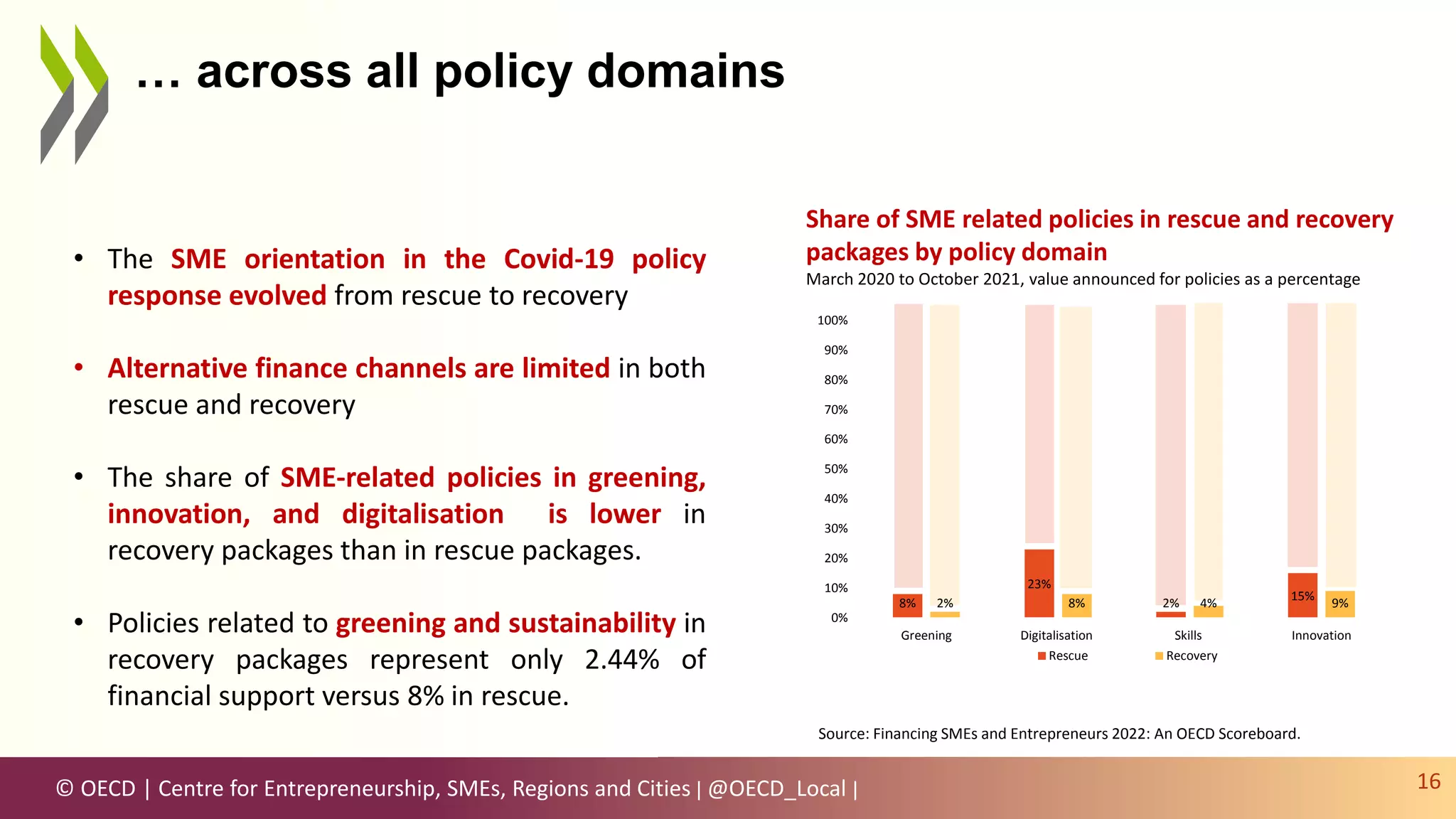
Share of SME related policies in rescue and recovery
packages by policy domain
March 2020 to October 2021, value announced for policies as a percentage
Source: Financing SMEs and Entrepreneurs 2022: An OECD Scoreboard.
• The SME orientation in the Covid-19 policy
response evolved from rescue to recovery
• Alternative finance channels are limited in both
rescue and recovery
• The share of SME-related policies in greening,
innovation, and digitalisation is lower in
recovery packages than in rescue packages.
• Policies related to greening and sustainability in
recovery packages represent only 2.44% of
financial support versus 8% in rescue.
8%
23%
2%
15%
2% 8% 4% 9%
0%
10%
20%
30%
40%
50%
60%
70%
80%
90%
100%
Greening Digitalisation Skills Innovation
Rescue Recovery
© OECD | Centre for Entrepreneurship, SMEs, Regions and Cities | @OECD_Local |
Policy implications and
way forward
Change image
© OECD | Centre for Entrepreneurship, SMEs, Regions and Cities | @OECD_Local |
Policy implications and the way forward
18
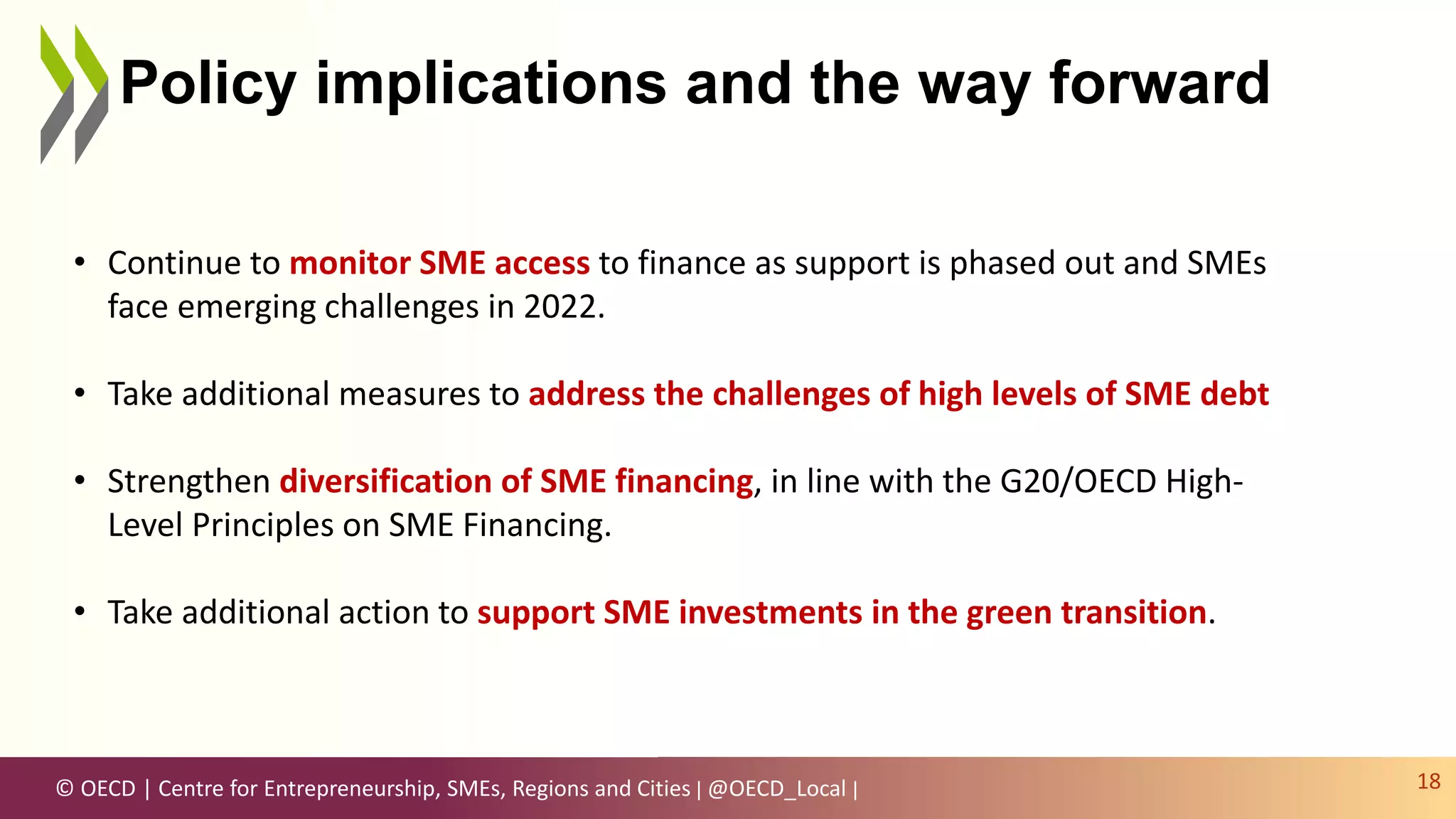
• Continue to monitor SME access to finance as support is phased out and SMEs
face emerging challenges in 2022.
• Take additional measures to address the challenges of high levels of SME debt
• Strengthen diversification of SME financing, in line with the G20/OECD High-
Level Principles on SME Financing.
• Take additional action to support SME investments in the green transition.
© OECD | Centre for Entrepreneurship, SMEs, Regions and Cities | @OECD_Local |
OECD
Public banks
Private banks
SMEs
Governments
19
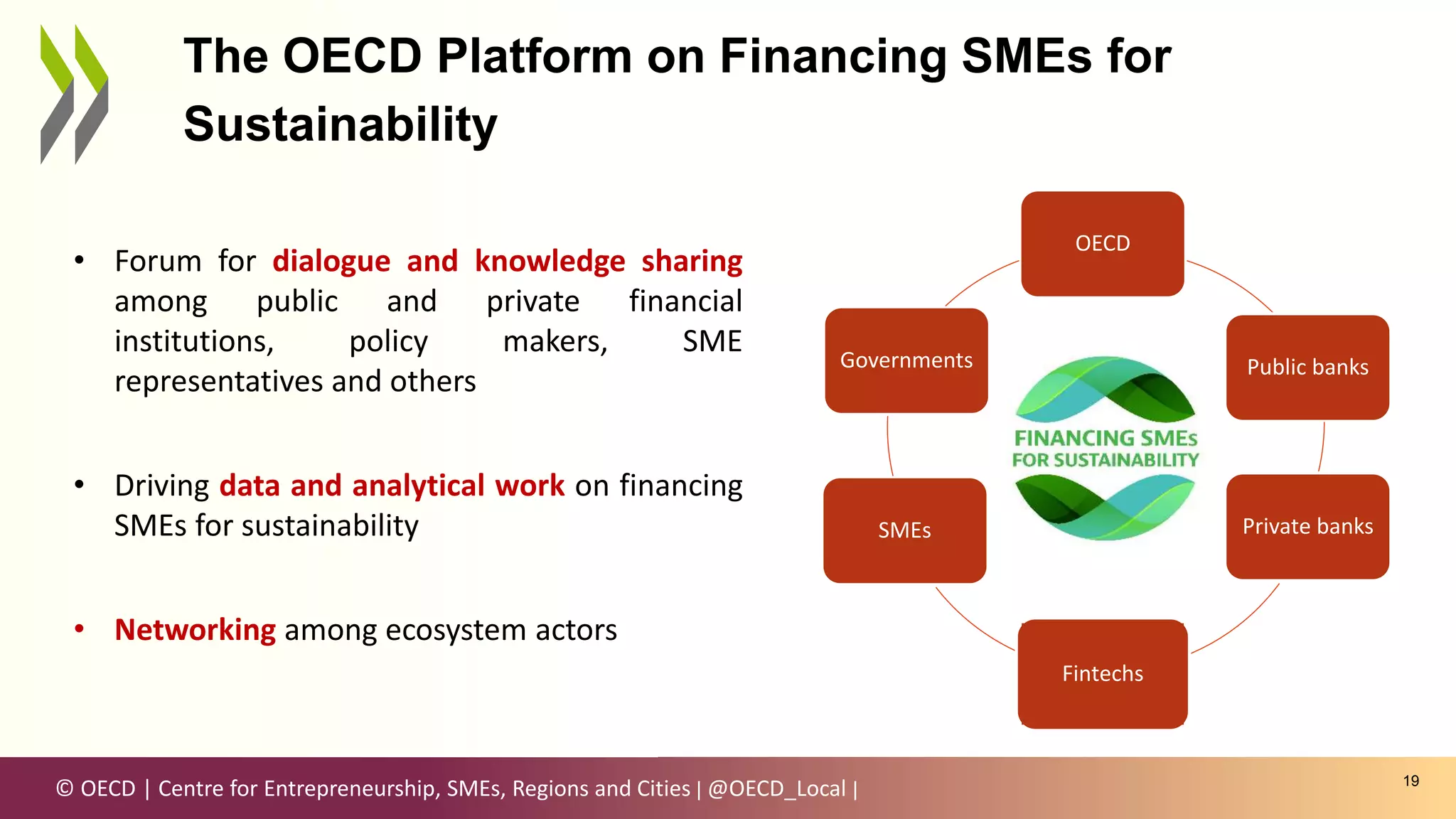
The OECD Platform on Financing SMEs for
Sustainability
• Forum for dialogue and knowledge sharing
among public and private financial
institutions, policy makers, SME
representatives and others
• Driving data and analytical work on financing
SMEs for sustainability
• Networking among ecosystem actors
Fintechs
@OECD_local www.linkedin.com/company/oecd-local www.oecd.org/cfe
THANK YOU

Presentation Scoreboard Launch_29 March 2022.pptx

  • 1.
    @OECD_local www.linkedin.com/company/oecd-local www.oecd.org/cfe FINANCINGSMES AND ENTREPRENEURS 2022: AN OECD SCOREBOARD 29 March 2022
  • 2.
    © OECD |Centre for Entrepreneurship, SMEs, Regions and Cities | @OECD_Local | Overview 2 1. The Scoreboard in a nutshell 2. How did SME finance weather the COVID-19 crisis? 3. Will recovery packages boost SME finance? 4. Policy implications and the way forward
  • 3.
    © OECD |Centre for Entrepreneurship, SMEs, Regions and Cities | @OECD_Local | The SME and entrepreneurship finance Scoreboard 3 • Biennial flagship publication that aims to improve the evidence base on SME and entrepreneurship finance • Provides comparable data on debt, credit costs and conditions, asset-based and equity financing, bankruptcies and late payments • Highlights key trends in SME finance policy in 48 countries • Official data from ministries, central banks, statistical offices, and sector organisations
  • 4.
    © OECD |Centre for Entrepreneurship, SMEs, Regions and Cities | @OECD_Local | How did SME finance weather the COVID-19 crisis?
  • 5.
    © OECD |Centre for Entrepreneurship, SMEs, Regions and Cities | @OECD_Local | The global environment has been – and remains - challenging 5 • Global GDP declined by 3.5% in 2020 and rebounded to 5.6% in 2021. The war in Ukraine could slow global growth in 2022 by 1% according to current estimates. • Interest rates are expected to rise 2½ percentage points in 2022 to combat inflation. • Recovery expectations diverge strongly across countries, with middle income and Eastern European countries taking more time to recover. Source: OECD Interim Economic Outlook, March 2022. Simulated impact on GDP and inflation 2022, GDP expressed in percentage change and Inflation in percentage points, difference from baseline
  • 6.
    © OECD |Centre for Entrepreneurship, SMEs, Regions and Cities | @OECD_Local | SMEs were particularly hard hit and often turned to credit 6 Median growth rate in the outstanding stock of SME lending 2008-2020, y-o-y growth, as a percentage Note: Countries are categorized according to the World Bank country classification by income level. Source: Data compiled from the individual country profiles. -10 -5 0 5 10 15 2008 2009 2010 2011 2012 2013 2014 2015 2016 2017 2018 2019 2020 Scoreboard EU High income Upper middle income • In 2020, the outstanding stock of SME loans increased by 4.9% compared to an average annual increase of 1.2% in the previous 5 years. • The rise is explained by large- scale use of debt moratoria and support for lending. • NPLs were also a factor in some countries.
  • 7.
    © OECD |Centre for Entrepreneurship, SMEs, Regions and Cities | @OECD_Local | New SME lending showed divergent trends across countries 7 New SME loans, growth rates by country 2019 – 2020, y-o-y growth, as a percentage Note: All data are adjusted for inflation using the OECD GDP deflator (2007 base year). Data for non-OECD countries were extracted from the World Development Indicators from the World Bank. Source: Data compiled from the individual country profiles. -60 -40 -20 0 20 40 60 2020 2019 180 • In 2020, new lending increased in half of the Scoreboard countries. • In some countries, the liquidity constraints of SMEs in highly impacted sectors resulted in high demand of new loans. • In others, alternative liquidity support measures displaced new lending.
  • 8.
    © OECD |Centre for Entrepreneurship, SMEs, Regions and Cities | @OECD_Local | Overall, credit conditions were advantageous for SMEs during the pandemic SME interest rates, growth rate by country 2019 – 2020, Nominal rates, percentage points Note: All data are adjusted for inflation using the OECD GDP deflator (2007 base year). Data for non-OECD countries were extracted from the World Development Indicators from the World Bank Source: Data compiled from the individual country profiles. -4 -3 -2 -1 0 1 2 3 2020 2019 -19 -5 • In 2020, interest rates declined in 34 out of 42 countries. • In the remaining 8 countries, the increase is less than 1 percentage point. • This decline reflects monetary policy interventions, as well as the significant recourse to government-subsidized lending
  • 9.
    © OECD |Centre for Entrepreneurship, SMEs, Regions and Cities | @OECD_Local | Lending was strongly supported by government use of guarantees in 2020 9 Government loan guarantees 2008-2020, y-o-y growth, as a percentage Source: Data compiled from the individual country profiles. -30 -10 10 30 50 70 90 110 130 150 2008 2009 2010 2011 2012 2013 2014 2015 2016 2017 2018 2019 2020 Scoreboard High income Upper middle income OECD EU 159 • Credit guarantees were used in all 27 countries providing data for this indicator. • The Scoreboard median increased by 110% in 2020 (compared to an increase of 0.32% in 2019).
  • 10.
    © OECD |Centre for Entrepreneurship, SMEs, Regions and Cities | @OECD_Local | Bankruptcy rates declined in the majority of countries 10 SME bankruptcies, growth rate by country 2019 – 2020, y-o-y, as a percentage Source: Data compiled from the individual country profiles. -60 -40 -20 0 20 40 60 80 2020 2019 368.6 • In 2020, public support measures contributed to a sharp decline in bankruptcies. • This indicator declined in 26 out of 32 Scoreboard countries. • The median bankruptcy rate declined by 11.7%, a decline never registered before in the history of the Scoreboard.
  • 11.
    © OECD |Centre for Entrepreneurship, SMEs, Regions and Cities | @OECD_Local | Trends in alternative sources of finance
  • 12.
    © OECD |Centre for Entrepreneurship, SMEs, Regions and Cities | @OECD_Local | Asset-based financing declined in 2020, in part due to substitution effects 12 Leasing and hire purchases growth by country 2019 – 2020, y-o-y growth, as a percentage Source: Data from Austria, Czech Republic, Denmark, Italy, Slovenia, Slovak Republic, Norway and Poland is compiled from Leaseurope Annual Statistics 2021; the data for other countries is compiled from the individual country profiles. -40 -30 -20 -10 0 10 20 30 40 2020 2019 • In 2020, 21 out of 27 countries registered a decline in leasing activities, the highest number of Scoreboard countries registering a decline since 2009. • Weaker demand for new leasing services, and lower payment capacity on leases affected leasing activities. • Factoring activities also fell by 16.27%.
  • 13.
    © OECD |Centre for Entrepreneurship, SMEs, Regions and Cities | @OECD_Local | Equity financing was resilient, growing in both 2020 and 2021, with some fluctuation in early stage financing 13 Venture capital investments, growth rate by country 2019 – 2020, y-o-y growth, as a percentage Source: OECD Entrepreneurship at a Glance, and data compiled from the individual country profiles when the information was not otherwise provided. • Half of the countries that provided data for this indicator registered positive growth in 2020. • Seed and early stage capital experienced a decline in 2020 while later stages increased. • However, in 2021, early stage VC rebounded. -105 -55 -5 45 95 145 195 2020 2019 428
  • 14.
    © OECD |Centre for Entrepreneurship, SMEs, Regions and Cities | @OECD_Local | Will recovery packages boost SME financing?
  • 15.
    © OECD |Centre for Entrepreneurship, SMEs, Regions and Cities | @OECD_Local | SMEs are a less explicit focus in recovery packages… 15 Source: Global Recovery Observatory (O’Callaghan, 2020[47]) Share of SME related policies in the total value announced in rescue and recovery packages March 2020 to October 2021, value announced for policies in USD billions and as a percentage • The SME orientation in COVID-19 policy responses declined from the rescue to recovery phases. • Only around 2% of total funding in recovery packages targets SMEs, compared to more than 25% in crisis rescue packages. • In absolute terms, spending on SME-related policies dropped from USD 3 862.02 billion in the rescue packages to USD 78.15 billion in recovery packages. [CELLRANGE] [CELLRANGE] [CELLRANGE] [CELLRANGE] [CELLRANGE] [CELLRANGE] 0% 10% 20% 30% 40% 50% 60% 70% 80% 90% 100% Rescue Recovery Total Share of SME related policies Share of other policies Value tags in USD billion
  • 16.
    © OECD |Centre for Entrepreneurship, SMEs, Regions and Cities | @OECD_Local | … across all policy domains 16 Share of SME related policies in rescue and recovery packages by policy domain March 2020 to October 2021, value announced for policies as a percentage Source: Financing SMEs and Entrepreneurs 2022: An OECD Scoreboard. • The SME orientation in the Covid-19 policy response evolved from rescue to recovery • Alternative finance channels are limited in both rescue and recovery • The share of SME-related policies in greening, innovation, and digitalisation is lower in recovery packages than in rescue packages. • Policies related to greening and sustainability in recovery packages represent only 2.44% of financial support versus 8% in rescue. 8% 23% 2% 15% 2% 8% 4% 9% 0% 10% 20% 30% 40% 50% 60% 70% 80% 90% 100% Greening Digitalisation Skills Innovation Rescue Recovery
  • 17.
    © OECD |Centre for Entrepreneurship, SMEs, Regions and Cities | @OECD_Local | Policy implications and way forward Change image
  • 18.
    © OECD |Centre for Entrepreneurship, SMEs, Regions and Cities | @OECD_Local | Policy implications and the way forward 18 • Continue to monitor SME access to finance as support is phased out and SMEs face emerging challenges in 2022. • Take additional measures to address the challenges of high levels of SME debt • Strengthen diversification of SME financing, in line with the G20/OECD High- Level Principles on SME Financing. • Take additional action to support SME investments in the green transition.
  • 19.
    © OECD |Centre for Entrepreneurship, SMEs, Regions and Cities | @OECD_Local | OECD Public banks Private banks SMEs Governments 19 The OECD Platform on Financing SMEs for Sustainability • Forum for dialogue and knowledge sharing among public and private financial institutions, policy makers, SME representatives and others • Driving data and analytical work on financing SMEs for sustainability • Networking among ecosystem actors Fintechs
  • 20.

Editor's Notes

  • #6 Show a chart for the new economic outlook, Maybe the GDP – chart on the right side and bullets left hand side ,thirds bullet can drop. Focus on 2021, the recovery Bullets on the left hand side. And the chart in the right.
  • #10 Debt was used as precautionary savings and raised the questions is debt a bruder for SmeS TO large to carry – put this on TPs.
  • #19  Give an example, promoting diversification – give a country example – Addd a talking point on Ukraine
  • #21 Why policies SME sme target The comparisons between recovery and rescue , assumes The goals in rescue and recovery are different and why we compare, what the comparison tried to achieve