Back to the Future: what old screens are telling us about how we create interfaces Design and Usability Awareness Campaign – SAP – July 2011/ Gustavo Fischer  UNISINOS
Topics: Weaving timelines: media and software history. A brief genealogy of the screen  Remidiation and Interfaces The archeological approach: flashbacks at screens to rebuild the flow of transformations. What could we learn regarding design and usability? Cases that challenge our traditional media-centered or software-centered approaches
With a [huge] help from my friends
 
Weaving timelines:  media and software history.
 
Software history
“ Today we're beginning to realize that the new media aren't just mechanical gimmicks for creating worlds of illusion, but new languages with new and unique powers of expression.” Marshall McLuhan, 1960.  A media approach
New media calls for a new stage in media theory whose  beginnings can be traced back to the revolutionary works of Robert Innis and Marshall McLuhan of the 1950s.  To understand the logic of new media we need to turn to computer science .  (Lev Manovich, 2008) Connecting with a software perspective
 
Let's think about the screen as a point of connection between media and software. By Lev Manovich – The Language of New Media A brief genealogy of the screen
As soluções de Virtual Reality eram muito comentadas à época.
Classical Screen Visual culture of the modern period, from painting to cinema, is characterized by an intriguing phenomenon: the existence of another virtual space, another three-dimensional world enclosed by a frame and situated inside our normal space. The frame separates two absolutely different spaces that somehow coexist. This phenomenon is what defines the screen in the most general sense, or, as I will call it, the "classical screen."
Point of view
Even proportions have not  changed in five centuries, they are similar for a typical fifteenth century painting,a film screen and a computer screen.
In this respect it is not accidental that the very names of the two main formats of computer displays point to two genres of painting: a horizontal format is referred to as "landscape mode" while the vertical format is referred to as "portrait mode."
This new type retains all the properties of a classical screen while adding something new: it can display an image changing over time. This is the screen of cinema, television, video.  Dynamic screen
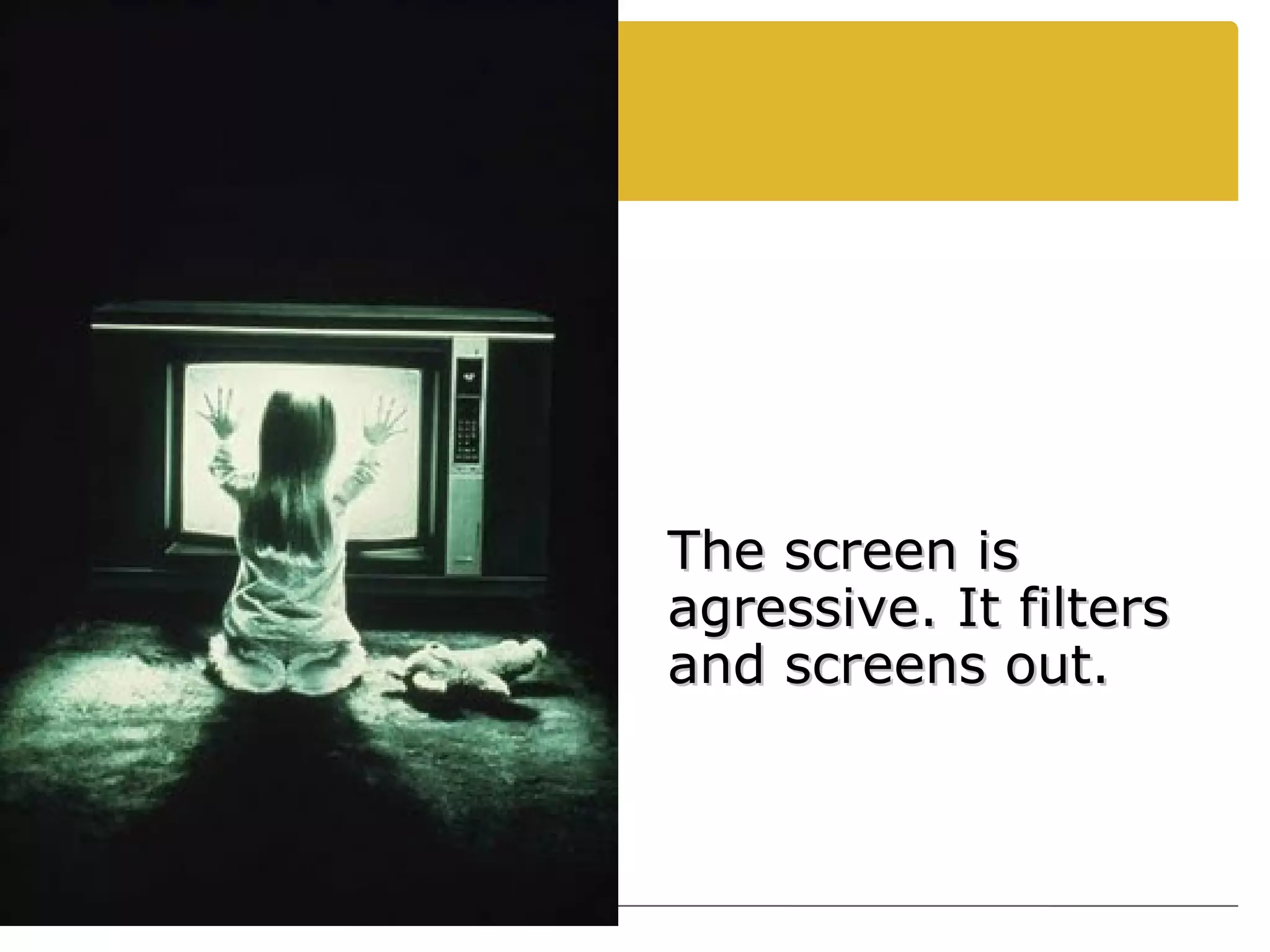
The screen is agressive. It filters and screens out.
This viewing regime is challenged by the arrival of the computer, (altough not yet with the overlapping windows of the Graphical User Interfaces).
The movie screen is an evolution from several devices during the 19th and 20th century, related to entertainment, documentary, fiction. But the computer screen is related to surveillance technology with the invention of the radar.
Real time screen What is new about such a screen is that its image can change in real time, reflecting changes in the referent, be it the position of an object in space (radar), any alteration in visible reality (live video) or changing data in the computer's memory (computer screen). The image can be continually updated in real time. This is the third, after classic and dynamic, type of a screen — the screen of real time.
Let´s get back to the overlapping screens.
Interactive screen The concentration of visualization is no longer in just one image. Blocks of text data, image, video suggest that the computer screen has more to do with graphic design and windows.
When we change something in the screen, we “change” something regarding the computer´s memory, data, etc.
Classical Dynamic Real time Interactive
Remidiation and Interfaces
Definition Remidiation is the representation of one media on another, which is the main characteristic of new media.
Premise There would be the following contradiction  (or paradox): our culture would have a simultaneous desire for and immediacy and hypermediation, the dual logic of remidiation.
Which means that... Our culture wants to simultaneously multiply its media and erase all traces of media. The act of erasing would aim to multiply, ideally.
Immediacy:
Immediacy: When dealing with media (watching, listening, interacting) we want to feel as we were in the presence of what´s on the “other side”. We develop new devices to get closer and closer to “reality”. We want to erase the traces of the author/artist/programmer when we build our artifacts.
 
Hipermediacy: “ a style of visual representation whose goal is to remind the viewer of the medium.”
The digital visual media can best be understood by the ways in which  honor, rival, and revise  the perspective painting, photography, film, television and print. What is newabout "new media" would be the particular way in which these aspects are addressed between the old and new media.
Hypermediation:   fascination by the media (media). Process and performance are higher than the result. Heterogeneous spaces, windowed style, multiple acts of representation.
Hipermediation Hypermedia: + random access multiple media. The desktop interface is not erased. Media (content) and  software are related by the computer, a metamedium (Manovich) .
Immediacy/Hipermediacy Art explores the meaning of the interface makes it arises in the eyes of the user, whilethe "engineering" perfect technology to make it go away.
Acts of remidiation Borrowing, archiving, remodeling, absorption. In order to mediate and reform. How can we trace these acts?


The archeological approach: flashbacks at screens to rebuild the flow of transformations. The trap of novelty and our “device-fetiche” age. We are always seeking the next big thing without paying atention at the huge genealogy of media and software behind us which is showing us a major trend: a  mixture of rivalry and influence between the cultures of media and  software. And it is all happening at a screen next to you!


What could we learn regarding design and usability?
If media and software timelines are weaving more and more, why can´t professionals of these  fields do the same?
Should we obey all UX rules or  media/advertising/branding guidelines?
Interfaces not only reveal ancient aesthetic languages ​​and trends, but are the result of design processes  driven by certain mental models .
Examples that may challenge  our traditional media-centered or  software-centered approaches
The Big App Show
The Big App Show
GIF is back> a vintage trend?
Media + service + design + software
References: BOLTER, Jay David; GRUSIN, Richard.  Remediation . Understanding new media. Cambridge, Massachussets e Londres, Inglaterra: Mit Press, 1999. MCLUHAN, Marshall.  A galáxia de Gutenberg : a formação do homem tipográfico. São Paulo: Nacional, 1977. ______.  Os meios de comunicação como extensões do homem . São Paulo: Cultrix, 1979. _______. et al.  Guerra e paz na aldeia global . São Paulo: Record, 1971. MANOVICH, Lev.  Self-interview by Lev Manovich for MIT Press .  [s.d.]. Disponível em: <http://www.manovich.net/LNM/Q&A_Manovich.html>.  Acesso em: out. 2008.  ______.  The language of new media .   Londres:   The MIT Press, 2001. ______. Software Takes Command. www,manovich.net. 2008
Q+A & Thank you. @gusfischer slideshare.net/gusfischer [email_address] More: TCAV.com.br  - Research Group @ Unisinos  Invitation: August 15th to 18th “Image Week” (Semana da Imagem) @ Unisinos

Presentation @SAP: sofware and media, weaving timelines

  • 1.
    Back to theFuture: what old screens are telling us about how we create interfaces Design and Usability Awareness Campaign – SAP – July 2011/ Gustavo Fischer UNISINOS
  • 2.
    Topics: Weaving timelines:media and software history. A brief genealogy of the screen Remidiation and Interfaces The archeological approach: flashbacks at screens to rebuild the flow of transformations. What could we learn regarding design and usability? Cases that challenge our traditional media-centered or software-centered approaches
  • 3.
    With a [huge]help from my friends
  • 4.
  • 5.
    Weaving timelines: media and software history.
  • 6.
  • 7.
  • 8.
    “ Today we'rebeginning to realize that the new media aren't just mechanical gimmicks for creating worlds of illusion, but new languages with new and unique powers of expression.” Marshall McLuhan, 1960. A media approach
  • 9.
    New media callsfor a new stage in media theory whose beginnings can be traced back to the revolutionary works of Robert Innis and Marshall McLuhan of the 1950s. To understand the logic of new media we need to turn to computer science . (Lev Manovich, 2008) Connecting with a software perspective
  • 10.
  • 11.
    Let's think about thescreen as a point of connection between media and software. By Lev Manovich – The Language of New Media A brief genealogy of the screen
  • 12.
    As soluções deVirtual Reality eram muito comentadas à época.
  • 13.
    Classical Screen Visualculture of the modern period, from painting to cinema, is characterized by an intriguing phenomenon: the existence of another virtual space, another three-dimensional world enclosed by a frame and situated inside our normal space. The frame separates two absolutely different spaces that somehow coexist. This phenomenon is what defines the screen in the most general sense, or, as I will call it, the &quot;classical screen.&quot;
  • 14.
  • 15.
    Even proportions havenot changed in five centuries, they are similar for a typical fifteenth century painting,a film screen and a computer screen.
  • 16.
    In this respectit is not accidental that the very names of the two main formats of computer displays point to two genres of painting: a horizontal format is referred to as &quot;landscape mode&quot; while the vertical format is referred to as &quot;portrait mode.&quot;
  • 17.
    This new typeretains all the properties of a classical screen while adding something new: it can display an image changing over time. This is the screen of cinema, television, video. Dynamic screen
  • 18.
    The screen isagressive. It filters and screens out.
  • 19.
    This viewing regimeis challenged by the arrival of the computer, (altough not yet with the overlapping windows of the Graphical User Interfaces).
  • 20.
    The movie screenis an evolution from several devices during the 19th and 20th century, related to entertainment, documentary, fiction. But the computer screen is related to surveillance technology with the invention of the radar.
  • 21.
    Real time screenWhat is new about such a screen is that its image can change in real time, reflecting changes in the referent, be it the position of an object in space (radar), any alteration in visible reality (live video) or changing data in the computer's memory (computer screen). The image can be continually updated in real time. This is the third, after classic and dynamic, type of a screen — the screen of real time.
  • 22.
    Let´s get backto the overlapping screens.
  • 23.
    Interactive screen Theconcentration of visualization is no longer in just one image. Blocks of text data, image, video suggest that the computer screen has more to do with graphic design and windows.
  • 24.
    When we changesomething in the screen, we “change” something regarding the computer´s memory, data, etc.
  • 25.
    Classical Dynamic Realtime Interactive
  • 26.
  • 27.
    Definition Remidiation isthe representation of one media on another, which is the main characteristic of new media.
  • 28.
    Premise There wouldbe the following contradiction  (or paradox): our culture would have a simultaneous desire for and immediacy and hypermediation, the dual logic of remidiation.
  • 29.
    Which means that...Our culture wants to simultaneously multiply its media and erase all traces of media. The act of erasing would aim to multiply, ideally.
  • 30.
  • 31.
    Immediacy: When dealingwith media (watching, listening, interacting) we want to feel as we were in the presence of what´s on the “other side”. We develop new devices to get closer and closer to “reality”. We want to erase the traces of the author/artist/programmer when we build our artifacts.
  • 32.
  • 33.
    Hipermediacy: “ astyle of visual representation whose goal is to remind the viewer of the medium.”
  • 34.
    The digital visual media can bestbe understood by the ways in which  honor, rival, and revise the perspective painting, photography, film, television and print. What is newabout &quot;new media&quot; would be the particular way in which these aspects are addressed between the old and new media.
  • 35.
    Hypermediation:   fascination bythe media (media). Process and performance are higher than the result. Heterogeneous spaces, windowed style, multiple acts of representation.
  • 36.
    Hipermediation Hypermedia: + random access multiplemedia. The desktop interface is not erased. Media (content) and  software are related by the computer, a metamedium (Manovich) .
  • 37.
    Immediacy/Hipermediacy Art explores the meaning ofthe interface makes it arises in the eyes of the user, whilethe &quot;engineering&quot; perfect technology to make it go away.
  • 38.
    Acts of remidiationBorrowing, archiving, remodeling, absorption. In order to mediate and reform. How can we trace these acts?
  • 39.
  • 40.
  • 41.
  • 42.
  • 43.
  • 44.
    The archeological approach:flashbacks at screens to rebuild the flow of transformations. The trap of novelty and our “device-fetiche” age. We are always seeking the next big thing without paying atention at the huge genealogy of media and software behind us which is showing us a major trend: a mixture of rivalry and influence between the cultures of media and software. And it is all happening at a screen next to you!
  • 45.
  • 46.
  • 47.
  • 48.
  • 49.
  • 50.
  • 51.
  • 52.
  • 53.
  • 54.
  • 55.
  • 56.
    What could welearn regarding design and usability?
  • 57.
    If media andsoftware timelines are weaving more and more, why can´t professionals of these fields do the same?
  • 58.
    Should we obeyall UX rules or media/advertising/branding guidelines?
  • 59.
    Interfaces not only reveal ancient aesthetic languages ​​and trends, but arethe result of design processes  driven by certain mental models .
  • 60.
    Examples that maychallenge our traditional media-centered or software-centered approaches
  • 61.
  • 62.
  • 63.
    GIF is back>a vintage trend?
  • 64.
    Media + service+ design + software
  • 65.
    References: BOLTER, JayDavid; GRUSIN, Richard. Remediation . Understanding new media. Cambridge, Massachussets e Londres, Inglaterra: Mit Press, 1999. MCLUHAN, Marshall. A galáxia de Gutenberg : a formação do homem tipográfico. São Paulo: Nacional, 1977. ______. Os meios de comunicação como extensões do homem . São Paulo: Cultrix, 1979. _______. et al. Guerra e paz na aldeia global . São Paulo: Record, 1971. MANOVICH, Lev. Self-interview by Lev Manovich for MIT Press . [s.d.]. Disponível em: <http://www.manovich.net/LNM/Q&A_Manovich.html>. Acesso em: out. 2008. ______. The language of new media . Londres: The MIT Press, 2001. ______. Software Takes Command. www,manovich.net. 2008
  • 66.
    Q+A & Thankyou. @gusfischer slideshare.net/gusfischer [email_address] More: TCAV.com.br - Research Group @ Unisinos Invitation: August 15th to 18th “Image Week” (Semana da Imagem) @ Unisinos