Project By Nikunj Krishna Udainiya •Class-12th
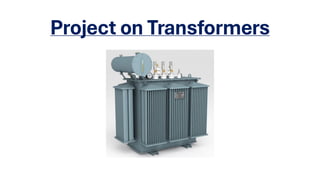
Project on Transformers
Acknowledgement
I am sincerely grateful to my teacher, Mr. Sripal Singh Porus,
for guiding me throughout the process of this project. Their
continuous support, valuable insights, and encouragement
made it possible for me to complete this project with clarity
and understanding.
I would also like to extend my thanks to my classmates and
family for their support and motivation.
Table of Contents
• Introduction
• Working Principle of Transformers
• Types of Transformers
• Construction of a Transformer
• Applications of Transformers
• Conclusion
1. Introduction
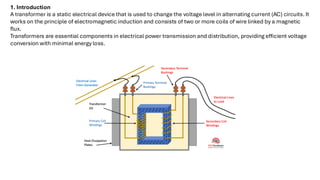
A transformer is a static electrical device that is used to change the voltage level in alternating current (AC) circuits. It
works on the principle of electromagnetic induction and consists of two or more coils of wire linked by a magnetic
flux.
Transformers are essential components in electrical power transmission and distribution, providing efficient voltage
conversion with minimal energy loss.
2. Working Principle of Transformers
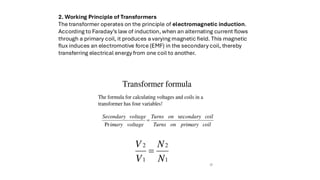
The transformer operates on the principle of electromagnetic induction.
According to Faraday’s law of induction, when an alternating current flows
through a primary coil, it produces a varying magnetic field. This magnetic
flux induces an electromotive force (EMF) in the secondary coil, thereby
transferring electrical energy from one coil to another.
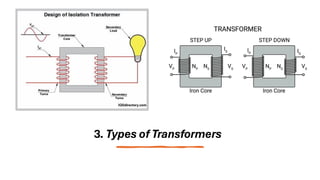
3. Types of Transformers
4. Construction of a Transformer
A typical transformer consists of the following parts:
• Core: Usually made of laminated iron, the core provides a path for the magnetic flux.
• Primary Coil: The coil connected to the AC source, which creates the magnetic flux.
• Secondary Coil: The coil that receives the induced EMF from the primary coil.
• Insulation: Insulating materials are used to prevent electrical short circuits and
ensure the safety of the transformer.
5. Applications of Transformers
•Power Transmission: Transformers are used in power stations to step up
the voltage for long-distance transmission. High voltage reduces the
energy loss during transmission.
•Voltage Regulation: Used in electronic devices to convert the voltage to
the required level.
•Impedance Matching: Used in audio systems and communication
circuits to match impedances.
•Electrical Isolation: Used to isolate circuits for safety, especially in
sensitive equipment.
6. Conclusion
Transformers are crucial devices in the field of electrical
engineering. They enable the efficient transmission of electrical
power over long distances by adjusting the voltage levels. The
principle of electromagnetic induction, along with the relationship
between the number of turns in the coils and voltage, makes
transformers an indispensable part of modern electrical systems.
Through this project, I have gained a deeper understanding of the
working and importance of transformers, and their application in
various fields.

Presentation Physics Class 12th Transformers

  • 1.
    Project By NikunjKrishna Udainiya •Class-12th
  • 2.
  • 3.
    Acknowledgement I am sincerelygrateful to my teacher, Mr. Sripal Singh Porus, for guiding me throughout the process of this project. Their continuous support, valuable insights, and encouragement made it possible for me to complete this project with clarity and understanding. I would also like to extend my thanks to my classmates and family for their support and motivation.
  • 4.
    Table of Contents •Introduction • Working Principle of Transformers • Types of Transformers • Construction of a Transformer • Applications of Transformers • Conclusion
  • 5.
    1. Introduction A transformeris a static electrical device that is used to change the voltage level in alternating current (AC) circuits. It works on the principle of electromagnetic induction and consists of two or more coils of wire linked by a magnetic flux. Transformers are essential components in electrical power transmission and distribution, providing efficient voltage conversion with minimal energy loss.
  • 6.
    2. Working Principleof Transformers The transformer operates on the principle of electromagnetic induction. According to Faraday’s law of induction, when an alternating current flows through a primary coil, it produces a varying magnetic field. This magnetic flux induces an electromotive force (EMF) in the secondary coil, thereby transferring electrical energy from one coil to another.
  • 7.
    3. Types ofTransformers
  • 8.
    4. Construction ofa Transformer A typical transformer consists of the following parts: • Core: Usually made of laminated iron, the core provides a path for the magnetic flux. • Primary Coil: The coil connected to the AC source, which creates the magnetic flux. • Secondary Coil: The coil that receives the induced EMF from the primary coil. • Insulation: Insulating materials are used to prevent electrical short circuits and ensure the safety of the transformer.
  • 9.
    5. Applications ofTransformers •Power Transmission: Transformers are used in power stations to step up the voltage for long-distance transmission. High voltage reduces the energy loss during transmission. •Voltage Regulation: Used in electronic devices to convert the voltage to the required level. •Impedance Matching: Used in audio systems and communication circuits to match impedances. •Electrical Isolation: Used to isolate circuits for safety, especially in sensitive equipment.
  • 10.
    6. Conclusion Transformers arecrucial devices in the field of electrical engineering. They enable the efficient transmission of electrical power over long distances by adjusting the voltage levels. The principle of electromagnetic induction, along with the relationship between the number of turns in the coils and voltage, makes transformers an indispensable part of modern electrical systems. Through this project, I have gained a deeper understanding of the working and importance of transformers, and their application in various fields.