By Angel Ortiz:
 Born Gaius Caecilius, Pliny theYounger was a
lawyer and author in Ancient Rome who lived
from 61 – c. 113.
 Was tutored at home before moving to Rome
to continue his education.
 His uncle, Pliny the Elder dies trying to rescue
people from the Mt.Vesuvius eruption.
 Pliny theYounger inherited his estate, and
was also adopted by his uncle in his will.
 Pliny wrote hundreds
of letters that much
historical significance
in his time period.
 He wrote about many
topics including the
Christian religion and
the eruption of Mt.
Vesuvius, something
he witnessed himself.
 His Epistulae is Pliny theYounger’s largest
surviving body of work.
 They are a series of letters written to friends
and associates.
 They have been an invaluable source of
everyday life in his time period and a guide as
to how administrative processes were held in
Ancient Rome.
 Pliny wrote a letter to a
friend namedTacitus
about the eruption of
Mt.Vesuvius because
Tacitus wanted to know
more about Pliny the
Elder’s death.
 In those letters Pliny
spoke in great detail
about the volcano and
its eruption.Those
details are still used
today.
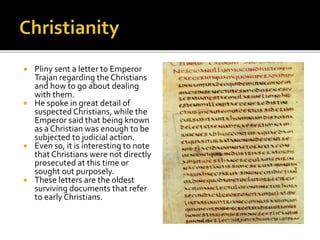
 Pliny sent a letter to Emperor
Trajan regarding the Christians
and how to go about dealing
with them.
 He spoke in great detail of
suspected Christians, while the
Emperor said that being known
as a Christian was enough to be
subjected to judicial action.
 Even so, it is interesting to note
that Christians were not directly
prosecuted at this time or
sought out purposely.
 These letters are the oldest
surviving documents that refer
to early Christians.
 In conclusion, Pliny theYounger’s work
reflects the life of people that lived in that
time.
 Pliny’s letters have been a great insight into
the politics, lifestyles, and events that have
had a great impact in our history.
 Pliny’s letters are still analyzed today in order
to understand the way people lived as well as
their thought processes.
 Kirby, Peter. "Historical JesusTheories." Early Christian
Writings. 2015. 14 July 2015
<http://www.earlychristianwritings.com/text/pliny.ht
ml>.
 Pliny Contributors. "A Brief Summary of Pliny's
Letters."
Http://www.vroma.org/~hwalker/Pliny/PlinySummaries
.html. Roman Literary Life, 23 Jan. 2004.Web. 14 July
2015.
 Welmoth,William. "Letters of Pliny."
Http://www.gutenberg.org/files/2811/2811-h/2811-

Presentation on pliny

  • 1.
  • 2.
     Born GaiusCaecilius, Pliny theYounger was a lawyer and author in Ancient Rome who lived from 61 – c. 113.  Was tutored at home before moving to Rome to continue his education.  His uncle, Pliny the Elder dies trying to rescue people from the Mt.Vesuvius eruption.  Pliny theYounger inherited his estate, and was also adopted by his uncle in his will.
  • 3.
     Pliny wrotehundreds of letters that much historical significance in his time period.  He wrote about many topics including the Christian religion and the eruption of Mt. Vesuvius, something he witnessed himself.
  • 4.
     His Epistulaeis Pliny theYounger’s largest surviving body of work.  They are a series of letters written to friends and associates.  They have been an invaluable source of everyday life in his time period and a guide as to how administrative processes were held in Ancient Rome.
  • 5.
     Pliny wrotea letter to a friend namedTacitus about the eruption of Mt.Vesuvius because Tacitus wanted to know more about Pliny the Elder’s death.  In those letters Pliny spoke in great detail about the volcano and its eruption.Those details are still used today.
  • 6.
     Pliny senta letter to Emperor Trajan regarding the Christians and how to go about dealing with them.  He spoke in great detail of suspected Christians, while the Emperor said that being known as a Christian was enough to be subjected to judicial action.  Even so, it is interesting to note that Christians were not directly prosecuted at this time or sought out purposely.  These letters are the oldest surviving documents that refer to early Christians.
  • 7.
     In conclusion,Pliny theYounger’s work reflects the life of people that lived in that time.  Pliny’s letters have been a great insight into the politics, lifestyles, and events that have had a great impact in our history.  Pliny’s letters are still analyzed today in order to understand the way people lived as well as their thought processes.
  • 8.
     Kirby, Peter."Historical JesusTheories." Early Christian Writings. 2015. 14 July 2015 <http://www.earlychristianwritings.com/text/pliny.ht ml>.  Pliny Contributors. "A Brief Summary of Pliny's Letters." Http://www.vroma.org/~hwalker/Pliny/PlinySummaries .html. Roman Literary Life, 23 Jan. 2004.Web. 14 July 2015.  Welmoth,William. "Letters of Pliny." Http://www.gutenberg.org/files/2811/2811-h/2811-