PRESENTATION ON FRICTION
KIRAN DHUNGANA
SVI , BALAJU
CONTENTS
 Apparatus required
 Theory
 Laws of limiting friction
 Laws of static friction
 Verification of laws of limiting friction
 Result
 Conclusion
 precaution
APPARATUS REQUIRED
a) Light pan
b) Thread
c) Spring balance
d) Weight box
e) Meter scale
f) Friction apparatus
THEORY:
The opposite force produce between two surfaces when
one slides above another surface is called friction or frictional
force
limiting or sliding friction: it is the maximum or limiting value of
the force of friction that comes to play when a body just begins to slide over
the surface of another body.
The laws of limiting friction are as follows:
1. force of friction is acting tangentially opposite to the direction of motion.
2. force of friction is independent with area of surfaces and depends upon
nature of surfaces .
3. force of friction is directly proportional normal reaction.
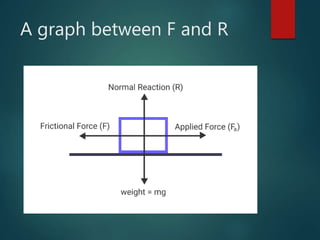
A graph between F and R
 F R
F=µR
 µ=FR…………(i)
 Where µis the proportionality constant called
coefficient of limiting friction. The equation (i) is
similar to y=mx which is the equation of a straight line
passing through the origin.
Laws of static friction
a. The static friction is independent of the area of constant between
the body and the surface, when the normal reaction is
constant.
b. The limiting friction is directly proportional to the normal
reaction for the case of static friction .
c. Law of dynamic or kinetic friction: The dynamic or kinetic
friction is directly proportional to the normal reaction.
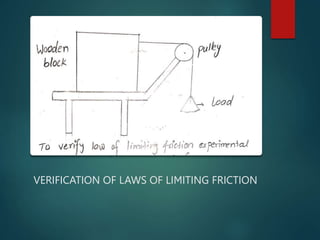
VERIFICATION OF LAWS OF LIMITING FRICTION
VERIFICATION OF FIRST LAW:
To verify the first law different loads are placed on
the pan experimentally, it is found that all loads
can not slide the wooden block. To slide the block
load should be greater than frictional force which
verifies first law.
VERIFICATION OF
SECOND LAW:
To verify the second law
different wooden block
are placed on the table .
It is found that in case of
(I) and (II) wooden block
equal load can slide
them but in the case of
(III) wooden block some
more load should be
added on the pan which
verifies second law.
VERIFICATION OF
THIRD LAW:
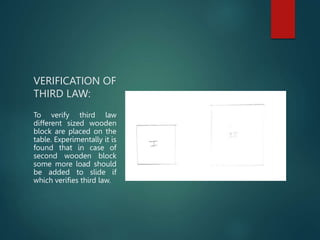
To verify third law
different sized wooden
block are placed on the
table. Experimentally it is
found that in case of
second wooden block
some more load should
be added to slide if
which verifies third law.
RESULT
It is found experimentally that:
(a). The static friction is independent of the area of contact
between the body and the surface, when the normal
reaction is constant.
(b). The limiting friction is directly proportional to the normal
reaction for the case of static friction.
(c). The dynamic or kinetic friction is directly proportional to
the normal reaction.
CONCLUSION
The laws of solid friction is verified.
PRECAUTION
1. The pulley should be oiled well.
2. The surface should be tapped very gently.
3. The glass surface and the thread should be horizontal.
4. The pan should not touch any part of the table.
5. The tray should be placed in the middle of the inclined
plane.
THANK YOU….

PRESENTATION ON FRICTION

  • 1.
    PRESENTATION ON FRICTION KIRANDHUNGANA SVI , BALAJU
  • 2.
    CONTENTS  Apparatus required Theory  Laws of limiting friction  Laws of static friction  Verification of laws of limiting friction  Result  Conclusion  precaution
  • 3.
    APPARATUS REQUIRED a) Lightpan b) Thread c) Spring balance d) Weight box e) Meter scale f) Friction apparatus
  • 4.
    THEORY: The opposite forceproduce between two surfaces when one slides above another surface is called friction or frictional force limiting or sliding friction: it is the maximum or limiting value of the force of friction that comes to play when a body just begins to slide over the surface of another body. The laws of limiting friction are as follows: 1. force of friction is acting tangentially opposite to the direction of motion. 2. force of friction is independent with area of surfaces and depends upon nature of surfaces . 3. force of friction is directly proportional normal reaction.
  • 5.
  • 6.
     F R F=µR µ=FR…………(i)  Where µis the proportionality constant called coefficient of limiting friction. The equation (i) is similar to y=mx which is the equation of a straight line passing through the origin.
  • 7.
    Laws of staticfriction a. The static friction is independent of the area of constant between the body and the surface, when the normal reaction is constant. b. The limiting friction is directly proportional to the normal reaction for the case of static friction . c. Law of dynamic or kinetic friction: The dynamic or kinetic friction is directly proportional to the normal reaction.
  • 8.
    VERIFICATION OF LAWSOF LIMITING FRICTION
  • 9.
    VERIFICATION OF FIRSTLAW: To verify the first law different loads are placed on the pan experimentally, it is found that all loads can not slide the wooden block. To slide the block load should be greater than frictional force which verifies first law.
  • 10.
    VERIFICATION OF SECOND LAW: Toverify the second law different wooden block are placed on the table . It is found that in case of (I) and (II) wooden block equal load can slide them but in the case of (III) wooden block some more load should be added on the pan which verifies second law.
  • 11.
    VERIFICATION OF THIRD LAW: Toverify third law different sized wooden block are placed on the table. Experimentally it is found that in case of second wooden block some more load should be added to slide if which verifies third law.
  • 12.
    RESULT It is foundexperimentally that: (a). The static friction is independent of the area of contact between the body and the surface, when the normal reaction is constant. (b). The limiting friction is directly proportional to the normal reaction for the case of static friction. (c). The dynamic or kinetic friction is directly proportional to the normal reaction. CONCLUSION The laws of solid friction is verified.
  • 13.
    PRECAUTION 1. The pulleyshould be oiled well. 2. The surface should be tapped very gently. 3. The glass surface and the thread should be horizontal. 4. The pan should not touch any part of the table. 5. The tray should be placed in the middle of the inclined plane.
  • 14.