ELISA
Principle of ELISA
• 2 Components
• Immunosorbent: Absorbs antigen or antibody
present in serum
• Enzyme: used to label one of the components of
immunoassay
• Substrate-chromogen system : added at the final
step of ELISA
(Ag-Ab complex) – enzyme + substrate activates the chromogen
Color change detected by spectrophotometry
Procedure of ELISA
• Microtitre plate- 96 wells- polyvinyl, polystyrene or
polycarbonate material
• ELISA kits- commercially available- enzyme
conjugate, dilution buffer, substrate/chromogen
• At each step- reagent added – incubated- washing
Types
• Direct ELISA
• Indirect ELISA
• Sandwich ELISA
• IgM antibody capture (MAC ELISA)
• Competitive ELISA
• ELISPOT TEST
• IgG avidity ELISA
Direct ELISA
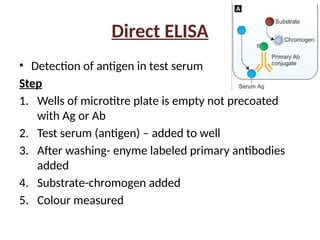
• Detection of antigen in test serum
Step
1. Wells of microtitre plate is empty not precoated
with Ag or Ab
2. Test serum (antigen) – added to well
3. After washing- enyme labeled primary antibodies
added
4. Substrate-chromogen added
5. Colour measured
Indirect ELISA
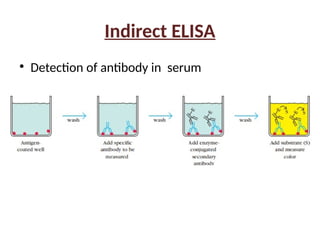
• Detection of antibody in serum
• Uses - determination of serum antibodies for
diagnosis of HIV
• Japanese encephalitis
• Dengue, many other viral infections
SANDWICH ELISA
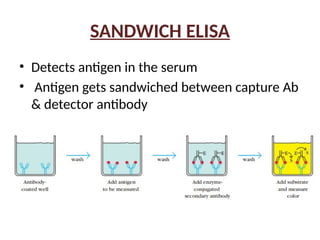
• Detects antigen in the serum
• Antigen gets sandwiched between capture Ab
& detector antibody
• Used to detect rotavirus & enterotoxin of
E.coli in feces.
IgM ANTIBODY CAPTURE ELISA(MAC)
• Enzymatically amplifies sandwich type
immunoassay
• Based on capturing primary IgM Ab
• Microtitre plate precoated with antihuman
IgM antibody (capture IgM)
• Followed by addition of Recombinant Ag
eg.Dengue antigen
• Enzyme labelled secondary antibody specific
for antigen – added
• Addition of substrate chromogen system
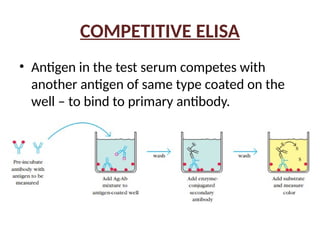
COMPETITIVE ELISA
• Antigen in the test serum competes with
another antigen of same type coated on the
well – to bind to primary antibody.
• Most commonly used – detection of HIV
antibodies in serum
ELISPOT TEST
• Modification of ELISA
• Allows quantitative detection of cells
producing antibodies (plasma cells) or cytokines
(lymphocytes or macrophages)
•Used in IGRA – diagnosis of latent TB
•Sensitized T cells capable of producing IFN- γ
are measured
IgG AVIDITY ELISA
• Differentiating recent from past infection
Principle
• Avidity of an antibody- indicates how firmly it is
bound with its antigen
• Avidity reflects maturity of antibodies- which usually
increases with time
• Detection of low avidity IgG – recent infection
• High avidity IgG- past infection
Uses
Diagnosis of following infections:
• Rubella, CMV, VZV, toxoplasmosis, EBV, HIV,
viral hepatitis & west nile virus infection.
ADVANTAGES 0F ELISA
• Large sample can be tested together
• Economical
• High sensitivity
DISADVANTAGES OF ELISA
• Small laboratories- ELISA less preferred
• Takes more time (2-3hrs) compared to rapid
test (10-20min)
• Needs expensive equipments- ELISA washer,
reader
APPLICATIONS OF ELISA
• Antigen detection: HBsAg, HBeAg, NS1 antigen
for dengue
• Antibody detection: Hepatitis B, hepatitis C,
HIV, dengue, EBV, HSV, toxoplasmosis,
leishmaniasis
Consists of two antigen–antibody complement systems:
• (a) an indicator system
• (b) a test system
• Indicator system:
 Consists - RBCs that have been preincubated with a
specific anti-RBC antibody, in concentrations that do
not cause agglutination, and no hemolysis of RBCs
occurs in the absence of complement.
 Such RBCs -“sensitized” red cells

Presentation on ELISA - Principle,Types.pptx

  • 1.
  • 2.
    Principle of ELISA •2 Components • Immunosorbent: Absorbs antigen or antibody present in serum • Enzyme: used to label one of the components of immunoassay • Substrate-chromogen system : added at the final step of ELISA (Ag-Ab complex) – enzyme + substrate activates the chromogen Color change detected by spectrophotometry
  • 3.
    Procedure of ELISA •Microtitre plate- 96 wells- polyvinyl, polystyrene or polycarbonate material • ELISA kits- commercially available- enzyme conjugate, dilution buffer, substrate/chromogen • At each step- reagent added – incubated- washing
  • 4.
    Types • Direct ELISA •Indirect ELISA • Sandwich ELISA • IgM antibody capture (MAC ELISA) • Competitive ELISA • ELISPOT TEST • IgG avidity ELISA
  • 5.
    Direct ELISA • Detectionof antigen in test serum Step 1. Wells of microtitre plate is empty not precoated with Ag or Ab 2. Test serum (antigen) – added to well 3. After washing- enyme labeled primary antibodies added 4. Substrate-chromogen added 5. Colour measured
  • 6.
    Indirect ELISA • Detectionof antibody in serum
  • 7.
    • Uses -determination of serum antibodies for diagnosis of HIV • Japanese encephalitis • Dengue, many other viral infections
  • 8.
    SANDWICH ELISA • Detectsantigen in the serum • Antigen gets sandwiched between capture Ab & detector antibody
  • 9.
    • Used todetect rotavirus & enterotoxin of E.coli in feces.
  • 10.
    IgM ANTIBODY CAPTUREELISA(MAC) • Enzymatically amplifies sandwich type immunoassay • Based on capturing primary IgM Ab • Microtitre plate precoated with antihuman IgM antibody (capture IgM) • Followed by addition of Recombinant Ag eg.Dengue antigen
  • 11.
    • Enzyme labelledsecondary antibody specific for antigen – added • Addition of substrate chromogen system
  • 12.
    COMPETITIVE ELISA • Antigenin the test serum competes with another antigen of same type coated on the well – to bind to primary antibody.
  • 13.
    • Most commonlyused – detection of HIV antibodies in serum
  • 14.
    ELISPOT TEST • Modificationof ELISA • Allows quantitative detection of cells producing antibodies (plasma cells) or cytokines (lymphocytes or macrophages) •Used in IGRA – diagnosis of latent TB •Sensitized T cells capable of producing IFN- γ are measured
  • 15.
    IgG AVIDITY ELISA •Differentiating recent from past infection Principle • Avidity of an antibody- indicates how firmly it is bound with its antigen • Avidity reflects maturity of antibodies- which usually increases with time • Detection of low avidity IgG – recent infection • High avidity IgG- past infection
  • 16.
    Uses Diagnosis of followinginfections: • Rubella, CMV, VZV, toxoplasmosis, EBV, HIV, viral hepatitis & west nile virus infection.
  • 17.
    ADVANTAGES 0F ELISA •Large sample can be tested together • Economical • High sensitivity
  • 18.
    DISADVANTAGES OF ELISA •Small laboratories- ELISA less preferred • Takes more time (2-3hrs) compared to rapid test (10-20min) • Needs expensive equipments- ELISA washer, reader
  • 19.
    APPLICATIONS OF ELISA •Antigen detection: HBsAg, HBeAg, NS1 antigen for dengue • Antibody detection: Hepatitis B, hepatitis C, HIV, dengue, EBV, HSV, toxoplasmosis, leishmaniasis
  • 20.
    Consists of twoantigen–antibody complement systems: • (a) an indicator system • (b) a test system • Indicator system:  Consists - RBCs that have been preincubated with a specific anti-RBC antibody, in concentrations that do not cause agglutination, and no hemolysis of RBCs occurs in the absence of complement.  Such RBCs -“sensitized” red cells