BIOMETRIC
AUTHENTICATION
HEMVATI NANDAN BAHUGUNAGARHWAL
UNIVERSITY
— SAGAR KUMAR
B.TECH, VI SEM, ECE
( A CENTRAL UNIVERSITY) SRINAGAR,
UTTARAKHAND
SCHOOL OF ENGINEERING & TECHNOLOGY
DEPARTMENT OF ELECTRONICS & COMMUNICATION
ENGINEERING
An Overview of Modern Identity Verification
2.
1.Introduction
2.What is Authentication& it’s types
3.What is Biometric Authentication?
4.Classification of Biometrics
5.Fingerprint Recognition
6.How it’s work
7.Facial Recognition system
8.Advantage & Disadvantages of Biometric
Authentication
9.Applications
10.Conclusion
CONTENTS
00
3.
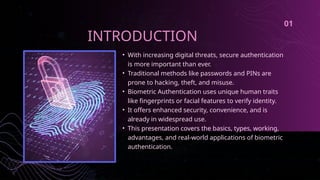
• With increasingdigital threats, secure authentication
is more important than ever.
• Traditional methods like passwords and PINs are
prone to hacking, theft, and misuse.
• Biometric Authentication uses unique human traits
like fingerprints or facial features to verify identity.
• It offers enhanced security, convenience, and is
already in widespread use.
• This presentation covers the basics, types, working,
advantages, and real-world applications of biometric
authentication.
INTRODUCTION
01
4.
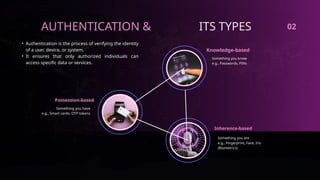
AUTHENTICATION & ITSTYPES
Knowledge-based
Something you know
e.g., Passwords, PINs
Possession-based
Something you have
e.g., Smart cards, OTP tokens
Inherence-based
Something you are
e.g., Fingerprint, Face, Iris
(Biometrics)
02
• Authentication is the process of verifying the identity
of a user, device, or system.
• It ensures that only authorized individuals can
access specific data or services.
5.
AUTHENTICATION
BIOMETRIC
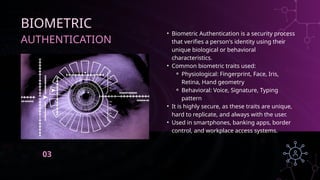
• Biometric Authenticationis a security process
that verifies a person's identity using their
unique biological or behavioral
characteristics.
• Common biometric traits used:
⚬ Physiological: Fingerprint, Face, Iris,
Retina, Hand geometry
⚬ Behavioral: Voice, Signature, Typing
pattern
• It is highly secure, as these traits are unique,
hard to replicate, and always with the user.
• Used in smartphones, banking apps, border
control, and workplace access systems.
03
6.
CLASSIFICATION OF
TRAITS
BIOMETRICS
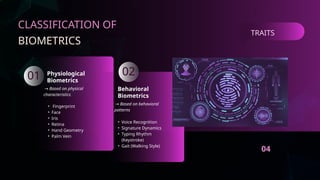
01 Physiological
Biometrics
04
•Fingerprint
• Face
• Iris
• Retina
• Hand Geometry
• Palm Vein
→ Based on physical
characteristics
02
Behavioral
Biometrics
• Voice Recognition
• Signature Dynamics
• Typing Rhythm
(Keystroke)
• Gait (Walking Style)
→ Based on behavioral
patterns
7.
FINGERPRINT
RECOGNITION
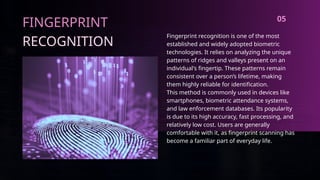
Fingerprint recognition isone of the most
established and widely adopted biometric
technologies. It relies on analyzing the unique
patterns of ridges and valleys present on an
individual's fingertip. These patterns remain
consistent over a person’s lifetime, making
them highly reliable for identification.
This method is commonly used in devices like
smartphones, biometric attendance systems,
and law enforcement databases. Its popularity
is due to its high accuracy, fast processing, and
relatively low cost. Users are generally
comfortable with it, as fingerprint scanning has
become a familiar part of everyday life.
05
8.
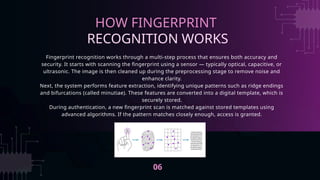
Fingerprint recognition worksthrough a multi-step process that ensures both accuracy and
security. It starts with scanning the fingerprint using a sensor — typically optical, capacitive, or
ultrasonic. The image is then cleaned up during the preprocessing stage to remove noise and
enhance clarity.
Next, the system performs feature extraction, identifying unique patterns such as ridge endings
and bifurcations (called minutiae). These features are converted into a digital template, which is
securely stored.
During authentication, a new fingerprint scan is matched against stored templates using
advanced algorithms. If the pattern matches closely enough, access is granted.
HOW FINGERPRINT
RECOGNITION WORKS
06
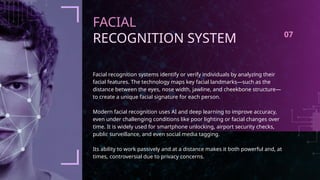
9.
FACIAL
RECOGNITION SYSTEM
Facial recognitionsystems identify or verify individuals by analyzing their
facial features. The technology maps key facial landmarks—such as the
distance between the eyes, nose width, jawline, and cheekbone structure—
to create a unique facial signature for each person.
Modern facial recognition uses AI and deep learning to improve accuracy,
even under challenging conditions like poor lighting or facial changes over
time. It is widely used for smartphone unlocking, airport security checks,
public surveillance, and even social media tagging.
Its ability to work passively and at a distance makes it both powerful and, at
times, controversial due to privacy concerns.
07
10.
08
ADVANTAGE DISADVANTAGE
• Highlevel of security due to
unique biological traits
• No need to remember passwords
or carry physical tokens
• Fast and convenient for users
• Difficult to forge or replicate
• Widely adopted in consumer
devices and enterprise systems
• High level of security due to
unique biological traits
• No need to remember
passwords or carry physical
tokens
• Fast and convenient for users
• Difficult to forge or replicate
• Widely adopted in consumer
devices and enterprise systems
BIOMETRIC AUTHENTICATION
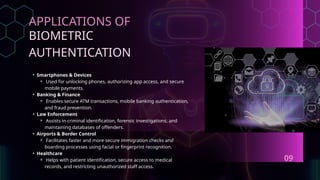
11.
APPLICATIONS OF
BIOMETRIC
AUTHENTICATION
• Smartphones& Devices
⚬ Used for unlocking phones, authorizing app access, and secure
mobile payments.
• Banking & Finance
⚬ Enables secure ATM transactions, mobile banking authentication,
and fraud prevention.
• Law Enforcement
⚬ Assists in criminal identification, forensic investigations, and
maintaining databases of offenders.
• Airports & Border Control
⚬ Facilitates faster and more secure immigration checks and
boarding processes using facial or fingerprint recognition.
• Healthcare
⚬ Helps with patient identification, secure access to medical
records, and restricting unauthorized staff access.
09
12.
CONCLUSION
Biometric authentication istransforming the way we secure our
digital and physical environments. By relying on unique human
traits, it offers a powerful alternative to traditional methods like
passwords and PINs. Its growing presence in everyday applications
—from unlocking phones to securing borders—proves its value in
both convenience and security.
However, as the technology evolves, it's important to address
challenges such as privacy, ethical concerns, and potential misuse.
When implemented responsibly, biometrics can play a key role in
building a safer, smarter, and more secure future.
10




![Biometric-Authentication-A-Comprehensive-Guide[1].pptx](https://cdn.slidesharecdn.com/ss_thumbnails/biometric-authentication-a-comprehensive-guide1-250206165919-b8054a8b-thumbnail.jpg?width=640&height=640&fit=bounds)


![谷歌留痕技术 [ 𝙩𝙤𝙥 𝟮𝟯𝟯. 𝙘 𝙤𝙢 ]](https://cdn.slidesharecdn.com/ss_thumbnails/top233-260130174328-3833018c-thumbnail.jpg?width=640&height=640&fit=bounds)