The Importance of Numbers in
Our Daily Lives
Name: Sai Patil , Samiksha Patil , Suparna Kumar,
Janhavi KanadeAthar Shaikh
Standard: 9th B
School: VPP CBSE
Introduction
 Numbers are an essential part of our daily lives, woven
into the fabric of our routines and activities.
 Today, we'll explore the various ways in which numbers
play a crucial role in shaping our day-to-day experiences.
 Imagine a day without numbers... What would it look
like?“
 From waking up to going to bed, numbers are everywhere
– from the clock that wakes us up to the steps we take in a
day.
Mathematics in Everyday Tasks
• Grocery Shopping:
• Numbers come alive in the supermarket.
• Example: Calculating the total cost of items using prices and
quantities.
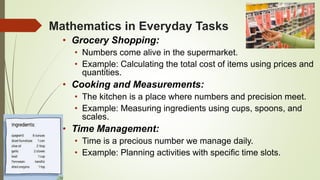
• Cooking and Measurements:
• The kitchen is a place where numbers and precision meet.
• Example: Measuring ingredients using cups, spoons, and
scales.
• Time Management:
• Time is a precious number we manage daily.
• Example: Planning activities with specific time slots.
Budgeting and Money Management
• Concept of Budgeting:
• "Budgeting is like planning how to use your money wisely."
• Example: "Imagine you get pocket money. How would you plan to
spend it on things you need?"
• Tracking Expenses:
• "It's important to keep track of what you spend."
• Example: "Have you ever kept a record of what you buy with your
pocket money?"
• Savings and Investments:
• "Numbers also help us save for things we want in the future."
• Example: "If you save a little every week, you can buy something
special later."
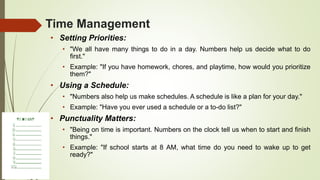
Time Management
• Setting Priorities:
• "We all have many things to do in a day. Numbers help us decide what to do
first."
• Example: "If you have homework, chores, and playtime, how would you prioritize
them?"
• Using a Schedule:
• "Numbers also help us make schedules. A schedule is like a plan for your day."
• Example: "Have you ever used a schedule or a to-do list?"
• Punctuality Matters:
• "Being on time is important. Numbers on the clock tell us when to start and finish
things."
• Example: "If school starts at 8 AM, what time do you need to wake up to get
ready?"
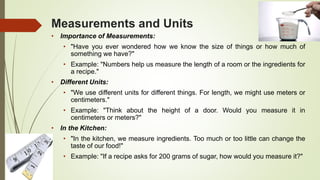
Measurements and Units
• Importance of Measurements:
• "Have you ever wondered how we know the size of things or how much of
something we have?"
• Example: "Numbers help us measure the length of a room or the ingredients for
a recipe."
• Different Units:
• "We use different units for different things. For length, we might use meters or
centimeters."
• Example: "Think about the height of a door. Would you measure it in
centimeters or meters?"
• In the Kitchen:
• "In the kitchen, we measure ingredients. Too much or too little can change the
taste of our food!"
• Example: "If a recipe asks for 200 grams of sugar, how would you measure it?"
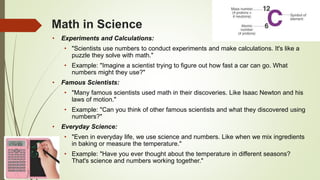
Math in Science
• Experiments and Calculations:
• "Scientists use numbers to conduct experiments and make calculations. It's like a
puzzle they solve with math."
• Example: "Imagine a scientist trying to figure out how fast a car can go. What
numbers might they use?"
• Famous Scientists:
• "Many famous scientists used math in their discoveries. Like Isaac Newton and his
laws of motion."
• Example: "Can you think of other famous scientists and what they discovered using
numbers?"
• Everyday Science:
• "Even in everyday life, we use science and numbers. Like when we mix ingredients
in baking or measure the temperature."
• Example: "Have you ever thought about the temperature in different seasons?
That's science and numbers working together."
Technology and Numbers
• Coding and Algorithms:
• "Have you ever heard of coding? It's like giving instructions to a
computer using numbers and symbols."
• Example: "When you play a game on your computer or phone, there's
a lot of code behind it. It's all about numbers and logic."
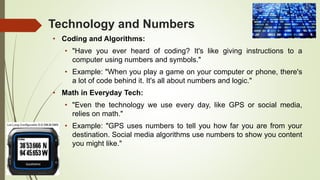
• Math in Everyday Tech:
• "Even the technology we use every day, like GPS or social media,
relies on math."
• Example: "GPS uses numbers to tell you how far you are from your
destination. Social media algorithms use numbers to show you content
you might like."
Math in Art and Design
• Proportions and Symmetry:
• "Artists and designers use numbers to create balance
and harmony. Proportions and symmetry are like the
magic wands of art."
• Example: "Have you ever noticed how a face is divided
into equal parts in a portrait?"
• Patterns and Geometry:
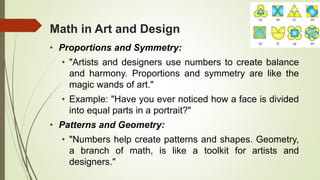
• "Numbers help create patterns and shapes. Geometry,
a branch of math, is like a toolkit for artists and
designers."
Problem Solving
• Everyday Problem Solving:
• "Have you ever faced a problem that needed solving?
Numbers can be your guide in finding solutions."
• Example: "Imagine you have a limited budget for a week.
How would you plan your spending?"
• Logical Thinking:
• "Numbers help us think logically and make decisions. It's like
having a roadmap to navigate through problems."
• Example: "If you have two options for a problem, how do you
use numbers to decide which one is better?"
Summary
"We've taken a fascinating journey exploring how
numbers are more than just digits on a page. They are
the unsung heroes of our daily lives."
• Key Takeaways:
• "From budgeting to sports, technology to art, numbers
are everywhere, guiding us and helping us understand
the world."
• Appreciation:
• "Next time you see a number, remember it's not just a
math problem. It's a part of the amazing puzzle that
makes our lives interesting and organized."
presentation for Saee aaaaand Samiksha.pptx

presentation for Saee aaaaand Samiksha.pptx

  • 1.
    The Importance ofNumbers in Our Daily Lives Name: Sai Patil , Samiksha Patil , Suparna Kumar, Janhavi KanadeAthar Shaikh Standard: 9th B School: VPP CBSE
  • 2.
    Introduction  Numbers arean essential part of our daily lives, woven into the fabric of our routines and activities.  Today, we'll explore the various ways in which numbers play a crucial role in shaping our day-to-day experiences.  Imagine a day without numbers... What would it look like?“  From waking up to going to bed, numbers are everywhere – from the clock that wakes us up to the steps we take in a day.
  • 3.
    Mathematics in EverydayTasks • Grocery Shopping: • Numbers come alive in the supermarket. • Example: Calculating the total cost of items using prices and quantities. • Cooking and Measurements: • The kitchen is a place where numbers and precision meet. • Example: Measuring ingredients using cups, spoons, and scales. • Time Management: • Time is a precious number we manage daily. • Example: Planning activities with specific time slots.
  • 4.
    Budgeting and MoneyManagement • Concept of Budgeting: • "Budgeting is like planning how to use your money wisely." • Example: "Imagine you get pocket money. How would you plan to spend it on things you need?" • Tracking Expenses: • "It's important to keep track of what you spend." • Example: "Have you ever kept a record of what you buy with your pocket money?" • Savings and Investments: • "Numbers also help us save for things we want in the future." • Example: "If you save a little every week, you can buy something special later."
  • 5.
    Time Management • SettingPriorities: • "We all have many things to do in a day. Numbers help us decide what to do first." • Example: "If you have homework, chores, and playtime, how would you prioritize them?" • Using a Schedule: • "Numbers also help us make schedules. A schedule is like a plan for your day." • Example: "Have you ever used a schedule or a to-do list?" • Punctuality Matters: • "Being on time is important. Numbers on the clock tell us when to start and finish things." • Example: "If school starts at 8 AM, what time do you need to wake up to get ready?"
  • 6.
    Measurements and Units •Importance of Measurements: • "Have you ever wondered how we know the size of things or how much of something we have?" • Example: "Numbers help us measure the length of a room or the ingredients for a recipe." • Different Units: • "We use different units for different things. For length, we might use meters or centimeters." • Example: "Think about the height of a door. Would you measure it in centimeters or meters?" • In the Kitchen: • "In the kitchen, we measure ingredients. Too much or too little can change the taste of our food!" • Example: "If a recipe asks for 200 grams of sugar, how would you measure it?"
  • 7.
    Math in Science •Experiments and Calculations: • "Scientists use numbers to conduct experiments and make calculations. It's like a puzzle they solve with math." • Example: "Imagine a scientist trying to figure out how fast a car can go. What numbers might they use?" • Famous Scientists: • "Many famous scientists used math in their discoveries. Like Isaac Newton and his laws of motion." • Example: "Can you think of other famous scientists and what they discovered using numbers?" • Everyday Science: • "Even in everyday life, we use science and numbers. Like when we mix ingredients in baking or measure the temperature." • Example: "Have you ever thought about the temperature in different seasons? That's science and numbers working together."
  • 8.
    Technology and Numbers •Coding and Algorithms: • "Have you ever heard of coding? It's like giving instructions to a computer using numbers and symbols." • Example: "When you play a game on your computer or phone, there's a lot of code behind it. It's all about numbers and logic." • Math in Everyday Tech: • "Even the technology we use every day, like GPS or social media, relies on math." • Example: "GPS uses numbers to tell you how far you are from your destination. Social media algorithms use numbers to show you content you might like."
  • 9.
    Math in Artand Design • Proportions and Symmetry: • "Artists and designers use numbers to create balance and harmony. Proportions and symmetry are like the magic wands of art." • Example: "Have you ever noticed how a face is divided into equal parts in a portrait?" • Patterns and Geometry: • "Numbers help create patterns and shapes. Geometry, a branch of math, is like a toolkit for artists and designers."
  • 10.
    Problem Solving • EverydayProblem Solving: • "Have you ever faced a problem that needed solving? Numbers can be your guide in finding solutions." • Example: "Imagine you have a limited budget for a week. How would you plan your spending?" • Logical Thinking: • "Numbers help us think logically and make decisions. It's like having a roadmap to navigate through problems." • Example: "If you have two options for a problem, how do you use numbers to decide which one is better?"
  • 11.
    Summary "We've taken afascinating journey exploring how numbers are more than just digits on a page. They are the unsung heroes of our daily lives." • Key Takeaways: • "From budgeting to sports, technology to art, numbers are everywhere, guiding us and helping us understand the world." • Appreciation: • "Next time you see a number, remember it's not just a math problem. It's a part of the amazing puzzle that makes our lives interesting and organized."