the abstract science of number,
quantity, and space, either as
abstract concepts , or as applied to
other disciplines such as physics and
engineering
WE WILL USE MATH EVERY WHERE AND ANYTIME
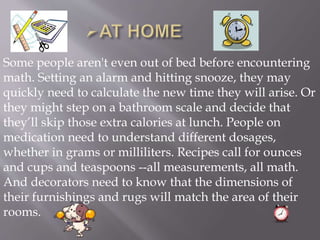
Some people aren't even out of bed before encountering
math. Setting an alarm and hitting snooze, they may
quickly need to calculate the new time they will arise. Or
they might step on a bathroom scale and decide that
they’ll skip those extra calories at lunch. People on
medication need to understand different dosages,
whether in grams or milliliters. Recipes call for ounces
and cups and teaspoons --all measurements, all math.
And decorators need to know that the dimensions of
their furnishings and rugs will match the area of their
rooms.
Travelers often consider their miles-per-gallon
when fueling up for daily trips, but they might
need to calculate anew when faced with
obstructionist detours and consider the cost in
miles, time and money. Air travelers need to know
departure times and arrival schedules. They also
need to know the weight of their luggage unless
they want to risk some hefty baggage surcharges.
Once on board, they might enjoy some common
aviation-related math such as speed, altitude and
flying time.
Students can’t avoid math -- most take it every day.
However, even in history and English classes they may
need to know a little math. Whether looking at time
expanses of decades, centuries or eras or calculating
how they’ll bring that B in English to an A, they’ll need
some basic math skills. Jobs in business and finance
may require sophisticated knowledge of how to read
profit and earning statements or how to decipher graph
analyses. However, even hourly earners will need to
know if their working hours times their rate of pay
accurately reflects their paychecks.
 Whether buying coffee or a car, basic principles
of math are in play. Purchasing decisions
require some understanding of budgets and the
cost and affordability of items from groceries to
houses. Short-term decisions may mean only
needing to know cash-at-hand, but bigger
purchases may require knowledge of interest
rates and amortization charts. Finding a
mortgage may be much different than choosing
a place to have lunch, but they both
cost money and require math.
Even off-time can be math time. Baseball
fans know a lot about statistics, whether
they’re considering basic win-loss ratios,
batting averages or pitchers' earned-run-
averages. Football fans know about yardage
gains and passing stats. And individual
athletes, whether runners, bikers, sailors or
hikers, often have their own ways of
charting their progress, from time to
mileage to elevation.
Generally we will use math while
playing games to count the score to
keep the time and many more are
there so we can’t skip math in our
life
FOLLWING CHAPTERS WE WILL USE IN OUR LIFE
1. TRIGNOMENTRY
2. FRACTIONS
3. SYMMENTRY
4. MESURMENTS
5. PROBABILITY
6. GEOMENTRY
7. PROBLEM SOLVING AND MANY MORE ARE THERE
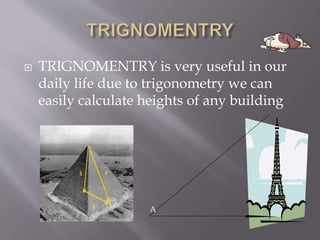
 TRIGNOMENTRY is very useful in our
daily life due to trigonometry we can
easily calculate heights of any building
A
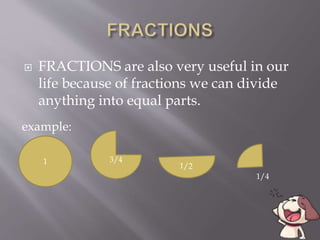
 FRACTIONS are also very useful in our
life because of fractions we can divide
anything into equal parts.
1 3/4
example:
1/4
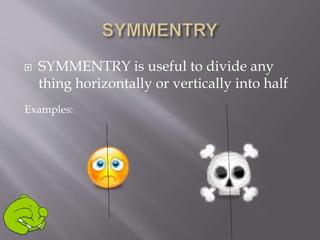
 SYMMENTRY is useful to divide any
thing horizontally or vertically into half
Examples:
 MESURMENTS are used to measure
distances and many more everyday we
will use measurements in our life
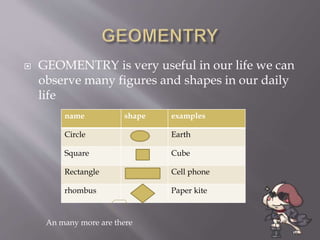
 GEOMENTRY is very useful in our life we can
observe many figures and shapes in our daily
life
name shape examples
Circle Earth
Square Cube
Rectangle Cell phone
rhombus Paper kite
An many more are there
 PROBLEM SOLVING is one of the very useful
chapter we use in our daily life problem
solving is use to do daily calculations
regarding money ,food and many more
From these we can learn that
math very useful in our life
 Done by B.Jaya Shankar
 Class-9th section -A
 School-sri chaitnaya school

Math in our daily life

  • 2.
    the abstract scienceof number, quantity, and space, either as abstract concepts , or as applied to other disciplines such as physics and engineering
  • 3.
    WE WILL USEMATH EVERY WHERE AND ANYTIME
  • 4.
    Some people aren'teven out of bed before encountering math. Setting an alarm and hitting snooze, they may quickly need to calculate the new time they will arise. Or they might step on a bathroom scale and decide that they’ll skip those extra calories at lunch. People on medication need to understand different dosages, whether in grams or milliliters. Recipes call for ounces and cups and teaspoons --all measurements, all math. And decorators need to know that the dimensions of their furnishings and rugs will match the area of their rooms.
  • 5.
    Travelers often considertheir miles-per-gallon when fueling up for daily trips, but they might need to calculate anew when faced with obstructionist detours and consider the cost in miles, time and money. Air travelers need to know departure times and arrival schedules. They also need to know the weight of their luggage unless they want to risk some hefty baggage surcharges. Once on board, they might enjoy some common aviation-related math such as speed, altitude and flying time.
  • 6.
    Students can’t avoidmath -- most take it every day. However, even in history and English classes they may need to know a little math. Whether looking at time expanses of decades, centuries or eras or calculating how they’ll bring that B in English to an A, they’ll need some basic math skills. Jobs in business and finance may require sophisticated knowledge of how to read profit and earning statements or how to decipher graph analyses. However, even hourly earners will need to know if their working hours times their rate of pay accurately reflects their paychecks.
  • 7.
     Whether buyingcoffee or a car, basic principles of math are in play. Purchasing decisions require some understanding of budgets and the cost and affordability of items from groceries to houses. Short-term decisions may mean only needing to know cash-at-hand, but bigger purchases may require knowledge of interest rates and amortization charts. Finding a mortgage may be much different than choosing a place to have lunch, but they both cost money and require math.
  • 8.
    Even off-time canbe math time. Baseball fans know a lot about statistics, whether they’re considering basic win-loss ratios, batting averages or pitchers' earned-run- averages. Football fans know about yardage gains and passing stats. And individual athletes, whether runners, bikers, sailors or hikers, often have their own ways of charting their progress, from time to mileage to elevation.
  • 9.
    Generally we willuse math while playing games to count the score to keep the time and many more are there so we can’t skip math in our life
  • 10.
    FOLLWING CHAPTERS WEWILL USE IN OUR LIFE 1. TRIGNOMENTRY 2. FRACTIONS 3. SYMMENTRY 4. MESURMENTS 5. PROBABILITY 6. GEOMENTRY 7. PROBLEM SOLVING AND MANY MORE ARE THERE
  • 11.
     TRIGNOMENTRY isvery useful in our daily life due to trigonometry we can easily calculate heights of any building A
  • 12.
     FRACTIONS arealso very useful in our life because of fractions we can divide anything into equal parts. 1 3/4 example: 1/4
  • 13.
     SYMMENTRY isuseful to divide any thing horizontally or vertically into half Examples:
  • 14.
     MESURMENTS areused to measure distances and many more everyday we will use measurements in our life
  • 15.
     GEOMENTRY isvery useful in our life we can observe many figures and shapes in our daily life name shape examples Circle Earth Square Cube Rectangle Cell phone rhombus Paper kite An many more are there
  • 16.
     PROBLEM SOLVINGis one of the very useful chapter we use in our daily life problem solving is use to do daily calculations regarding money ,food and many more
  • 17.
    From these wecan learn that math very useful in our life  Done by B.Jaya Shankar  Class-9th section -A  School-sri chaitnaya school