Human
Development
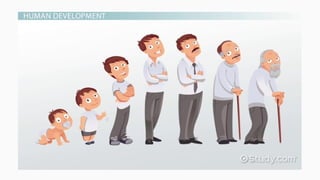
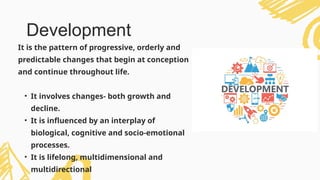
It is the pattern of progressive, orderly and
predictable changes that begin at conception
and continue throughout life.
• It involves changes- both growth and
decline.
• It is influenced by an interplay of
biological, cognitive and socio-emotional
processes.
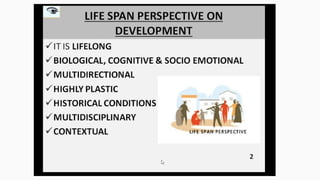
• It is lifelong, multidimensional and
multidirectional
Development
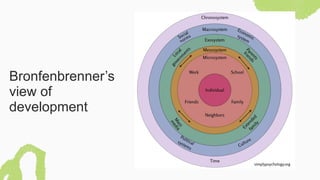
Bronfenbrenner’s
view of
development
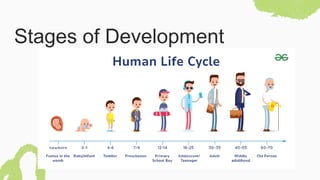
Stages of Development
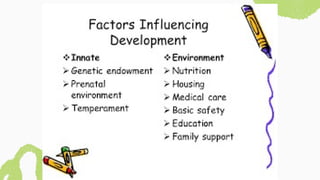
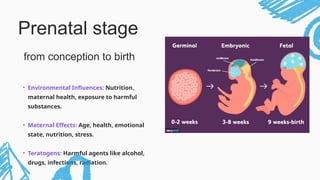
• Environmental Influences: Nutrition,
maternal health, exposure to harmful
substances.
• Maternal Effects: Age, health, emotional
state, nutrition, stress.
• Teratogens: Harmful agents like alcohol,
drugs, infections, radiation.
Prenatal stage
from conception to birth
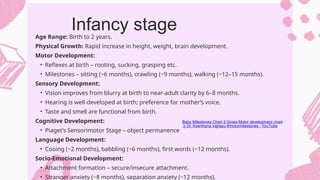
Age Range: Birth to 2 years.
Physical Growth: Rapid increase in height, weight, brain development.
Motor Development:
• Reflexes at birth – rooting, sucking, grasping etc.
• Milestones – sitting (~6 months), crawling (~9 months), walking (~12–15 months).
Sensory Development:
• Vision improves from blurry at birth to near-adult clarity by 6–8 months.
• Hearing is well-developed at birth; preference for mother’s voice.
• Taste and smell are functional from birth.
Cognitive Development:
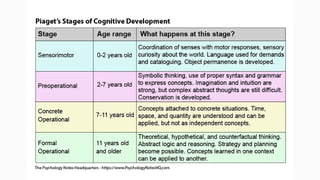
• Piaget’s Sensorimotor Stage – object permanence
Language Development:
• Cooing (~2 months), babbling (~6 months), first words (~12 months).
Socio-Emotional Development:
• Attachment formation – secure/insecure attachment.
• Stranger anxiety (~8 months), separation anxiety (~12 months).
Infancy stage
Baby Milestones Chart || Gross Motor development chart
|| Dr. Keerthana Vajrapu #motormilestones - YouTube
Infancy stage
Object Permanence
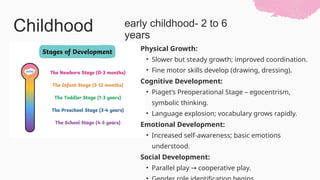
Physical Growth:
• Slower but steady growth; improved coordination.
• Fine motor skills develop (drawing, dressing).
Cognitive Development:
• Piaget’s Preoperational Stage – egocentrism,
symbolic thinking.
• Language explosion; vocabulary grows rapidly.
Emotional Development:
• Increased self-awareness; basic emotions
understood.
Social Development:
• Parallel play cooperative play.
→
Childhood early childhood- 2 to 6
years
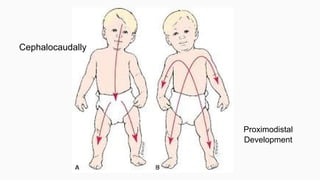
Cephalocaudally
Proximodistal
Development
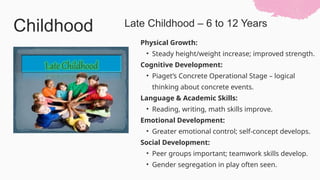
Physical Growth:
• Steady height/weight increase; improved strength.
Cognitive Development:
• Piaget’s Concrete Operational Stage – logical
thinking about concrete events.
Language & Academic Skills:
• Reading, writing, math skills improve.
Emotional Development:
• Greater emotional control; self-concept develops.
Social Development:
• Peer groups important; teamwork skills develop.
• Gender segregation in play often seen.
Childhood Late Childhood – 6 to 12 Years
Adolescence is the transitional stage of
physical and psychological development
between childhood and adulthood,
typically occurring from ages 10 to 19.
This period is characterized by significant
physical changes, including puberty, as
well as cognitive, social, and emotional
development. Adolescents also
experience shifts in their social roles,
relationships, and expectations as they
navigate towards adulthood
Adolescence
https://youtu.be/Nw2yHKxrj7o
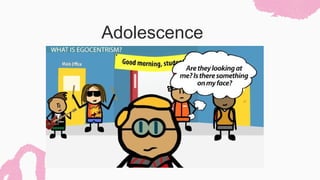
Adolescence
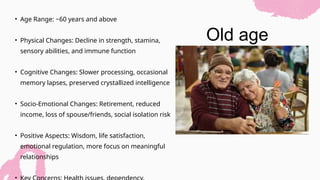
Old age
• Age Range: ~60 years and above
• Physical Changes: Decline in strength, stamina,
sensory abilities, and immune function
• Cognitive Changes: Slower processing, occasional
memory lapses, preserved crystallized intelligence
• Socio-Emotional Changes: Retirement, reduced
income, loss of spouse/friends, social isolation risk
• Positive Aspects: Wisdom, life satisfaction,
emotional regulation, more focus on meaningful
relationships
•
Thank you
very much

Presentation for Chapter-3 Human Development

  • 1.
  • 3.
    It is thepattern of progressive, orderly and predictable changes that begin at conception and continue throughout life. • It involves changes- both growth and decline. • It is influenced by an interplay of biological, cognitive and socio-emotional processes. • It is lifelong, multidimensional and multidirectional Development
  • 6.
  • 7.
  • 8.
    • Environmental Influences:Nutrition, maternal health, exposure to harmful substances. • Maternal Effects: Age, health, emotional state, nutrition, stress. • Teratogens: Harmful agents like alcohol, drugs, infections, radiation. Prenatal stage from conception to birth
  • 10.
    Age Range: Birthto 2 years. Physical Growth: Rapid increase in height, weight, brain development. Motor Development: • Reflexes at birth – rooting, sucking, grasping etc. • Milestones – sitting (~6 months), crawling (~9 months), walking (~12–15 months). Sensory Development: • Vision improves from blurry at birth to near-adult clarity by 6–8 months. • Hearing is well-developed at birth; preference for mother’s voice. • Taste and smell are functional from birth. Cognitive Development: • Piaget’s Sensorimotor Stage – object permanence Language Development: • Cooing (~2 months), babbling (~6 months), first words (~12 months). Socio-Emotional Development: • Attachment formation – secure/insecure attachment. • Stranger anxiety (~8 months), separation anxiety (~12 months). Infancy stage Baby Milestones Chart || Gross Motor development chart || Dr. Keerthana Vajrapu #motormilestones - YouTube
  • 11.
  • 12.
    Physical Growth: • Slowerbut steady growth; improved coordination. • Fine motor skills develop (drawing, dressing). Cognitive Development: • Piaget’s Preoperational Stage – egocentrism, symbolic thinking. • Language explosion; vocabulary grows rapidly. Emotional Development: • Increased self-awareness; basic emotions understood. Social Development: • Parallel play cooperative play. → Childhood early childhood- 2 to 6 years
  • 13.
  • 14.
    Physical Growth: • Steadyheight/weight increase; improved strength. Cognitive Development: • Piaget’s Concrete Operational Stage – logical thinking about concrete events. Language & Academic Skills: • Reading, writing, math skills improve. Emotional Development: • Greater emotional control; self-concept develops. Social Development: • Peer groups important; teamwork skills develop. • Gender segregation in play often seen. Childhood Late Childhood – 6 to 12 Years
  • 15.
    Adolescence is thetransitional stage of physical and psychological development between childhood and adulthood, typically occurring from ages 10 to 19. This period is characterized by significant physical changes, including puberty, as well as cognitive, social, and emotional development. Adolescents also experience shifts in their social roles, relationships, and expectations as they navigate towards adulthood Adolescence https://youtu.be/Nw2yHKxrj7o
  • 16.
  • 18.
    Old age • AgeRange: ~60 years and above • Physical Changes: Decline in strength, stamina, sensory abilities, and immune function • Cognitive Changes: Slower processing, occasional memory lapses, preserved crystallized intelligence • Socio-Emotional Changes: Retirement, reduced income, loss of spouse/friends, social isolation risk • Positive Aspects: Wisdom, life satisfaction, emotional regulation, more focus on meaningful relationships •

  • 19.