FINANCING FOR DEVELOPMENT-
THE ROLE OF MICROFINANCE IN
GHANA
WHAT IS MICROFINANCE:
• Microfinance, according to Otero (1999, p.8) is “the provision of financial
services to low-income poor and very poor self-employed people”.
• Schreiner and Colombet (2001, p.339) define microfinance as “the attempt
to improve access to small deposits and small loans for poor households
neglected by banks.”
BRIEF HISTORY OF MICROFINANCE
• Microcredit and microfinance are relatively new terms in the field of
development, first coming to prominence in the 1970s, according to
Robinson (2001) and Otero (1999). Prior to then, from the 1950s through to
the 1970s, the provision of financial services by donors or governments was
mainly inthe form of subsidised rural credit programmes. These often
resulted in high loan defaults, high loses and an inability to reach poor rural
households (Robinson, 2001).
Microfinance and its impact in development
• Microfinance has a very important role to play in development according to
proponents of microfinance. UNCDF (2004) states that studies have shown
that microfinance plays three key roles in development.
• It: helps very poor households meet basic needs and protects against risks,
• is associated with improvements in household economic welfare,
• helps to empower women by supporting women’s economic participation
and so promotes gender equity.
Microfinance and its impact in
development cont’d
Otero (1999, p.10) illustrates the
various ways in which “microfinance,
at its core combats poverty 8”. She
states that microfinance creates access
to productive capital for the poor,
which together with human capital,
addressed through education and
Microfinance and its impact in
development cont’d
training, and social capital, achieved through local
organisation building, enables people to move out
of poverty (1999). By providing material capital to
a poor person, their sense of dignity is
strengthened and this can help to empower the
person to participate in the economy and society
(Otero, 1999)
).
CHALLENGES OF MICROFINANCE
IN GHANA
Institutional Arrangement
• Capacity Building
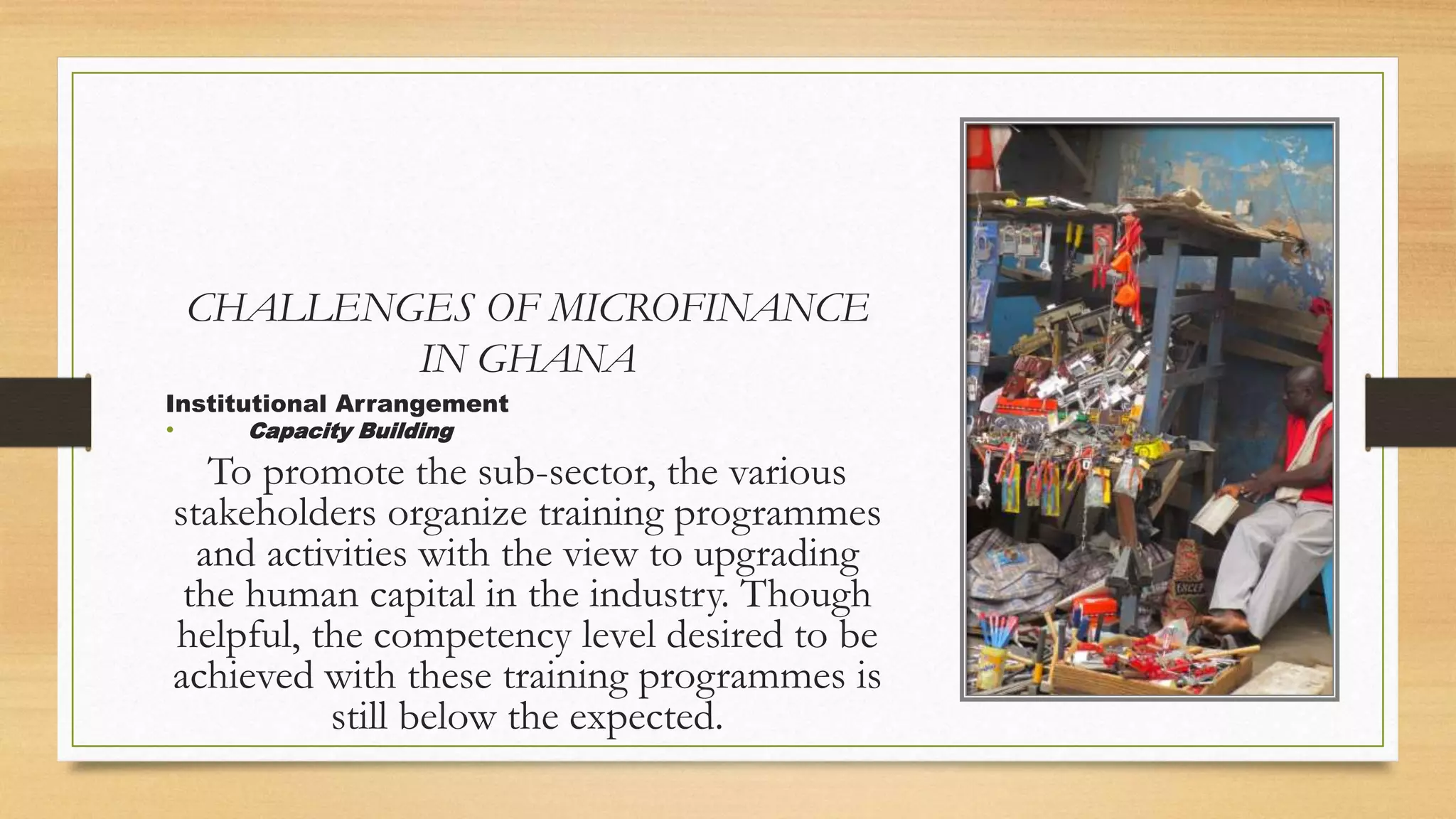
To promote the sub-sector, the various
stakeholders organize training programmes
and activities with the view to upgrading
the human capital in the industry. Though
helpful, the competency level desired to be
achieved with these training programmes is
still below the expected.
CHALLENGES CONT’D
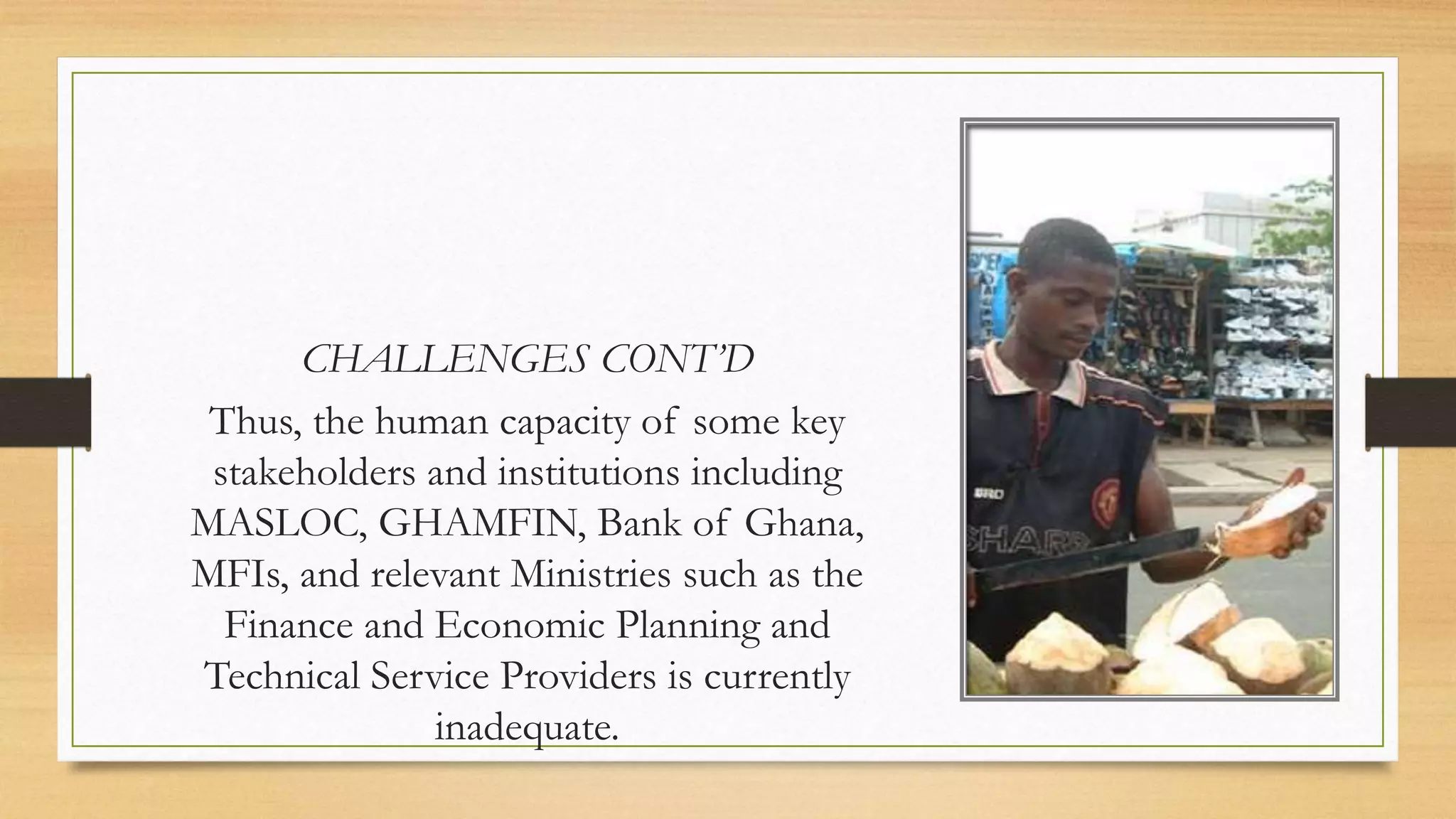
Thus, the human capacity of some key
stakeholders and institutions including
MASLOC, GHAMFIN, Bank of Ghana,
MFIs, and relevant Ministries such as the
Finance and Economic Planning and
Technical Service Providers is currently
inadequate.
CHALLENGES CONT’D
The random and incoherent nature of
training programmes has also hampered the
achievements of the projected gains for the
sub-sector. The flaw in the human capacity
of all the stakeholders has had a rippling
effect on the governance and structure of
the industry.
CHALLENGES CONT’D
Furthermore, the current Microfinance Apex
bodies lack adequate cadre of in-house trainers
and/or facilitators as well as in-house monitoring
and evaluation units to continually measure
progress of their activities consistently overtime.
CHALLENGES CONT’D
Infrastructure
Infrastructural capacity in the sub-sector is yet to
be developed around an integrated and holistic
logistical support and internal operating systems.
CHALLENGES CONT’D
Funding
Funding for the sub-sector has been from three sources: the institutions
themselves, government and development partners. Firstly, available
funds do not seem to be adequate to meet demand and secondly, the
varying sources come with their conditions, distorting the market in
some cases. There is also no microfinance fund to which MFIs can
apply for on-lending and capacity building support.
Credit Delivery and Management
Credit Delivery Mechanisms
The current strategies for credit
delivery are not adequately
diversified and inefficient, and
therefore, unable to meet the
varying demands of the market.
Classifying target groups
The objective of the microfinance is
to provide resources for the poor.
Nonetheless, there is yet to be
adequate, reliable and acceptable
methods for classifying varied poverty
levels to enhance the categorization
of potential and actual MFI clients.
Credit Delivery and Management
Cont’d
• People with disabilities
People with disabilities and differently-
abled do not have designed products to
meet their needs and are also not
adequately served by existing
microfinance funds and services. The
necessary skills training for this target
group is currently non-existent.
• Women
The existing skills training and funding
arrangements for women do not seem to be
market-driven. Thus, specific services and
products that target women for
entrepreneurship development to enable
them engage in economic activities and
become more self-reliant are inadequate and
incoherent.
Way Forward
• Relationships and roles must be clearly defined to enhance effective
implementation and delivery of services
• Central Microfinance Fund could be established to provide on-
lending and/or capacity building support. The experience of the RFSP
Training Fund should be built upon
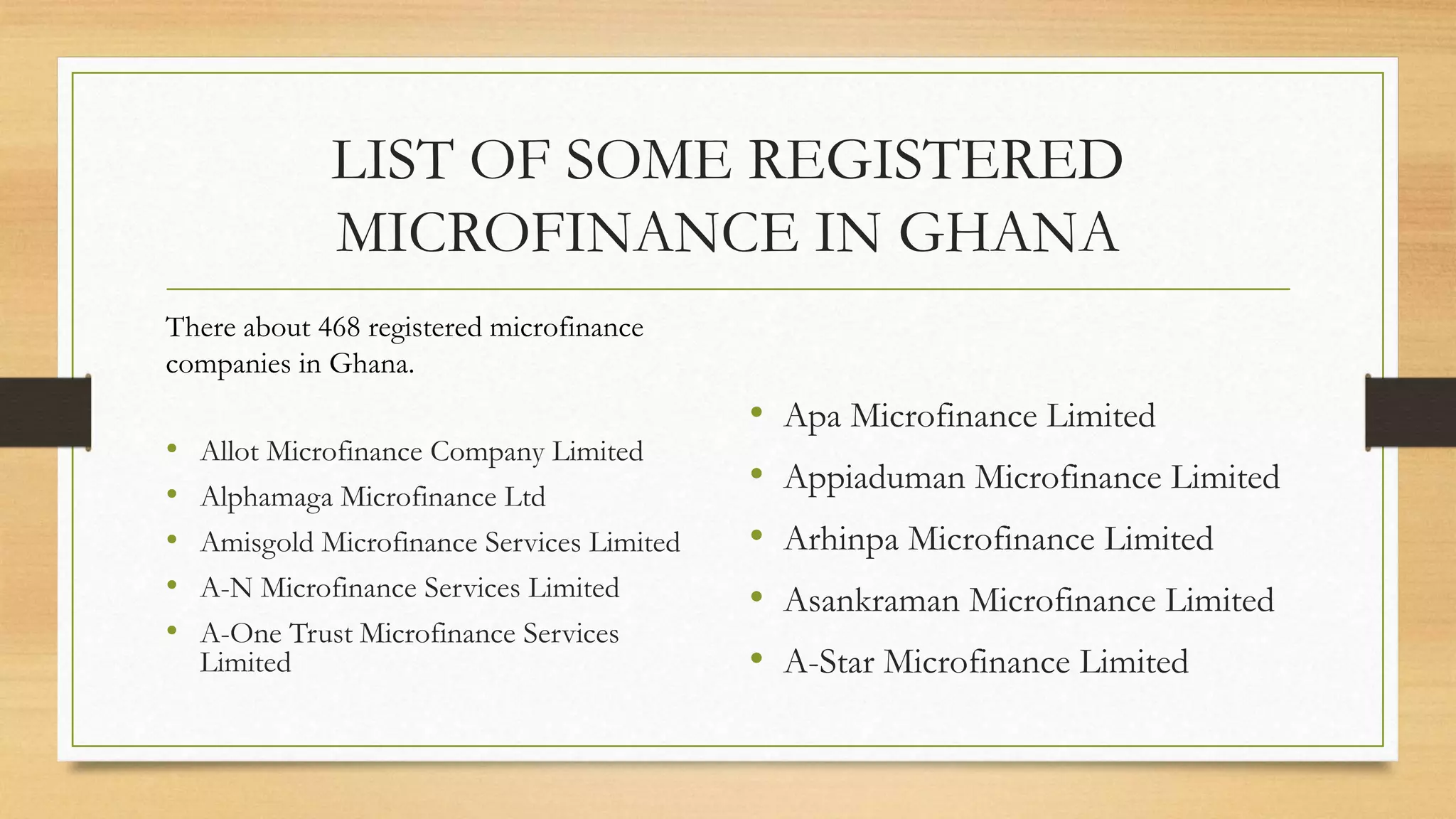
LIST OF SOME REGISTERED
MICROFINANCE IN GHANA
There about 468 registered microfinance
companies in Ghana.
• Allot Microfinance Company Limited
• Alphamaga Microfinance Ltd
• Amisgold Microfinance Services Limited
• A-N Microfinance Services Limited
• A-One Trust Microfinance Services
Limited
• Apa Microfinance Limited
• Appiaduman Microfinance Limited
• Arhinpa Microfinance Limited
• Asankraman Microfinance Limited
• A-Star Microfinance Limited
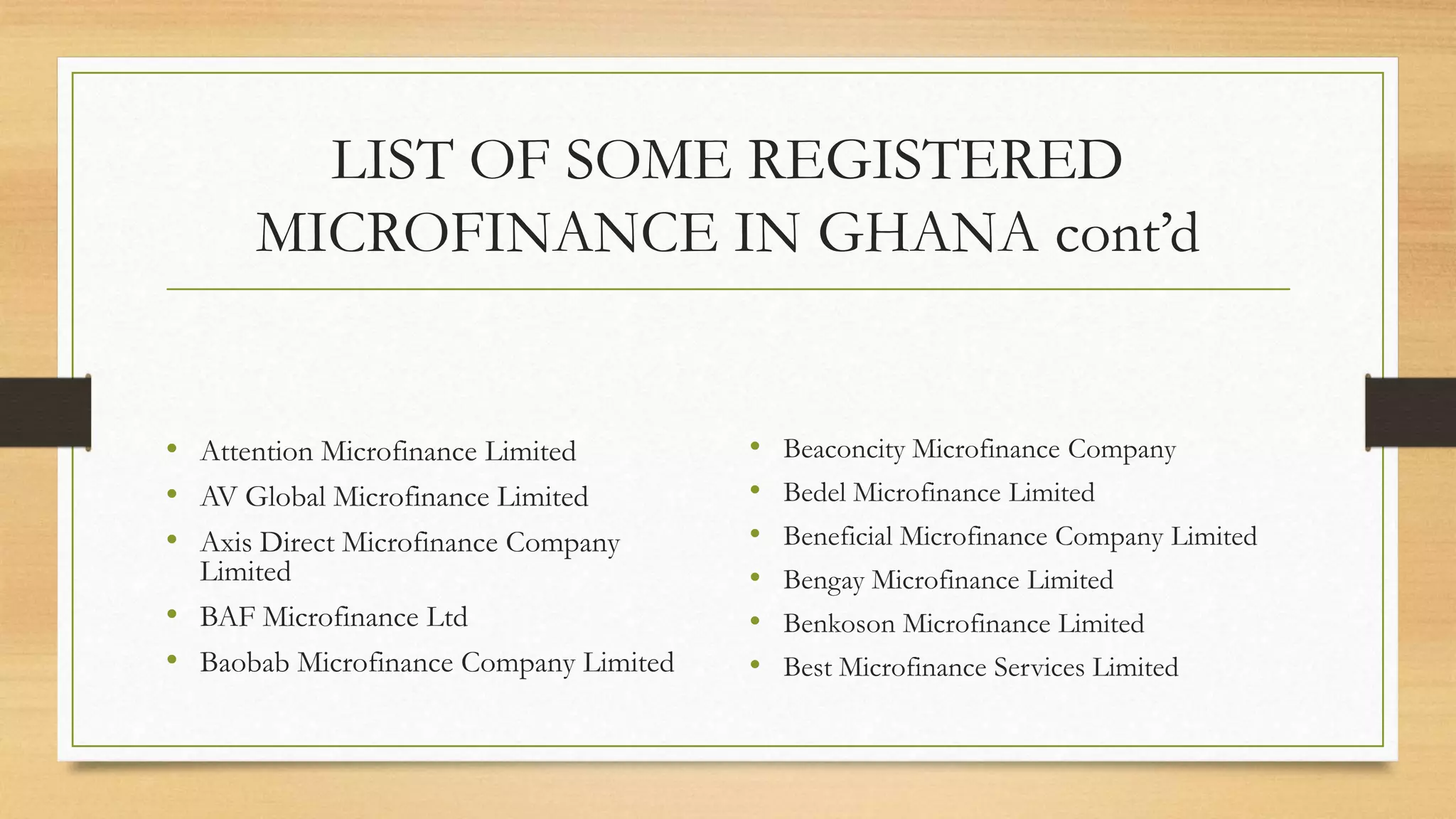
LIST OF SOME REGISTERED
MICROFINANCE IN GHANA cont’d
• Attention Microfinance Limited
• AV Global Microfinance Limited
• Axis Direct Microfinance Company
Limited
• BAF Microfinance Ltd
• Baobab Microfinance Company Limited
• Beaconcity Microfinance Company
• Bedel Microfinance Limited
• Beneficial Microfinance Company Limited
• Bengay Microfinance Limited
• Benkoson Microfinance Limited
• Best Microfinance Services Limited
THANK YOU

Presentation fin4 dev role of microfinance in ghana

  • 1.
    FINANCING FOR DEVELOPMENT- THEROLE OF MICROFINANCE IN GHANA
  • 2.
    WHAT IS MICROFINANCE: •Microfinance, according to Otero (1999, p.8) is “the provision of financial services to low-income poor and very poor self-employed people”. • Schreiner and Colombet (2001, p.339) define microfinance as “the attempt to improve access to small deposits and small loans for poor households neglected by banks.”
  • 3.
    BRIEF HISTORY OFMICROFINANCE • Microcredit and microfinance are relatively new terms in the field of development, first coming to prominence in the 1970s, according to Robinson (2001) and Otero (1999). Prior to then, from the 1950s through to the 1970s, the provision of financial services by donors or governments was mainly inthe form of subsidised rural credit programmes. These often resulted in high loan defaults, high loses and an inability to reach poor rural households (Robinson, 2001).
  • 4.
    Microfinance and itsimpact in development • Microfinance has a very important role to play in development according to proponents of microfinance. UNCDF (2004) states that studies have shown that microfinance plays three key roles in development. • It: helps very poor households meet basic needs and protects against risks, • is associated with improvements in household economic welfare, • helps to empower women by supporting women’s economic participation and so promotes gender equity.
  • 5.
    Microfinance and itsimpact in development cont’d Otero (1999, p.10) illustrates the various ways in which “microfinance, at its core combats poverty 8”. She states that microfinance creates access to productive capital for the poor, which together with human capital, addressed through education and
  • 6.
    Microfinance and itsimpact in development cont’d training, and social capital, achieved through local organisation building, enables people to move out of poverty (1999). By providing material capital to a poor person, their sense of dignity is strengthened and this can help to empower the person to participate in the economy and society (Otero, 1999) ).
  • 7.
    CHALLENGES OF MICROFINANCE INGHANA Institutional Arrangement • Capacity Building To promote the sub-sector, the various stakeholders organize training programmes and activities with the view to upgrading the human capital in the industry. Though helpful, the competency level desired to be achieved with these training programmes is still below the expected.
  • 8.
    CHALLENGES CONT’D Thus, thehuman capacity of some key stakeholders and institutions including MASLOC, GHAMFIN, Bank of Ghana, MFIs, and relevant Ministries such as the Finance and Economic Planning and Technical Service Providers is currently inadequate.
  • 9.
    CHALLENGES CONT’D The randomand incoherent nature of training programmes has also hampered the achievements of the projected gains for the sub-sector. The flaw in the human capacity of all the stakeholders has had a rippling effect on the governance and structure of the industry.
  • 10.
    CHALLENGES CONT’D Furthermore, thecurrent Microfinance Apex bodies lack adequate cadre of in-house trainers and/or facilitators as well as in-house monitoring and evaluation units to continually measure progress of their activities consistently overtime.
  • 11.
    CHALLENGES CONT’D Infrastructure Infrastructural capacityin the sub-sector is yet to be developed around an integrated and holistic logistical support and internal operating systems.
  • 12.
    CHALLENGES CONT’D Funding Funding forthe sub-sector has been from three sources: the institutions themselves, government and development partners. Firstly, available funds do not seem to be adequate to meet demand and secondly, the varying sources come with their conditions, distorting the market in some cases. There is also no microfinance fund to which MFIs can apply for on-lending and capacity building support.
  • 13.
    Credit Delivery andManagement Credit Delivery Mechanisms The current strategies for credit delivery are not adequately diversified and inefficient, and therefore, unable to meet the varying demands of the market. Classifying target groups The objective of the microfinance is to provide resources for the poor. Nonetheless, there is yet to be adequate, reliable and acceptable methods for classifying varied poverty levels to enhance the categorization of potential and actual MFI clients.
  • 14.
    Credit Delivery andManagement Cont’d • People with disabilities People with disabilities and differently- abled do not have designed products to meet their needs and are also not adequately served by existing microfinance funds and services. The necessary skills training for this target group is currently non-existent. • Women The existing skills training and funding arrangements for women do not seem to be market-driven. Thus, specific services and products that target women for entrepreneurship development to enable them engage in economic activities and become more self-reliant are inadequate and incoherent.
  • 15.
    Way Forward • Relationshipsand roles must be clearly defined to enhance effective implementation and delivery of services • Central Microfinance Fund could be established to provide on- lending and/or capacity building support. The experience of the RFSP Training Fund should be built upon
  • 16.
    LIST OF SOMEREGISTERED MICROFINANCE IN GHANA There about 468 registered microfinance companies in Ghana. • Allot Microfinance Company Limited • Alphamaga Microfinance Ltd • Amisgold Microfinance Services Limited • A-N Microfinance Services Limited • A-One Trust Microfinance Services Limited • Apa Microfinance Limited • Appiaduman Microfinance Limited • Arhinpa Microfinance Limited • Asankraman Microfinance Limited • A-Star Microfinance Limited
  • 17.
    LIST OF SOMEREGISTERED MICROFINANCE IN GHANA cont’d • Attention Microfinance Limited • AV Global Microfinance Limited • Axis Direct Microfinance Company Limited • BAF Microfinance Ltd • Baobab Microfinance Company Limited • Beaconcity Microfinance Company • Bedel Microfinance Limited • Beneficial Microfinance Company Limited • Bengay Microfinance Limited • Benkoson Microfinance Limited • Best Microfinance Services Limited
  • 18.