International AIDS Conference 2010 Learning Tools for Intervention Recommendations presented by  TREVVY
“ The Big Picture” Globally, 33.4 million people living with HIV. 40% are young people. Achieving Universal Access & replenishing Global Fund (at least $20 billion dollars) are crucial. “ Rights Here, Right Now” - Criminalisation of HIV, same sex relationships & sex workers needs to be abolished for HIV prevention to be truly effective.
Human Rights & MSM
Learning Human Rights & MSM Human rights violations and punitive laws against MSM have multiple negative consequences: affecting mental health, social relations, behaviour and access to health services. Implications: Increased depression/suicidal thought Increased stigma/self-stigmatisation Decreased access to condoms/lubricant Increased fear to access services/commodities Disruptions in HIV services Decline in medical visits by MSM, including ART interruptions
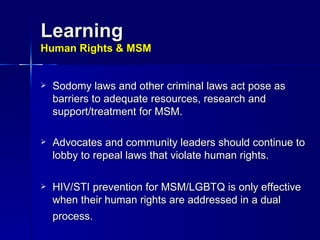
Learning Human Rights & MSM Sodomy laws and other criminal laws act pose as barriers to adequate resources, research and support/treatment for MSM. Advocates and community leaders should continue to lobby to repeal laws that violate human rights. HIV/STI prevention for MSM/LGBTQ is only effective when their human rights are addressed in a dual process.
Youth Perspectives
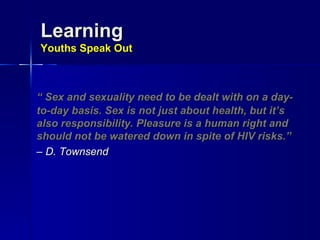
Learning Youths Speak Out “  Sex and sexuality need to be dealt with on a day-to-day basis. Sex is not just about health, but it’s also responsibility. Pleasure is a human right and should not be watered down in spite of HIV risks.”   –  D. Townsend
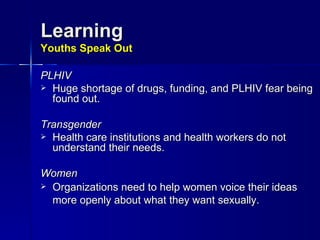
Learning Youths Speak Out PLHIV Huge shortage of drugs, funding, and PLHIV fear being found out. Transgender  Health care institutions and health workers do not understand their needs. Women Organizations need to help women voice their ideas more openly about what they want sexually.
Tools for Intervention
Tools for Intervention Medical Intervention: Anti-HIV Drugs for Prevention Old preventive measures such as influencing sexual behaviours and using condoms, and even circumcision on some extent, do contribute to fighting the HIV epidemic but it’s also important that we consider anti-HIV drugs as a new prevention method. 100% condom use is hard to achieve realistically.  As such, ART is potentially more effective when used with other prevention methods. Studies done in Africa on HAART show that it has a marked additional effect when used in combination with condoms in serodiscordant heterosexual couples.
Tools for Intervention  Social Intervention Animation   Effective HIV prevention strategy to engage the target audience. Video Testimonials   Powerful tool for social change in attitudes & behaviours through lived experiences of young PLHIV.  Video Advocacy Complementary advocacy tool to drive changes in policies and practices.
Tools for Intervention  Social Intervention Individual to community level: Training POL (Popular Opinion Leader) initiatives Community events Stigma reduction campaigns Printed collaterals Distribution of condoms and lubricants
Tools for Intervention  Social Intervention Non community MSM: Internet-based communication: viral Resource website Newsletter SMS Online counselling Online outreach Support for HIV+ MSM: Peer support Group empowerment Participation with non-infected MSM
Recommendations
Recommendations Youths Partnerships between young people and established leaders in the process of decision and policy making, implementation and evaluation of programmes.  Donors need clear strategies to address young people’s needs in HIV prevention, treatment and health care support. Training and capacity building of young people is crucial to the sustainability of youth programmes.
Recommendations MSM Need to incorporate human rights in HIV/STI prevention programmes. Adopting combination prevention strategies that address multiple levels of risk. MSM interventions should include the treatment of HIV positive MSM, as well as the extension of the antiretrovirals to all MSM as needed.

Presentation by Kenny, Trevvy

  • 1.
    International AIDS Conference2010 Learning Tools for Intervention Recommendations presented by TREVVY
  • 2.
    “ The BigPicture” Globally, 33.4 million people living with HIV. 40% are young people. Achieving Universal Access & replenishing Global Fund (at least $20 billion dollars) are crucial. “ Rights Here, Right Now” - Criminalisation of HIV, same sex relationships & sex workers needs to be abolished for HIV prevention to be truly effective.
  • 3.
  • 4.
    Learning Human Rights& MSM Human rights violations and punitive laws against MSM have multiple negative consequences: affecting mental health, social relations, behaviour and access to health services. Implications: Increased depression/suicidal thought Increased stigma/self-stigmatisation Decreased access to condoms/lubricant Increased fear to access services/commodities Disruptions in HIV services Decline in medical visits by MSM, including ART interruptions
  • 5.
    Learning Human Rights& MSM Sodomy laws and other criminal laws act pose as barriers to adequate resources, research and support/treatment for MSM. Advocates and community leaders should continue to lobby to repeal laws that violate human rights. HIV/STI prevention for MSM/LGBTQ is only effective when their human rights are addressed in a dual process.
  • 6.
  • 7.
    Learning Youths SpeakOut “ Sex and sexuality need to be dealt with on a day-to-day basis. Sex is not just about health, but it’s also responsibility. Pleasure is a human right and should not be watered down in spite of HIV risks.” – D. Townsend
  • 8.
    Learning Youths SpeakOut PLHIV Huge shortage of drugs, funding, and PLHIV fear being found out. Transgender Health care institutions and health workers do not understand their needs. Women Organizations need to help women voice their ideas more openly about what they want sexually.
  • 9.
  • 10.
    Tools for InterventionMedical Intervention: Anti-HIV Drugs for Prevention Old preventive measures such as influencing sexual behaviours and using condoms, and even circumcision on some extent, do contribute to fighting the HIV epidemic but it’s also important that we consider anti-HIV drugs as a new prevention method. 100% condom use is hard to achieve realistically. As such, ART is potentially more effective when used with other prevention methods. Studies done in Africa on HAART show that it has a marked additional effect when used in combination with condoms in serodiscordant heterosexual couples.
  • 11.
    Tools for Intervention Social Intervention Animation Effective HIV prevention strategy to engage the target audience. Video Testimonials Powerful tool for social change in attitudes & behaviours through lived experiences of young PLHIV. Video Advocacy Complementary advocacy tool to drive changes in policies and practices.
  • 12.
    Tools for Intervention Social Intervention Individual to community level: Training POL (Popular Opinion Leader) initiatives Community events Stigma reduction campaigns Printed collaterals Distribution of condoms and lubricants
  • 13.
    Tools for Intervention Social Intervention Non community MSM: Internet-based communication: viral Resource website Newsletter SMS Online counselling Online outreach Support for HIV+ MSM: Peer support Group empowerment Participation with non-infected MSM
  • 14.
  • 15.
    Recommendations Youths Partnershipsbetween young people and established leaders in the process of decision and policy making, implementation and evaluation of programmes. Donors need clear strategies to address young people’s needs in HIV prevention, treatment and health care support. Training and capacity building of young people is crucial to the sustainability of youth programmes.
  • 16.
    Recommendations MSM Needto incorporate human rights in HIV/STI prevention programmes. Adopting combination prevention strategies that address multiple levels of risk. MSM interventions should include the treatment of HIV positive MSM, as well as the extension of the antiretrovirals to all MSM as needed.