Synthesis and Identification
of Anionic Foldamers for
Macromolecule Delivery
Brad DeMarco Sackler/REU
Miranker Research Group
Membrane Active Peptides
IAPP
• Involved in Type II Diabetes
• Passes through cell membranes
• Toxic To Cells
Cell Penetrating
Peptides
• Non-toxic
• Studied as cargo transporters
Membrane Active Peptides
IAPP
• Involved in Type II Diabetes
• Passes through cell membranes
• Toxic To Cells
Cell Penetrating
Peptides
• Non-toxic
• Studied as cargo transporters
Our Project
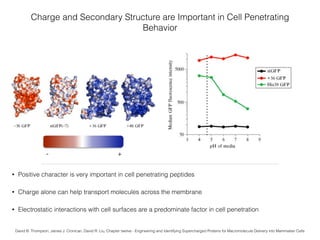
Charge and Secondary Structure are Important in Cell Penetrating
Behavior
David B. Thompson, James J. Cronican, David R. Liu, Chapter twelve - Engineering and Identifying Supercharged Proteins for Macromolecule Delivery into Mammalian Cells
• Positive character is very important in cell penetrating peptides
• Charge alone can help transport molecules across the membrane
• Electrostatic interactions with cell surfaces are a predominate factor in cell penetration
- +
Folding is Equally Important in Cell Penetration
Martín, I., Teixidó, M. & Giralt , E. Design, Synthesis and Characterization of a New Anionic Cell‐Penetrating Peptide: SAP(E). ChemBioChem 12, 896–903 (2011).
• Secondary structure is also directly responsible for the penetrating ability of a
molecule
• High helical propensities relate to its ability to cross membranes
ADM-116 Rescues IAPP Toxicity Intracellularly
N
O
NH
N
O
NH O
O
N
O
NH O
N
O
O
O OH
O OH
CH3
CH3
NO2
OMe
• Inhibitor of IAPP
• Cell penetrating property is attributed to its folding behavior
• Takes a passive mode of diffusion
• Anionic
Dr. Melissa Birol
ADM-116
Building Monomeric Quinoline Units
NH2
NO2
O
CO2CH3N
H
NO2
CHCO2CH3
MeOH
CCO2CH3
HCCO2C
N
H
O
NO2
COOMe
N
H
O
NO2
COOMe
N
NO2
O
OtBu
O
COOMe N
NO2
O
OtBu
O
COOH
N
NO2
O
OtBu
O
COOH
HO Br
N
NO2
O
OtBu
O
O
O
Br N
NH2
O
OtBu
O
O
O
Br
N
H
O
NO2
COOMe N
NO2
O CH3
COOMe N
NO2
O CH3
COOH
1.) LiOH, THF
2.) Acetic Acid
DIAD, THF
Triphenyl Phosphine
Pd/C, H2 Atm
DIAD, THF, EtOH
Triphenyl Phosphine
1.) LiOH, THF
2.) Acetic Acid
BrCH2CO2tBu, Na2CO3
NaI
Acetone/DMF, 70°
Dr. Sunil Kumar
∆
95%
~90% 20%
60%~90%
~90%
95%
ADM-116 Azide Functionalized Analog
Quinoline Tetrameric Synthesis Scheme
Dr. Sunil Kumar
N
NH
O
OH
O
O
O
N3
N
NH
EtO
O
N
NH
O
O
HO O
N
NO2
EtO
O
ADM-158
N
NH2
O
OtBu
O
O
O
Br
N
NO2
EtO
COOH
N
NH
O
OtBu
O
O
O
Br
N
NO2
EtO
O
2-Chloro-1-Methylpyrridinum iodide
Triethylamine
Dichloromethane
+
Pd/C, H2 Atm
N
NH
O
OtBu
O
O
O
Br
N
NH2
EtO
O
1.) Dimer Formation and Reduction
ADM-116 Azide Functionalized Analog
Dr. Sunil Kumar
N
NH
O
OH
O
O
O
N3
N
NH
EtO
O
N
NH
O
O
HO O
N
NO2
EtO
O
ADM-158
N
NH
O
OtBu
O
O
O
Br
N
NH2
EtO
O
N
NO2
O
COOH
tBuO O
+
N
NH
O
OtBu
O
O
O
Br
N
NH
EtO
O
N
NO2
O
O
tBuO O
2-Chloro-1-Methylpyrridinum iodide
Triethylamine
Dichloromethane
Pd/C, H2 Atm
N
NH
O
OtBu
O
O
O
Br
N
NH
EtO
O
N
NH2
O
O
tBuO O
Quinoline Tetrameric Synthesis Scheme
2.) Trimer Formation and Reduction
ADM-116 Azide Functionalized Analog
Dr. Sunil Kumar
N
NH
O
OH
O
O
O
N3
N
NH
EtO
O
N
NH
O
O
HO O
N
NO2
EtO
O
ADM-158
N
NH
O
OtBu
O
O
O
Br
N
NH
EtO
O
N
NH2
O
O
tBuO O
N
NO2
EtO
COOH
+
2-Chloro-1-Methylpyrridinum iodide
Triethylamine
Dichloromethane
N
NH
O
OtBu
O
O
O
Br
N
NH
EtO
O
N
NH
O
O
tBuO O
N
NO2
EtO
O
Quinoline Tetrameric Synthesis Scheme
3.) Tetramer Synthesis and Reduction
ADM-116 Azide Functionalized Analog
Dr. Sunil Kumar
N
NH
O
OH
O
O
O
N3
N
NH
EtO
O
N
NH
O
O
HO O
N
NO2
EtO
O
ADM-158
N
NH
O
OtBu
O
O
O
Br
N
NH
EtO
O
N
NH
O
O
tBuO O
N
NO2
EtO
O
N
NH
O
OH
O
O
O
N3
N
NH
EtO
O
N
NH
O
O
HO O
N
NO2
EtO
O
DCM, TFA, TESNaN3, DMF,
Quinoline Tetrameric Synthesis Scheme
4.) Substitution and Deprotection
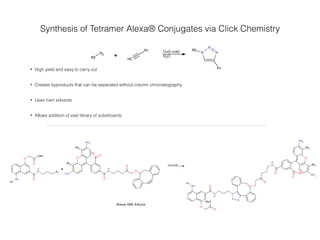
Synthesis of Tetramer Alexa® Conjugates via Click Chemistry
R2
N3
HC
R1
N
N N
R2
R1
+
Cu(I) (cat)
H2O
• High yield and easy to carry out
• Creates byproducts that can be separated without column chromatography
• Uses inert solvents
• Allows addition of vast library of substituents
NH
O
O
H
N N3
OtBu
O
R1
O
SO3
SO3
NH2
H2N
HO
O
O
H
N
O
O
O
O
H
N
O
O
OH
NH2
NH2
SO3
SO3
O
N
N
R1
O
tBuO
NH
O
O
N
H
N
+
Cu (I) Cat.
Alexa-488 Alkyne
Future Applications
R Groups
Alkyne Alexa 488 Fluor®
FAM-Oligonucleotides
FAM-Labelled Neutral Peptides (Gly-Ser)
FAM-Labelled Postive Peptides (His-Lys)
N
NH
O
OH
O
O
O
N
N
NH
EtO
O
N
NH
O
O
HO O
N
NO2
EtO
O
N
N
R
Future Applications
N
NH
O
OH
O
O
O
N
N
NH
EtO
O
N
NH
O
O
HO O
N
NO2
EtO
O
N
N
R
GPMV
• Allows for easy assay of successful cell penetration
• Possible fluors can be Alexa™ and Fluorescein alkyne nucleotide/peptide conjugates
(Large Vesicle From Cell Membranes)
Acknowledgements
• Sackler REU Program
• National Science Foundation
Dr. Sunil Kumar Professor Andrew Miranker
Miranker LabMentor

Presentation

  • 1.
    Synthesis and Identification ofAnionic Foldamers for Macromolecule Delivery Brad DeMarco Sackler/REU Miranker Research Group
  • 2.
    Membrane Active Peptides IAPP •Involved in Type II Diabetes • Passes through cell membranes • Toxic To Cells Cell Penetrating Peptides • Non-toxic • Studied as cargo transporters
  • 3.
    Membrane Active Peptides IAPP •Involved in Type II Diabetes • Passes through cell membranes • Toxic To Cells Cell Penetrating Peptides • Non-toxic • Studied as cargo transporters Our Project
  • 4.
    Charge and SecondaryStructure are Important in Cell Penetrating Behavior David B. Thompson, James J. Cronican, David R. Liu, Chapter twelve - Engineering and Identifying Supercharged Proteins for Macromolecule Delivery into Mammalian Cells • Positive character is very important in cell penetrating peptides • Charge alone can help transport molecules across the membrane • Electrostatic interactions with cell surfaces are a predominate factor in cell penetration - +
  • 5.
    Folding is EquallyImportant in Cell Penetration Martín, I., Teixidó, M. & Giralt , E. Design, Synthesis and Characterization of a New Anionic Cell‐Penetrating Peptide: SAP(E). ChemBioChem 12, 896–903 (2011). • Secondary structure is also directly responsible for the penetrating ability of a molecule • High helical propensities relate to its ability to cross membranes
  • 6.
    ADM-116 Rescues IAPPToxicity Intracellularly N O NH N O NH O O N O NH O N O O O OH O OH CH3 CH3 NO2 OMe • Inhibitor of IAPP • Cell penetrating property is attributed to its folding behavior • Takes a passive mode of diffusion • Anionic Dr. Melissa Birol ADM-116
  • 7.
    Building Monomeric QuinolineUnits NH2 NO2 O CO2CH3N H NO2 CHCO2CH3 MeOH CCO2CH3 HCCO2C N H O NO2 COOMe N H O NO2 COOMe N NO2 O OtBu O COOMe N NO2 O OtBu O COOH N NO2 O OtBu O COOH HO Br N NO2 O OtBu O O O Br N NH2 O OtBu O O O Br N H O NO2 COOMe N NO2 O CH3 COOMe N NO2 O CH3 COOH 1.) LiOH, THF 2.) Acetic Acid DIAD, THF Triphenyl Phosphine Pd/C, H2 Atm DIAD, THF, EtOH Triphenyl Phosphine 1.) LiOH, THF 2.) Acetic Acid BrCH2CO2tBu, Na2CO3 NaI Acetone/DMF, 70° Dr. Sunil Kumar ∆ 95% ~90% 20% 60%~90% ~90% 95%
  • 8.
    ADM-116 Azide FunctionalizedAnalog Quinoline Tetrameric Synthesis Scheme Dr. Sunil Kumar N NH O OH O O O N3 N NH EtO O N NH O O HO O N NO2 EtO O ADM-158 N NH2 O OtBu O O O Br N NO2 EtO COOH N NH O OtBu O O O Br N NO2 EtO O 2-Chloro-1-Methylpyrridinum iodide Triethylamine Dichloromethane + Pd/C, H2 Atm N NH O OtBu O O O Br N NH2 EtO O 1.) Dimer Formation and Reduction
  • 9.
    ADM-116 Azide FunctionalizedAnalog Dr. Sunil Kumar N NH O OH O O O N3 N NH EtO O N NH O O HO O N NO2 EtO O ADM-158 N NH O OtBu O O O Br N NH2 EtO O N NO2 O COOH tBuO O + N NH O OtBu O O O Br N NH EtO O N NO2 O O tBuO O 2-Chloro-1-Methylpyrridinum iodide Triethylamine Dichloromethane Pd/C, H2 Atm N NH O OtBu O O O Br N NH EtO O N NH2 O O tBuO O Quinoline Tetrameric Synthesis Scheme 2.) Trimer Formation and Reduction
  • 10.
    ADM-116 Azide FunctionalizedAnalog Dr. Sunil Kumar N NH O OH O O O N3 N NH EtO O N NH O O HO O N NO2 EtO O ADM-158 N NH O OtBu O O O Br N NH EtO O N NH2 O O tBuO O N NO2 EtO COOH + 2-Chloro-1-Methylpyrridinum iodide Triethylamine Dichloromethane N NH O OtBu O O O Br N NH EtO O N NH O O tBuO O N NO2 EtO O Quinoline Tetrameric Synthesis Scheme 3.) Tetramer Synthesis and Reduction
  • 11.
    ADM-116 Azide FunctionalizedAnalog Dr. Sunil Kumar N NH O OH O O O N3 N NH EtO O N NH O O HO O N NO2 EtO O ADM-158 N NH O OtBu O O O Br N NH EtO O N NH O O tBuO O N NO2 EtO O N NH O OH O O O N3 N NH EtO O N NH O O HO O N NO2 EtO O DCM, TFA, TESNaN3, DMF, Quinoline Tetrameric Synthesis Scheme 4.) Substitution and Deprotection
  • 12.
    Synthesis of TetramerAlexa® Conjugates via Click Chemistry R2 N3 HC R1 N N N R2 R1 + Cu(I) (cat) H2O • High yield and easy to carry out • Creates byproducts that can be separated without column chromatography • Uses inert solvents • Allows addition of vast library of substituents NH O O H N N3 OtBu O R1 O SO3 SO3 NH2 H2N HO O O H N O O O O H N O O OH NH2 NH2 SO3 SO3 O N N R1 O tBuO NH O O N H N + Cu (I) Cat. Alexa-488 Alkyne
  • 13.
    Future Applications R Groups AlkyneAlexa 488 Fluor® FAM-Oligonucleotides FAM-Labelled Neutral Peptides (Gly-Ser) FAM-Labelled Postive Peptides (His-Lys) N NH O OH O O O N N NH EtO O N NH O O HO O N NO2 EtO O N N R
  • 14.
    Future Applications N NH O OH O O O N N NH EtO O N NH O O HO O N NO2 EtO O N N R GPMV •Allows for easy assay of successful cell penetration • Possible fluors can be Alexa™ and Fluorescein alkyne nucleotide/peptide conjugates (Large Vesicle From Cell Membranes)
  • 15.
    Acknowledgements • Sackler REUProgram • National Science Foundation Dr. Sunil Kumar Professor Andrew Miranker Miranker LabMentor