TABLE OF CONTENT
 WHAT IS PARLIAMENT AND IT’S NEED
 INTRODUCTION OF NEW PARLIAMENT HOUSE
 DIFFERENCE BETWEEN OLD AND NEW PARLIAMENT
HOUSE
 ADVANTAGES OF NEW PARLIAMENT IN CURRENT
SCENARIO
 CONCLUSION
What Is Parliament in IndianDemocracySystem
Parliament is the supreme legislative body of India. The Indian Parliament
comprises of the President and the two Houses – Rajya Sabha (Council of
States) and Lok Sabha (House of the People). The President has the power to
summon and prorogue either House of Parliament or to dissolve Lok Sabha.
The Constitution of India came into force on January 26, 1950. The first
general elections under the new Constitution were held during the year 1951-
52 and the first elected Parliament came into existence in April, 1952.
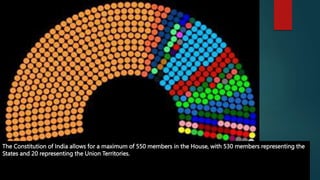
The Constitution of India allows for a maximum of 550 members in the House, with 530 members representing the
States and 20 representing the Union Territories.
The Roleof Parliament
 The Parliament, which is made up of all representatives together, controls and guides the government. In
this sense people, through their chosen representatives, form the government and also control it.
 The Parliament is also vested with powers to impeach the President and to remove the Judges of
Supreme Court and High Courts, the Chief Election Commissioner and the Comptroller and Auditor
General in accordance with the procedure laid down in the Constitution.
Introduction to New Parliament
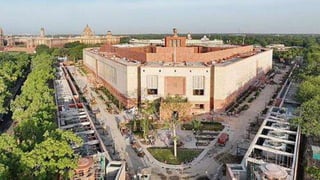
 The new building will house larger chambers for legislature.
 A larger Lok Sabha Hall with a capacity of up to 888 seats.
 A larger Rajya Sabha Hall with a capacity of up to 384 seats.
 The Lok Sabha Hall may accommodate up to 1,272 seats for joint
sessions.
 The new Parliament building is part of the redevelopment of the
Central Vista, the nation’s power corridor.
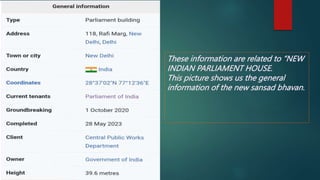
These information are related to “NEW
INDIAN PARLIAMENT HOUSE.
This picture shows us the general
information of the new sansad bhavan.
DIFFERENCE BETWEEN OLD AND NEW
PARLIAMENT
 Architectural Origins
 Size and Plan of New Parliament Building
 Increased Seating Capacity.
 Enhanced Safety Features.
 Modern Resources
 Central Hall Absence
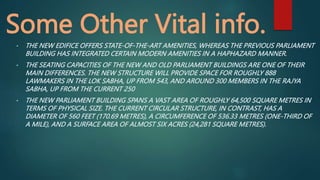
Some Other Vital info.
• THE NEW EDIFICE OFFERS STATE-OF-THE-ART AMENITIES, WHEREAS THE PREVIOUS PARLIAMENT
BUILDING HAS INTEGRATED CERTAIN MODERN AMENITIES IN A HAPHAZARD MANNER.
• THE SEATING CAPACITIES OF THE NEW AND OLD PARLIAMENT BUILDINGS ARE ONE OF THEIR
MAIN DIFFERENCES. THE NEW STRUCTURE WILL PROVIDE SPACE FOR ROUGHLY 888
LAWMAKERS IN THE LOK SABHA, UP FROM 543, AND AROUND 300 MEMBERS IN THE RAJYA
SABHA, UP FROM THE CURRENT 250
• THE NEW PARLIAMENT BUILDING SPANS A VAST AREA OF ROUGHLY 64,500 SQUARE METRES IN
TERMS OF PHYSICAL SIZE. THE CURRENT CIRCULAR STRUCTURE, IN CONTRAST, HAS A
DIAMETER OF 560 FEET (170.69 METRES), A CIRCUMFERENCE OF 536.33 METRES (ONE-THIRD OF
A MILE), AND A SURFACE AREA OF ALMOST SIX ACRES (24,281 SQUARE METRES).
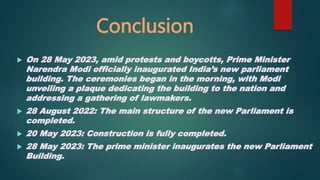
Conclusion
 On 28 May 2023, amid protests and boycotts, Prime Minister
Narendra Modi officially inaugurated India’s new parliament
building. The ceremonies began in the morning, with Modi
unveiling a plaque dedicating the building to the nation and
addressing a gathering of lawmakers.
 28 August 2022: The main structure of the new Parliament is
completed.
 20 May 2023: Construction is fully completed.
 28 May 2023: The prime minister inaugurates the new Parliament
Building.
Presentation (2).pptx

Presentation (2).pptx

  • 2.
    TABLE OF CONTENT WHAT IS PARLIAMENT AND IT’S NEED  INTRODUCTION OF NEW PARLIAMENT HOUSE  DIFFERENCE BETWEEN OLD AND NEW PARLIAMENT HOUSE  ADVANTAGES OF NEW PARLIAMENT IN CURRENT SCENARIO  CONCLUSION
  • 3.
    What Is Parliamentin IndianDemocracySystem Parliament is the supreme legislative body of India. The Indian Parliament comprises of the President and the two Houses – Rajya Sabha (Council of States) and Lok Sabha (House of the People). The President has the power to summon and prorogue either House of Parliament or to dissolve Lok Sabha. The Constitution of India came into force on January 26, 1950. The first general elections under the new Constitution were held during the year 1951- 52 and the first elected Parliament came into existence in April, 1952.
  • 4.
    The Constitution ofIndia allows for a maximum of 550 members in the House, with 530 members representing the States and 20 representing the Union Territories.
  • 5.
    The Roleof Parliament The Parliament, which is made up of all representatives together, controls and guides the government. In this sense people, through their chosen representatives, form the government and also control it.  The Parliament is also vested with powers to impeach the President and to remove the Judges of Supreme Court and High Courts, the Chief Election Commissioner and the Comptroller and Auditor General in accordance with the procedure laid down in the Constitution.
  • 6.
    Introduction to NewParliament  The new building will house larger chambers for legislature.  A larger Lok Sabha Hall with a capacity of up to 888 seats.  A larger Rajya Sabha Hall with a capacity of up to 384 seats.  The Lok Sabha Hall may accommodate up to 1,272 seats for joint sessions.  The new Parliament building is part of the redevelopment of the Central Vista, the nation’s power corridor.
  • 8.
    These information arerelated to “NEW INDIAN PARLIAMENT HOUSE. This picture shows us the general information of the new sansad bhavan.
  • 9.
    DIFFERENCE BETWEEN OLDAND NEW PARLIAMENT  Architectural Origins  Size and Plan of New Parliament Building  Increased Seating Capacity.  Enhanced Safety Features.  Modern Resources  Central Hall Absence
  • 10.
    Some Other Vitalinfo. • THE NEW EDIFICE OFFERS STATE-OF-THE-ART AMENITIES, WHEREAS THE PREVIOUS PARLIAMENT BUILDING HAS INTEGRATED CERTAIN MODERN AMENITIES IN A HAPHAZARD MANNER. • THE SEATING CAPACITIES OF THE NEW AND OLD PARLIAMENT BUILDINGS ARE ONE OF THEIR MAIN DIFFERENCES. THE NEW STRUCTURE WILL PROVIDE SPACE FOR ROUGHLY 888 LAWMAKERS IN THE LOK SABHA, UP FROM 543, AND AROUND 300 MEMBERS IN THE RAJYA SABHA, UP FROM THE CURRENT 250 • THE NEW PARLIAMENT BUILDING SPANS A VAST AREA OF ROUGHLY 64,500 SQUARE METRES IN TERMS OF PHYSICAL SIZE. THE CURRENT CIRCULAR STRUCTURE, IN CONTRAST, HAS A DIAMETER OF 560 FEET (170.69 METRES), A CIRCUMFERENCE OF 536.33 METRES (ONE-THIRD OF A MILE), AND A SURFACE AREA OF ALMOST SIX ACRES (24,281 SQUARE METRES).
  • 11.
    Conclusion  On 28May 2023, amid protests and boycotts, Prime Minister Narendra Modi officially inaugurated India’s new parliament building. The ceremonies began in the morning, with Modi unveiling a plaque dedicating the building to the nation and addressing a gathering of lawmakers.  28 August 2022: The main structure of the new Parliament is completed.  20 May 2023: Construction is fully completed.  28 May 2023: The prime minister inaugurates the new Parliament Building.