Assalamu’alaikum
wr.wb,
Selamat pagi...
Social Exchange Theory
John Thibaut and Harold Kelley
Social Exchange Theory (SET) is based on the notion that
people think about their relationships in economic terms.
SET argues that people ases their relationship in term of costs
and rewards.
Outcome = reward – costs
Costs : element of relational life with negative
value.
Reward : elements of relational life with positive
value
Outcome : whether people continue in a
relationship or terminate it
Asumsi Teori Pertukaran Sosial mengenai keadaan
manusia (human nature):
1. Manusia mencari keuntungan dan menghindari
hukuman
2. Manusia sebagai mahluk rasional
3. Standar-standar manusia menggunakan evaluasi
biaya dan keuntungan dari waktu ke waktu dan
dari orang per orang.
Asumsi Teori Pertukaran Sosial mengenai hubungan
manusia:
1. Hubungan manusia saling ketergantungan
2. Hubungan manusia sebagai suatu proses
Evaluasi suatu hubungan
-The comparison level is a standard representing
what people feel they should receive in the
way of rewards and costs from a particular
relationship.
-Comparison level for alternatives:
how people evaluate a relationship based on
what rheir aternatives to the relationship are
Pola Pertukaran
-Behavioral sequences: a series of of action
designed to achives a goal
-Power: the degree of dependence a person has
on another for outcomes
-Behavior control; the power to change
another’s behavior
Struktur Pertukaran
Direct exchange; an echange where two people
reciprocate costs and rewards
A B
Generalized Exchange; an exchange where
reciprocation involves the social network and
isn’t confined to two individuals
A B
C
Productive Exchange; an exchange where both
partners incur costs and benefits
simultaneously
AB
A B
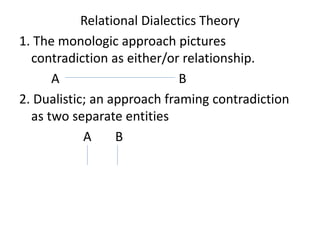
Relational Dialectics Theory
1. The monologic approach pictures
contradiction as either/or relationship.
A B
2. Dualistic; an approach framing contradiction
as two separate entities
A B
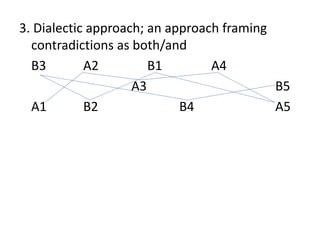
3. Dialectic approach; an approach framing
contradictions as both/and
B3 A2 B1 A4
A3 B5
A1 B2 B4 A5
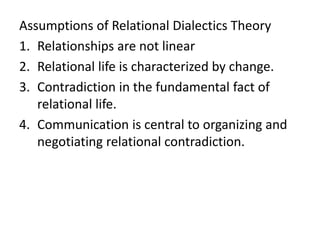
Assumptions of Relational Dialectics Theory
1. Relationships are not linear
2. Relational life is characterized by change.
3. Contradiction in the fundamental fact of
relational life.
4. Communication is central to organizing and
negotiating relational contradiction.
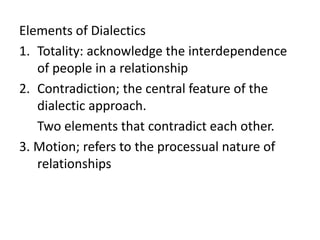
Elements of Dialectics
1. Totality: acknowledge the interdependence
of people in a relationship
2. Contradiction; the central feature of the
dialectic approach.
Two elements that contradict each other.
3. Motion; refers to the processual nature of
relationships
Basic Relational Dialetics
1. Autonomy and Connection
The dialectic between autonomy and connetion refers
to our simultaneous desires to be independent of our
significant others and to find intimacy with them.
2. Opennes and Protection
The openness and protection dialectic focuses on our
conflicting desires first to be open and vulnerable,
revealing personal information to our relational
partners, and second to be strategic and protective in
our communication.
3. Novelty and Predictability
The dialectic between novelty and predictability
refers the conflict between the comfort of stability
and the excitement of change.
4. Contextual Dialectics
a. Interactional dialectics: tensions resulting from
and constructed by communication
b. Contectual dialectics: tension resulting from the
place of the relationship within the culture
c. Public and private dialectic: a contextual
dialectic resulting from a private relationship
and public life
d. Real and ideal dialectic: a contextual dialectic
resulting from the differences between idealized
relationhips and lived relationship.
Kuis
A. Buatlah analisis aplikasi Teori Pertukaran
Sosial (TPS) dalam kontek komunikasi
Antarpersona
B. Bagaimana pendapat Saudara penerapan TPS
dalam aktivitas manusia melakukan:
1. Kegiatan sosial; memberi sumbangan pada
masyarakat yang tertimpa bencana
2. Kegiatan keagamaan; membangun tempat
ibadah, dll

Presentasi 3 11-2015

  • 1.
  • 2.
    Social Exchange Theory JohnThibaut and Harold Kelley
  • 3.
    Social Exchange Theory(SET) is based on the notion that people think about their relationships in economic terms. SET argues that people ases their relationship in term of costs and rewards. Outcome = reward – costs Costs : element of relational life with negative value. Reward : elements of relational life with positive value Outcome : whether people continue in a relationship or terminate it
  • 4.
    Asumsi Teori PertukaranSosial mengenai keadaan manusia (human nature): 1. Manusia mencari keuntungan dan menghindari hukuman 2. Manusia sebagai mahluk rasional 3. Standar-standar manusia menggunakan evaluasi biaya dan keuntungan dari waktu ke waktu dan dari orang per orang. Asumsi Teori Pertukaran Sosial mengenai hubungan manusia: 1. Hubungan manusia saling ketergantungan 2. Hubungan manusia sebagai suatu proses
  • 5.
    Evaluasi suatu hubungan -Thecomparison level is a standard representing what people feel they should receive in the way of rewards and costs from a particular relationship. -Comparison level for alternatives: how people evaluate a relationship based on what rheir aternatives to the relationship are
  • 6.
    Pola Pertukaran -Behavioral sequences:a series of of action designed to achives a goal -Power: the degree of dependence a person has on another for outcomes -Behavior control; the power to change another’s behavior
  • 7.
    Struktur Pertukaran Direct exchange;an echange where two people reciprocate costs and rewards A B Generalized Exchange; an exchange where reciprocation involves the social network and isn’t confined to two individuals A B C
  • 8.
    Productive Exchange; anexchange where both partners incur costs and benefits simultaneously AB A B
  • 9.
    Relational Dialectics Theory 1.The monologic approach pictures contradiction as either/or relationship. A B 2. Dualistic; an approach framing contradiction as two separate entities A B
  • 10.
    3. Dialectic approach;an approach framing contradictions as both/and B3 A2 B1 A4 A3 B5 A1 B2 B4 A5
  • 11.
    Assumptions of RelationalDialectics Theory 1. Relationships are not linear 2. Relational life is characterized by change. 3. Contradiction in the fundamental fact of relational life. 4. Communication is central to organizing and negotiating relational contradiction.
  • 12.
    Elements of Dialectics 1.Totality: acknowledge the interdependence of people in a relationship 2. Contradiction; the central feature of the dialectic approach. Two elements that contradict each other. 3. Motion; refers to the processual nature of relationships
  • 13.
    Basic Relational Dialetics 1.Autonomy and Connection The dialectic between autonomy and connetion refers to our simultaneous desires to be independent of our significant others and to find intimacy with them. 2. Opennes and Protection The openness and protection dialectic focuses on our conflicting desires first to be open and vulnerable, revealing personal information to our relational partners, and second to be strategic and protective in our communication. 3. Novelty and Predictability The dialectic between novelty and predictability refers the conflict between the comfort of stability and the excitement of change.
  • 14.
    4. Contextual Dialectics a.Interactional dialectics: tensions resulting from and constructed by communication b. Contectual dialectics: tension resulting from the place of the relationship within the culture c. Public and private dialectic: a contextual dialectic resulting from a private relationship and public life d. Real and ideal dialectic: a contextual dialectic resulting from the differences between idealized relationhips and lived relationship.
  • 15.
    Kuis A. Buatlah analisisaplikasi Teori Pertukaran Sosial (TPS) dalam kontek komunikasi Antarpersona B. Bagaimana pendapat Saudara penerapan TPS dalam aktivitas manusia melakukan: 1. Kegiatan sosial; memberi sumbangan pada masyarakat yang tertimpa bencana 2. Kegiatan keagamaan; membangun tempat ibadah, dll