LA CARLOTA
LAURA ALCÁNTARA
JOSE ANTONIO CARMONA
ISABEL Mª ESTABLE
DAVID MARTÍNEZ
HELENA CHACÓN
ALEJANDRO CARMONA
PILAR HERMÁN
ADRIÁN ZAFRA
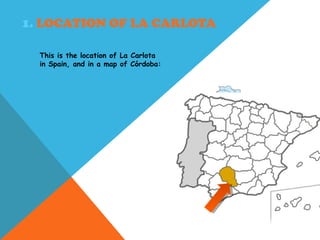
1. LOCATION OF LA CARLOTA
This is the location of La Carlota
in Spain, and in a map of Córdoba:
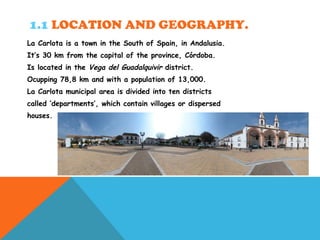
1.1 LOCATION AND GEOGRAPHY.
La Carlota is a town in the South of Spain, in Andalusia.
It’s 30 km from the capital of the province, Córdoba.
Is located in the Vega del Guadalquivir district.
Ocupping 78,8 km and with a population of 13,000.
La Carlota municipal area is divided into ten districts
called ‘departments’, which contain villages or dispersed
houses.
2. HISTORY
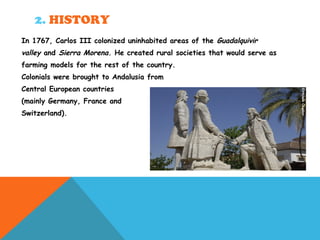
In 1767, Carlos III colonized uninhabited areas of the Guadalquivir
valley and Sierra Morena. He created rural societies that would serve as
farming models for the rest of the country.
Colonials were brought to Andalusia from
Central European countries
(mainly Germany, France and
Switzerland).
3. MONUMENTS
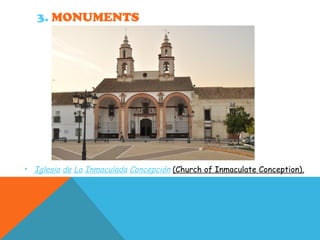
• Iglesia de La Inmaculada Concepción (Church of Inmaculate Conception).
3. MONUMENTS
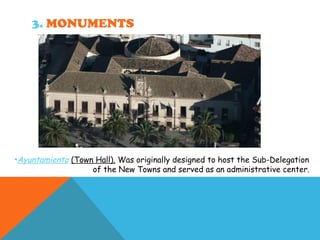
•Ayuntamiento (Town Hall). Was originally designed to host the Sub-Delegation
of the New Towns and served as an administrative center.
3. MONUMENTS
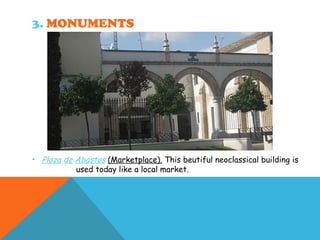
• Plaza de Abastos (Marketplace). This beutiful neoclassical building is
used today like a local market.
3. MONUMENTS
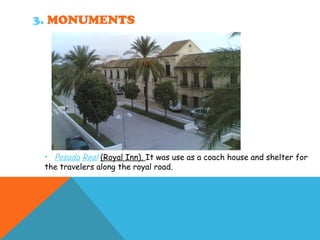
• Posada Real (Royal Inn). It was use as a coach house and shelter for
the travelers along the royal road.
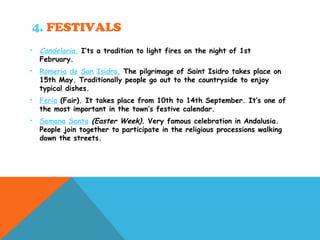
4. FESTIVALS
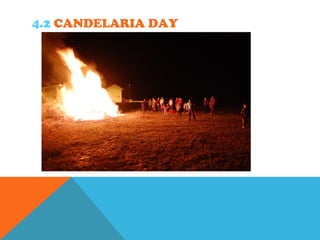
• Candelaria. I’ts a tradition to light fires on the night of 1st
February.
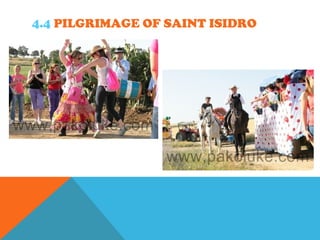
• Romeria de San Isidro. The pilgrimage of Saint Isidro takes place on
15th May. Traditionally people go out to the countryside to enjoy
typical dishes.
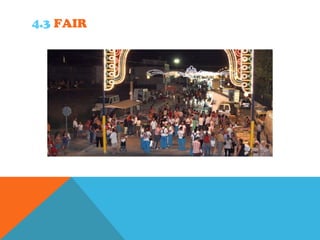
• Feria (Fair). It takes place from 10th to 14th September. It’s one of
the most important in the town’s festive calendar.
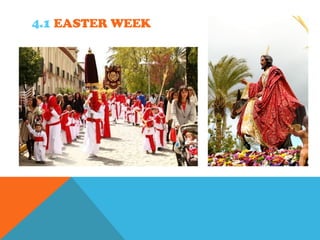
• Semana Santa (Easter Week). Very famous celebration in Andalusia.
People join together to participate in the religious processions walking
down the streets.
4.1 EASTER WEEK
4.2 CANDELARIA DAY
4.3 FAIR
4.4 PILGRIMAGE OF SAINT ISIDRO
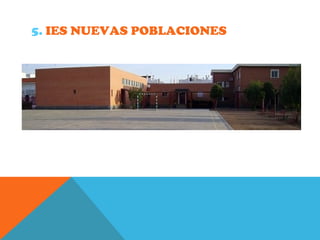
5. IES NUEVAS POBLACIONES
5.1 OUR SCHOOL
• Nº of pupils: 600
• Nº of teachers: 61
• Type of school: Secondary school.
Compulsory education (12-16)
Post-pbligatory (16-18)
Vocational training(16-18)
o Electrycity
o Administration and managemnet
- STEREOTYPES
1. SPANISH PEOPLE ARE LAZY.
It’s the most common stereotype about spanish people. Spain
has very hard-working people, for example, you can see
people working in the countryside at 3-4 am. And in
Madrid,Barcelona..., you can find people pulling 50 hours per
week shifts. So, from our point of view, Spain isn’t a lazy
country.
- STEREOTYPES
2. SPANISH DO THE “SIESTA”.
Althought some people do the ‘’siesta’’, most people don’t.
This is said because the normal working hours are from 9 am
to 14 pm and from 16 pm to 19 pm, so you get 2 hours for
lunch, but with the activities that most people do, there is no
time left for the ‘’siesta’’.
- STEREOTYPES
3. SPANISH PEOPLE ARE
LOUD.
Some people tend to talk loudly in comparation with the
Northern or Eastern Europe, but that’s because they are
very intense when expressing something. However, you can
find a lot of different tones around Spain.
- STEREOTYPES
4. SPAIN’S OFFICIAL LANGUAGE IS SPANISH
This is true, but there are other three co-official languages:
• Euskera or Basque: It’s spoken in the Basque country and in
Navarra. It’s the oldest spoken language in Europe and it has
five different dialects.
• Catalan: It’s spoken in Catalunya, Valencia, Balearic Islands,
in La Franja of Aragon and in Carche, Murcia.
• Galego: Is mainly spoken in Galicia, but also in some parts of
Asturias, Castile and León. Is similar to Portuguese.
- STEREOTYPES
5. SPANISH PEOPLE LOVE THE
PARTY
It’s true. Spanish is one of the European Countries with more
festivities during the whole year. Most spanish people like
holidays, music and being social.
- STEREOTYPES
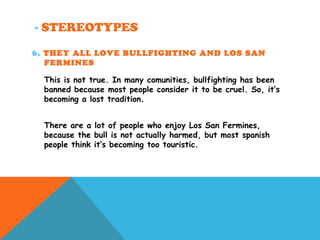
6. THEY ALL LOVE BULLFIGHTING AND LOS SAN
FERMINES
This is not true. In many comunities, bullfighting has been
banned because most people consider it to be cruel. So, it’s
becoming a lost tradition.
There are a lot of people who enjoy Los San Fermines,
because the bull is not actually harmed, but most spanish
people think it’s becoming too touristic.
- STEREOTYPES
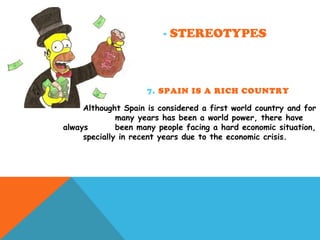
7. SPAIN IS A RICH COUNTRY
Althought Spain is considered a first world country and for
many years has been a world power, there have
always been many people facing a hard economic situation,
specially in recent years due to the economic crisis.
- STEREOTYPES
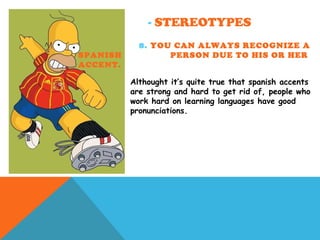
8. YOU CAN ALWAYS RECOGNIZE A
SPANISH PERSON DUE TO HIS OR HER
ACCENT.
Althought it’s quite true that spanish accents
are strong and hard to get rid of, people who
work hard on learning languages have good
pronunciations.
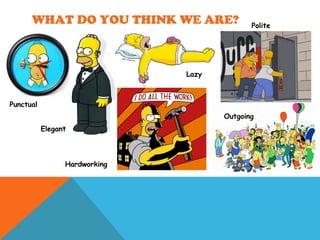
WHAT DO YOU THINK WE ARE?
Punctual
Elegant
Hardworking
Lazy
Outgoing
Polite
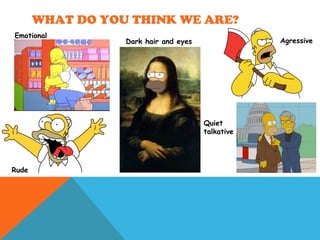
WHAT DO YOU THINK WE ARE?
Agressive
Rude
Emotional
Dark hair and eyes
Quiet
talkative

Presentación en portugal comenius

  • 1.
    LA CARLOTA LAURA ALCÁNTARA JOSEANTONIO CARMONA ISABEL Mª ESTABLE DAVID MARTÍNEZ HELENA CHACÓN ALEJANDRO CARMONA PILAR HERMÁN ADRIÁN ZAFRA
  • 2.
    1. LOCATION OFLA CARLOTA This is the location of La Carlota in Spain, and in a map of Córdoba:
  • 3.
    1.1 LOCATION ANDGEOGRAPHY. La Carlota is a town in the South of Spain, in Andalusia. It’s 30 km from the capital of the province, Córdoba. Is located in the Vega del Guadalquivir district. Ocupping 78,8 km and with a population of 13,000. La Carlota municipal area is divided into ten districts called ‘departments’, which contain villages or dispersed houses.
  • 4.
    2. HISTORY In 1767,Carlos III colonized uninhabited areas of the Guadalquivir valley and Sierra Morena. He created rural societies that would serve as farming models for the rest of the country. Colonials were brought to Andalusia from Central European countries (mainly Germany, France and Switzerland).
  • 5.
    3. MONUMENTS • Iglesiade La Inmaculada Concepción (Church of Inmaculate Conception).
  • 6.
    3. MONUMENTS •Ayuntamiento (TownHall). Was originally designed to host the Sub-Delegation of the New Towns and served as an administrative center.
  • 7.
    3. MONUMENTS • Plazade Abastos (Marketplace). This beutiful neoclassical building is used today like a local market.
  • 8.
    3. MONUMENTS • PosadaReal (Royal Inn). It was use as a coach house and shelter for the travelers along the royal road.
  • 9.
    4. FESTIVALS • Candelaria.I’ts a tradition to light fires on the night of 1st February. • Romeria de San Isidro. The pilgrimage of Saint Isidro takes place on 15th May. Traditionally people go out to the countryside to enjoy typical dishes. • Feria (Fair). It takes place from 10th to 14th September. It’s one of the most important in the town’s festive calendar. • Semana Santa (Easter Week). Very famous celebration in Andalusia. People join together to participate in the religious processions walking down the streets.
  • 10.
  • 11.
  • 12.
  • 13.
    4.4 PILGRIMAGE OFSAINT ISIDRO
  • 14.
    5. IES NUEVASPOBLACIONES
  • 15.
    5.1 OUR SCHOOL •Nº of pupils: 600 • Nº of teachers: 61 • Type of school: Secondary school. Compulsory education (12-16) Post-pbligatory (16-18) Vocational training(16-18) o Electrycity o Administration and managemnet
  • 16.
    - STEREOTYPES 1. SPANISHPEOPLE ARE LAZY. It’s the most common stereotype about spanish people. Spain has very hard-working people, for example, you can see people working in the countryside at 3-4 am. And in Madrid,Barcelona..., you can find people pulling 50 hours per week shifts. So, from our point of view, Spain isn’t a lazy country.
  • 17.
    - STEREOTYPES 2. SPANISHDO THE “SIESTA”. Althought some people do the ‘’siesta’’, most people don’t. This is said because the normal working hours are from 9 am to 14 pm and from 16 pm to 19 pm, so you get 2 hours for lunch, but with the activities that most people do, there is no time left for the ‘’siesta’’.
  • 18.
    - STEREOTYPES 3. SPANISHPEOPLE ARE LOUD. Some people tend to talk loudly in comparation with the Northern or Eastern Europe, but that’s because they are very intense when expressing something. However, you can find a lot of different tones around Spain.
  • 19.
    - STEREOTYPES 4. SPAIN’SOFFICIAL LANGUAGE IS SPANISH This is true, but there are other three co-official languages: • Euskera or Basque: It’s spoken in the Basque country and in Navarra. It’s the oldest spoken language in Europe and it has five different dialects. • Catalan: It’s spoken in Catalunya, Valencia, Balearic Islands, in La Franja of Aragon and in Carche, Murcia. • Galego: Is mainly spoken in Galicia, but also in some parts of Asturias, Castile and León. Is similar to Portuguese.
  • 20.
    - STEREOTYPES 5. SPANISHPEOPLE LOVE THE PARTY It’s true. Spanish is one of the European Countries with more festivities during the whole year. Most spanish people like holidays, music and being social.
  • 21.
    - STEREOTYPES 6. THEYALL LOVE BULLFIGHTING AND LOS SAN FERMINES This is not true. In many comunities, bullfighting has been banned because most people consider it to be cruel. So, it’s becoming a lost tradition. There are a lot of people who enjoy Los San Fermines, because the bull is not actually harmed, but most spanish people think it’s becoming too touristic.
  • 22.
    - STEREOTYPES 7. SPAINIS A RICH COUNTRY Althought Spain is considered a first world country and for many years has been a world power, there have always been many people facing a hard economic situation, specially in recent years due to the economic crisis.
  • 23.
    - STEREOTYPES 8. YOUCAN ALWAYS RECOGNIZE A SPANISH PERSON DUE TO HIS OR HER ACCENT. Althought it’s quite true that spanish accents are strong and hard to get rid of, people who work hard on learning languages have good pronunciations.
  • 24.
    WHAT DO YOUTHINK WE ARE? Punctual Elegant Hardworking Lazy Outgoing Polite
  • 25.
    WHAT DO YOUTHINK WE ARE? Agressive Rude Emotional Dark hair and eyes Quiet talkative