Restricted Use
Funded by the European Union. Views and opinions expressed are however those of the author(s) only and do not necessarily reflect those of the European Commission. Neither the
European Union nor the granting authority can be held responsible for them.
Data Gap Analysis
Approach and Discussion
First Expert Workshop 31.01.2023
Restricted Use
This project has received funding from the Digital Europe Programme under grant agreement n°101083655.
AGENDA
• Background and Goals
• The Bigger Picture
• Approach for the Data Gap Analysis
• Timelines and Next Steps
• Questions and Discussion
Restricted Use
This project has received funding from the Digital Europe Programme under grant agreement n°101083655.
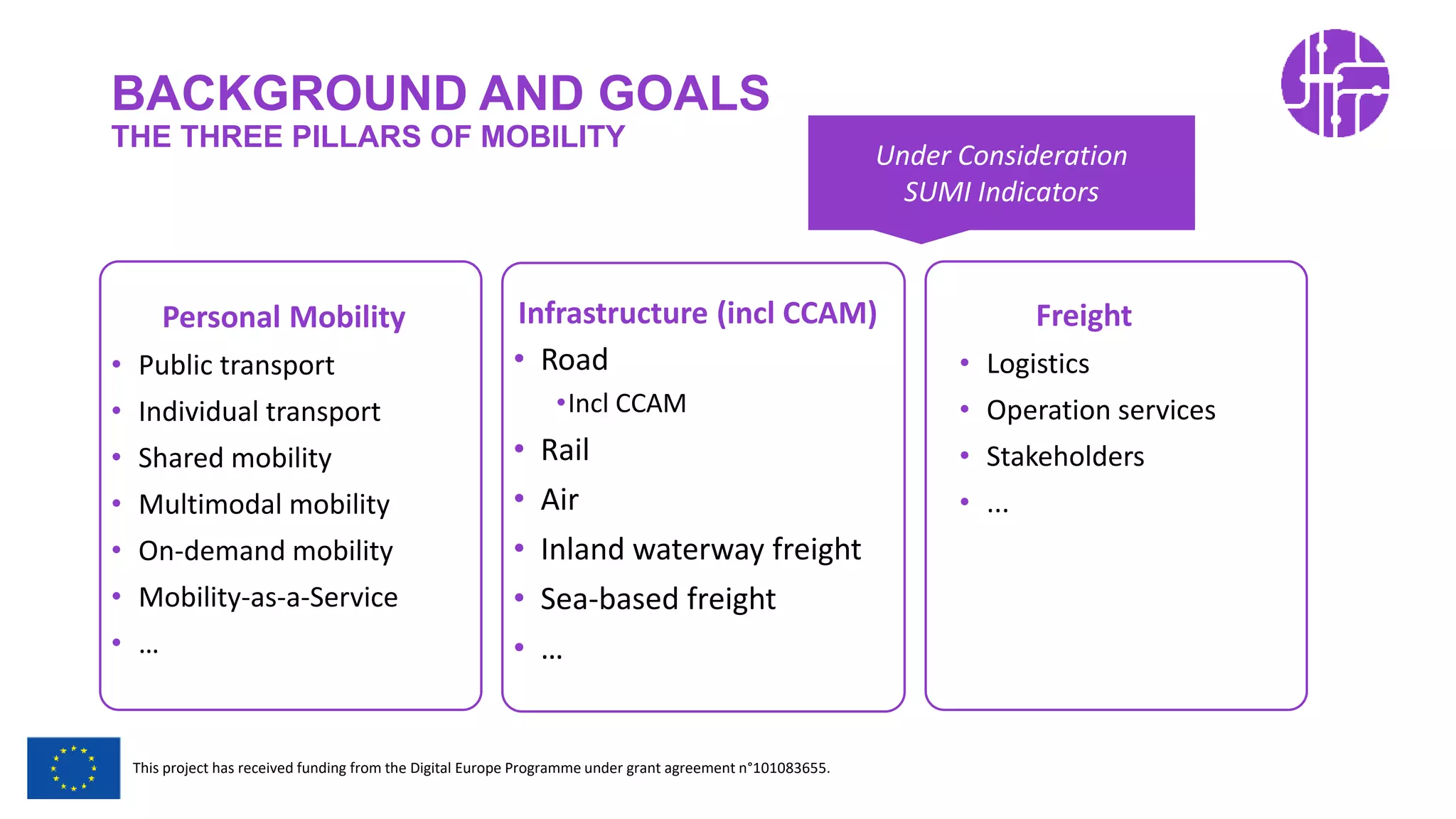
Infrastructure (incl CCAM)
• Road
•Incl CCAM
• Rail
• Air
• Inland waterway freight
• Sea-based freight
• …
BACKGROUND AND GOALS
THE THREE PILLARS OF MOBILITY
Personal Mobility
• Public transport
• Individual transport
• Shared mobility
• Multimodal mobility
• On-demand mobility
• Mobility-as-a-Service
• …
Freight
• Logistics
• Operation services
• Stakeholders
• ...
Under Consideration
SUMI Indicators
Restricted Use
This project has received funding from the Digital Europe Programme under grant agreement n°101083655.
BACKGROUND AND GOALS
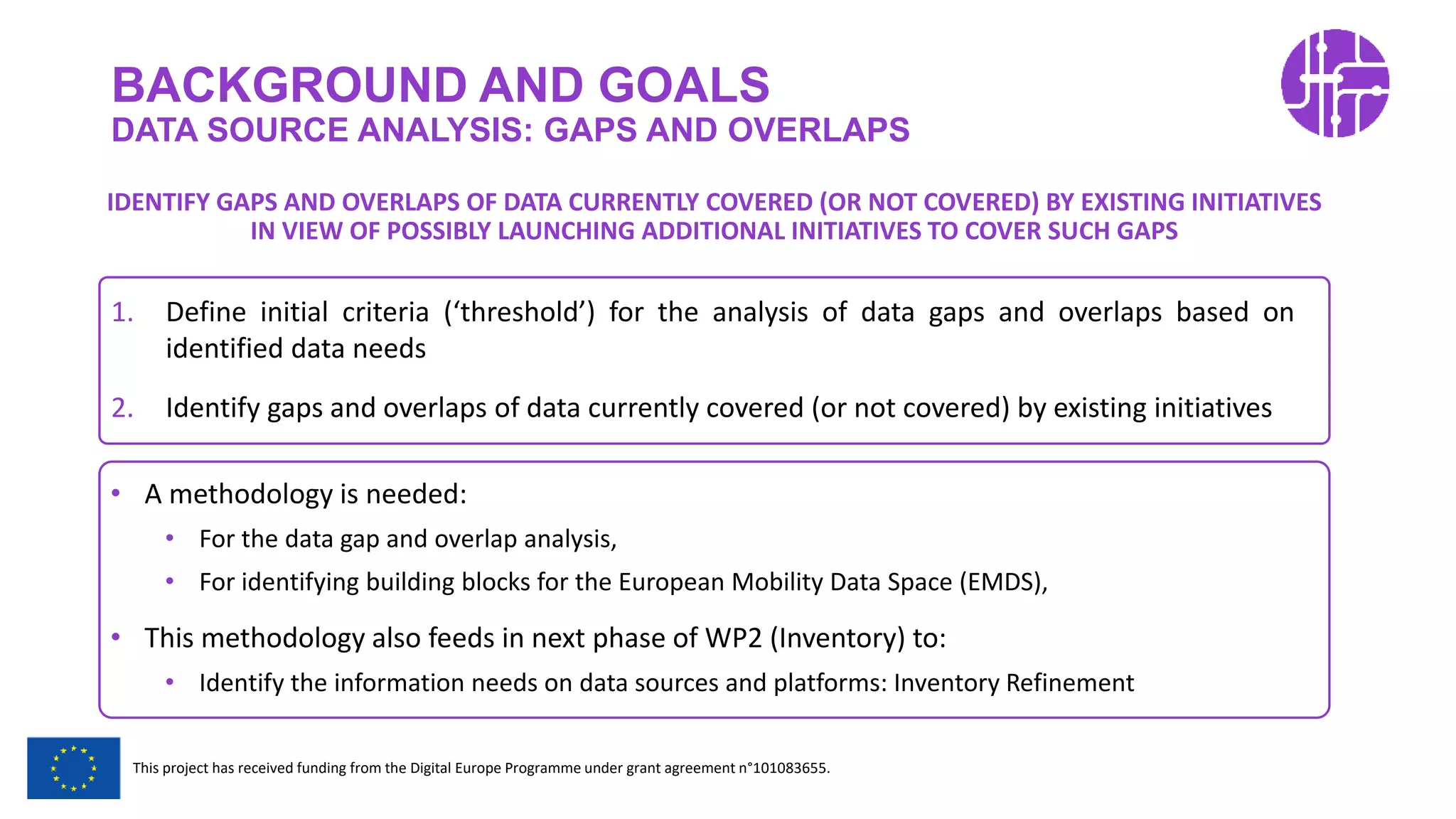
DATA SOURCE ANALYSIS: GAPS AND OVERLAPS
• A methodology is needed:
• For the data gap and overlap analysis,
• For identifying building blocks for the European Mobility Data Space (EMDS),
• This methodology also feeds in next phase of WP2 (Inventory) to:
• Identify the information needs on data sources and platforms: Inventory Refinement
IDENTIFY GAPS AND OVERLAPS OF DATA CURRENTLY COVERED (OR NOT COVERED) BY EXISTING INITIATIVES
IN VIEW OF POSSIBLY LAUNCHING ADDITIONAL INITIATIVES TO COVER SUCH GAPS
1. Define initial criteria (‘threshold’) for the analysis of data gaps and overlaps based on
identified data needs
2. Identify gaps and overlaps of data currently covered (or not covered) by existing initiatives
Restricted Use
This project has received funding from the Digital Europe Programme under grant agreement n°101083655.
THE BIGGER PICTURE
THE EU AMBITION
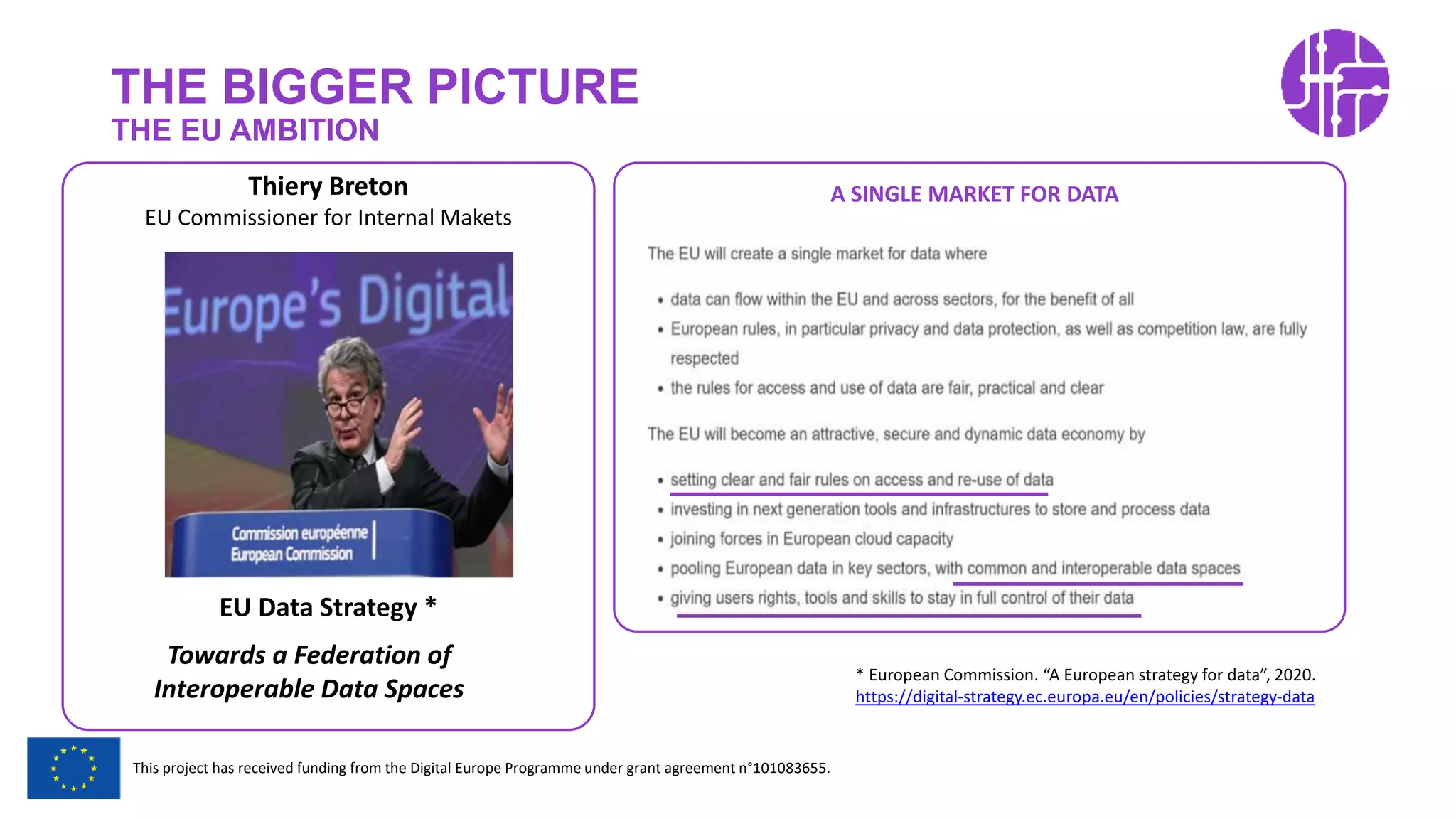
EU Data Strategy *
Towards a Federation of
Interoperable Data Spaces
Thiery Breton
EU Commissioner for Internal Makets
* European Commission. “A European strategy for data”, 2020.
https://digital-strategy.ec.europa.eu/en/policies/strategy-data
A SINGLE MARKET FOR DATA
Restricted Use
This project has received funding from the Digital Europe Programme under grant agreement n°101083655.
THE BIGGER PICTURE
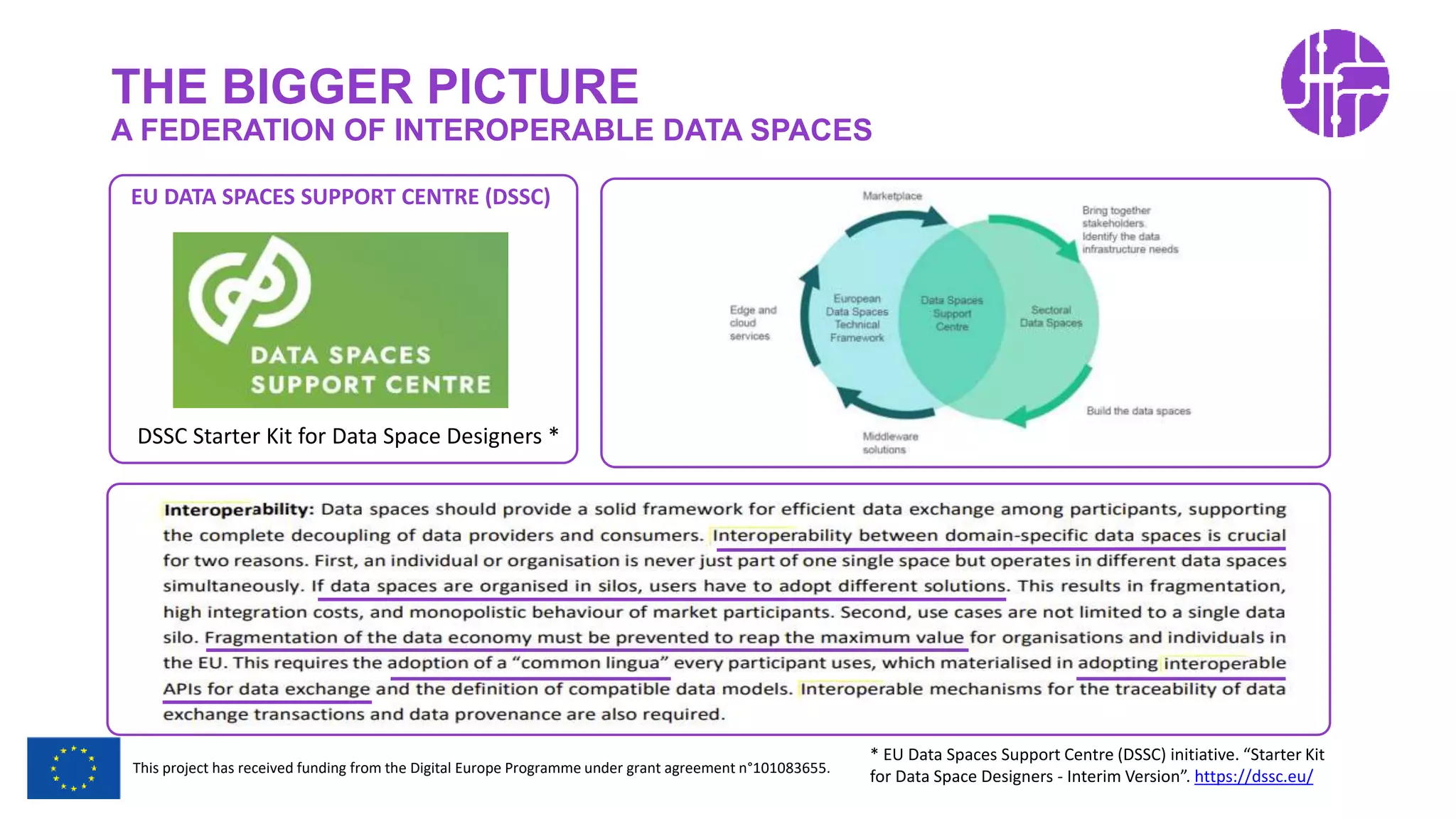
A FEDERATION OF INTEROPERABLE DATA SPACES
EU DATA SPACES SUPPORT CENTRE (DSSC)
* EU Data Spaces Support Centre (DSSC) initiative. “Starter Kit
for Data Space Designers - Interim Version”. https://dssc.eu/
DSSC Starter Kit for Data Space Designers *
Restricted Use
This project has received funding from the Digital Europe Programme under grant agreement n°101083655.
THE BIGGER PICTURE
A FEDERATION OF INTEROPERABLE DATA SPACES
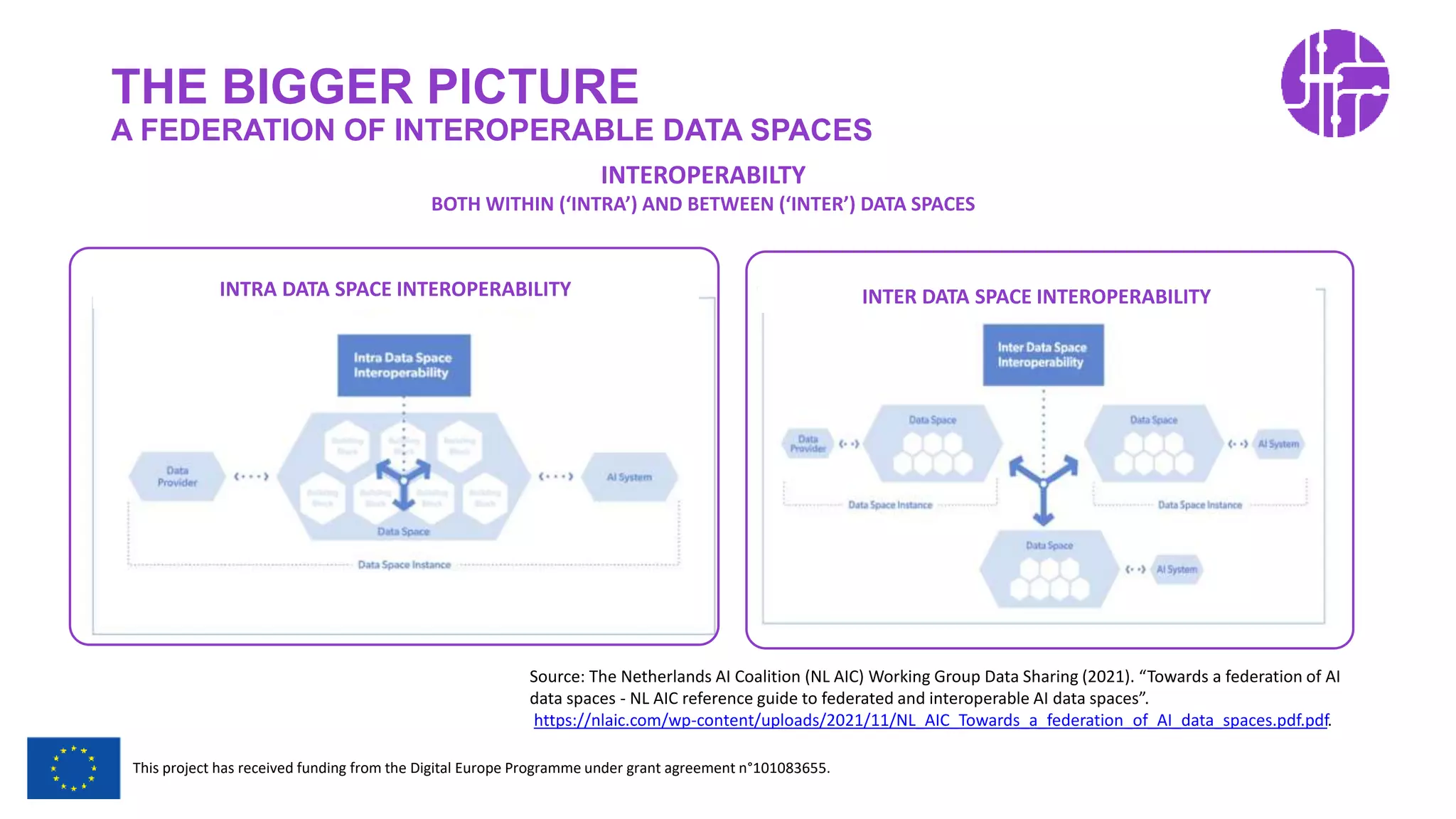
Source: The Netherlands AI Coalition (NL AIC) Working Group Data Sharing (2021). “Towards a federation of AI
data spaces - NL AIC reference guide to federated and interoperable AI data spaces”.
https://nlaic.com/wp-content/uploads/2021/11/NL_AIC_Towards_a_federation_of_AI_data_spaces.pdf.pdf.
INTRA DATA SPACE INTEROPERABILITY INTER DATA SPACE INTEROPERABILITY
INTEROPERABILTY
BOTH WITHIN (‘INTRA’) AND BETWEEN (‘INTER’) DATA SPACES
Restricted Use
This project has received funding from the Digital Europe Programme under grant agreement n°101083655.
THE BIGGER PICTURE
A FEDERATION OF INTEROPERABLE DATA SPACES
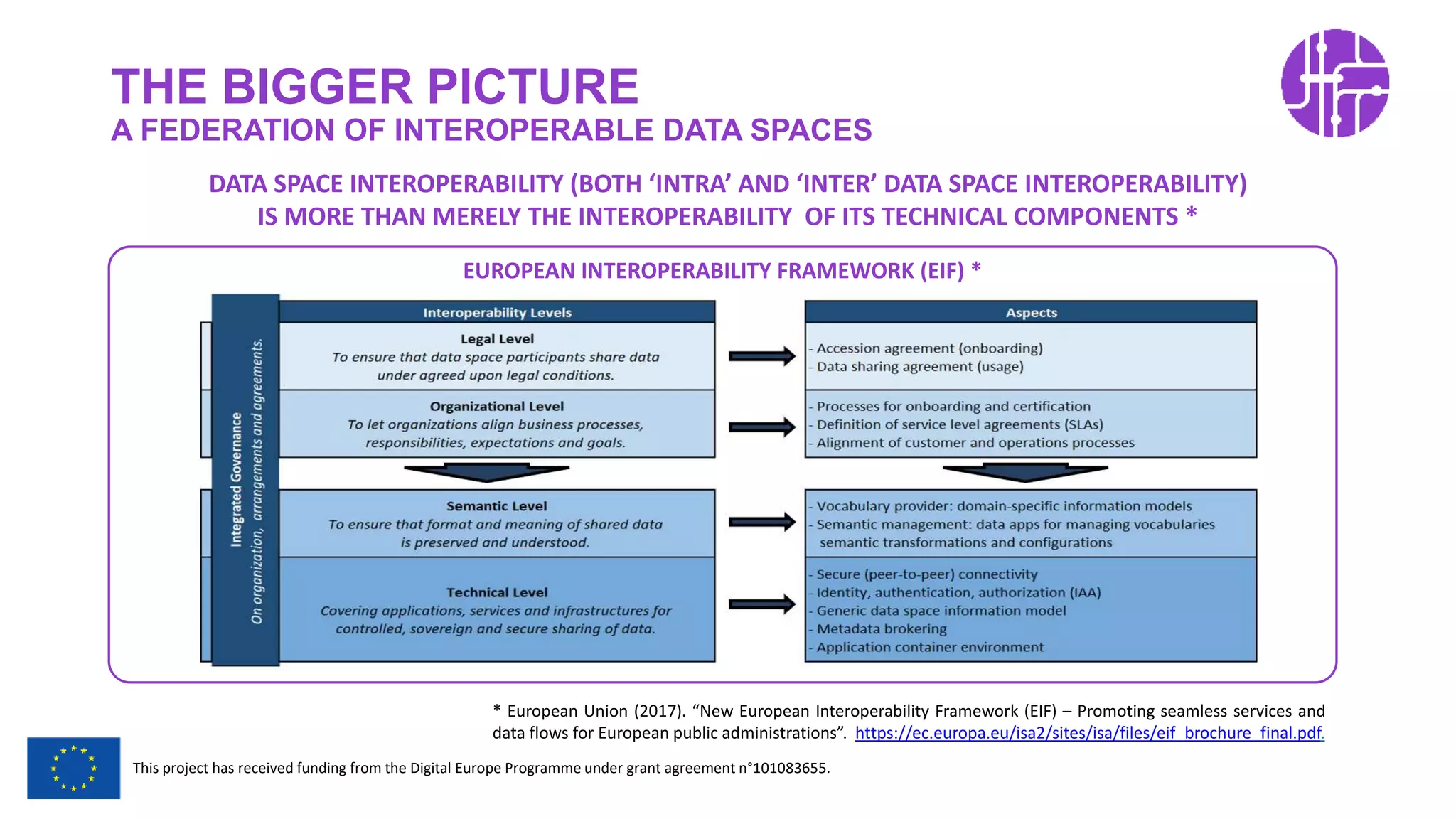
* European Union (2017). “New European Interoperability Framework (EIF) – Promoting seamless services and
data flows for European public administrations”. https://ec.europa.eu/isa2/sites/isa/files/eif_brochure_final.pdf.
EUROPEAN INTEROPERABILITY FRAMEWORK (EIF) *
DATA SPACE INTEROPERABILITY (BOTH ‘INTRA’ AND ‘INTER’ DATA SPACE INTEROPERABILITY)
IS MORE THAN MERELY THE INTEROPERABILITY OF ITS TECHNICAL COMPONENTS *
Restricted Use
This project has received funding from the Digital Europe Programme under grant agreement n°101083655.
METHODOLOGY FOR ANALYSIS OF BUILDING
BLOCKS
PREPDS4MOBILITY CSA BUSINESS: CONSIDERATIONS
• To what extend does EMDS take a ‘generic’ data space approach?, and, as such, addresses a duality in ‘generic’ and
‘specific’ EU data sharing initiatives, i.e.:
• Generic initiatives aim to be generically applicable to and over multiple sectors and application areas.
• Specific initiatives target a specific sector and / or application area, based on domain-specific data sharing functionalities.
• Does EMDS support each of the four types of data sharing?, being 'sharing of persistent (semi-static) data', 'sharing
of (real-time) streaming data‘, ‘algorithm sharing for local processing of (sensitive) data', and ‘smart contracting for
data flow control ‘.
• Does EMDS enable data services across data spaces?, i.e. to make data services accessible both within and across
multiple data space instances, both an intra and inter data space interoperability architecture needs to be developed.
• How is EMDS operationalized (e.g. by a four-corner * operations model)?, with well-defined roles and responsibilities
of various types service providers to deploy and operate the MDS, e.g..: ‘Infrastructure-as-a-Service Provider (IaaSP)’
roles, ‘Connecting Service Provider (CSP)’ roles and ‘Value Adding Service Provider’ roles.
CONSIDERATIONS TO BE TAKEN INTO ACCOUNT IN THE PREPDS4MOBILITY CSA DATA GAPS AND BUILDING BLOCKS
ANALYSIS WHEN POSITIONING EMDS WITHIN ‘A FEDERATION OF INTEROPERABLE DATA SPACES’
• Qvalia. "Understanding the Peppol four-corner model of business exchange”.
https://qvalia.com/blog/understanding-the-peppol-four-corner-model-of-business-exchange..
Restricted Use
This project has received funding from the Digital Europe Programme under grant agreement n°101083655.
1. Refinement of inventory on data sources (in WP2) on:
• Data sharing needs
• Data sharing typology
• Data source characteristics
2. Assessment of refined inventory on data sources with respect to:
• Completeness of the available data sources
• Diversity in data source characteristics
• Uniformity in accessibility of the data sources
METHODOLOGY FOR ANALYSIS OF DATA SOURCES
TWO-STEP APPROACH
THE METHODOLOGY FOR ANALYSIS OF DATA SOURCES - A 2-STEP APPROACH
Restricted Use
This project has received funding from the Digital Europe Programme under grant agreement n°101083655.
Refinement of inventory on data sharing needs:
• To support key EU initiatives, e.g.:
• Sustainable and Smart Mobility Strategy
• ITS Directive, Data for Road Safety
• …
• To support common usage scenarios:
• Extending the data needs in the thematic approach in the inventory (WP2)
• To be validated by representative use cases
METHODOLOGY FOR ANALYSIS OF DATA SOURCES
REFINEMENT OF INVENTORY ON DATA SOURCES: DATA SHARING NEEDS
Restricted Use
This project has received funding from the Digital Europe Programme under grant agreement n°101083655.
METHODOLOGY FOR ANALYSIS OF DATA SOURCES
REFINEMENT OF INVENTORY ON DATA SOURCES: TYPOLOGY OF DATA SHARING
• Sharing of persistent (semi-static) data. This may for instance be (sensitive) operations data, for which sharing across
organizations enables a competitive collaborative strategy, yields efficiency gains, provides new business opportunities
or serve public goals.
• Sharing of (real-time) streaming data: To an ever larger extent, sensors and actuators provide real-time streaming
data as part of the emerging Internet-of-Things (IoT). The data streams may have to be shared in a controlled manner
with multiple receivers / consumers, with timeliness being an important aspect.
• Algorithm sharing for local processing of (sensitive) data: This allows processing algorithms to locally access sensitive
data, i.e. within the domain of a data services provider. This may prevent sensitive data from having to be shared at all:
only processed results are shared. This way, for instance distributed AI algorithms (e.g. Federated Learning) or Privacy
Enhancing Technologies (PETs, e.g. secure Multi-Party Computation) can use sensitive or private data without the need
for that data to be shared with third parties.
• Smart contracting for data flow control: This allows data to be shared between organizations by means of a
controlled data flow. In logistics for example, event-driven real-time data flow control allows improved visibility along
the supply chain and tracking of goods and trucks and transportation conditions (e.g. for perishable goods) and
enables for (automated) sharing of transport documents for business reporting or legal compliance.
THE PREPDS4MOBILITY CSA WP3 DISTINGUISHES FOUR TYPES OF DATA SHARING IN THE ANALYSIS *
• TKI Dinalog Data Logistics for Logistics Data (DL4LD) project e.a. (2020) “The Logistics Data Sharing Infrastructure - White Paper”.
https://www.dinalog.nl/wp-content/uploads/2020/08/Dinalog_Whitepaper-Data-Infrastructure_DEF.pdf.
Restricted Use
This project has received funding from the Digital Europe Programme under grant agreement n°101083655.
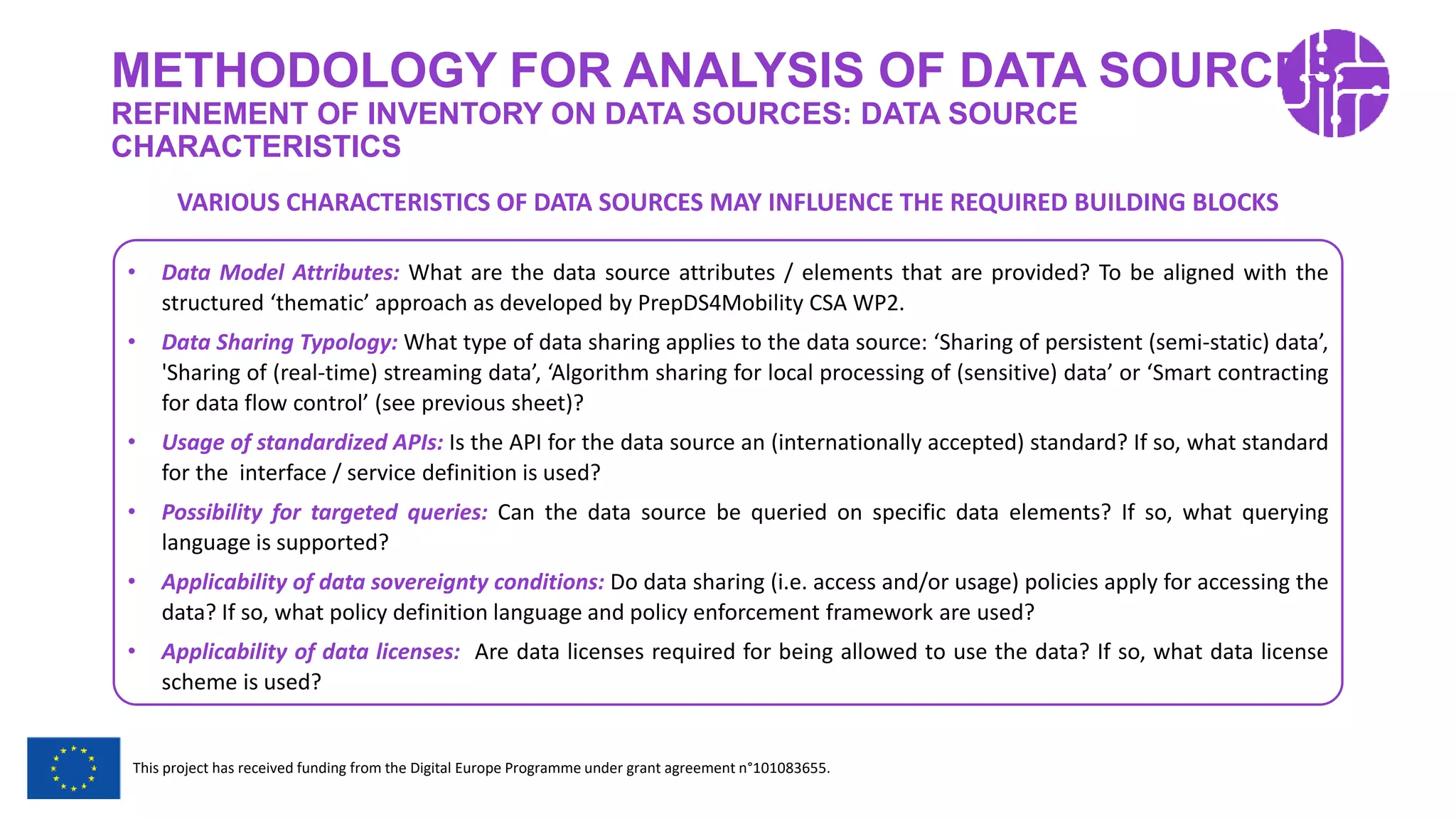
METHODOLOGY FOR ANALYSIS OF DATA SOURCES
REFINEMENT OF INVENTORY ON DATA SOURCES: DATA SOURCE
CHARACTERISTICS
• Data Model Attributes: What are the data source attributes / elements that are provided? To be aligned with the
structured ‘thematic’ approach as developed by PrepDS4Mobility CSA WP2.
• Data Sharing Typology: What type of data sharing applies to the data source: ‘Sharing of persistent (semi-static) data’,
'Sharing of (real-time) streaming data’, ‘Algorithm sharing for local processing of (sensitive) data’ or ‘Smart contracting
for data flow control’ (see previous sheet)?
• Usage of standardized APIs: Is the API for the data source an (internationally accepted) standard? If so, what standard
for the interface / service definition is used?
• Possibility for targeted queries: Can the data source be queried on specific data elements? If so, what querying
language is supported?
• Applicability of data sovereignty conditions: Do data sharing (i.e. access and/or usage) policies apply for accessing the
data? If so, what policy definition language and policy enforcement framework are used?
• Applicability of data licenses: Are data licenses required for being allowed to use the data? If so, what data license
scheme is used?
VARIOUS CHARACTERISTICS OF DATA SOURCES MAY INFLUENCE THE REQUIRED BUILDING BLOCKS
Restricted Use
This project has received funding from the Digital Europe Programme under grant agreement n°101083655.
Methodology for Analysis of Data Sources
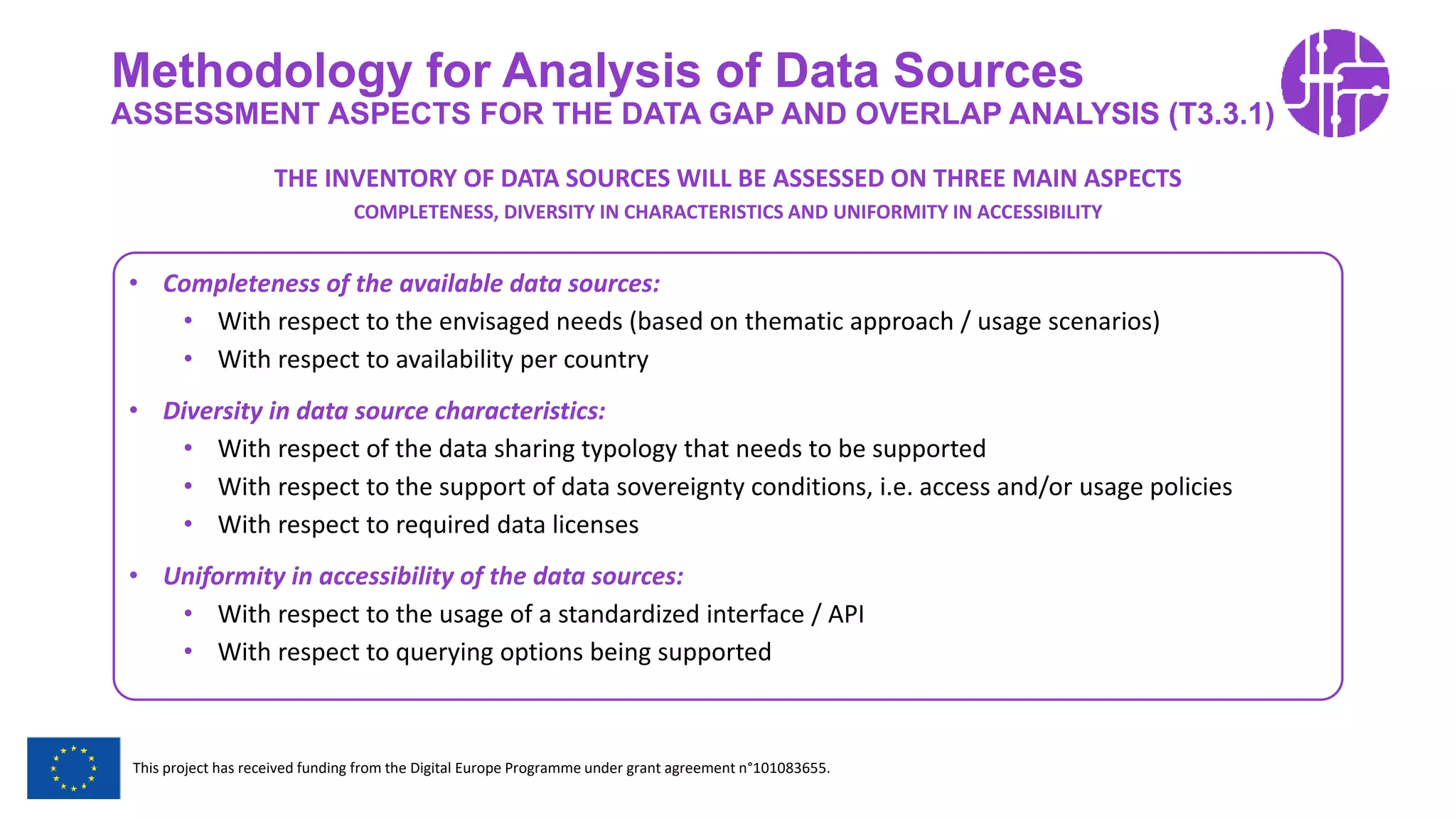
ASSESSMENT ASPECTS FOR THE DATA GAP AND OVERLAP ANALYSIS (T3.3.1)
• Completeness of the available data sources:
• With respect to the envisaged needs (based on thematic approach / usage scenarios)
• With respect to availability per country
• Diversity in data source characteristics:
• With respect of the data sharing typology that needs to be supported
• With respect to the support of data sovereignty conditions, i.e. access and/or usage policies
• With respect to required data licenses
• Uniformity in accessibility of the data sources:
• With respect to the usage of a standardized interface / API
• With respect to querying options being supported
THE INVENTORY OF DATA SOURCES WILL BE ASSESSED ON THREE MAIN ASPECTS
COMPLETENESS, DIVERSITY IN CHARACTERISTICS AND UNIFORMITY IN ACCESSIBILITY
Restricted Use
This project has received funding from the Digital Europe Programme under grant agreement n°101083655.
METHODOLOGY FOR ANALYSIS OF DATA SOURCES
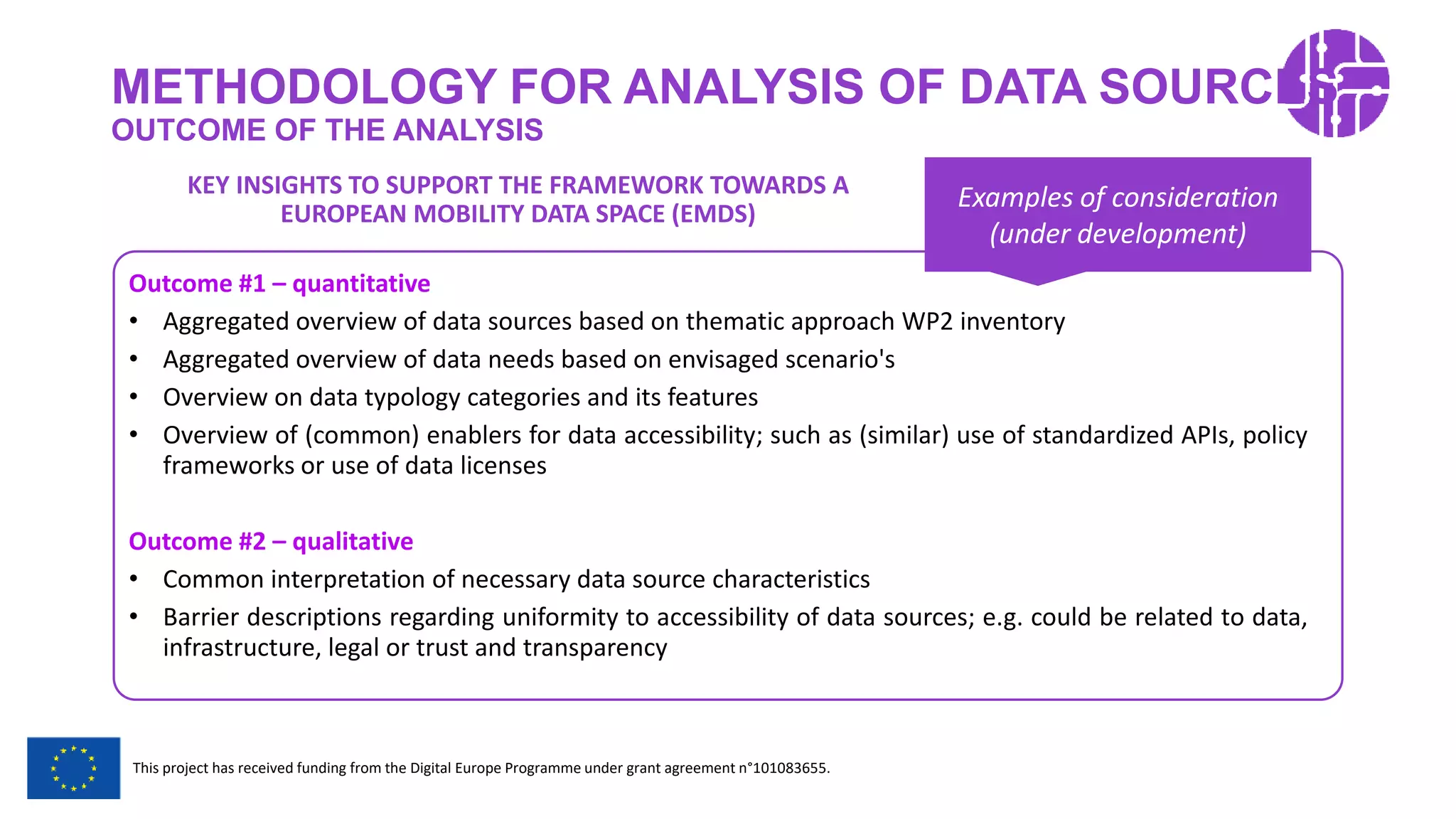
OUTCOME OF THE ANALYSIS
Outcome #1 – quantitative
• Aggregated overview of data sources based on thematic approach WP2 inventory
• Aggregated overview of data needs based on envisaged scenario's
• Overview on data typology categories and its features
• Overview of (common) enablers for data accessibility; such as (similar) use of standardized APIs, policy
frameworks or use of data licenses
Outcome #2 – qualitative
• Common interpretation of necessary data source characteristics
• Barrier descriptions regarding uniformity to accessibility of data sources; e.g. could be related to data,
infrastructure, legal or trust and transparency
Examples of consideration
(under development)
KEY INSIGHTS TO SUPPORT THE FRAMEWORK TOWARDS A
EUROPEAN MOBILITY DATA SPACE (EMDS)
Restricted Use
This project has received funding from the Digital Europe Programme under grant agreement n°101083655.
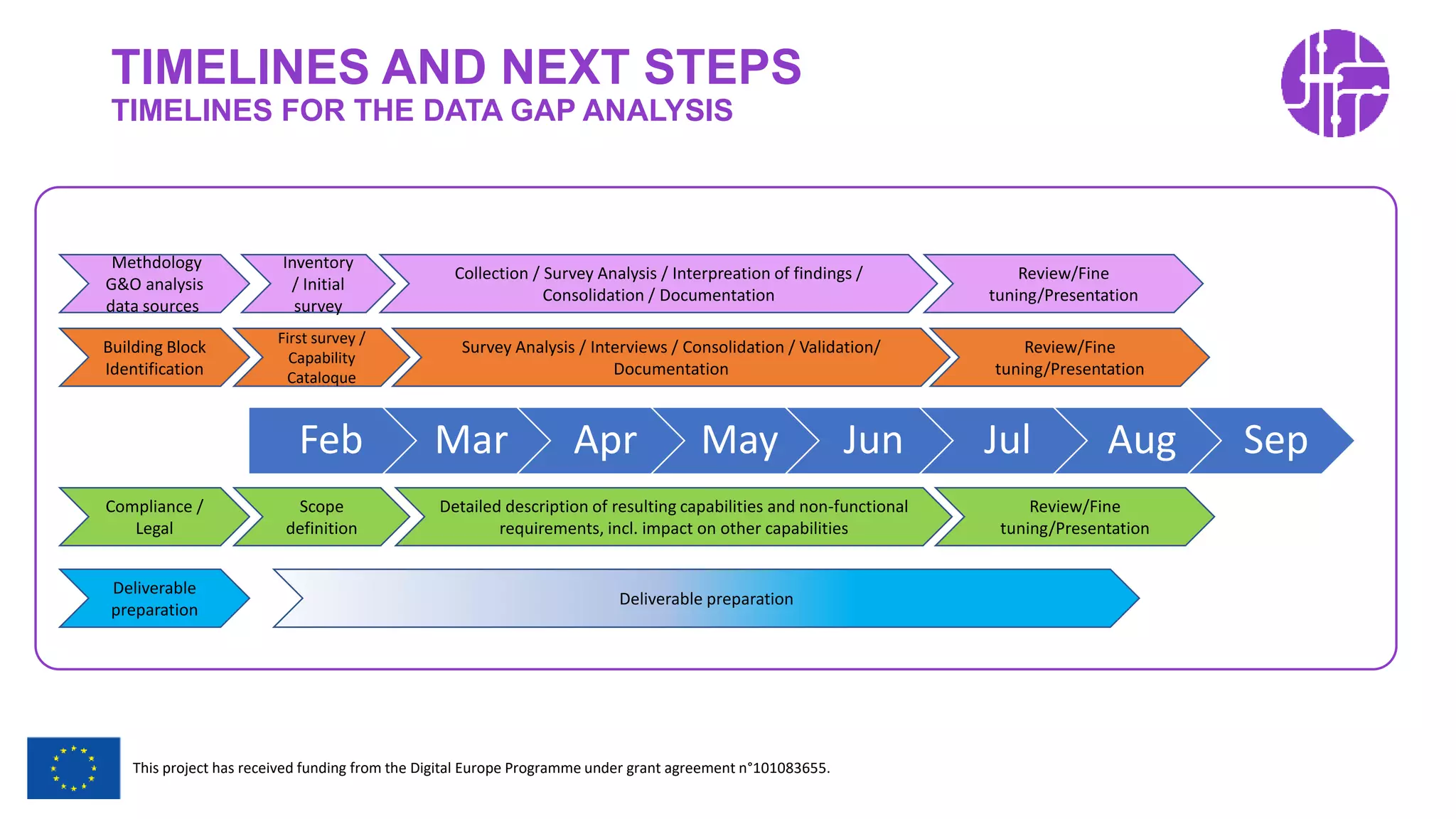
Feb Mar Apr May Jun Jul Aug Sep
Building Block
Identification
First survey /
Capability
Cataloque
Survey Analysis / Interviews / Consolidation / Validation/
Documentation
Review/Fine
tuning/Presentation
Compliance /
Legal
Scope
definition
Detailed description of resulting capabilities and non-functional
requirements, incl. impact on other capabilities
Review/Fine
tuning/Presentation
Deliverable
preparation
Deliverable preparation
Methdology
G&O analysis
data sources
Collection / Survey Analysis / Interpreation of findings /
Consolidation / Documentation
Review/Fine
tuning/Presentation
Inventory
/ Initial
survey
TIMELINES AND NEXT STEPS
TIMELINES FOR THE DATA GAP ANALYSIS
Restricted Use
This project has received funding from the Digital Europe Programme under grant agreement n°101083655.
TIMELINES AND NEXT STEPS
NEXT STEPS FOR THE DATA GAP ANALYSIS
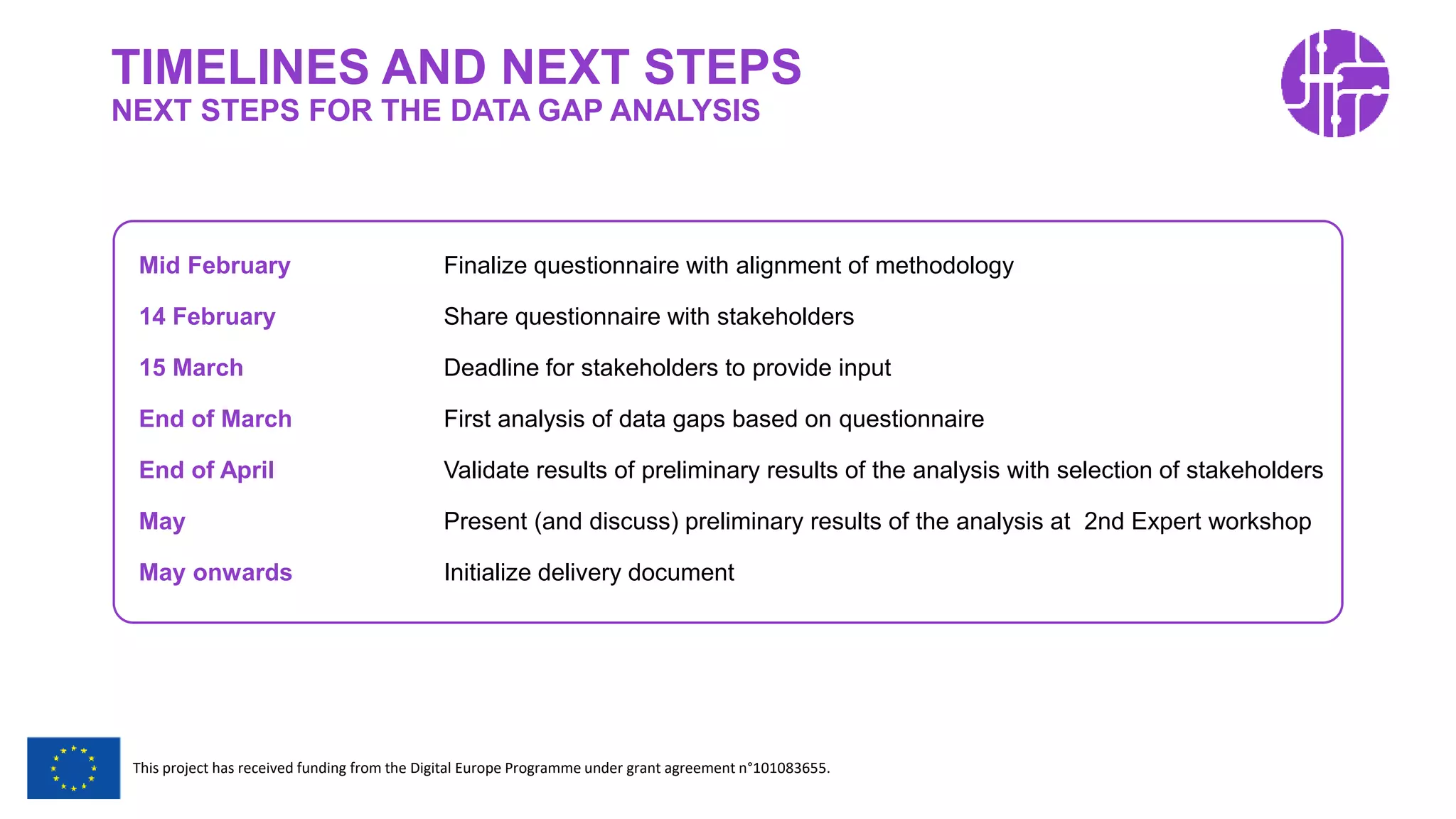
Mid February Finalize questionnaire with alignment of methodology
14 February Share questionnaire with stakeholders
15 March Deadline for stakeholders to provide input
End of March First analysis of data gaps based on questionnaire
End of April Validate results of preliminary results of the analysis with selection of stakeholders
May Present (and discuss) preliminary results of the analysis at 2nd Expert workshop
May onwards Initialize delivery document
Restricted Use
This project has received funding from the Digital Europe Programme under grant agreement n°101083655.
QUESTIONS AND DISCUSSIONS
1. Feasibility of the methodology presented for the data gap
analysis
2. Representative use cases from the private domain for
controlled data sharing
3. Additional assessment aspects to:
• Completeness of the available data sources
• Diversity in data source characteristics
• Uniformity in accessibility of the data sources
Please get involved by providing your input on
the inventory on data sources and platforms
Restricted Use
This project has received funding from the Digital Europe Programme under grant agreement n°101083655.

PrepData4Mobilty Data Gap Analysis - Approach and Discussion.pptx

  • 1.
    Restricted Use Funded bythe European Union. Views and opinions expressed are however those of the author(s) only and do not necessarily reflect those of the European Commission. Neither the European Union nor the granting authority can be held responsible for them. Data Gap Analysis Approach and Discussion First Expert Workshop 31.01.2023
  • 2.
    Restricted Use This projecthas received funding from the Digital Europe Programme under grant agreement n°101083655. AGENDA • Background and Goals • The Bigger Picture • Approach for the Data Gap Analysis • Timelines and Next Steps • Questions and Discussion
  • 3.
    Restricted Use This projecthas received funding from the Digital Europe Programme under grant agreement n°101083655. Infrastructure (incl CCAM) • Road •Incl CCAM • Rail • Air • Inland waterway freight • Sea-based freight • … BACKGROUND AND GOALS THE THREE PILLARS OF MOBILITY Personal Mobility • Public transport • Individual transport • Shared mobility • Multimodal mobility • On-demand mobility • Mobility-as-a-Service • … Freight • Logistics • Operation services • Stakeholders • ... Under Consideration SUMI Indicators
  • 4.
    Restricted Use This projecthas received funding from the Digital Europe Programme under grant agreement n°101083655. BACKGROUND AND GOALS DATA SOURCE ANALYSIS: GAPS AND OVERLAPS • A methodology is needed: • For the data gap and overlap analysis, • For identifying building blocks for the European Mobility Data Space (EMDS), • This methodology also feeds in next phase of WP2 (Inventory) to: • Identify the information needs on data sources and platforms: Inventory Refinement IDENTIFY GAPS AND OVERLAPS OF DATA CURRENTLY COVERED (OR NOT COVERED) BY EXISTING INITIATIVES IN VIEW OF POSSIBLY LAUNCHING ADDITIONAL INITIATIVES TO COVER SUCH GAPS 1. Define initial criteria (‘threshold’) for the analysis of data gaps and overlaps based on identified data needs 2. Identify gaps and overlaps of data currently covered (or not covered) by existing initiatives
  • 5.
    Restricted Use This projecthas received funding from the Digital Europe Programme under grant agreement n°101083655. THE BIGGER PICTURE THE EU AMBITION EU Data Strategy * Towards a Federation of Interoperable Data Spaces Thiery Breton EU Commissioner for Internal Makets * European Commission. “A European strategy for data”, 2020. https://digital-strategy.ec.europa.eu/en/policies/strategy-data A SINGLE MARKET FOR DATA
  • 6.
    Restricted Use This projecthas received funding from the Digital Europe Programme under grant agreement n°101083655. THE BIGGER PICTURE A FEDERATION OF INTEROPERABLE DATA SPACES EU DATA SPACES SUPPORT CENTRE (DSSC) * EU Data Spaces Support Centre (DSSC) initiative. “Starter Kit for Data Space Designers - Interim Version”. https://dssc.eu/ DSSC Starter Kit for Data Space Designers *
  • 7.
    Restricted Use This projecthas received funding from the Digital Europe Programme under grant agreement n°101083655. THE BIGGER PICTURE A FEDERATION OF INTEROPERABLE DATA SPACES Source: The Netherlands AI Coalition (NL AIC) Working Group Data Sharing (2021). “Towards a federation of AI data spaces - NL AIC reference guide to federated and interoperable AI data spaces”. https://nlaic.com/wp-content/uploads/2021/11/NL_AIC_Towards_a_federation_of_AI_data_spaces.pdf.pdf. INTRA DATA SPACE INTEROPERABILITY INTER DATA SPACE INTEROPERABILITY INTEROPERABILTY BOTH WITHIN (‘INTRA’) AND BETWEEN (‘INTER’) DATA SPACES
  • 8.
    Restricted Use This projecthas received funding from the Digital Europe Programme under grant agreement n°101083655. THE BIGGER PICTURE A FEDERATION OF INTEROPERABLE DATA SPACES * European Union (2017). “New European Interoperability Framework (EIF) – Promoting seamless services and data flows for European public administrations”. https://ec.europa.eu/isa2/sites/isa/files/eif_brochure_final.pdf. EUROPEAN INTEROPERABILITY FRAMEWORK (EIF) * DATA SPACE INTEROPERABILITY (BOTH ‘INTRA’ AND ‘INTER’ DATA SPACE INTEROPERABILITY) IS MORE THAN MERELY THE INTEROPERABILITY OF ITS TECHNICAL COMPONENTS *
  • 9.
    Restricted Use This projecthas received funding from the Digital Europe Programme under grant agreement n°101083655. METHODOLOGY FOR ANALYSIS OF BUILDING BLOCKS PREPDS4MOBILITY CSA BUSINESS: CONSIDERATIONS • To what extend does EMDS take a ‘generic’ data space approach?, and, as such, addresses a duality in ‘generic’ and ‘specific’ EU data sharing initiatives, i.e.: • Generic initiatives aim to be generically applicable to and over multiple sectors and application areas. • Specific initiatives target a specific sector and / or application area, based on domain-specific data sharing functionalities. • Does EMDS support each of the four types of data sharing?, being 'sharing of persistent (semi-static) data', 'sharing of (real-time) streaming data‘, ‘algorithm sharing for local processing of (sensitive) data', and ‘smart contracting for data flow control ‘. • Does EMDS enable data services across data spaces?, i.e. to make data services accessible both within and across multiple data space instances, both an intra and inter data space interoperability architecture needs to be developed. • How is EMDS operationalized (e.g. by a four-corner * operations model)?, with well-defined roles and responsibilities of various types service providers to deploy and operate the MDS, e.g..: ‘Infrastructure-as-a-Service Provider (IaaSP)’ roles, ‘Connecting Service Provider (CSP)’ roles and ‘Value Adding Service Provider’ roles. CONSIDERATIONS TO BE TAKEN INTO ACCOUNT IN THE PREPDS4MOBILITY CSA DATA GAPS AND BUILDING BLOCKS ANALYSIS WHEN POSITIONING EMDS WITHIN ‘A FEDERATION OF INTEROPERABLE DATA SPACES’ • Qvalia. "Understanding the Peppol four-corner model of business exchange”. https://qvalia.com/blog/understanding-the-peppol-four-corner-model-of-business-exchange..
  • 10.
    Restricted Use This projecthas received funding from the Digital Europe Programme under grant agreement n°101083655. 1. Refinement of inventory on data sources (in WP2) on: • Data sharing needs • Data sharing typology • Data source characteristics 2. Assessment of refined inventory on data sources with respect to: • Completeness of the available data sources • Diversity in data source characteristics • Uniformity in accessibility of the data sources METHODOLOGY FOR ANALYSIS OF DATA SOURCES TWO-STEP APPROACH THE METHODOLOGY FOR ANALYSIS OF DATA SOURCES - A 2-STEP APPROACH
  • 11.
    Restricted Use This projecthas received funding from the Digital Europe Programme under grant agreement n°101083655. Refinement of inventory on data sharing needs: • To support key EU initiatives, e.g.: • Sustainable and Smart Mobility Strategy • ITS Directive, Data for Road Safety • … • To support common usage scenarios: • Extending the data needs in the thematic approach in the inventory (WP2) • To be validated by representative use cases METHODOLOGY FOR ANALYSIS OF DATA SOURCES REFINEMENT OF INVENTORY ON DATA SOURCES: DATA SHARING NEEDS
  • 12.
    Restricted Use This projecthas received funding from the Digital Europe Programme under grant agreement n°101083655. METHODOLOGY FOR ANALYSIS OF DATA SOURCES REFINEMENT OF INVENTORY ON DATA SOURCES: TYPOLOGY OF DATA SHARING • Sharing of persistent (semi-static) data. This may for instance be (sensitive) operations data, for which sharing across organizations enables a competitive collaborative strategy, yields efficiency gains, provides new business opportunities or serve public goals. • Sharing of (real-time) streaming data: To an ever larger extent, sensors and actuators provide real-time streaming data as part of the emerging Internet-of-Things (IoT). The data streams may have to be shared in a controlled manner with multiple receivers / consumers, with timeliness being an important aspect. • Algorithm sharing for local processing of (sensitive) data: This allows processing algorithms to locally access sensitive data, i.e. within the domain of a data services provider. This may prevent sensitive data from having to be shared at all: only processed results are shared. This way, for instance distributed AI algorithms (e.g. Federated Learning) or Privacy Enhancing Technologies (PETs, e.g. secure Multi-Party Computation) can use sensitive or private data without the need for that data to be shared with third parties. • Smart contracting for data flow control: This allows data to be shared between organizations by means of a controlled data flow. In logistics for example, event-driven real-time data flow control allows improved visibility along the supply chain and tracking of goods and trucks and transportation conditions (e.g. for perishable goods) and enables for (automated) sharing of transport documents for business reporting or legal compliance. THE PREPDS4MOBILITY CSA WP3 DISTINGUISHES FOUR TYPES OF DATA SHARING IN THE ANALYSIS * • TKI Dinalog Data Logistics for Logistics Data (DL4LD) project e.a. (2020) “The Logistics Data Sharing Infrastructure - White Paper”. https://www.dinalog.nl/wp-content/uploads/2020/08/Dinalog_Whitepaper-Data-Infrastructure_DEF.pdf.
  • 13.
    Restricted Use This projecthas received funding from the Digital Europe Programme under grant agreement n°101083655. METHODOLOGY FOR ANALYSIS OF DATA SOURCES REFINEMENT OF INVENTORY ON DATA SOURCES: DATA SOURCE CHARACTERISTICS • Data Model Attributes: What are the data source attributes / elements that are provided? To be aligned with the structured ‘thematic’ approach as developed by PrepDS4Mobility CSA WP2. • Data Sharing Typology: What type of data sharing applies to the data source: ‘Sharing of persistent (semi-static) data’, 'Sharing of (real-time) streaming data’, ‘Algorithm sharing for local processing of (sensitive) data’ or ‘Smart contracting for data flow control’ (see previous sheet)? • Usage of standardized APIs: Is the API for the data source an (internationally accepted) standard? If so, what standard for the interface / service definition is used? • Possibility for targeted queries: Can the data source be queried on specific data elements? If so, what querying language is supported? • Applicability of data sovereignty conditions: Do data sharing (i.e. access and/or usage) policies apply for accessing the data? If so, what policy definition language and policy enforcement framework are used? • Applicability of data licenses: Are data licenses required for being allowed to use the data? If so, what data license scheme is used? VARIOUS CHARACTERISTICS OF DATA SOURCES MAY INFLUENCE THE REQUIRED BUILDING BLOCKS
  • 14.
    Restricted Use This projecthas received funding from the Digital Europe Programme under grant agreement n°101083655. Methodology for Analysis of Data Sources ASSESSMENT ASPECTS FOR THE DATA GAP AND OVERLAP ANALYSIS (T3.3.1) • Completeness of the available data sources: • With respect to the envisaged needs (based on thematic approach / usage scenarios) • With respect to availability per country • Diversity in data source characteristics: • With respect of the data sharing typology that needs to be supported • With respect to the support of data sovereignty conditions, i.e. access and/or usage policies • With respect to required data licenses • Uniformity in accessibility of the data sources: • With respect to the usage of a standardized interface / API • With respect to querying options being supported THE INVENTORY OF DATA SOURCES WILL BE ASSESSED ON THREE MAIN ASPECTS COMPLETENESS, DIVERSITY IN CHARACTERISTICS AND UNIFORMITY IN ACCESSIBILITY
  • 15.
    Restricted Use This projecthas received funding from the Digital Europe Programme under grant agreement n°101083655. METHODOLOGY FOR ANALYSIS OF DATA SOURCES OUTCOME OF THE ANALYSIS Outcome #1 – quantitative • Aggregated overview of data sources based on thematic approach WP2 inventory • Aggregated overview of data needs based on envisaged scenario's • Overview on data typology categories and its features • Overview of (common) enablers for data accessibility; such as (similar) use of standardized APIs, policy frameworks or use of data licenses Outcome #2 – qualitative • Common interpretation of necessary data source characteristics • Barrier descriptions regarding uniformity to accessibility of data sources; e.g. could be related to data, infrastructure, legal or trust and transparency Examples of consideration (under development) KEY INSIGHTS TO SUPPORT THE FRAMEWORK TOWARDS A EUROPEAN MOBILITY DATA SPACE (EMDS)
  • 16.
    Restricted Use This projecthas received funding from the Digital Europe Programme under grant agreement n°101083655. Feb Mar Apr May Jun Jul Aug Sep Building Block Identification First survey / Capability Cataloque Survey Analysis / Interviews / Consolidation / Validation/ Documentation Review/Fine tuning/Presentation Compliance / Legal Scope definition Detailed description of resulting capabilities and non-functional requirements, incl. impact on other capabilities Review/Fine tuning/Presentation Deliverable preparation Deliverable preparation Methdology G&O analysis data sources Collection / Survey Analysis / Interpreation of findings / Consolidation / Documentation Review/Fine tuning/Presentation Inventory / Initial survey TIMELINES AND NEXT STEPS TIMELINES FOR THE DATA GAP ANALYSIS
  • 17.
    Restricted Use This projecthas received funding from the Digital Europe Programme under grant agreement n°101083655. TIMELINES AND NEXT STEPS NEXT STEPS FOR THE DATA GAP ANALYSIS Mid February Finalize questionnaire with alignment of methodology 14 February Share questionnaire with stakeholders 15 March Deadline for stakeholders to provide input End of March First analysis of data gaps based on questionnaire End of April Validate results of preliminary results of the analysis with selection of stakeholders May Present (and discuss) preliminary results of the analysis at 2nd Expert workshop May onwards Initialize delivery document
  • 18.
    Restricted Use This projecthas received funding from the Digital Europe Programme under grant agreement n°101083655. QUESTIONS AND DISCUSSIONS 1. Feasibility of the methodology presented for the data gap analysis 2. Representative use cases from the private domain for controlled data sharing 3. Additional assessment aspects to: • Completeness of the available data sources • Diversity in data source characteristics • Uniformity in accessibility of the data sources Please get involved by providing your input on the inventory on data sources and platforms
  • 19.
    Restricted Use This projecthas received funding from the Digital Europe Programme under grant agreement n°101083655.

Editor's Notes

  • #4 To understand overarching types of data sharing to be supported in EMDS To understand current state of data characteristics as it is important for alignment with building block analysis Enabling current state 
  • #11 To understand overarching types of data sharing to be supported in EMDS To understand current state of data characteristics as it is important for alignment with building block analysis Enabling current state 
  • #12 To understand overarching types of data sharing to be supported in EMDS To understand current state of data characteristics as it is important for alignment with building block analysis Enabling current state 
  • #17 "Building Blocks" are usually a container for a group of related requirements, which a real system must/should meet. The objective of PrepDS4Mobility to prepare a guideline for the implementation of a mobility DS (almost everyone of the audience is already involved in that), a possible strategy could be to provide to the future projects answers and solutions to the requirements which they face.