Preliminaries For
Export Import
Meaning & Definition of Export
Meaning:
An export is a function of international trade whereby goods produced in one
country are shipped to another country for future sale or trade. If used for trade,
exports are exchanged for other products or services in other countries.
To send goods or services across national borders for the purpose of selling and
realizing foreign exchange. It can be shipped, sent by email, or carried in
personal luggage on a plane.
Definition:
The term export is derived from the conceptual meaning as to ship the goods
and services out of the port of a country The seller of such goods and services
is referred as an "exporter" who is based in the country of export
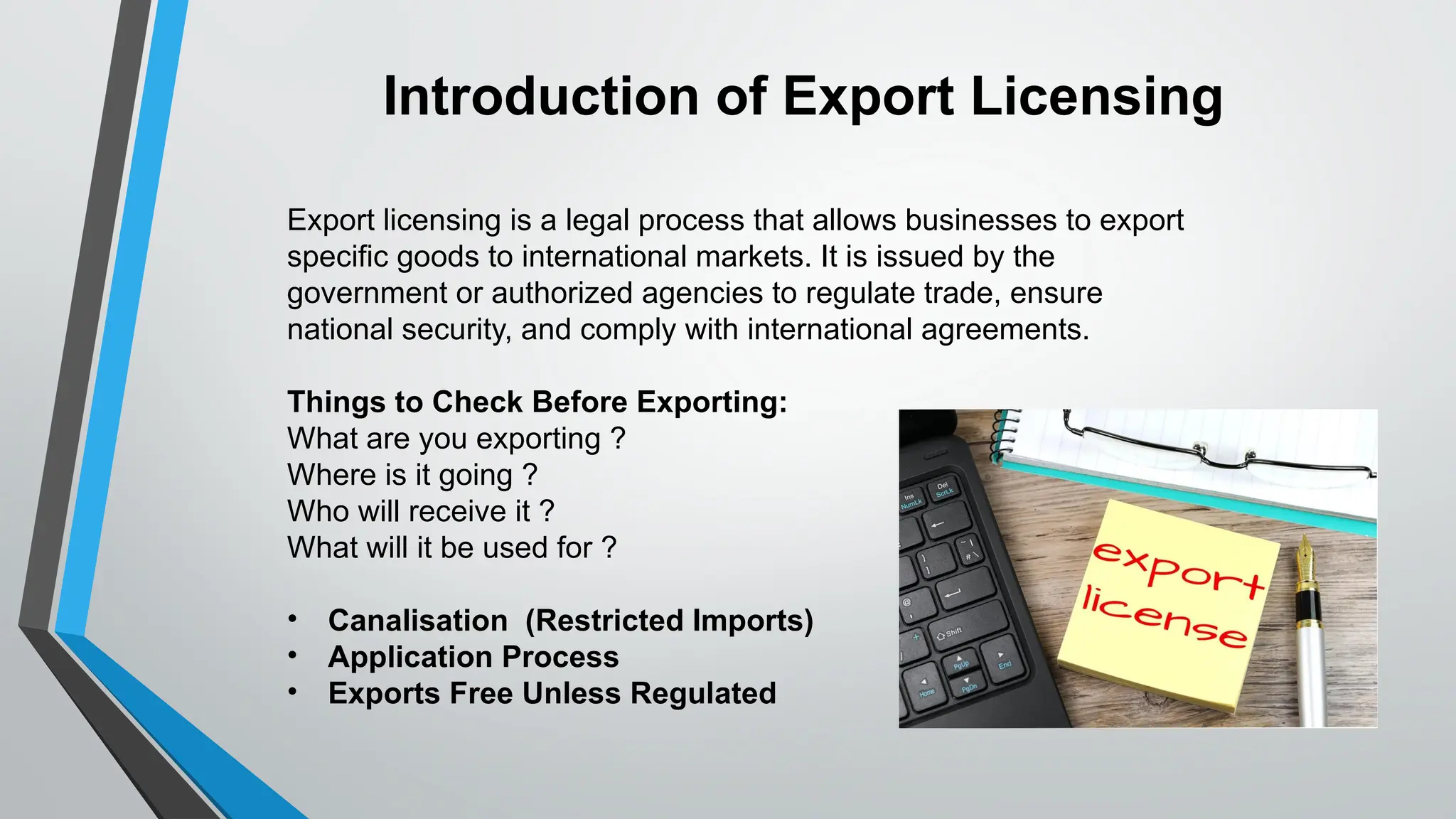
Export licensing is a legal process that allows businesses to export
specific goods to international markets. It is issued by the
government or authorized agencies to regulate trade, ensure
national security, and comply with international agreements.
Things to Check Before Exporting:
What are you exporting ?
Where is it going ?
Who will receive it ?
What will it be used for ?
• Canalisation (Restricted Imports)
• Application Process
• Exports Free Unless Regulated
Introduction of Export Licensing
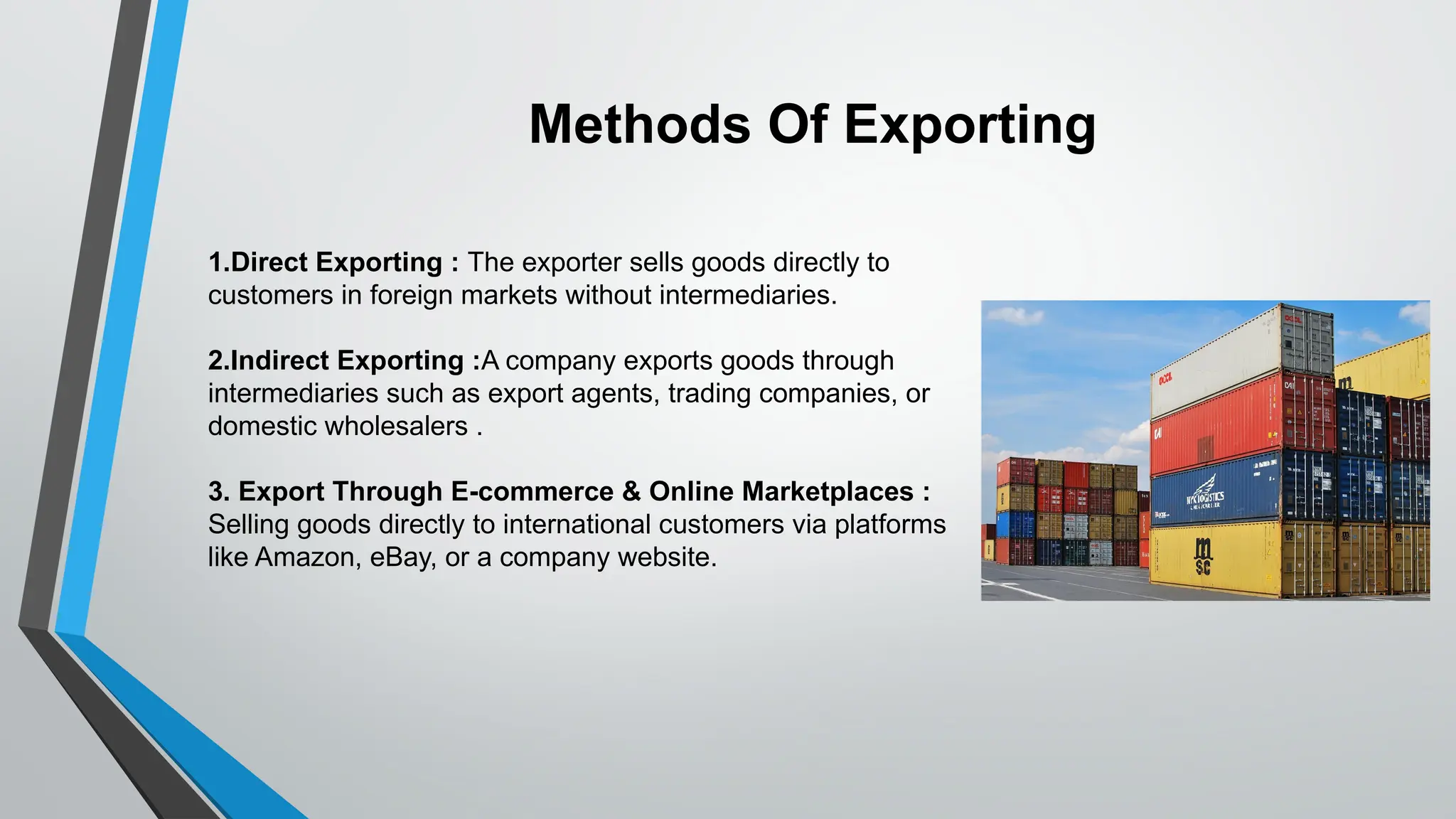
1.Direct Exporting : The exporter sells goods directly to
customers in foreign markets without intermediaries.
2.Indirect Exporting :A company exports goods through
intermediaries such as export agents, trading companies, or
domestic wholesalers .
3. Export Through E-commerce & Online Marketplaces :
Selling goods directly to international customers via platforms
like Amazon, eBay, or a company website.
Methods Of Exporting
1. Importer Exporter Code (IEC) Registration
2. Registration with Export Promotion Councils (EPCs)
3. Registration with the Ministry of Commerce and Industry
4. GST Registration
5. SEIS (Service Exports from India Scheme) Registration
6. MEIS (Merchandise Exports from India Scheme) Registration
7. Registration with the Reserve Bank of India (RBI
8. Registration with the Customs Department
9. Obtaining an Export License
10.Compliance with Export Regulations
Registration Formalities for Export
Documents Required For Registration
1. PAN Crd
2. Aadhaar aCard
3. Business Registration Certificate
4. ID Proof
5. Address Proof
6. Bank Account Details
7. GSTIN
Factors to Consider:
1. Market Demand
2. Competitive Advantage
3. Government Policies & Regulations
4. Production & Supply Capability
5. Profitability & Pricing
6. Target Market Research
7. Sustainability & Ethical Practices
Selection of Export Product
FOB (Free on Board):
Definition: The seller's responsibility ends once the goods are loaded onto the shipping
vessel.
Key Points:
• Buyer bears all costs and risks once the goods are on board.
• FOB Origin: Buyer arranges and pays for transport.
• FOB Destination: Seller arranges transport but buyer still covers costs.
CIF (Cost, Insurance, and Freight):
Definition: The seller covers the cost of goods, insurance, and freight to the destination port.
Key Points:
• Seller bears the risk until the goods reach the destination port.
• Seller arranges and pays for transport and insurance.
• Buyer is responsible for import duties and further transport after the port.
FOB & CIF
Meaning:
Imports refer to goods and services purchased from other countries and brought into a
country for consumption, resale, or production purposes.
Definition:
The act of bringing goods or services into a country from another country for sale,
consumption, or use, typically for commercial purposes.
Importance of Imports:
The backbone of international trade.
Provides more choices to consumers.
Helps manage household budgets with cheaper options.
Allows countries to access technology, natural resources, and labor at a lower cost.
Meaning & Definition Of Import
Definition:
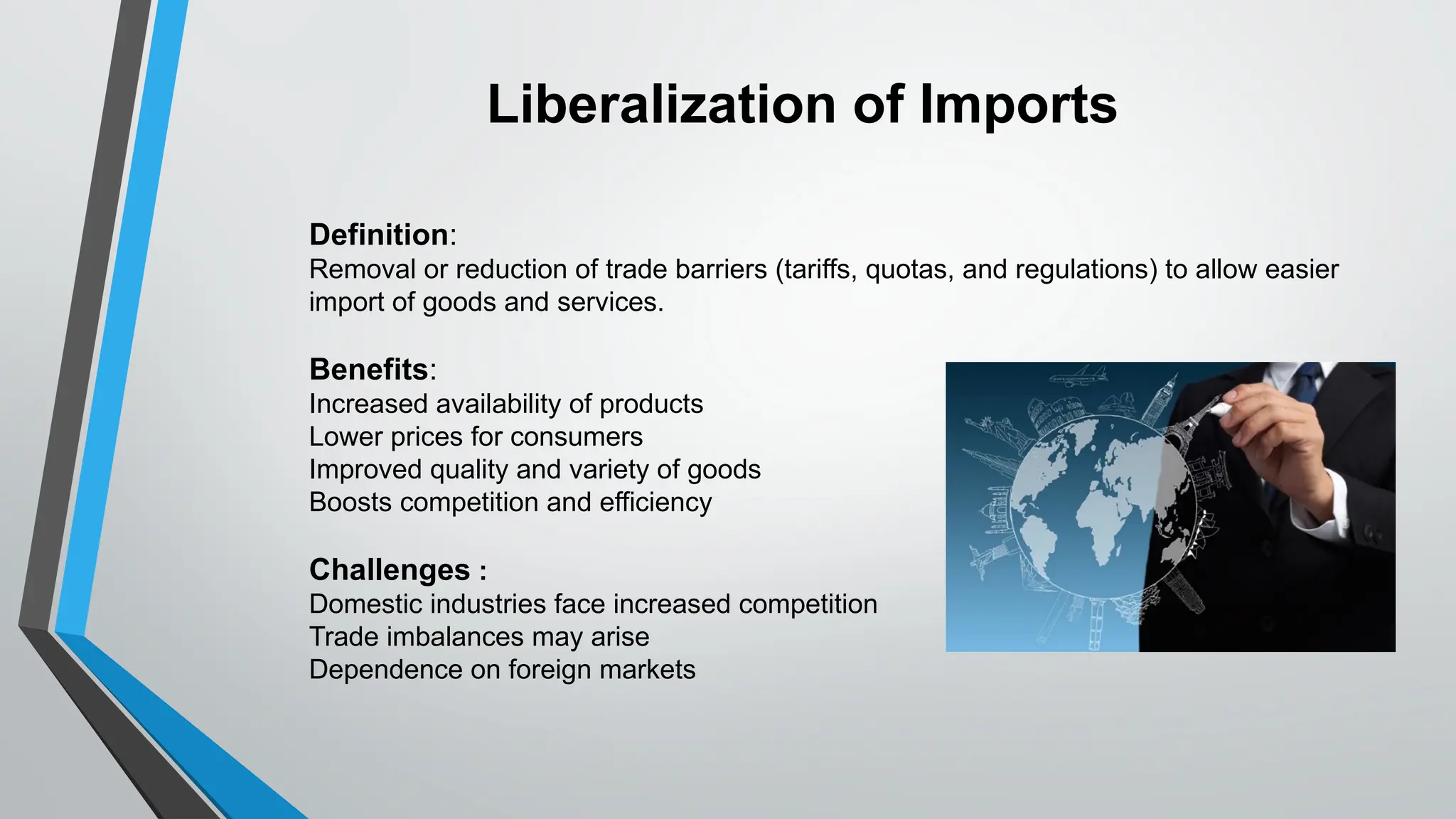
Removal or reduction of trade barriers (tariffs, quotas, and regulations) to allow easier
import of goods and services.
Benefits:
Increased availability of products
Lower prices for consumers
Improved quality and variety of goods
Boosts competition and efficiency
Challenges :
Domestic industries face increased competition
Trade imbalances may arise
Dependence on foreign markets
Liberalization of Imports
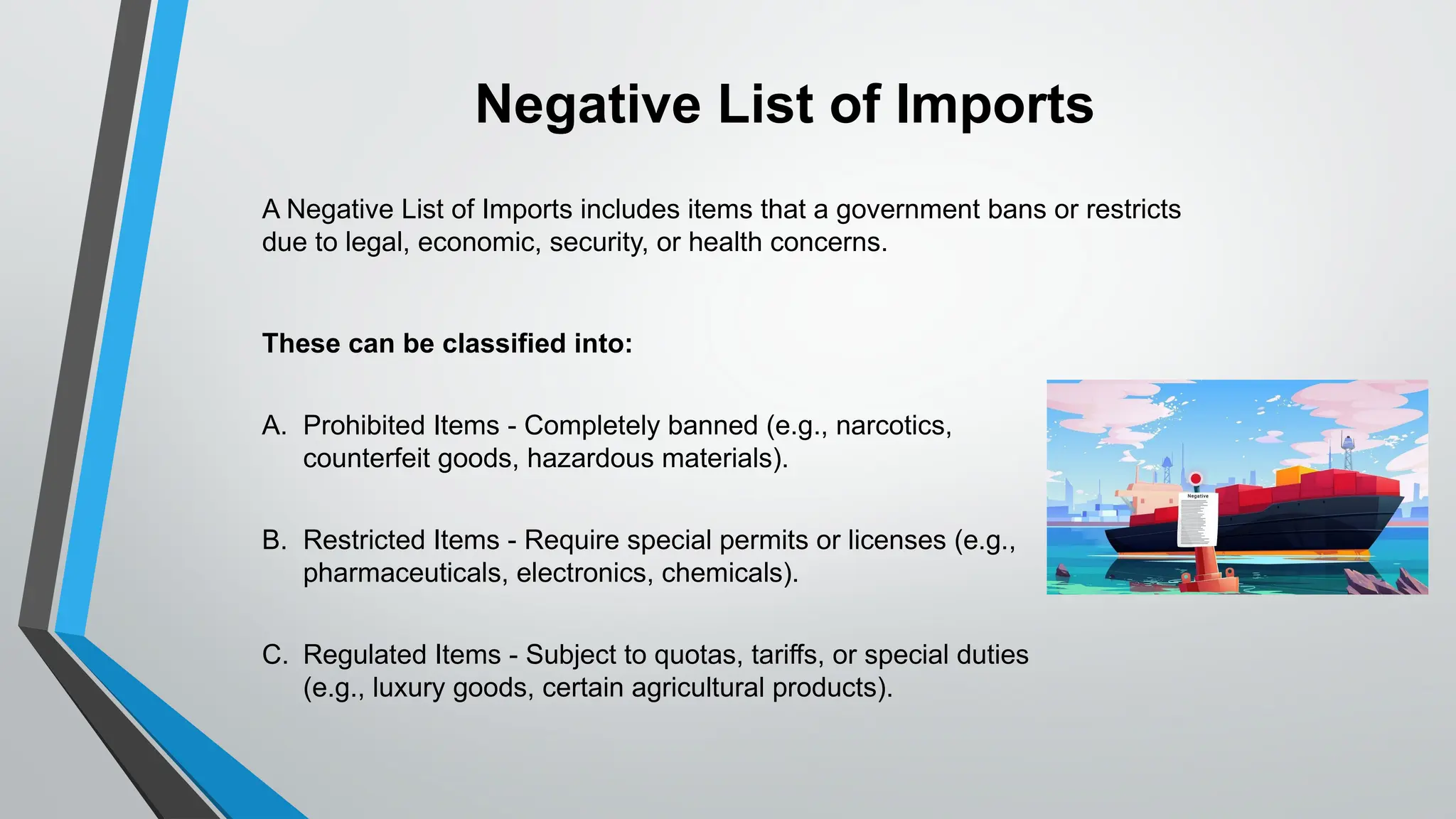
These can be classified into:
A. Prohibited Items - Completely banned (e.g., narcotics,
counterfeit goods, hazardous materials).
B. Restricted Items - Require special permits or licenses (e.g.,
pharmaceuticals, electronics, chemicals).
C. Regulated Items - Subject to quotas, tariffs, or special duties
(e.g., luxury goods, certain agricultural products).
Negative List of Imports
A Negative List of Imports includes items that a government bans or restricts
due to legal, economic, security, or health concerns.
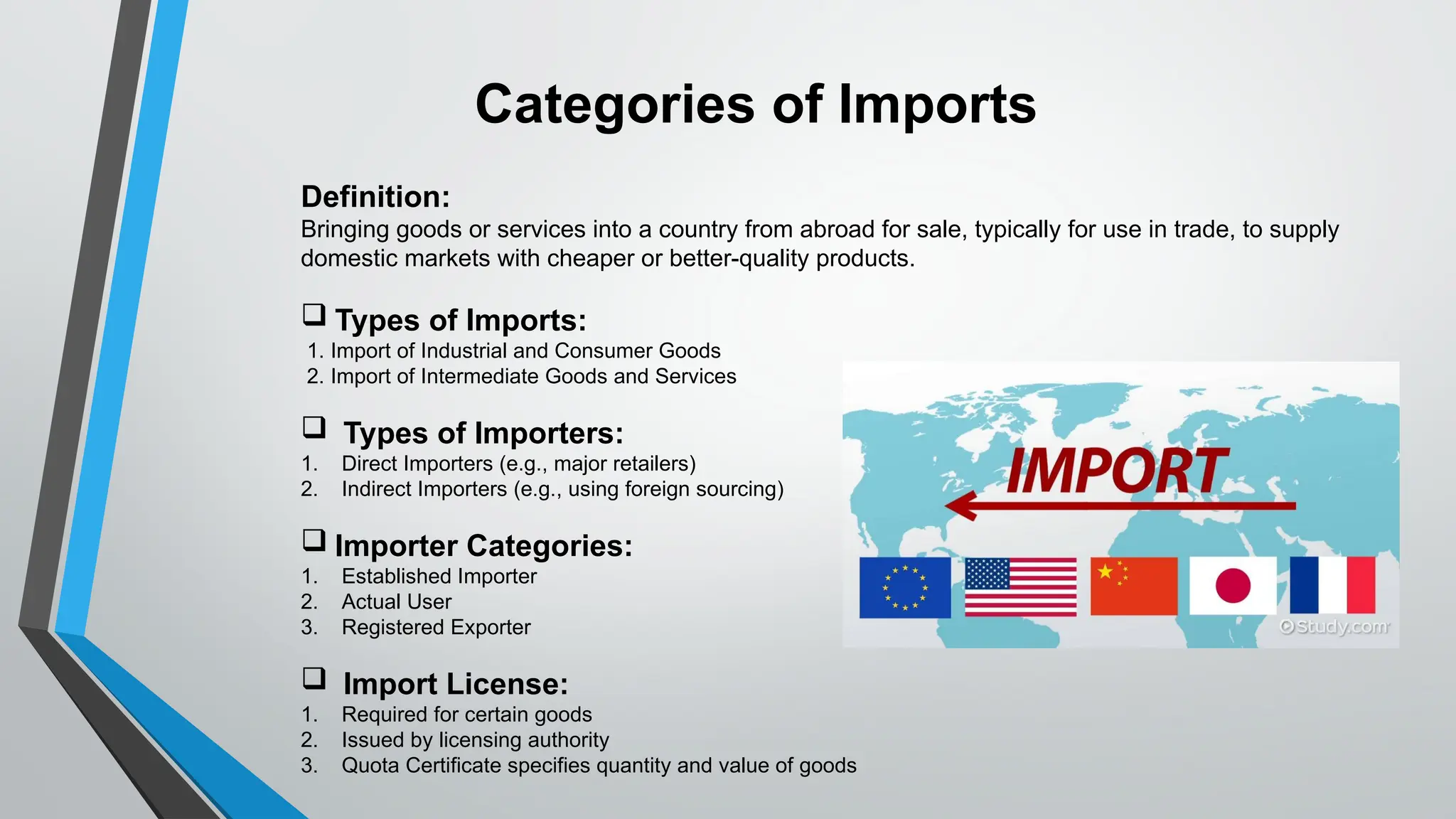
Categories of Imports
Definition:
Bringing goods or services into a country from abroad for sale, typically for use in trade, to supply
domestic markets with cheaper or better-quality products.
 Types of Imports:
1. Import of Industrial and Consumer Goods
2. Import of Intermediate Goods and Services
 Types of Importers:
1. Direct Importers (e.g., major retailers)
2. Indirect Importers (e.g., using foreign sourcing)
 Importer Categories:
1. Established Importer
2. Actual User
3. Registered Exporter
 Import License:
1. Required for certain goods
2. Issued by licensing authority
3. Quota Certificate specifies quantity and value of goods
Special Schemes for Importers
1. Preferential Rates
2. Duty Entitlement Passbook (DEPB)
Scheme
3. Agri Export Zones
4. Deemed Exports
THANK YOU

Preliminaries for Export and Import

  • 1.
  • 2.
    Meaning & Definitionof Export Meaning: An export is a function of international trade whereby goods produced in one country are shipped to another country for future sale or trade. If used for trade, exports are exchanged for other products or services in other countries. To send goods or services across national borders for the purpose of selling and realizing foreign exchange. It can be shipped, sent by email, or carried in personal luggage on a plane. Definition: The term export is derived from the conceptual meaning as to ship the goods and services out of the port of a country The seller of such goods and services is referred as an "exporter" who is based in the country of export
  • 3.
    Export licensing isa legal process that allows businesses to export specific goods to international markets. It is issued by the government or authorized agencies to regulate trade, ensure national security, and comply with international agreements. Things to Check Before Exporting: What are you exporting ? Where is it going ? Who will receive it ? What will it be used for ? • Canalisation (Restricted Imports) • Application Process • Exports Free Unless Regulated Introduction of Export Licensing
  • 4.
    1.Direct Exporting :The exporter sells goods directly to customers in foreign markets without intermediaries. 2.Indirect Exporting :A company exports goods through intermediaries such as export agents, trading companies, or domestic wholesalers . 3. Export Through E-commerce & Online Marketplaces : Selling goods directly to international customers via platforms like Amazon, eBay, or a company website. Methods Of Exporting
  • 5.
    1. Importer ExporterCode (IEC) Registration 2. Registration with Export Promotion Councils (EPCs) 3. Registration with the Ministry of Commerce and Industry 4. GST Registration 5. SEIS (Service Exports from India Scheme) Registration 6. MEIS (Merchandise Exports from India Scheme) Registration 7. Registration with the Reserve Bank of India (RBI 8. Registration with the Customs Department 9. Obtaining an Export License 10.Compliance with Export Regulations Registration Formalities for Export Documents Required For Registration 1. PAN Crd 2. Aadhaar aCard 3. Business Registration Certificate 4. ID Proof 5. Address Proof 6. Bank Account Details 7. GSTIN
  • 6.
    Factors to Consider: 1.Market Demand 2. Competitive Advantage 3. Government Policies & Regulations 4. Production & Supply Capability 5. Profitability & Pricing 6. Target Market Research 7. Sustainability & Ethical Practices Selection of Export Product
  • 7.
    FOB (Free onBoard): Definition: The seller's responsibility ends once the goods are loaded onto the shipping vessel. Key Points: • Buyer bears all costs and risks once the goods are on board. • FOB Origin: Buyer arranges and pays for transport. • FOB Destination: Seller arranges transport but buyer still covers costs. CIF (Cost, Insurance, and Freight): Definition: The seller covers the cost of goods, insurance, and freight to the destination port. Key Points: • Seller bears the risk until the goods reach the destination port. • Seller arranges and pays for transport and insurance. • Buyer is responsible for import duties and further transport after the port. FOB & CIF
  • 8.
    Meaning: Imports refer togoods and services purchased from other countries and brought into a country for consumption, resale, or production purposes. Definition: The act of bringing goods or services into a country from another country for sale, consumption, or use, typically for commercial purposes. Importance of Imports: The backbone of international trade. Provides more choices to consumers. Helps manage household budgets with cheaper options. Allows countries to access technology, natural resources, and labor at a lower cost. Meaning & Definition Of Import
  • 9.
    Definition: Removal or reductionof trade barriers (tariffs, quotas, and regulations) to allow easier import of goods and services. Benefits: Increased availability of products Lower prices for consumers Improved quality and variety of goods Boosts competition and efficiency Challenges : Domestic industries face increased competition Trade imbalances may arise Dependence on foreign markets Liberalization of Imports
  • 10.
    These can beclassified into: A. Prohibited Items - Completely banned (e.g., narcotics, counterfeit goods, hazardous materials). B. Restricted Items - Require special permits or licenses (e.g., pharmaceuticals, electronics, chemicals). C. Regulated Items - Subject to quotas, tariffs, or special duties (e.g., luxury goods, certain agricultural products). Negative List of Imports A Negative List of Imports includes items that a government bans or restricts due to legal, economic, security, or health concerns.
  • 11.
    Categories of Imports Definition: Bringinggoods or services into a country from abroad for sale, typically for use in trade, to supply domestic markets with cheaper or better-quality products.  Types of Imports: 1. Import of Industrial and Consumer Goods 2. Import of Intermediate Goods and Services  Types of Importers: 1. Direct Importers (e.g., major retailers) 2. Indirect Importers (e.g., using foreign sourcing)  Importer Categories: 1. Established Importer 2. Actual User 3. Registered Exporter  Import License: 1. Required for certain goods 2. Issued by licensing authority 3. Quota Certificate specifies quantity and value of goods
  • 12.
    Special Schemes forImporters 1. Preferential Rates 2. Duty Entitlement Passbook (DEPB) Scheme 3. Agri Export Zones 4. Deemed Exports
  • 13.