Pre-habilitation exercises for
hip arthroscopy surgery
The ‘HAPI’ study 2013
Louise Grant MCSP. Hip Specialist Chartered Physiotherapist
The HAPI ‘Hip Arthroscopy Pre-habilitation Intervention’ Study : Does pre-habilitation affect
outcomes in patients undergoing hip arthroscopy for femoro-acetabular impingement?
Notes to readers of this online document –
This plan was designed to be taught by a Chartered Physiotherapist (who is
additionally trained in pilates), with each exercise being supervised and practised
in a one-to-one setting before commencing with the plan.
The Physiotherapist needs to ensure that the patient understands terminologies
used in this guide and has the correct technique for ie. tummy muscles engaged.
The guide was designed for research study subjects who were awaiting femoro-
acetabular impingement/labral repair surgery and who were of varying
functional abilities and pain levels.
In clinical practice, we often find an individualised approach is more appropriate.
However, when designing an intervention for a study where all subjects perform
the same regime to enable measurement of quantitative data, exercises need to be
able to suit all participants.
Louise Grant - September 2013
National Research Ethics Service IRAS ID 129236
International Trials Registry ISRCTN 13779749
1. Calf raises –
Stand, facing an appropriate support that you
can lightly hold onto if needed.
Adopt a good posture so that your ear, shoulder,
hip, knee and ankle fall in a straight line.
Gently pull in your tummy muscles. Push
through the balls of your feet so you lift your
heels off the floor, feeling the effort in your calf
muscles.
Keep your ankles stable and pointing forwards
throughout the movement.
Next, slowly lower your heels to the floor.
If you are able to, try to perform this exercise on
one leg (photo shows double leg calf raises).
Repetitions – 10 each leg slowly, once a day.
Aim – to improve ankle push-off strength.
Reference – Lewis CL, Ferris DP.Walking with
increased ankle push off decreases hip muscle
moments. J of Biomech 2008; 41(10): 2082-2089.
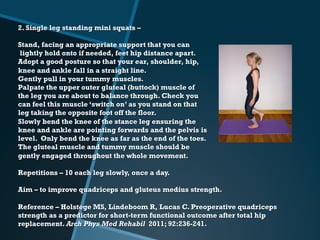
2. Single leg standing mini squats –
Stand, facing an appropriate support that you can
lightly hold onto if needed, feet hip distance apart.
Adopt a good posture so that your ear, shoulder, hip,
knee and ankle fall in a straight line.
Gently pull in your tummy muscles.
Palpate the upper outer gluteal (buttock) muscle of
the leg you are about to balance through. Check you
can feel this muscle ‘switch on’ as you stand on that
leg taking the opposite foot off the floor.
Slowly bend the knee of the stance leg ensuring the
knee and ankle are pointing forwards and the pelvis is
level. Only bend the knee as far as the end of the toes.
The gluteal muscle and tummy muscle should be
gently engaged throughout the whole movement.
Repetitions – 10 each leg slowly, once a day.
Aim – to improve quadriceps and gluteus medius strength.
Reference – Holstege MS, Lindeboom R, Lucas C. Preoperative quadriceps
strength as a predictor for short-term functional outcome after total hip
replacement. Arch Phys Med Rehabil 2011; 92:236-241.
3. Hip abduction in standing –
Stand, facing an appropriate support that you can
lightly hold onto if needed, feet hip distance apart.
Adopt a good posture so that your ear, shoulder, hip,
knee and ankle fall in a straight line.
Gently pull in your tummy muscles.
Palpate the upper outer gluteal muscle of the leg
you are about to balance through. Check you can feel
this muscle ‘switch on’ as you balance on that leg.
Now squeeze the upper outer gluteal muscle of the
opposite leg as you take this leg out to the side. Keep
this muscle ‘switched on’ and controlling the whole
movement from start to finish.
Repetitions – 10 each leg, hold for 5 seconds, once a
day.
Aim – to improve hip abduction strength.
Reference – Casartelli NC, Maffiuletti NA, Item-
Glatthorn JF et al. Hip muscle weakness in patients
with symptomatic femoroacetabular impingement.
Osteo & Cart 2011; 19: 816-821.
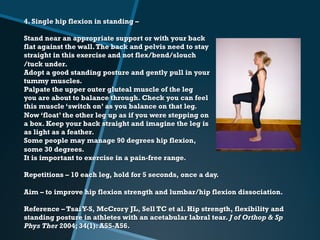
4. Single hip flexion in standing –
Stand near an appropriate support or with your back
flat against the wall.The back and pelvis need to stay
straight in this exercise and not flex/bend/slouch
/tuck under.
Adopt a good standing posture and gently pull in your
tummy muscles.
Palpate the upper outer gluteal muscle of the leg
you are about to balance through. Check you can feel
this muscle ‘switch on’ as you balance on that leg.
Now ‘float’ the other leg up as if you were stepping on
a box. Keep your back straight and imagine the leg is
as light as a feather.
Some people may manage 90 degrees hip flexion,
some 30 degrees.
It is important to exercise in a pain-free range.
Repetitions – 10 each leg, hold for 5 seconds, once a day.
Aim – to improve hip flexion strength and lumbar/hip flexion dissociation.
Reference – TsaiY-S, McCrory JL, Sell TC et al. Hip strength, flexibility and
standing posture in athletes with an acetabular labral tear. J of Orthop & Sp
Phys Ther 2004; 34(1): A55-A56.
5. Hip adduction in side lying –
Lie on your side, supporting yourself with pillows/
yoga blocks (see photo).
Make sure you are lying in straight line with your
back straight and your tummy pulled in gently.
Point the foot of the underneath leg, ‘lengthen
through the leg’ and float the leg upwards so it is
lifted off the floor.
Modifications may need to be made it it is
uncomfortable for you to lie on your hip. For
example, performing the action in standing.
Repetitions – 10 each leg, hold for 5 seconds, once a
day.
Aim – to improve hip adduction strength.
Reference – Casartelli NC, Maffiuletti NA, Item-
Glatthorn JF et al. Hip muscle weakness in patients
with symptomatic femoroacetabular impingement.
Osteo & Cart 2011; 19: 816-821.
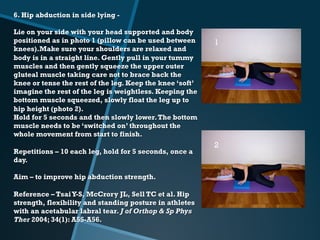
6. Hip abduction in side lying -
Lie on your side with your head supported and body
positioned as in photo 1 (pillow can be used between
knees).Make sure your shoulders are relaxed and
body is in a straight line. Gently pull in your tummy
muscles and then gently squeeze the upper outer
gluteal muscle taking care not to brace back the
knee or tense the rest of the leg. Keep the knee ‘soft’
imagine the rest of the leg is weightless. Keeping the
bottom muscle squeezed, slowly float the leg up to
hip height (photo 2).
Hold for 5 seconds and then slowly lower.The bottom
muscle needs to be ‘switched on’ throughout the
whole movement from start to finish.
Repetitions – 10 each leg, hold for 5 seconds, once a
day.
Aim – to improve hip abduction strength.
Reference – TsaiY-S, McCrory JL, Sell TC et al. Hip
strength, flexibility and standing posture in athletes
with an acetabular labral tear. J of Orthop & Sp Phys
Ther 2004; 34(1): A55-A56.
1
2
7. Double leg bridges –
Lie on your back with your knees and hips bent, feet
on the floor. Knees should be hip distance apart,
pelvis level, and lumbar spine in a neutral position.
Next, gently pull in your tummy muscles, gently
squeeze the gluteus maximus muscle (the main fleshy
bit lying over the back of your hip), tuck your tailbone
under and bit by bit slowly lift up each segment of your
spine so your body is in the position shown in the photo.
Too hard? Try positioning your heels closer to your
bottom, or don’t lift your bottom as high. Hold for 5
seconds, then slowly lower, starting with the upper
back and segment by segment, lowering until your tailbone is back on the floor.Your
gluteal muscles and tummy muscles should be gently engaged throughout. Do not
arch/extend the spine during this exercise.
Repetitions – 10 times, hold for 5 seconds, once a day.
Aim – to improve hip extension strength.
Reference –Valenzuela F, Gandler K, Dupler T & Adickes M. A retrospective study to
determine the effectiveness of non operative treatment of hip labral tears. Orth Phys
Ther Pract 2010; 22(3): 147-152.
8. Hip rotation in crook lying –
Lie on your back, knees and hips bent, feet on floor,
ankles together.The front of your pelvis, the bit
between your navel and pubic bone should be level,
imagine a spirit level across it in multiple directions.
Next, put one hand under the back of your hip
(deep hip rotator muscles) and one at the front
(hip flexor muscle) to be able to get palpable
feedback on what muscle you are activating.
Gently pull in your tummy muscles, then gently
‘fire-up’ the deep hip rotator round the back of your hip
(imagine inflating a balloon round the back of your hip), the hip flexor at the
front of the hip should not dominate it should be as relaxed as possible.
Keeping your pelvis level, tummy and deep hip rotator engaged, ROTATE your
leg outwards as shown in the photo.The deep hip rotator muscle should control
your leg throughout the WHOLE movement. Palpate to check it does not switch
off, particularly on the return.
Repetitions – 10 times, hold for 5 seconds, once a day.
Aim – to improve hip rotator strength.
Reference – Casartelli NC, Maffiuletti NA, Item-Glatthorn JF et al. Hip muscle
weakness in patients with symptomatic femoroacetabular impingement. Osteo
& Cart 2011; 19: 816-821.
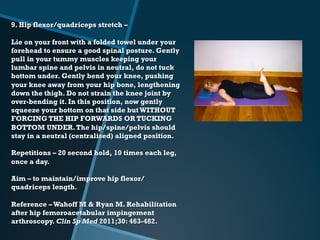
9. Hip flexor/quadriceps stretch –
Lie on your front with a folded towel under your
forehead to ensure a good spinal posture. Gently
pull in your tummy muscles keeping your
lumbar spine and pelvis in neutral, do not tuck
bottom under. Gently bend your knee, pushing
your knee away from your hip bone, lengthening
down the thigh. Do not strain the knee joint by
over-bending it. In this position, now gently
squeeze your bottom on that side but WITHOUT
FORCING THE HIP FORWARDS OR TUCKING
BOTTOM UNDER.The hip/spine/pelvis should
stay in a neutral (centralised) aligned position.
Repetitions – 20 second hold, 10 times each leg,
once a day.
Aim – to maintain/improve hip flexor/
quadriceps length.
Reference –Wahoff M & Ryan M. Rehabilitation
after hip femoroacetabular impingement
arthroscopy. Clin Sp Med 2011;30: 463-482.
10. Kneeling hip flexor stretch –
Adopt the position as shown in the photo.
Keeping your tummy muscles engaged and
lumbar spine in neutral, slowly lunge the front
knee forwards so that you feel a gentle stretch in
the rear thigh.Try and keep the hip, knee and
shoulder aligned so you are stretching the
muscle rather than forcing the hip joint forwards
(anterior femoral glide) against the
acetabular labrum and capsule.
Repetitions – 20 second hold, 10 times each leg,
once a day.
Aim – to maintain/improve hip flexor/
quadriceps length.
Reference – Wahoff M & Ryan M. Rehabilitation
after hip femoroacetabular impingement
arthroscopy. Clin Sp Med 2011;30: 463-482.

Pre-habilitation exercises 'The HAPI Study'

  • 1.
    Pre-habilitation exercises for hiparthroscopy surgery The ‘HAPI’ study 2013 Louise Grant MCSP. Hip Specialist Chartered Physiotherapist The HAPI ‘Hip Arthroscopy Pre-habilitation Intervention’ Study : Does pre-habilitation affect outcomes in patients undergoing hip arthroscopy for femoro-acetabular impingement?
  • 2.
    Notes to readersof this online document – This plan was designed to be taught by a Chartered Physiotherapist (who is additionally trained in pilates), with each exercise being supervised and practised in a one-to-one setting before commencing with the plan. The Physiotherapist needs to ensure that the patient understands terminologies used in this guide and has the correct technique for ie. tummy muscles engaged. The guide was designed for research study subjects who were awaiting femoro- acetabular impingement/labral repair surgery and who were of varying functional abilities and pain levels. In clinical practice, we often find an individualised approach is more appropriate. However, when designing an intervention for a study where all subjects perform the same regime to enable measurement of quantitative data, exercises need to be able to suit all participants. Louise Grant - September 2013 National Research Ethics Service IRAS ID 129236 International Trials Registry ISRCTN 13779749
  • 3.
    1. Calf raises– Stand, facing an appropriate support that you can lightly hold onto if needed. Adopt a good posture so that your ear, shoulder, hip, knee and ankle fall in a straight line. Gently pull in your tummy muscles. Push through the balls of your feet so you lift your heels off the floor, feeling the effort in your calf muscles. Keep your ankles stable and pointing forwards throughout the movement. Next, slowly lower your heels to the floor. If you are able to, try to perform this exercise on one leg (photo shows double leg calf raises). Repetitions – 10 each leg slowly, once a day. Aim – to improve ankle push-off strength. Reference – Lewis CL, Ferris DP.Walking with increased ankle push off decreases hip muscle moments. J of Biomech 2008; 41(10): 2082-2089.
  • 4.
    2. Single legstanding mini squats – Stand, facing an appropriate support that you can lightly hold onto if needed, feet hip distance apart. Adopt a good posture so that your ear, shoulder, hip, knee and ankle fall in a straight line. Gently pull in your tummy muscles. Palpate the upper outer gluteal (buttock) muscle of the leg you are about to balance through. Check you can feel this muscle ‘switch on’ as you stand on that leg taking the opposite foot off the floor. Slowly bend the knee of the stance leg ensuring the knee and ankle are pointing forwards and the pelvis is level. Only bend the knee as far as the end of the toes. The gluteal muscle and tummy muscle should be gently engaged throughout the whole movement. Repetitions – 10 each leg slowly, once a day. Aim – to improve quadriceps and gluteus medius strength. Reference – Holstege MS, Lindeboom R, Lucas C. Preoperative quadriceps strength as a predictor for short-term functional outcome after total hip replacement. Arch Phys Med Rehabil 2011; 92:236-241.
  • 5.
    3. Hip abductionin standing – Stand, facing an appropriate support that you can lightly hold onto if needed, feet hip distance apart. Adopt a good posture so that your ear, shoulder, hip, knee and ankle fall in a straight line. Gently pull in your tummy muscles. Palpate the upper outer gluteal muscle of the leg you are about to balance through. Check you can feel this muscle ‘switch on’ as you balance on that leg. Now squeeze the upper outer gluteal muscle of the opposite leg as you take this leg out to the side. Keep this muscle ‘switched on’ and controlling the whole movement from start to finish. Repetitions – 10 each leg, hold for 5 seconds, once a day. Aim – to improve hip abduction strength. Reference – Casartelli NC, Maffiuletti NA, Item- Glatthorn JF et al. Hip muscle weakness in patients with symptomatic femoroacetabular impingement. Osteo & Cart 2011; 19: 816-821.
  • 6.
    4. Single hipflexion in standing – Stand near an appropriate support or with your back flat against the wall.The back and pelvis need to stay straight in this exercise and not flex/bend/slouch /tuck under. Adopt a good standing posture and gently pull in your tummy muscles. Palpate the upper outer gluteal muscle of the leg you are about to balance through. Check you can feel this muscle ‘switch on’ as you balance on that leg. Now ‘float’ the other leg up as if you were stepping on a box. Keep your back straight and imagine the leg is as light as a feather. Some people may manage 90 degrees hip flexion, some 30 degrees. It is important to exercise in a pain-free range. Repetitions – 10 each leg, hold for 5 seconds, once a day. Aim – to improve hip flexion strength and lumbar/hip flexion dissociation. Reference – TsaiY-S, McCrory JL, Sell TC et al. Hip strength, flexibility and standing posture in athletes with an acetabular labral tear. J of Orthop & Sp Phys Ther 2004; 34(1): A55-A56.
  • 7.
    5. Hip adductionin side lying – Lie on your side, supporting yourself with pillows/ yoga blocks (see photo). Make sure you are lying in straight line with your back straight and your tummy pulled in gently. Point the foot of the underneath leg, ‘lengthen through the leg’ and float the leg upwards so it is lifted off the floor. Modifications may need to be made it it is uncomfortable for you to lie on your hip. For example, performing the action in standing. Repetitions – 10 each leg, hold for 5 seconds, once a day. Aim – to improve hip adduction strength. Reference – Casartelli NC, Maffiuletti NA, Item- Glatthorn JF et al. Hip muscle weakness in patients with symptomatic femoroacetabular impingement. Osteo & Cart 2011; 19: 816-821.
  • 8.
    6. Hip abductionin side lying - Lie on your side with your head supported and body positioned as in photo 1 (pillow can be used between knees).Make sure your shoulders are relaxed and body is in a straight line. Gently pull in your tummy muscles and then gently squeeze the upper outer gluteal muscle taking care not to brace back the knee or tense the rest of the leg. Keep the knee ‘soft’ imagine the rest of the leg is weightless. Keeping the bottom muscle squeezed, slowly float the leg up to hip height (photo 2). Hold for 5 seconds and then slowly lower.The bottom muscle needs to be ‘switched on’ throughout the whole movement from start to finish. Repetitions – 10 each leg, hold for 5 seconds, once a day. Aim – to improve hip abduction strength. Reference – TsaiY-S, McCrory JL, Sell TC et al. Hip strength, flexibility and standing posture in athletes with an acetabular labral tear. J of Orthop & Sp Phys Ther 2004; 34(1): A55-A56. 1 2
  • 9.
    7. Double legbridges – Lie on your back with your knees and hips bent, feet on the floor. Knees should be hip distance apart, pelvis level, and lumbar spine in a neutral position. Next, gently pull in your tummy muscles, gently squeeze the gluteus maximus muscle (the main fleshy bit lying over the back of your hip), tuck your tailbone under and bit by bit slowly lift up each segment of your spine so your body is in the position shown in the photo. Too hard? Try positioning your heels closer to your bottom, or don’t lift your bottom as high. Hold for 5 seconds, then slowly lower, starting with the upper back and segment by segment, lowering until your tailbone is back on the floor.Your gluteal muscles and tummy muscles should be gently engaged throughout. Do not arch/extend the spine during this exercise. Repetitions – 10 times, hold for 5 seconds, once a day. Aim – to improve hip extension strength. Reference –Valenzuela F, Gandler K, Dupler T & Adickes M. A retrospective study to determine the effectiveness of non operative treatment of hip labral tears. Orth Phys Ther Pract 2010; 22(3): 147-152.
  • 10.
    8. Hip rotationin crook lying – Lie on your back, knees and hips bent, feet on floor, ankles together.The front of your pelvis, the bit between your navel and pubic bone should be level, imagine a spirit level across it in multiple directions. Next, put one hand under the back of your hip (deep hip rotator muscles) and one at the front (hip flexor muscle) to be able to get palpable feedback on what muscle you are activating. Gently pull in your tummy muscles, then gently ‘fire-up’ the deep hip rotator round the back of your hip (imagine inflating a balloon round the back of your hip), the hip flexor at the front of the hip should not dominate it should be as relaxed as possible. Keeping your pelvis level, tummy and deep hip rotator engaged, ROTATE your leg outwards as shown in the photo.The deep hip rotator muscle should control your leg throughout the WHOLE movement. Palpate to check it does not switch off, particularly on the return. Repetitions – 10 times, hold for 5 seconds, once a day. Aim – to improve hip rotator strength. Reference – Casartelli NC, Maffiuletti NA, Item-Glatthorn JF et al. Hip muscle weakness in patients with symptomatic femoroacetabular impingement. Osteo & Cart 2011; 19: 816-821.
  • 11.
    9. Hip flexor/quadricepsstretch – Lie on your front with a folded towel under your forehead to ensure a good spinal posture. Gently pull in your tummy muscles keeping your lumbar spine and pelvis in neutral, do not tuck bottom under. Gently bend your knee, pushing your knee away from your hip bone, lengthening down the thigh. Do not strain the knee joint by over-bending it. In this position, now gently squeeze your bottom on that side but WITHOUT FORCING THE HIP FORWARDS OR TUCKING BOTTOM UNDER.The hip/spine/pelvis should stay in a neutral (centralised) aligned position. Repetitions – 20 second hold, 10 times each leg, once a day. Aim – to maintain/improve hip flexor/ quadriceps length. Reference –Wahoff M & Ryan M. Rehabilitation after hip femoroacetabular impingement arthroscopy. Clin Sp Med 2011;30: 463-482.
  • 12.
    10. Kneeling hipflexor stretch – Adopt the position as shown in the photo. Keeping your tummy muscles engaged and lumbar spine in neutral, slowly lunge the front knee forwards so that you feel a gentle stretch in the rear thigh.Try and keep the hip, knee and shoulder aligned so you are stretching the muscle rather than forcing the hip joint forwards (anterior femoral glide) against the acetabular labrum and capsule. Repetitions – 20 second hold, 10 times each leg, once a day. Aim – to maintain/improve hip flexor/ quadriceps length. Reference – Wahoff M & Ryan M. Rehabilitation after hip femoroacetabular impingement arthroscopy. Clin Sp Med 2011;30: 463-482.