UN I V E R S I T Y of
INDIANAPOLIS
Ⓡ
Pre-Planning for Service-
Learning: Creative Strategies for
Expanding Students’
Perspectives
Anne Mejia-Downs PT, MPH
Associate Professor Physical Therapy
Julie Gahimer, PT, HSD
Professor of Physical Therapy
International Symposium on Service-Learning (ISSL 2015)
Friday, May 29, 2015 2:45 – 3:45 p.m.
Introduction
Assist Doctor of Physical
Therapy (DPT) students
develop a deeper
appreciation for diverse
populations, as many of the
clients we serve are
financially disadvantaged
Workshop Objectives
Participants of this session will:
Describe pre-service learning strategies designed
to broaden students’ personal and societal
perspectives
Identify available tools for educating students
about low-resourced populations
Explain how students’ perspectives about poverty
were changed with pre-service learning strategies
Purpose
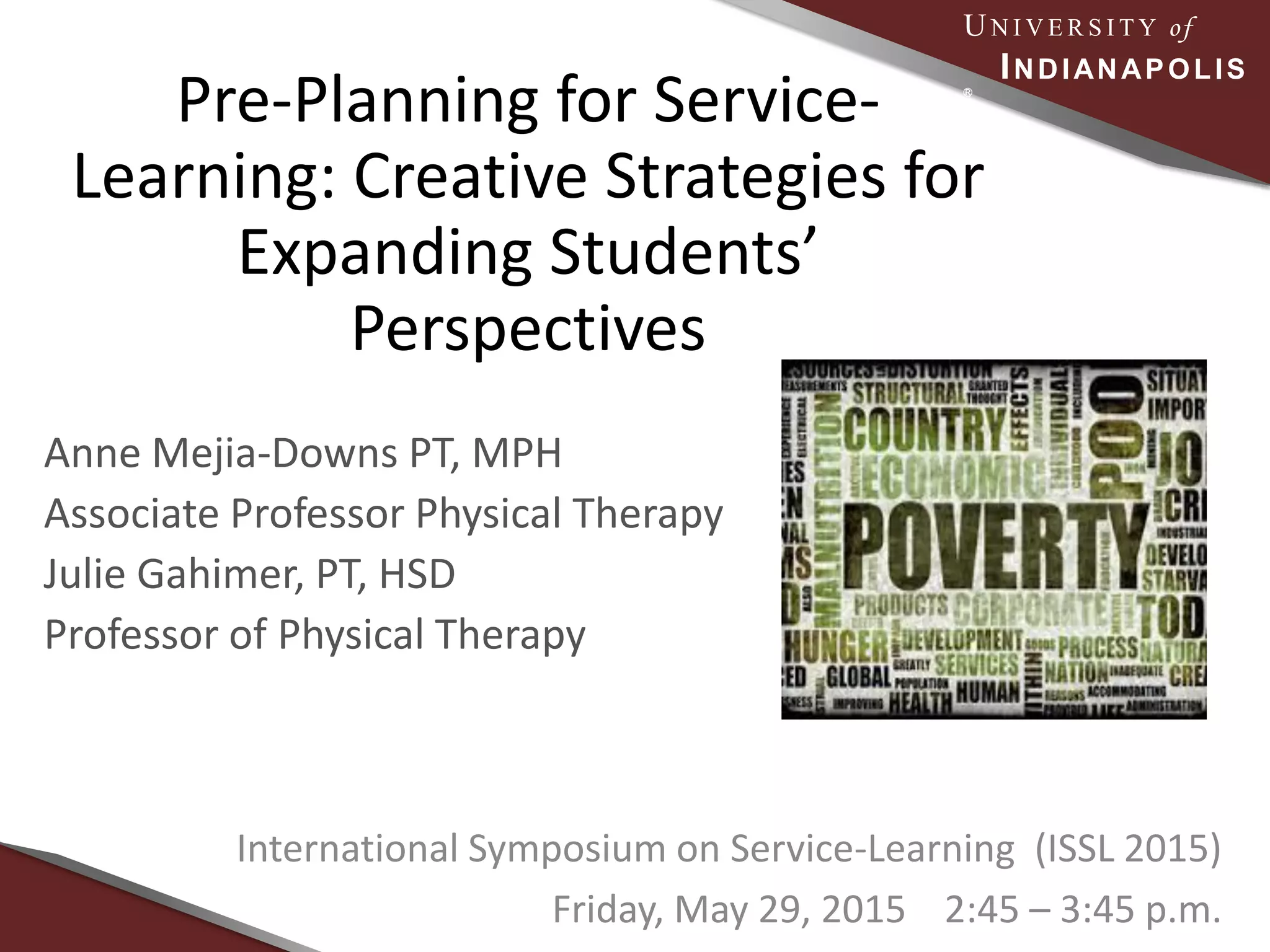
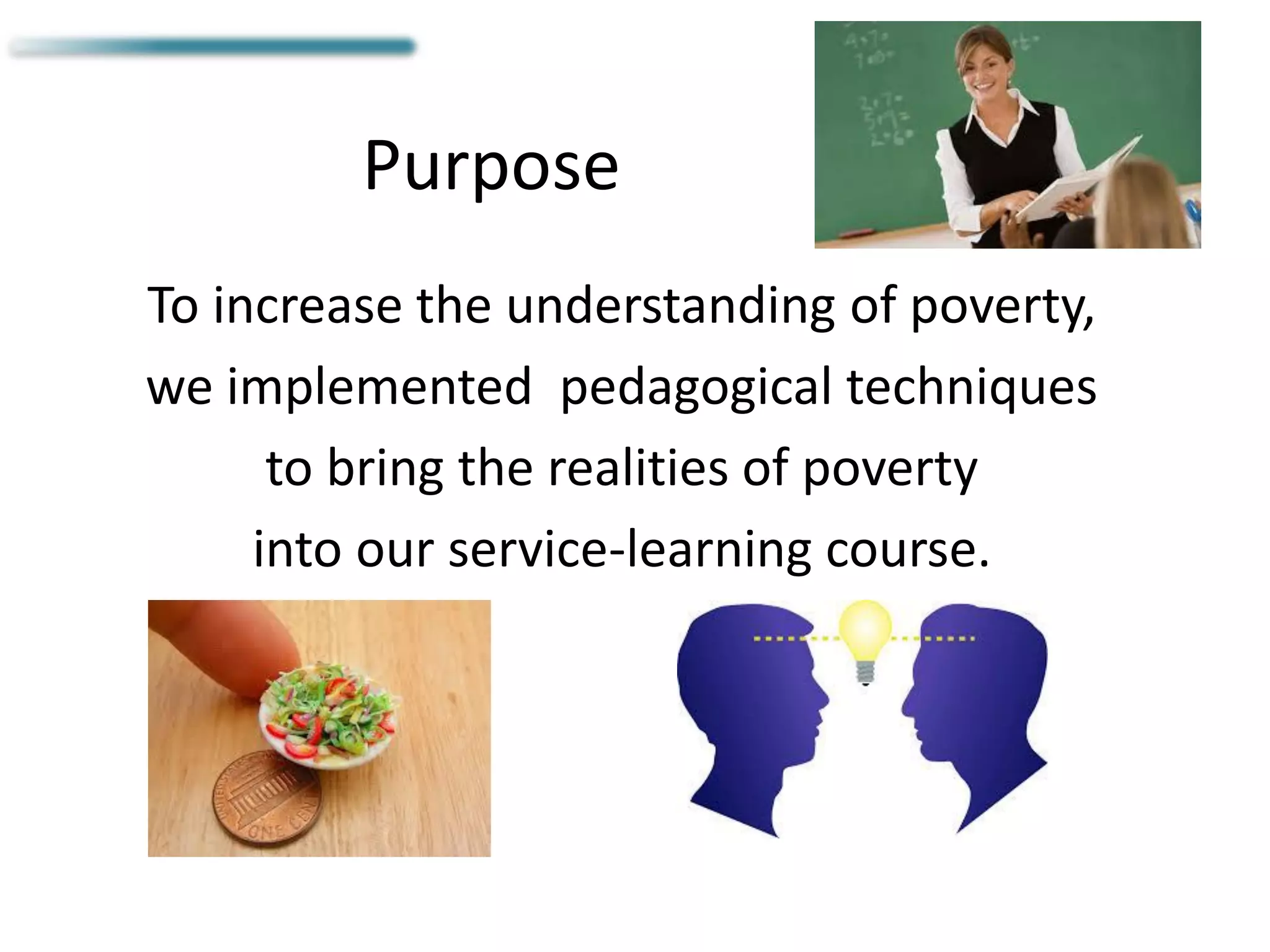
To increase the understanding of poverty,
we implemented pedagogical techniques
to bring the realities of poverty
into our service-learning course.
Session Format
Explanation of 3 Strategies
Pre-Packaged Poverty Simulation
Enlisting community members who
have experienced poverty
Using online poverty resources for
group activities
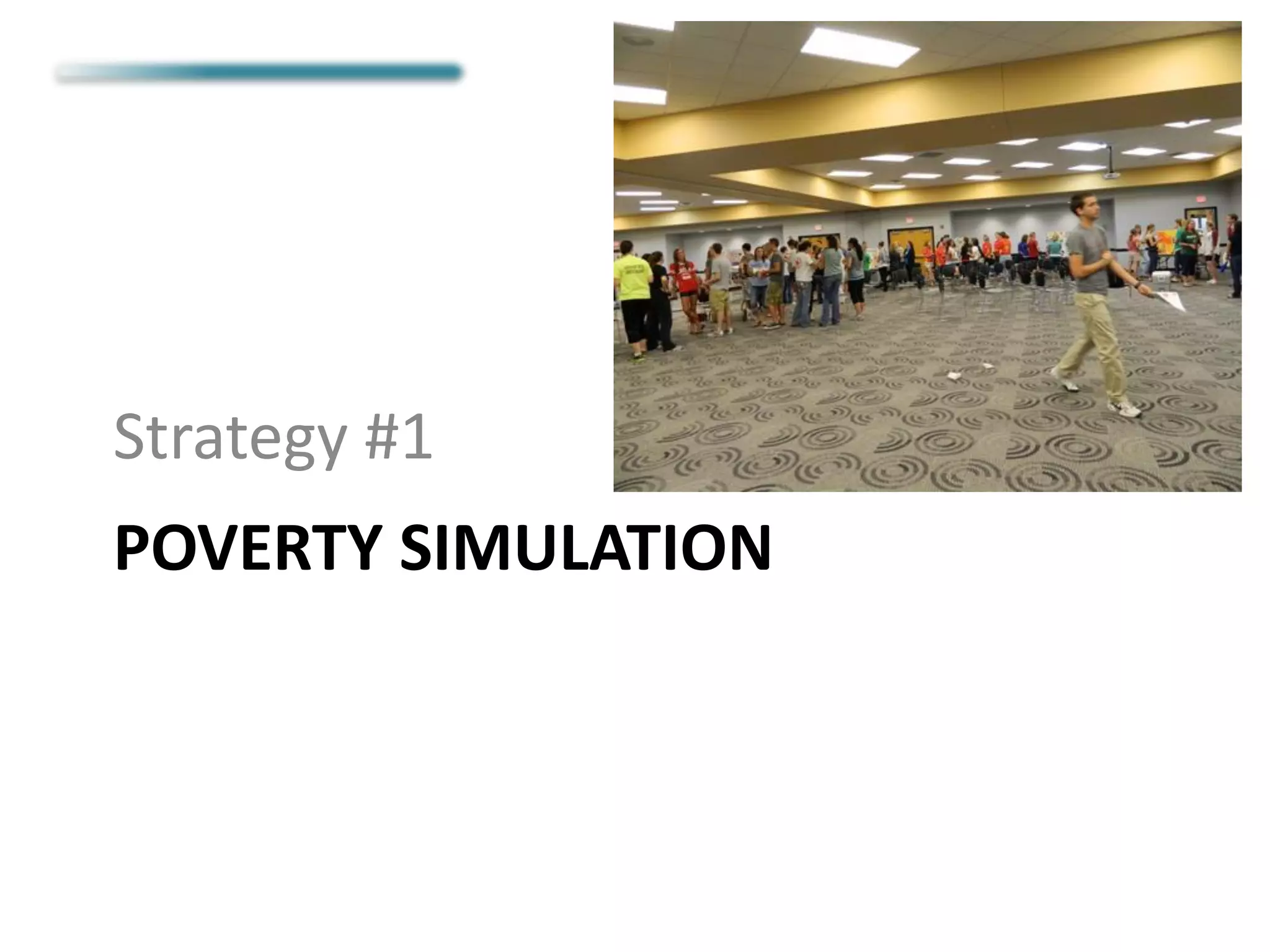
POVERTY SIMULATION
Strategy #1
Strategy # 1
The Poverty Simulation
This guided experience exposes participants to
realities of poverty, including challenges of
navigating the complex world of government
services and other essential service providers.
During the simulation, participants assume the
roles of different family members facing
poverty.
The task for each family is to provide basic
necessities and shelter, while balancing the
requirements of various service providers with
the realities of daily life.
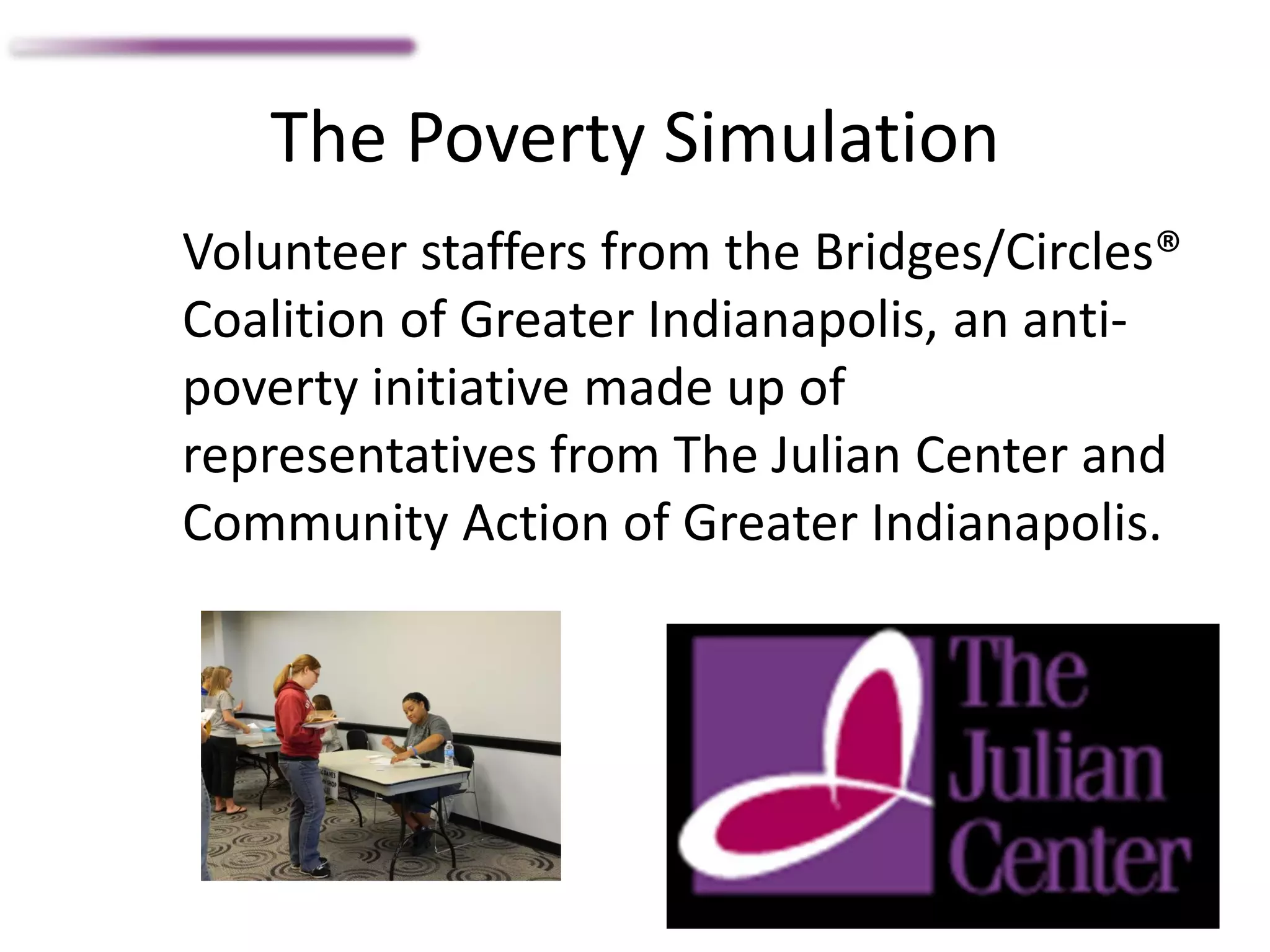
The Poverty Simulation
Volunteer staffers from the Bridges/Circles®
Coalition of Greater Indianapolis, an anti-
poverty initiative made up of
representatives from The Julian Center and
Community Action of Greater Indianapolis.
The Poverty Simulation
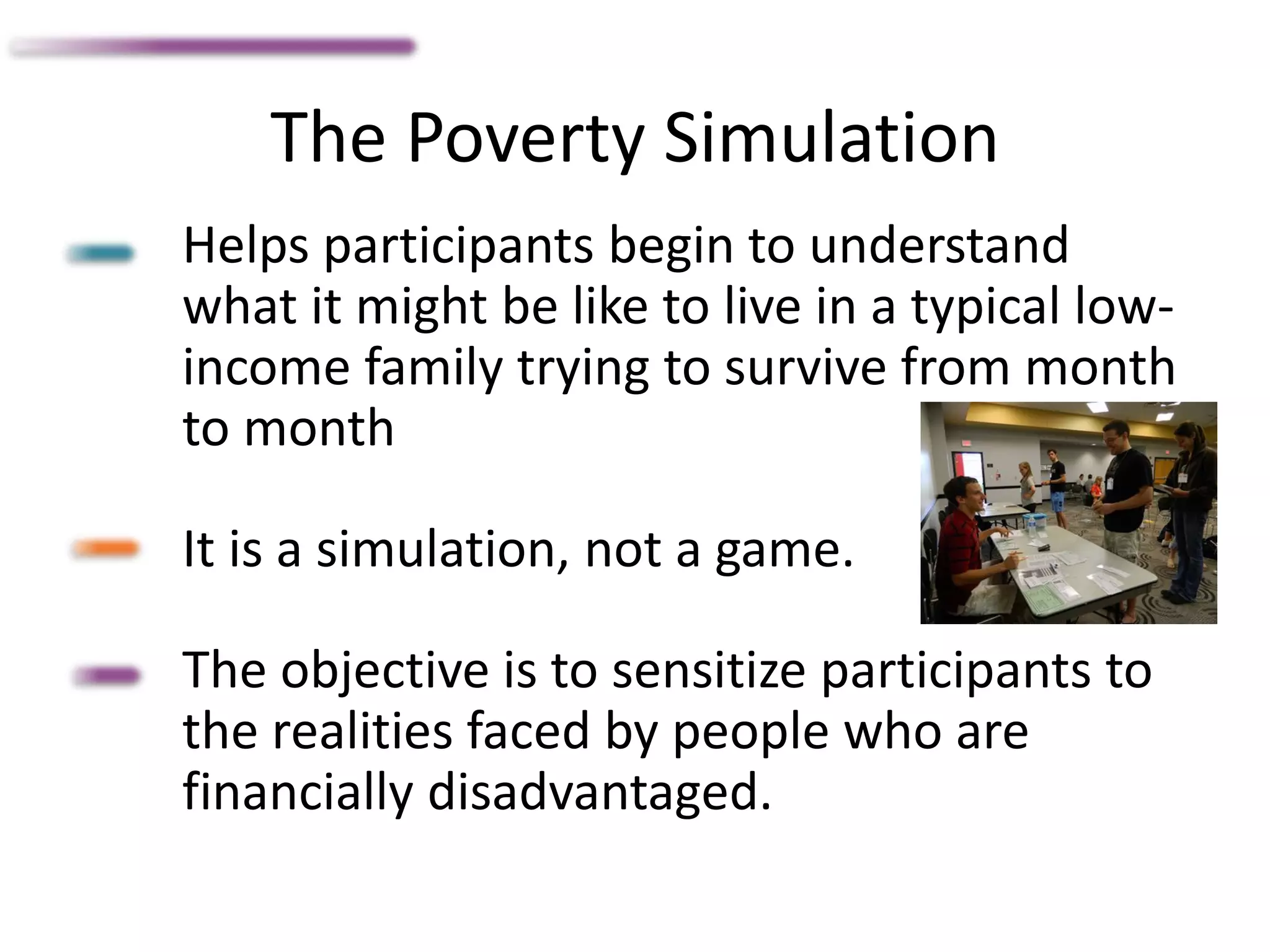
Helps participants begin to understand
what it might be like to live in a typical low-
income family trying to survive from month
to month
It is a simulation, not a game.
The objective is to sensitize participants to
the realities faced by people who are
financially disadvantaged.
The Poverty Simulation
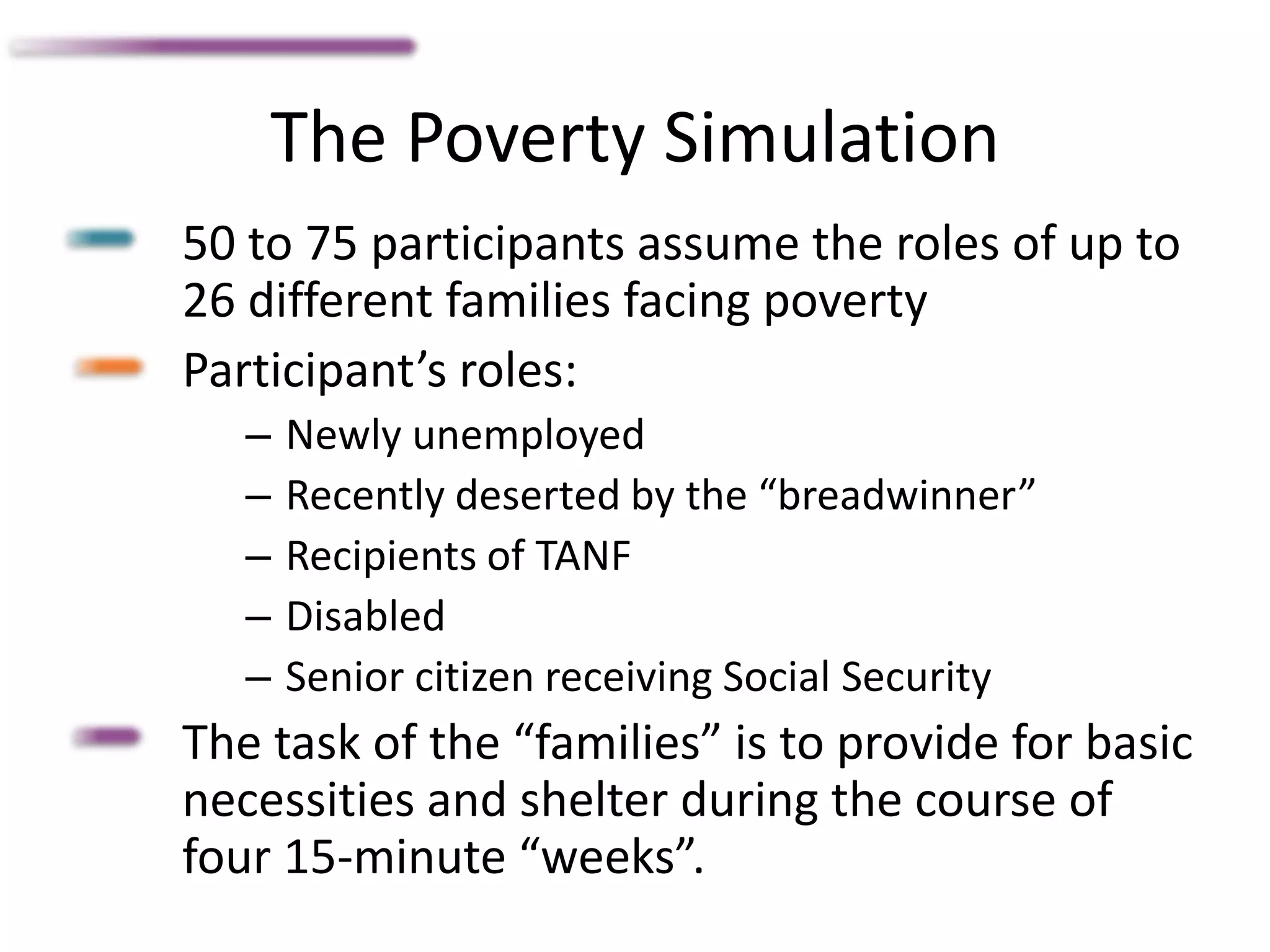
50 to 75 participants assume the roles of up to
26 different families facing poverty
Participant’s roles:
– Newly unemployed
– Recently deserted by the “breadwinner”
– Recipients of TANF
– Disabled
– Senior citizen receiving Social Security
The task of the “families” is to provide for basic
necessities and shelter during the course of
four 15-minute “weeks”.
The Poverty Simulation
Two to three hours:
– Introduction and briefing
– Actual simulation exercise
– Debriefing period for participants and
volunteer staffers to share reactions and
experiences
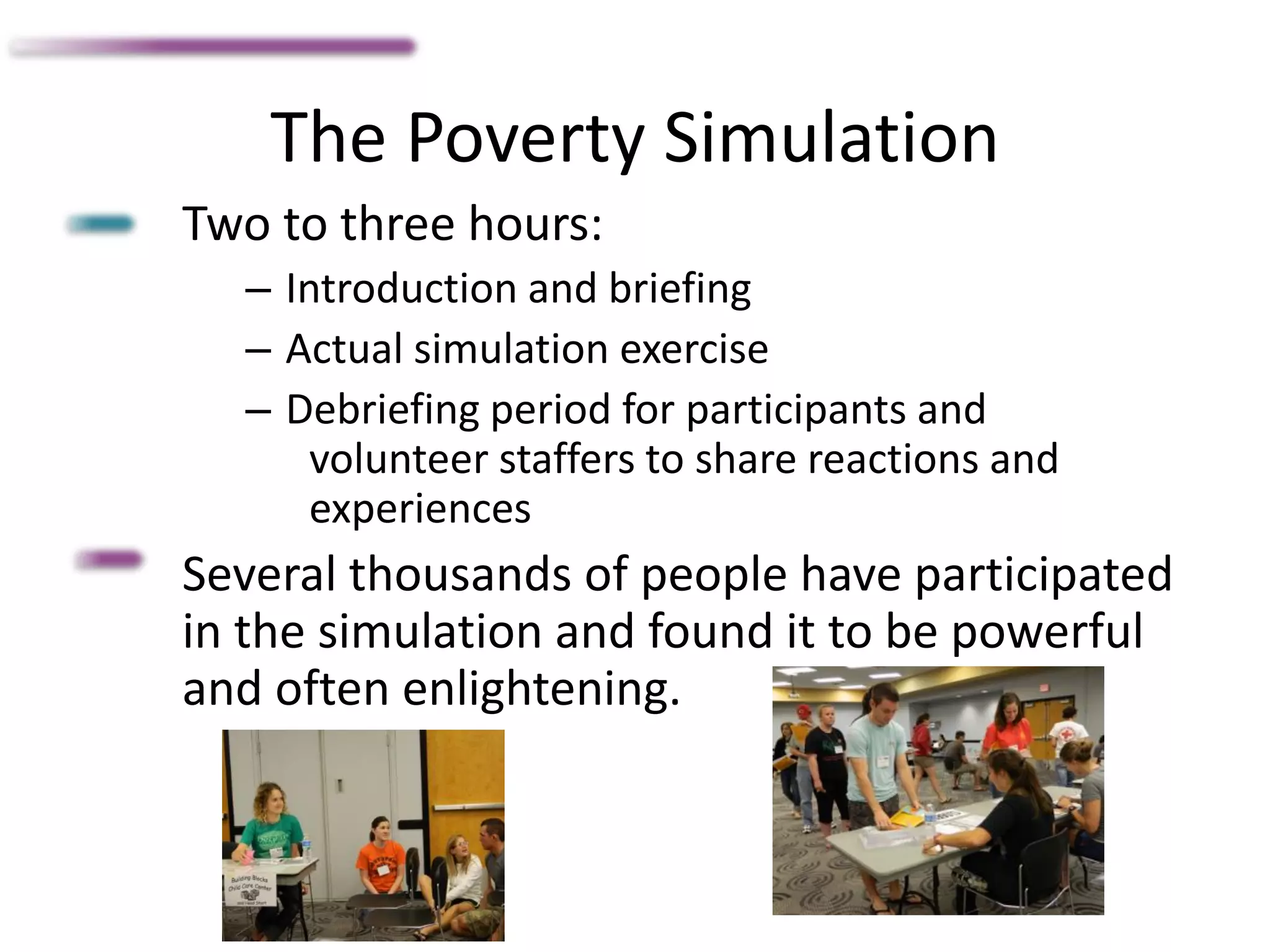
Several thousands of people have participated
in the simulation and found it to be powerful
and often enlightening.
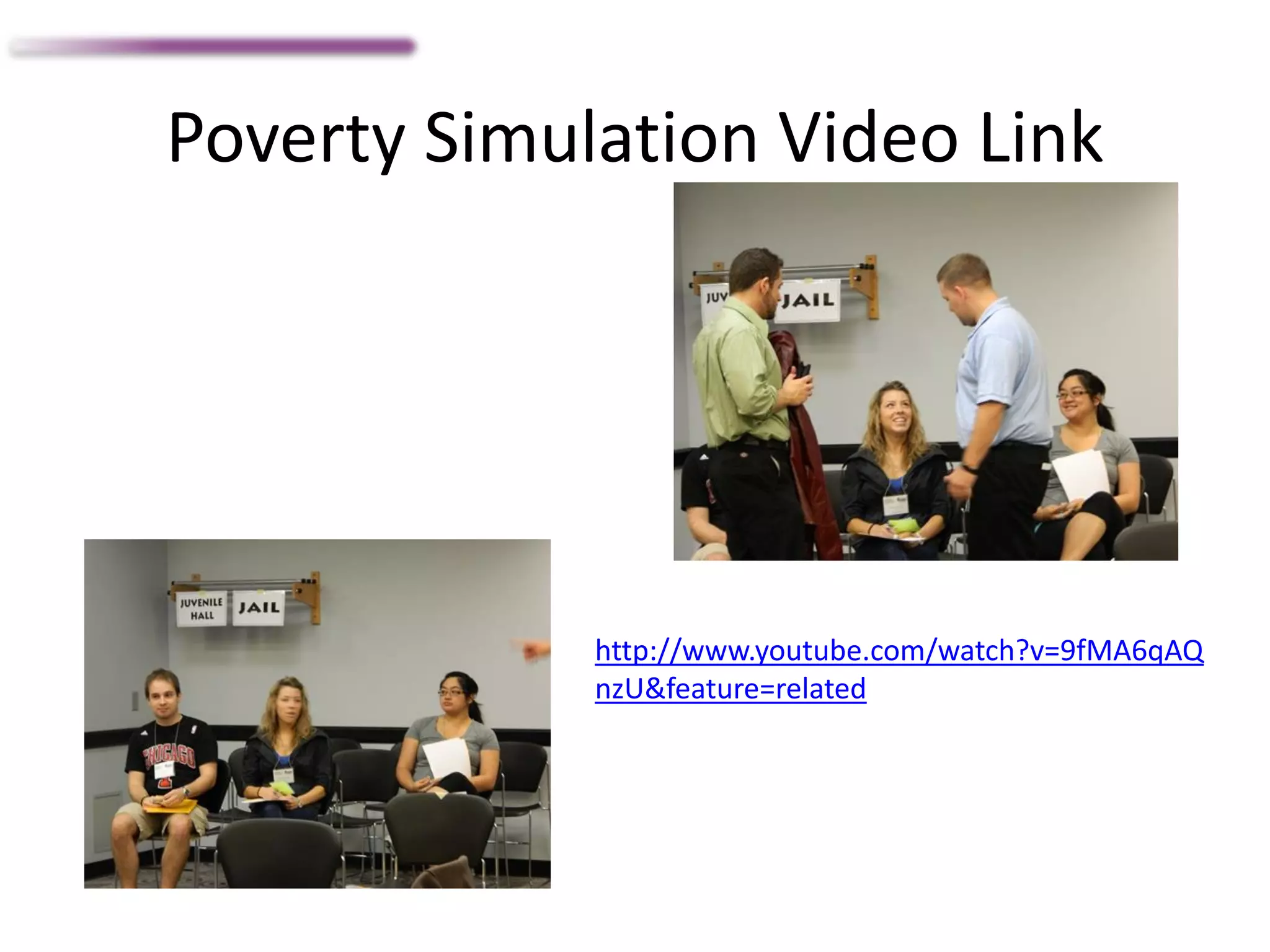
Poverty Simulation Video Link
http://www.youtube.com/watch?v=9fMA6qAQ
nzU&feature=related
Reactions from Students
• "I had no idea the stress that having only limited
resources and money could cause."
• "Thought provoking, I needed this."
• "Stressful! Confusing! It helps with understanding [life
in poverty] but you really can only know if you live it
day to day."
• "Amazing what empathy and compassion sixty minutes
of simulation creates."
• "It was very realistic and gave insight into the constant
frustration and choices between bad and worse."
• "[As a result of this experience] I will be more
conscious, more empathetic, more of an advocate."
USING COMMUNITY MEMBERS
Strategy #2
Strategy #2
Using Community Members
Clients from Circles of Support were
invited to the classroom
1. Smarties Activity
2. Cliff Effect Discussion
3. Laundry Basket
4. Shared personal stories of bridging
out of poverty
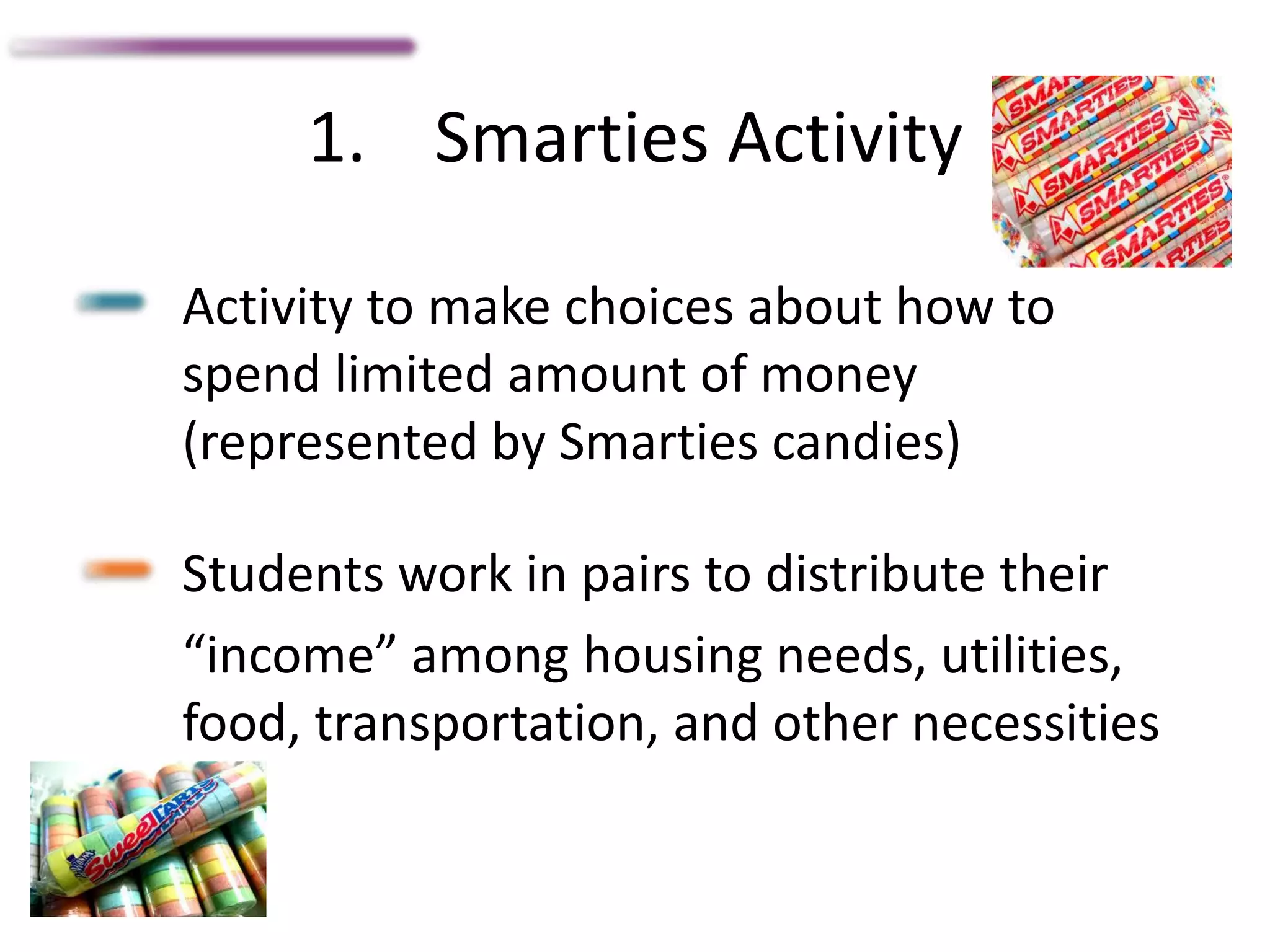
1. Smarties Activity
Activity to make choices about how to
spend limited amount of money
(represented by Smarties candies)
Students work in pairs to distribute their
“income” among housing needs, utilities,
food, transportation, and other necessities
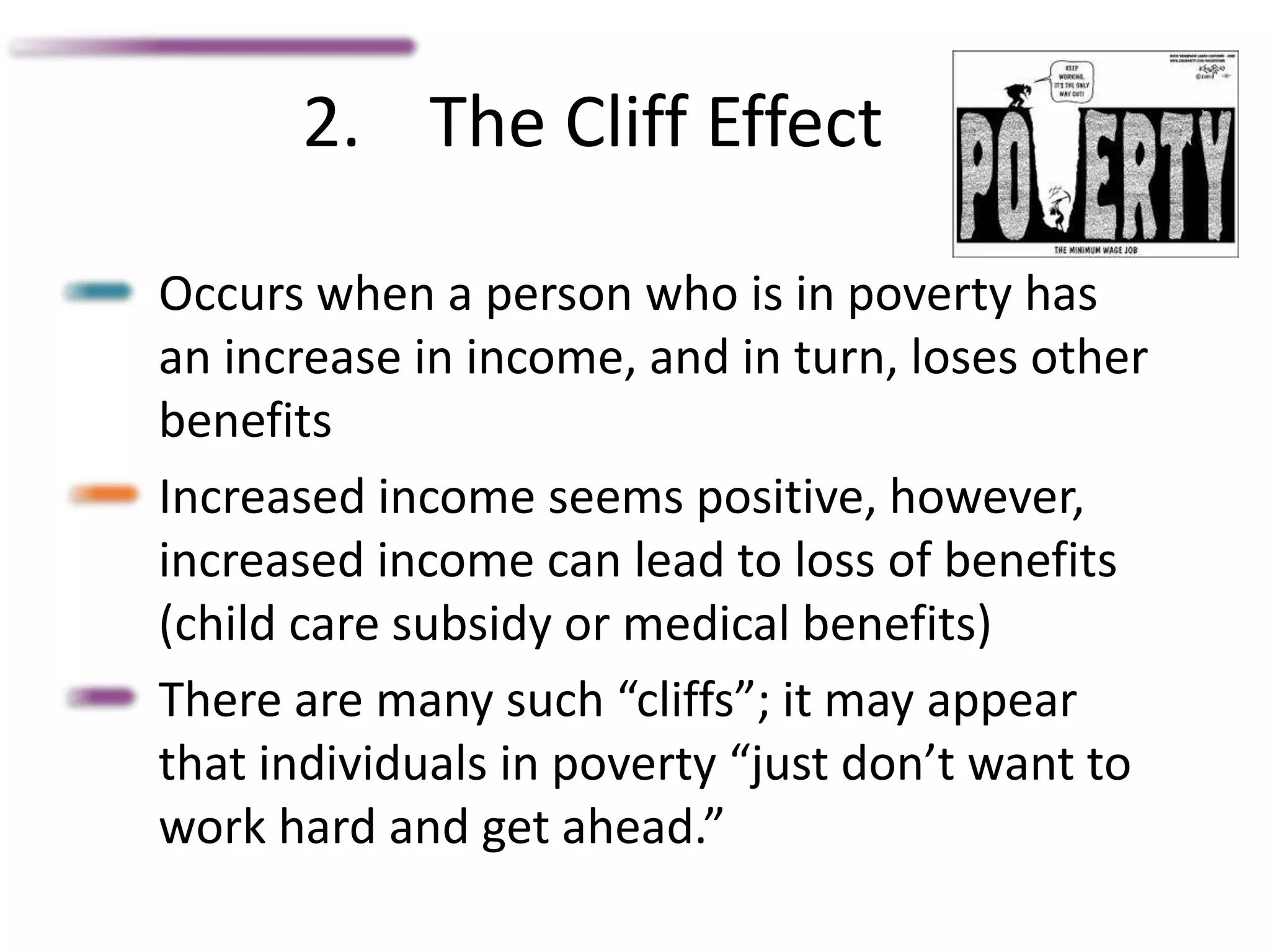
2. The Cliff Effect
Occurs when a person who is in poverty has
an increase in income, and in turn, loses other
benefits
Increased income seems positive, however,
increased income can lead to loss of benefits
(child care subsidy or medical benefits)
There are many such “cliffs”; it may appear
that individuals in poverty “just don’t want to
work hard and get ahead.”
3. Laundry Basket Activity
Students were asked to imagine someone
who has very few resources: low-paying
job, no family nearby, trying to stay off
welfare, and no good family role model.
– Single mother with 2 children—a daughter in
elementary school and a son who is a toddler
– Overwhelmed by all of life’s struggles, having
trouble keeping up with everything.
3. Laundry Basket Activity
Tasks she needs to do:
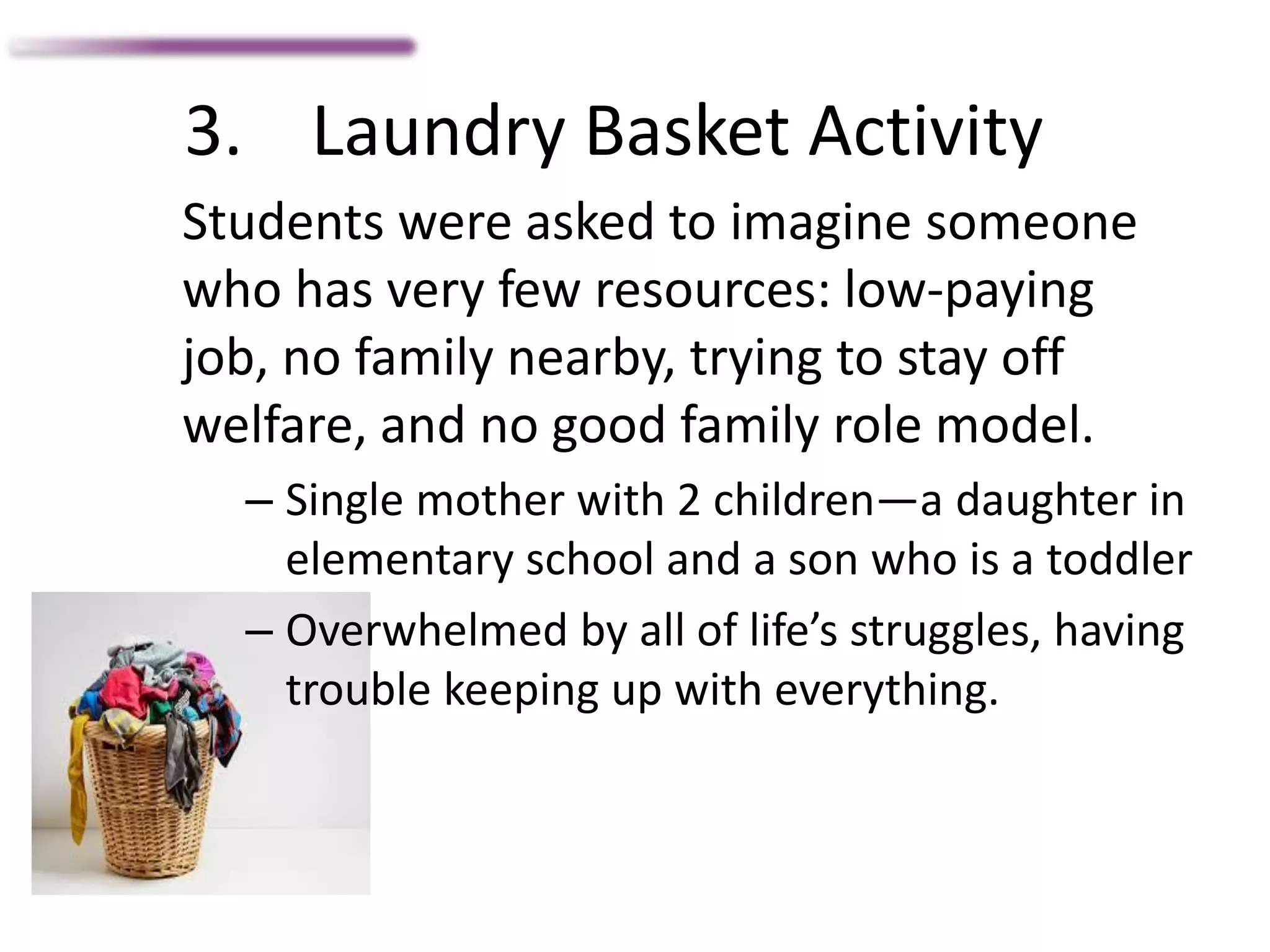
– Cook meals for family (pan)
– Take daughter to soccer
(soccer ball)
– Take Math course to work
on her GED (textbook)
– Read to her toddler (book)
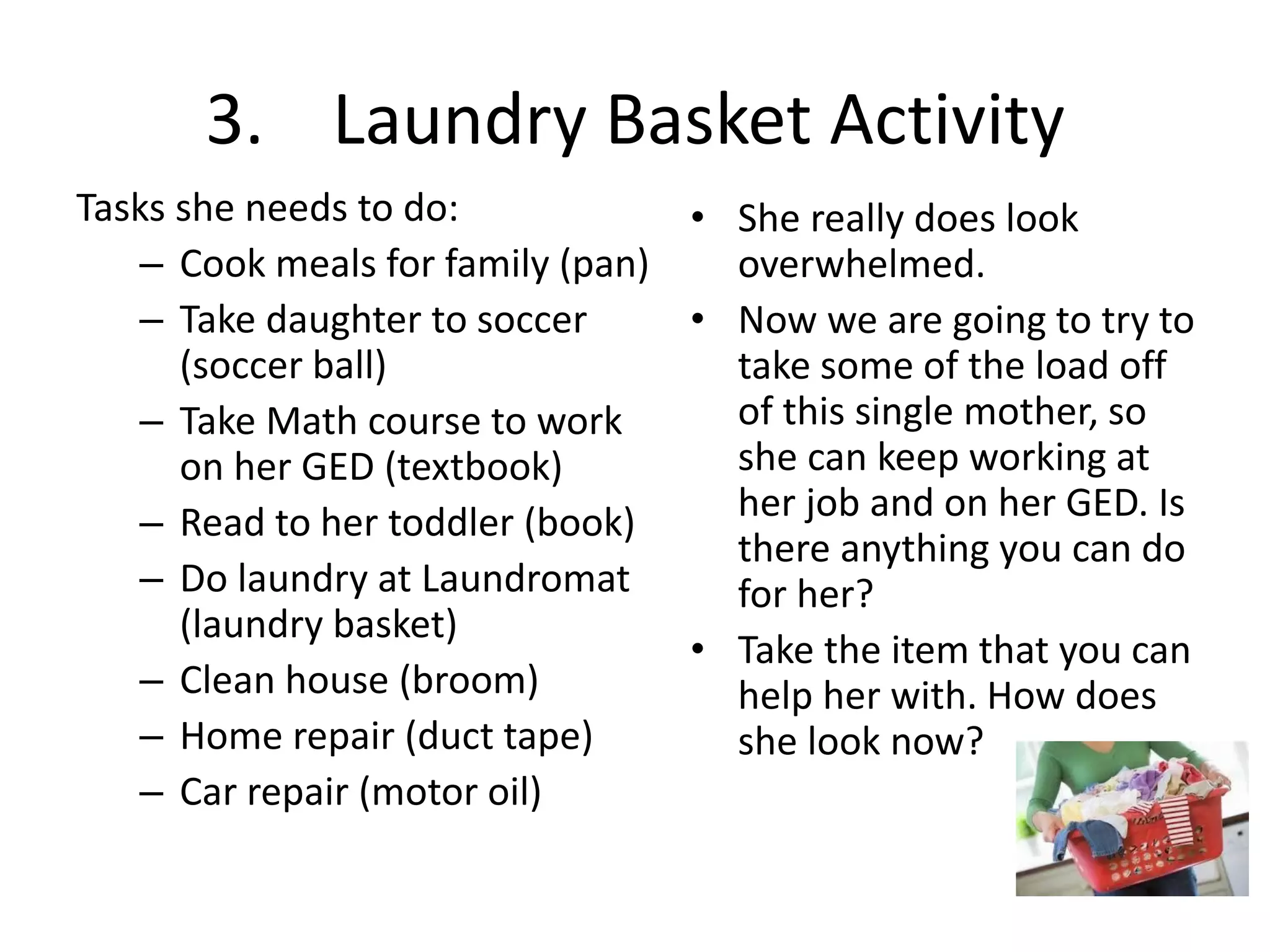
– Do laundry at Laundromat
(laundry basket)
– Clean house (broom)
– Home repair (duct tape)
– Car repair (motor oil)
• She really does look
overwhelmed.
• Now we are going to try to
take some of the load off
of this single mother, so
she can keep working at
her job and on her GED. Is
there anything you can do
for her?
• Take the item that you can
help her with. How does
she look now?
4. Personal Stories of Poverty
• Clients from Circles of Support® shared their
personal stories of “bridging out of poverty”
• Many discussed tough choices they made with
limited income
• Used examples of the “cliff effect” in their
lives, and how individuals from Circles of
Support® helped them
• Students shared how these stories impacted
their view of poverty and the working poor
USING ONLINE RESOURCES
Strategy #3
Strategy #3
Using Online Resources
1. Poverty Quiz
2. Spent Activity
3. Dollar a Day
4. Videos
5. Six Hats Discussion
1. “Poverty Quiz”
10 Minute QUIZ: What do you know about poverty in
America?
• Number of Americans on food stamps
• Unemployment rate for African-Americans
• Income, class, race
• Number of people living in poverty
• Percentage of that population working full time
• Child poverty rate in America
http://www.marketplace.org/topics/wealth-
poverty/quiz-what-do-you-know-about-poverty-america
2. “Spent Activity”
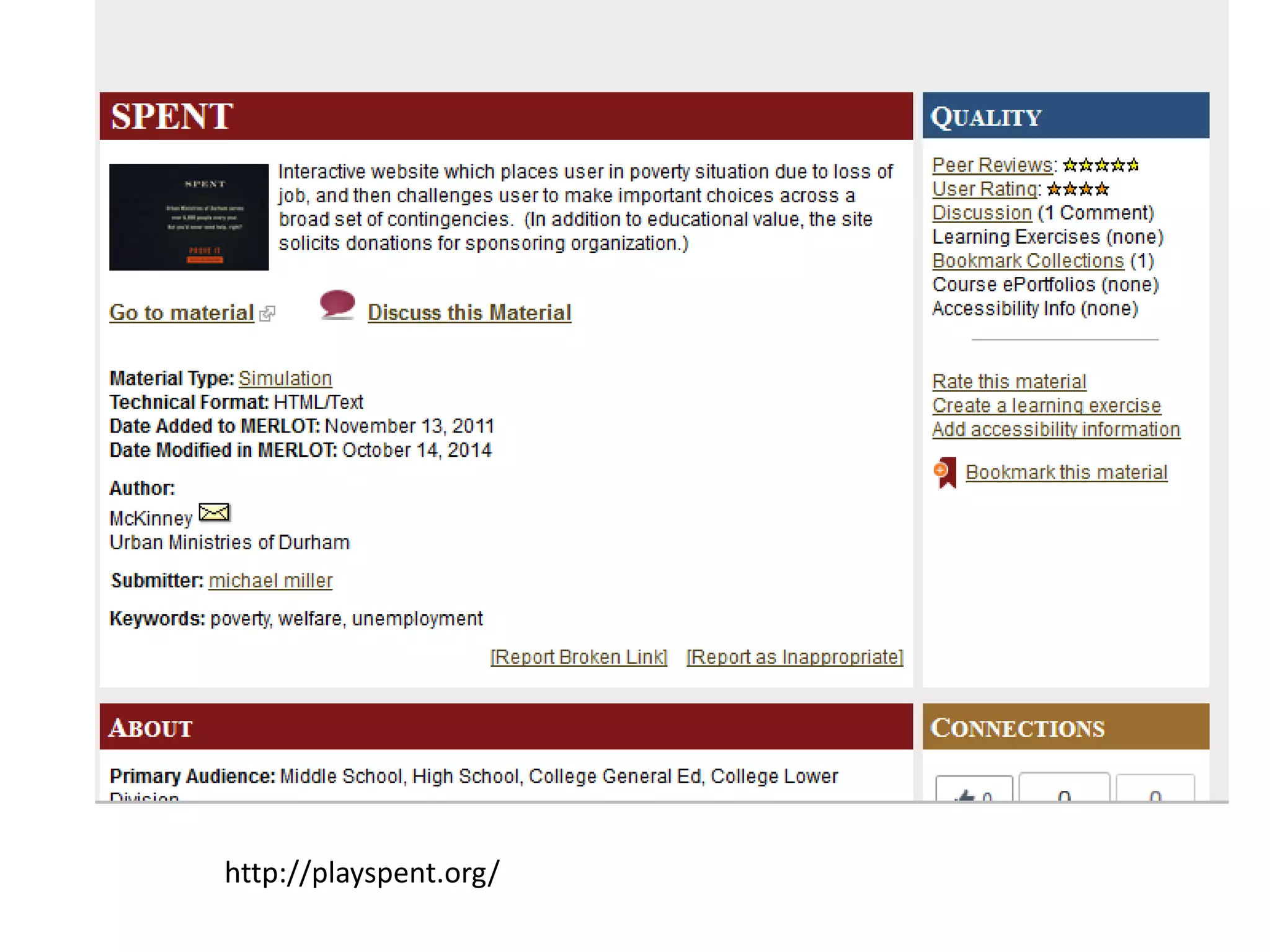
Interactive website that places user in
poverty situation due to loss of job
Challenges user to make important choices
across a broad set of contingencies of how
to allocate their funds (housing, food, child
care, and transportation)
Students expressed surprise at how
desperate they became, and even engaged
in unlawful activity
http://playspent.org/
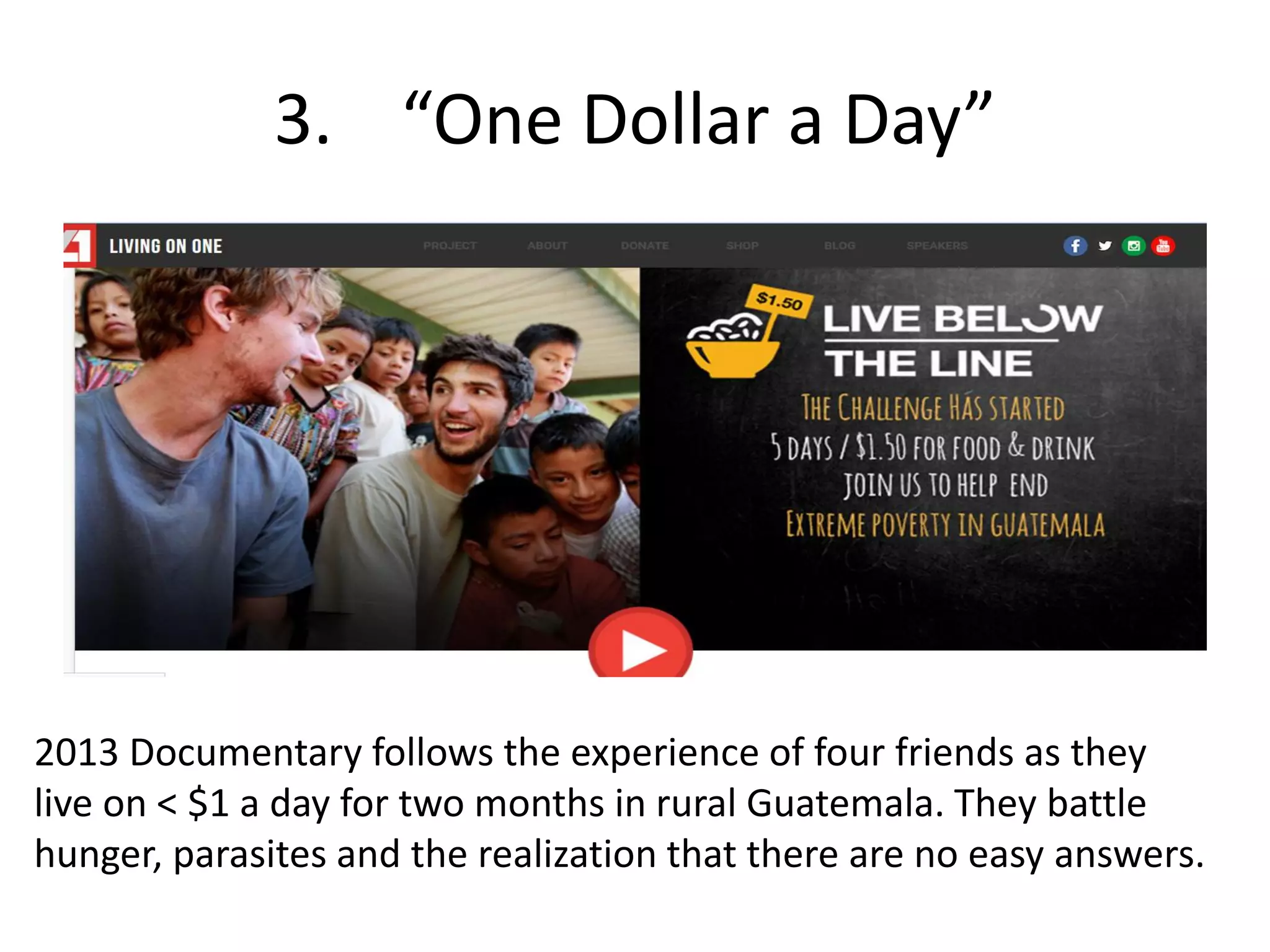
3. “One Dollar a Day”
2013 Documentary follows the experience of four friends as they
live on < $1 a day for two months in rural Guatemala. They battle
hunger, parasites and the realization that there are no easy answers.
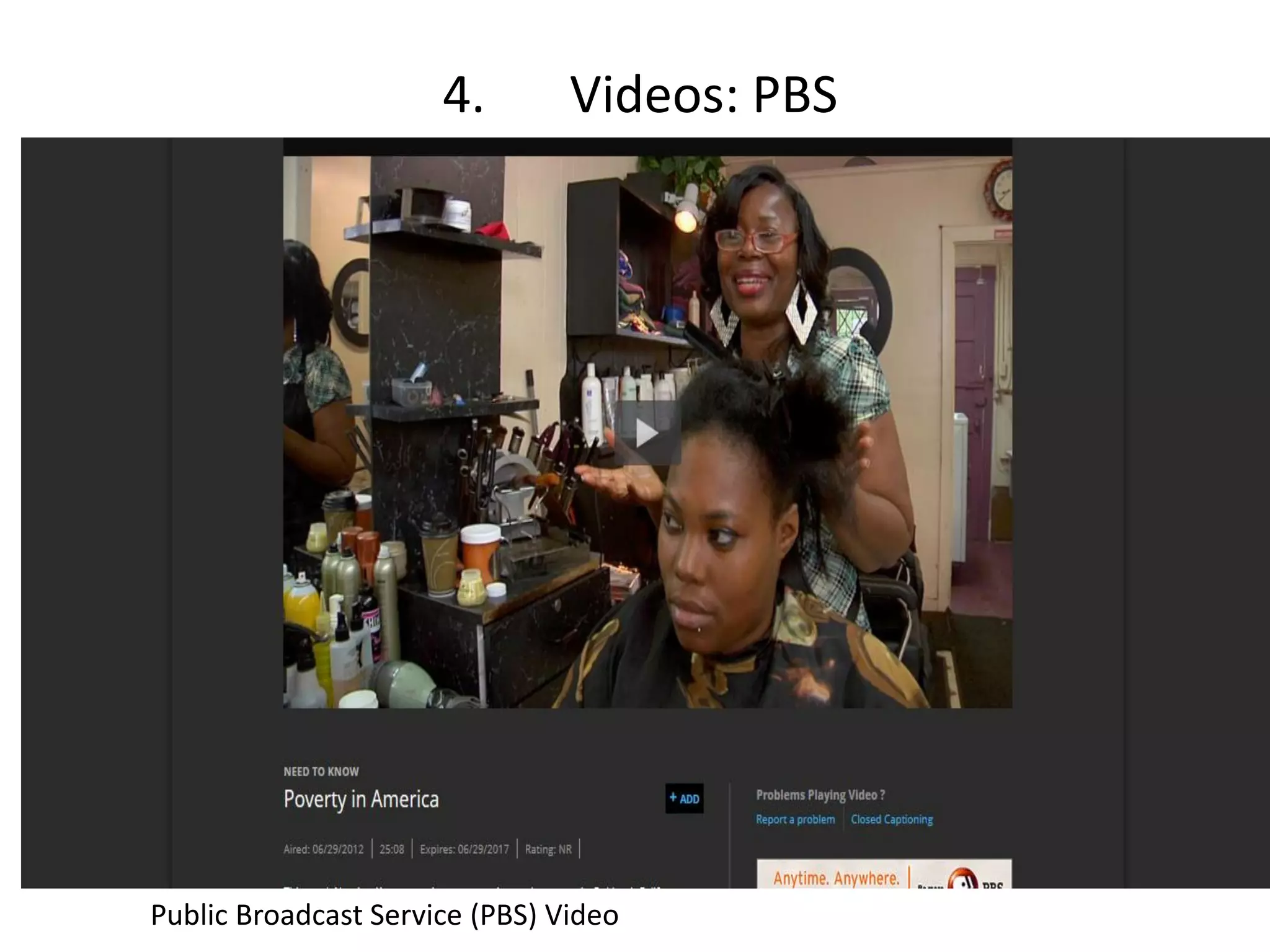
Public Broadcast Service (PBS) Video
4. Videos: PBS
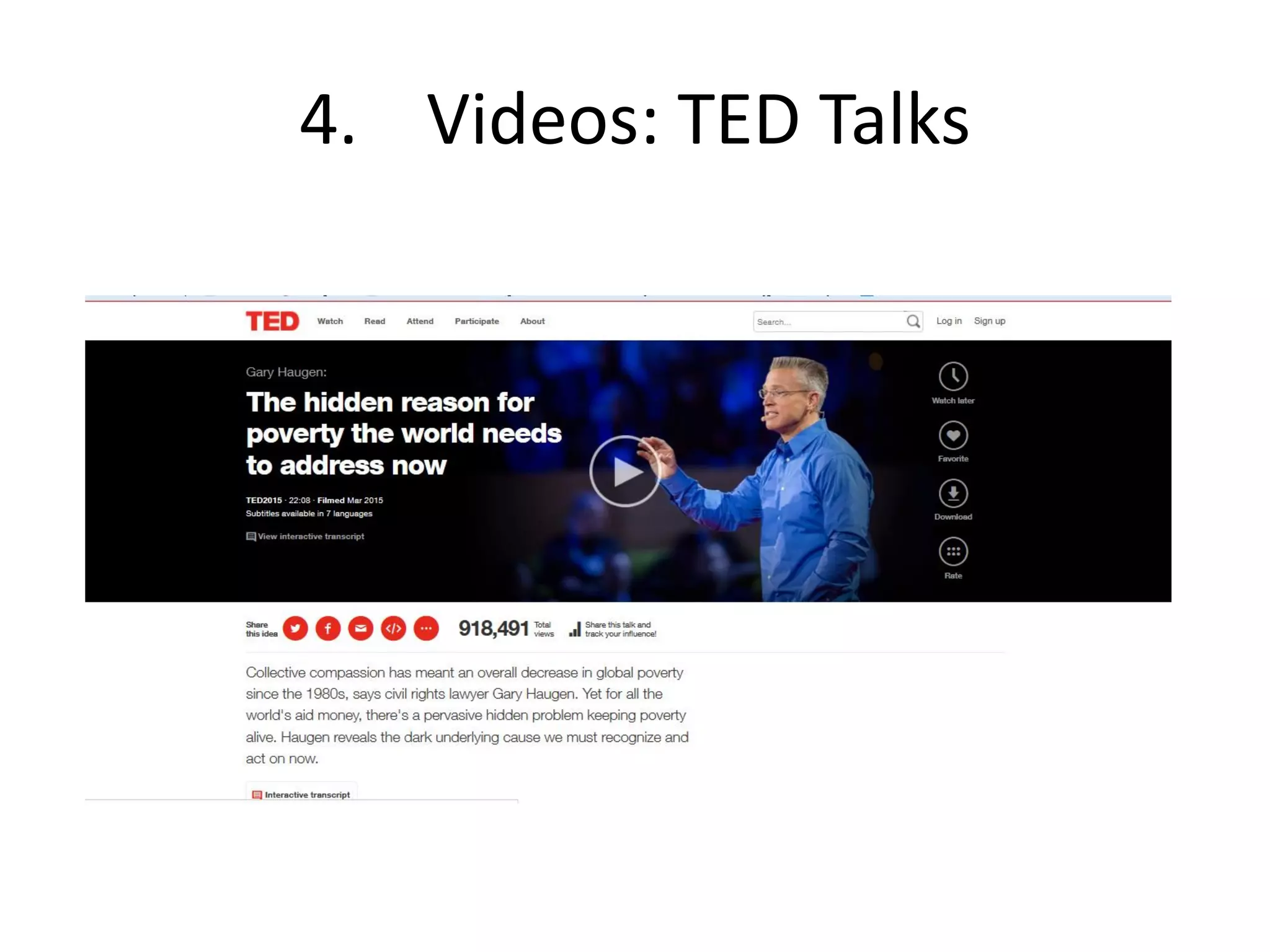
4. Videos: TED Talks
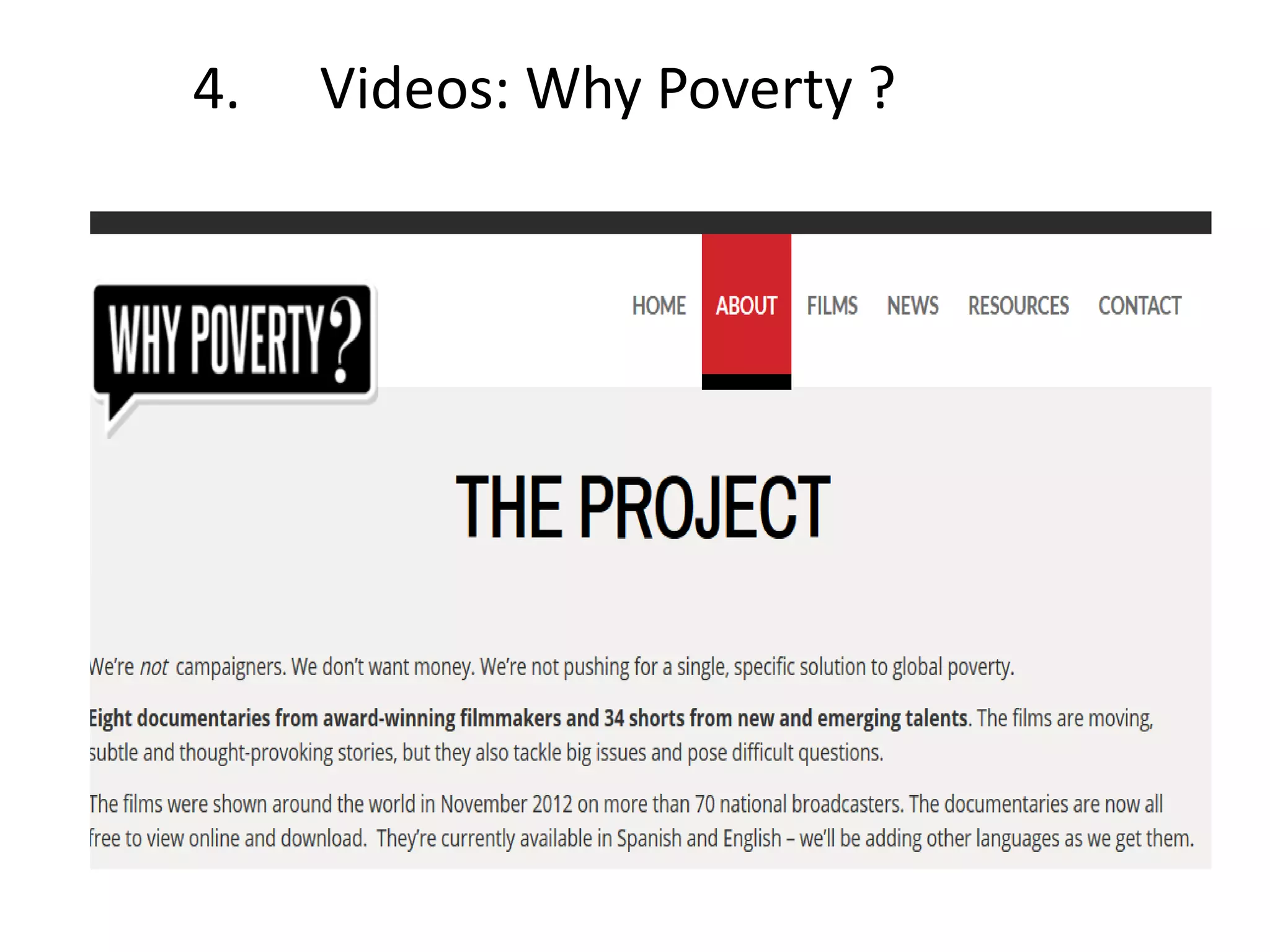
4. Videos: Why Poverty ?
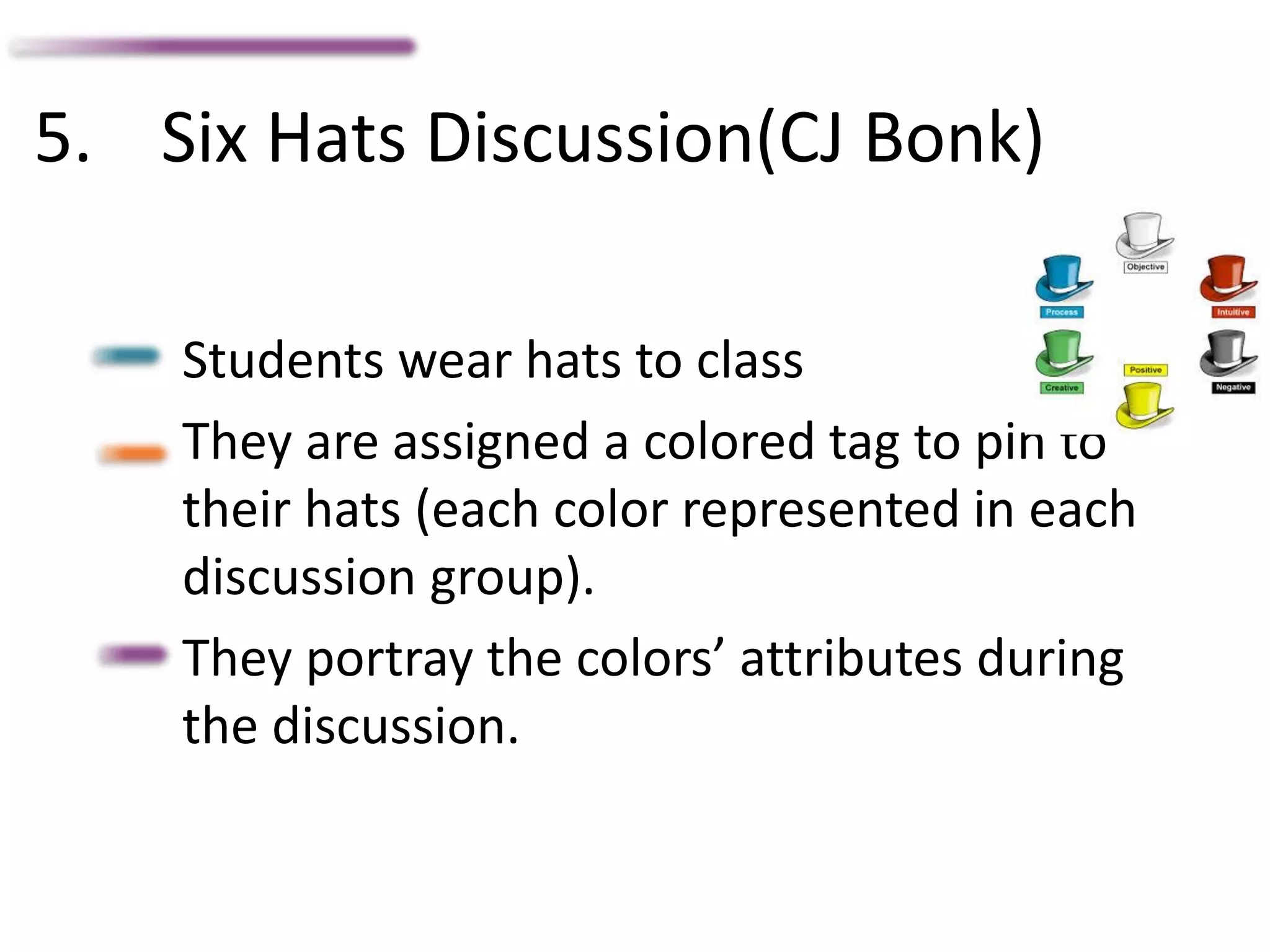
5. Six Hats Discussion(CJ Bonk)
Students wear hats to class
They are assigned a colored tag to pin to
their hats (each color represented in each
discussion group).
They portray the colors’ attributes during
the discussion.
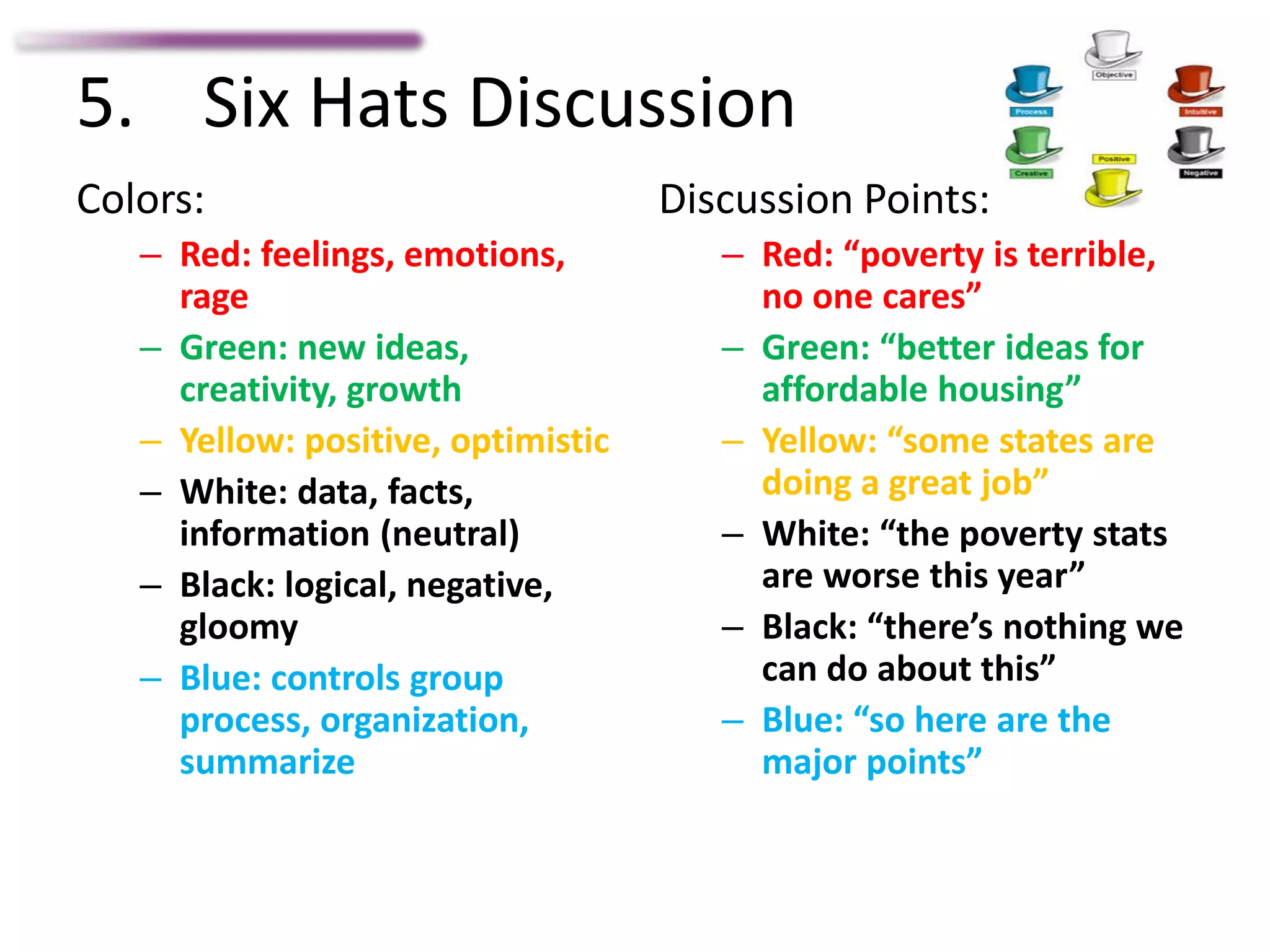
5. Six Hats Discussion
Colors:
– Red: feelings, emotions,
rage
– Green: new ideas,
creativity, growth
– Yellow: positive, optimistic
– White: data, facts,
information (neutral)
– Black: logical, negative,
gloomy
– Blue: controls group
process, organization,
summarize
Discussion Points:
– Red: “poverty is terrible,
no one cares”
– Green: “better ideas for
affordable housing”
– Yellow: “some states are
doing a great job”
– White: “the poverty stats
are worse this year”
– Black: “there’s nothing we
can do about this”
– Blue: “so here are the
major points”
Conclusion
Students were able to:
Consider a broad range of perspectives—
personal, community, and policy
Recognize biases and stereotypes
Link the service-learning experience to a
broader context in society
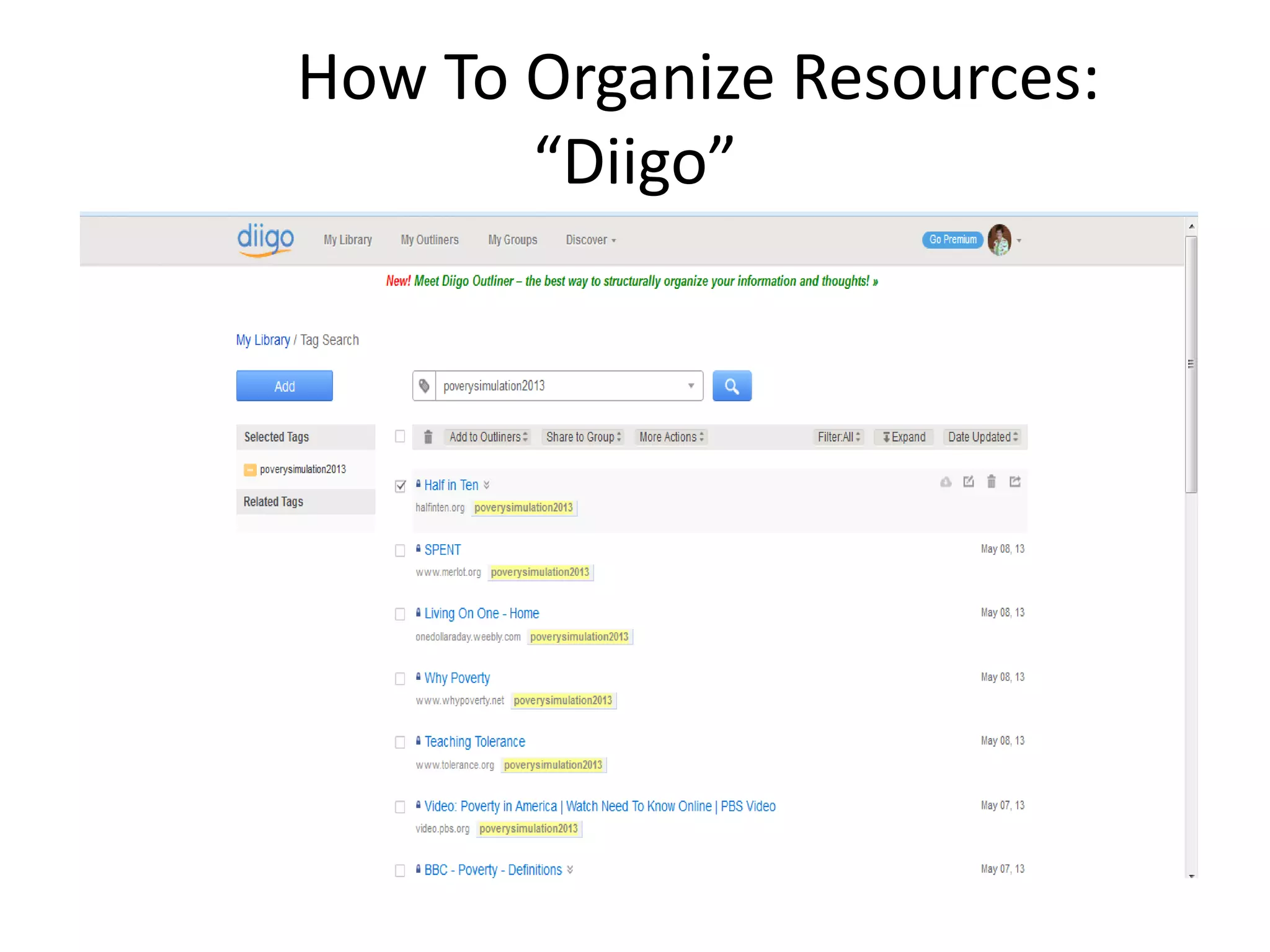
How To Organize Resources:
“Diigo”
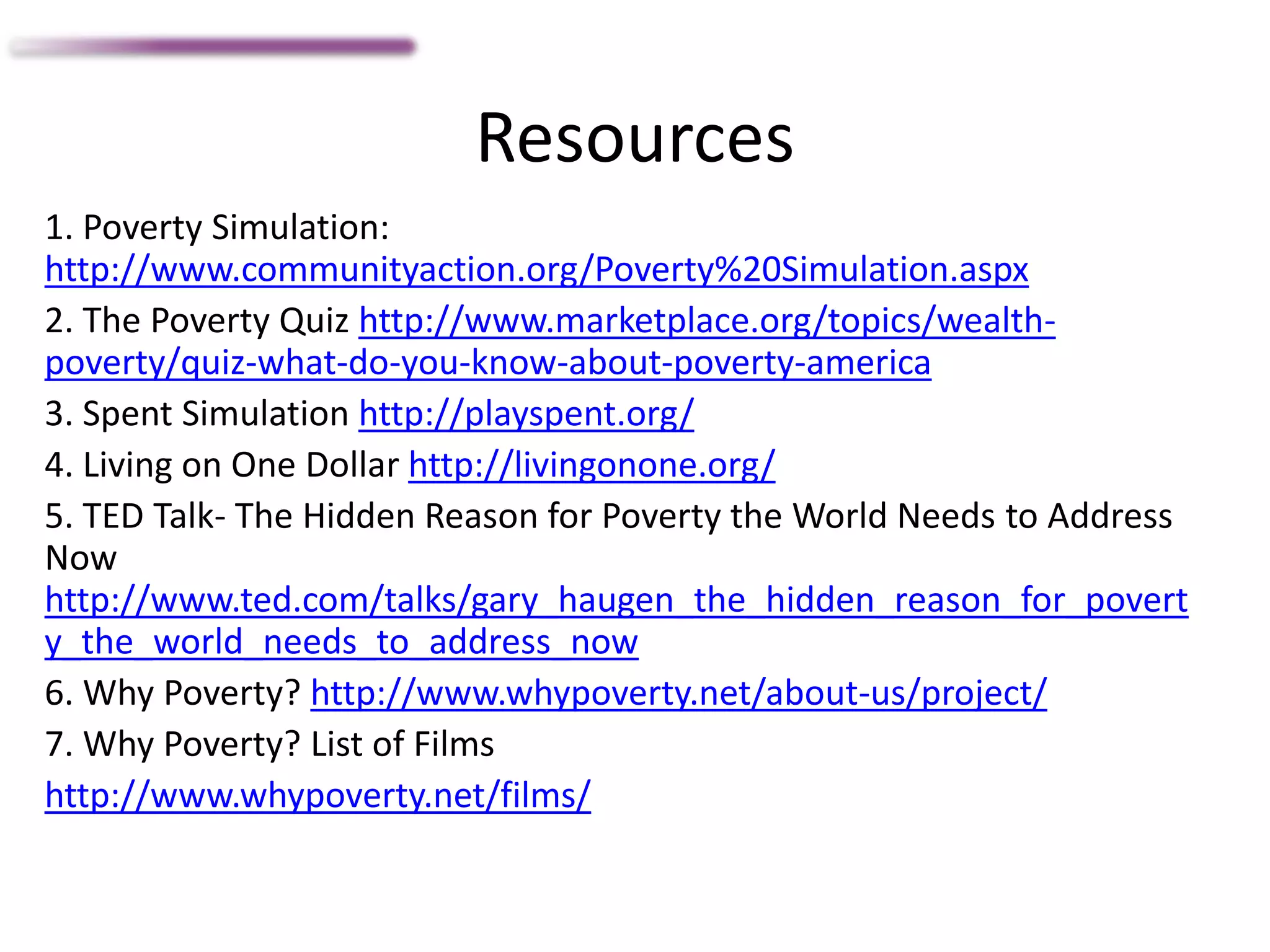
Resources
1. Poverty Simulation:
http://www.communityaction.org/Poverty%20Simulation.aspx
2. The Poverty Quiz http://www.marketplace.org/topics/wealth-
poverty/quiz-what-do-you-know-about-poverty-america
3. Spent Simulation http://playspent.org/
4. Living on One Dollar http://livingonone.org/
5. TED Talk- The Hidden Reason for Poverty the World Needs to Address
Now
http://www.ted.com/talks/gary_haugen_the_hidden_reason_for_povert
y_the_world_needs_to_address_now
6. Why Poverty? http://www.whypoverty.net/about-us/project/
7. Why Poverty? List of Films
http://www.whypoverty.net/films/

Pre planning for service learning may 27 1000am final

  • 1.
    UN I VE R S I T Y of INDIANAPOLIS Ⓡ Pre-Planning for Service- Learning: Creative Strategies for Expanding Students’ Perspectives Anne Mejia-Downs PT, MPH Associate Professor Physical Therapy Julie Gahimer, PT, HSD Professor of Physical Therapy International Symposium on Service-Learning (ISSL 2015) Friday, May 29, 2015 2:45 – 3:45 p.m.
  • 2.
    Introduction Assist Doctor ofPhysical Therapy (DPT) students develop a deeper appreciation for diverse populations, as many of the clients we serve are financially disadvantaged
  • 3.
    Workshop Objectives Participants ofthis session will: Describe pre-service learning strategies designed to broaden students’ personal and societal perspectives Identify available tools for educating students about low-resourced populations Explain how students’ perspectives about poverty were changed with pre-service learning strategies
  • 4.
    Purpose To increase theunderstanding of poverty, we implemented pedagogical techniques to bring the realities of poverty into our service-learning course.
  • 5.
    Session Format Explanation of3 Strategies Pre-Packaged Poverty Simulation Enlisting community members who have experienced poverty Using online poverty resources for group activities
  • 6.
  • 7.
    Strategy # 1 ThePoverty Simulation This guided experience exposes participants to realities of poverty, including challenges of navigating the complex world of government services and other essential service providers. During the simulation, participants assume the roles of different family members facing poverty. The task for each family is to provide basic necessities and shelter, while balancing the requirements of various service providers with the realities of daily life.
  • 8.
    The Poverty Simulation Volunteerstaffers from the Bridges/Circles® Coalition of Greater Indianapolis, an anti- poverty initiative made up of representatives from The Julian Center and Community Action of Greater Indianapolis.
  • 9.
    The Poverty Simulation Helpsparticipants begin to understand what it might be like to live in a typical low- income family trying to survive from month to month It is a simulation, not a game. The objective is to sensitize participants to the realities faced by people who are financially disadvantaged.
  • 10.
    The Poverty Simulation 50to 75 participants assume the roles of up to 26 different families facing poverty Participant’s roles: – Newly unemployed – Recently deserted by the “breadwinner” – Recipients of TANF – Disabled – Senior citizen receiving Social Security The task of the “families” is to provide for basic necessities and shelter during the course of four 15-minute “weeks”.
  • 11.
    The Poverty Simulation Twoto three hours: – Introduction and briefing – Actual simulation exercise – Debriefing period for participants and volunteer staffers to share reactions and experiences Several thousands of people have participated in the simulation and found it to be powerful and often enlightening.
  • 12.
    Poverty Simulation VideoLink http://www.youtube.com/watch?v=9fMA6qAQ nzU&feature=related
  • 13.
    Reactions from Students •"I had no idea the stress that having only limited resources and money could cause." • "Thought provoking, I needed this." • "Stressful! Confusing! It helps with understanding [life in poverty] but you really can only know if you live it day to day." • "Amazing what empathy and compassion sixty minutes of simulation creates." • "It was very realistic and gave insight into the constant frustration and choices between bad and worse." • "[As a result of this experience] I will be more conscious, more empathetic, more of an advocate."
  • 14.
  • 15.
    Strategy #2 Using CommunityMembers Clients from Circles of Support were invited to the classroom 1. Smarties Activity 2. Cliff Effect Discussion 3. Laundry Basket 4. Shared personal stories of bridging out of poverty
  • 16.
    1. Smarties Activity Activityto make choices about how to spend limited amount of money (represented by Smarties candies) Students work in pairs to distribute their “income” among housing needs, utilities, food, transportation, and other necessities
  • 17.
    2. The CliffEffect Occurs when a person who is in poverty has an increase in income, and in turn, loses other benefits Increased income seems positive, however, increased income can lead to loss of benefits (child care subsidy or medical benefits) There are many such “cliffs”; it may appear that individuals in poverty “just don’t want to work hard and get ahead.”
  • 18.
    3. Laundry BasketActivity Students were asked to imagine someone who has very few resources: low-paying job, no family nearby, trying to stay off welfare, and no good family role model. – Single mother with 2 children—a daughter in elementary school and a son who is a toddler – Overwhelmed by all of life’s struggles, having trouble keeping up with everything.
  • 19.
    3. Laundry BasketActivity Tasks she needs to do: – Cook meals for family (pan) – Take daughter to soccer (soccer ball) – Take Math course to work on her GED (textbook) – Read to her toddler (book) – Do laundry at Laundromat (laundry basket) – Clean house (broom) – Home repair (duct tape) – Car repair (motor oil) • She really does look overwhelmed. • Now we are going to try to take some of the load off of this single mother, so she can keep working at her job and on her GED. Is there anything you can do for her? • Take the item that you can help her with. How does she look now?
  • 20.
    4. Personal Storiesof Poverty • Clients from Circles of Support® shared their personal stories of “bridging out of poverty” • Many discussed tough choices they made with limited income • Used examples of the “cliff effect” in their lives, and how individuals from Circles of Support® helped them • Students shared how these stories impacted their view of poverty and the working poor
  • 21.
  • 22.
    Strategy #3 Using OnlineResources 1. Poverty Quiz 2. Spent Activity 3. Dollar a Day 4. Videos 5. Six Hats Discussion
  • 23.
    1. “Poverty Quiz” 10Minute QUIZ: What do you know about poverty in America? • Number of Americans on food stamps • Unemployment rate for African-Americans • Income, class, race • Number of people living in poverty • Percentage of that population working full time • Child poverty rate in America http://www.marketplace.org/topics/wealth- poverty/quiz-what-do-you-know-about-poverty-america
  • 24.
    2. “Spent Activity” Interactivewebsite that places user in poverty situation due to loss of job Challenges user to make important choices across a broad set of contingencies of how to allocate their funds (housing, food, child care, and transportation) Students expressed surprise at how desperate they became, and even engaged in unlawful activity
  • 25.
  • 26.
    3. “One Dollara Day” 2013 Documentary follows the experience of four friends as they live on < $1 a day for two months in rural Guatemala. They battle hunger, parasites and the realization that there are no easy answers.
  • 27.
    Public Broadcast Service(PBS) Video 4. Videos: PBS
  • 28.
  • 29.
    4. Videos: WhyPoverty ?
  • 30.
    5. Six HatsDiscussion(CJ Bonk) Students wear hats to class They are assigned a colored tag to pin to their hats (each color represented in each discussion group). They portray the colors’ attributes during the discussion.
  • 31.
    5. Six HatsDiscussion Colors: – Red: feelings, emotions, rage – Green: new ideas, creativity, growth – Yellow: positive, optimistic – White: data, facts, information (neutral) – Black: logical, negative, gloomy – Blue: controls group process, organization, summarize Discussion Points: – Red: “poverty is terrible, no one cares” – Green: “better ideas for affordable housing” – Yellow: “some states are doing a great job” – White: “the poverty stats are worse this year” – Black: “there’s nothing we can do about this” – Blue: “so here are the major points”
  • 32.
    Conclusion Students were ableto: Consider a broad range of perspectives— personal, community, and policy Recognize biases and stereotypes Link the service-learning experience to a broader context in society
  • 33.
    How To OrganizeResources: “Diigo”
  • 34.
    Resources 1. Poverty Simulation: http://www.communityaction.org/Poverty%20Simulation.aspx 2.The Poverty Quiz http://www.marketplace.org/topics/wealth- poverty/quiz-what-do-you-know-about-poverty-america 3. Spent Simulation http://playspent.org/ 4. Living on One Dollar http://livingonone.org/ 5. TED Talk- The Hidden Reason for Poverty the World Needs to Address Now http://www.ted.com/talks/gary_haugen_the_hidden_reason_for_povert y_the_world_needs_to_address_now 6. Why Poverty? http://www.whypoverty.net/about-us/project/ 7. Why Poverty? List of Films http://www.whypoverty.net/films/