Presentation
On
IT Act-Overview
Presented by:
Akash Maheshwari
Outlines..
 IT Scenario
 Introduction of IT Act
 Objective of IT Act 2000
 Cyber Crime
 Cyber Crimes Provisions under IT Act 2000
 Amendment of IT Act
 Case Study
IT Scenario
 IT covers both hardware and software
 Transformed the world into a global village
 Provides Communication and Analytical power
to trade
 Indian IT industry fastest growing industry
 Pioneer in software development
 Tremendous growth in Internet
Introduction Of IT Act
 The United Nations General Assembly have adopted the
Model Law on electronic commerce on 30 January,1997.
 It is referred as the UNCITRAL Model Law on E-
Commerce.
 Enacted on 17 May, 2000- India is the 12th Nation in the
world to adopt Cyber Laws.
 India passed the Information Technology Act, 2000 on
17th October, 2000.
 Information Technology Act 2000 consisted of 94
sections segregated into 13 chapters.
Objective Of IT Act
 To provide Legal recognition for transaction
 To facilitate electronic filing of documents
 To facilitate electronic storage of data
 To facilitate and give legal sanction to electronic fund
transfer between banks and financial institution
Cyber Crimes
 Refers to all criminal activities done using the medium
of computers, the Internet, and the world wide web.
 The Indian Law has not given any definition to the term
‘cyber crime’.
 The Indian Penal Code does not use the term ‘cyber
crime’ at any point even after its amendment.
 But “Cyber Security” is defined under Section (2) (b)
means of protecting information or security purpose.
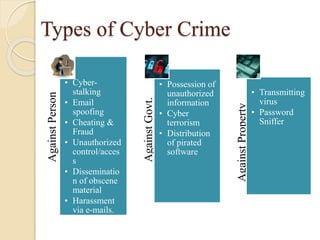
Types of Cyber Crime
AgainstPerson
• Cyber-
stalking
• Email
spoofing
• Cheating &
Fraud
• Unauthorized
control/acces
s
• Disseminatio
n of obscene
material
• Harassment
via e-mails.
AgainstGovt.
• Possession of
unauthorized
information
• Cyber
terrorism
• Distribution
of pirated
software
AgainstProperty
• Transmitting
virus
• Password
Sniffer
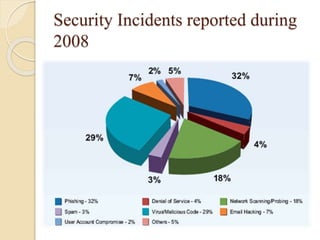
Security Incidents reported during
2008
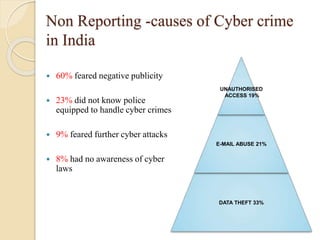
Non Reporting -causes of Cyber crime
in India
 60% feared negative publicity
 23% did not know police
equipped to handle cyber crimes
 9% feared further cyber attacks
 8% had no awareness of cyber
laws
DATA THEFT 33%
E-MAIL ABUSE 21%
UNAUTHORISED
ACCESS 19%
IT (Amendment) Act, 2008
 Amended on 27th October, 2009.
 Amended act is known as The Information Technology Amended Act-
(ITAA), 2008
 Established a strong data protection regime in India.
 Creates a more predictive legal environment for the growth of e-
commerce that includes data protection and cyber crimes measures.
 A strong data protection regime also requires that cyber crimes such as
identity theft, phishing, data leakage, cyber terrorism, child
pornography etc. be covered to ensure data security and data privacy.
 Example: Digital Signature introduced in ITAA as Electronic
Signature.
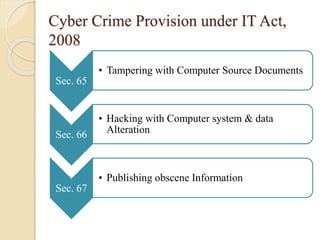
Cyber Crime Provision under IT Act,
2008
Sec. 65
• Tampering with Computer Source Documents
Sec. 66
• Hacking with Computer system & data
Alteration
Sec. 67
• Publishing obscene Information
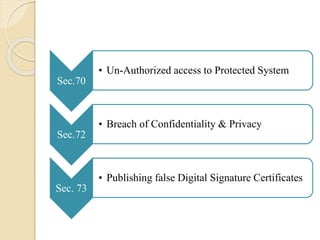
Sec.70
• Un-Authorized access to Protected System
Sec.72
• Breach of Confidentiality & Privacy
Sec. 73
• Publishing false Digital Signature Certificates
Case Study-1
Facts:
A Dubai based NRI was lured by anonymous women on internet who after
winning his confidence and love started blackmailing him under the guise that
the first women with whom the NRI got befriended had committed suicide and
police is investigating the case and seeking NRI’s details. The accused also
sent fake copies of the letters from CBI, High Court of Calcutta, New York
police and Punjab Police etc. The NRI by that time had paid about Rs. 1.25
corer to the accused.
Investigation: By Mumbai Police
 Thankfully, the NRI has saved all the emails which he has so far received
from the strangers he has been communicating with. The I.P. Address
embedded in all e-mails received by complainant reveals the origin of the
emails. The man assuming these various identities is a single person.
Actions:
Charges framed u/s 292, 389, 420, 465, 467, 468, 469, 471, 474 IPC read with
Section 67 of IT Act.
Case Study-2
Facts:
 24-year-old Nadeem Hamid Kashmiri employee of HSBC
BPO allegedly accessed personal information, security
information and debit card information of some customers
and these details were passed on to the fraudsters who
diverted £233,000 (approx. Rs. 2 cores) from the clients'
accounts,.
Actions:
 A case has been registered under Sections 66 and 72 of the IT
Act and 408, 468 and 420 of the Indian Penal Code.
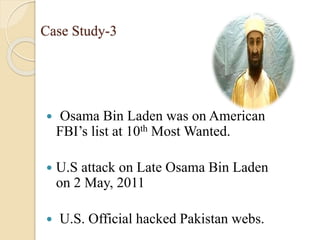
Case Study-3
 Osama Bin Laden was on American
FBI’s list at 10th Most Wanted.
 U.S attack on Late Osama Bin Laden
on 2 May, 2011
 U.S. Official hacked Pakistan webs.
Case Study-4
Hacker Hacks into Financial website
 The hacker Kalpesh (name changed) hacked Financial
Website.
 Kalpesh has done courses like CCNA, MCSE, etc & he
is computer addict.
 The Mumbai police arrested him.
 Case registered against Hacker under section-67.
Pre itact

Pre itact

  • 1.
  • 2.
    Outlines..  IT Scenario Introduction of IT Act  Objective of IT Act 2000  Cyber Crime  Cyber Crimes Provisions under IT Act 2000  Amendment of IT Act  Case Study
  • 3.
    IT Scenario  ITcovers both hardware and software  Transformed the world into a global village  Provides Communication and Analytical power to trade  Indian IT industry fastest growing industry  Pioneer in software development  Tremendous growth in Internet
  • 4.
    Introduction Of ITAct  The United Nations General Assembly have adopted the Model Law on electronic commerce on 30 January,1997.  It is referred as the UNCITRAL Model Law on E- Commerce.  Enacted on 17 May, 2000- India is the 12th Nation in the world to adopt Cyber Laws.  India passed the Information Technology Act, 2000 on 17th October, 2000.  Information Technology Act 2000 consisted of 94 sections segregated into 13 chapters.
  • 5.
    Objective Of ITAct  To provide Legal recognition for transaction  To facilitate electronic filing of documents  To facilitate electronic storage of data  To facilitate and give legal sanction to electronic fund transfer between banks and financial institution
  • 6.
    Cyber Crimes  Refersto all criminal activities done using the medium of computers, the Internet, and the world wide web.  The Indian Law has not given any definition to the term ‘cyber crime’.  The Indian Penal Code does not use the term ‘cyber crime’ at any point even after its amendment.  But “Cyber Security” is defined under Section (2) (b) means of protecting information or security purpose.
  • 7.
    Types of CyberCrime AgainstPerson • Cyber- stalking • Email spoofing • Cheating & Fraud • Unauthorized control/acces s • Disseminatio n of obscene material • Harassment via e-mails. AgainstGovt. • Possession of unauthorized information • Cyber terrorism • Distribution of pirated software AgainstProperty • Transmitting virus • Password Sniffer
  • 8.
  • 9.
    Non Reporting -causesof Cyber crime in India  60% feared negative publicity  23% did not know police equipped to handle cyber crimes  9% feared further cyber attacks  8% had no awareness of cyber laws DATA THEFT 33% E-MAIL ABUSE 21% UNAUTHORISED ACCESS 19%
  • 10.
    IT (Amendment) Act,2008  Amended on 27th October, 2009.  Amended act is known as The Information Technology Amended Act- (ITAA), 2008  Established a strong data protection regime in India.  Creates a more predictive legal environment for the growth of e- commerce that includes data protection and cyber crimes measures.  A strong data protection regime also requires that cyber crimes such as identity theft, phishing, data leakage, cyber terrorism, child pornography etc. be covered to ensure data security and data privacy.  Example: Digital Signature introduced in ITAA as Electronic Signature.
  • 11.
    Cyber Crime Provisionunder IT Act, 2008 Sec. 65 • Tampering with Computer Source Documents Sec. 66 • Hacking with Computer system & data Alteration Sec. 67 • Publishing obscene Information
  • 12.
    Sec.70 • Un-Authorized accessto Protected System Sec.72 • Breach of Confidentiality & Privacy Sec. 73 • Publishing false Digital Signature Certificates
  • 13.
    Case Study-1 Facts: A Dubaibased NRI was lured by anonymous women on internet who after winning his confidence and love started blackmailing him under the guise that the first women with whom the NRI got befriended had committed suicide and police is investigating the case and seeking NRI’s details. The accused also sent fake copies of the letters from CBI, High Court of Calcutta, New York police and Punjab Police etc. The NRI by that time had paid about Rs. 1.25 corer to the accused. Investigation: By Mumbai Police  Thankfully, the NRI has saved all the emails which he has so far received from the strangers he has been communicating with. The I.P. Address embedded in all e-mails received by complainant reveals the origin of the emails. The man assuming these various identities is a single person. Actions: Charges framed u/s 292, 389, 420, 465, 467, 468, 469, 471, 474 IPC read with Section 67 of IT Act.
  • 14.
    Case Study-2 Facts:  24-year-oldNadeem Hamid Kashmiri employee of HSBC BPO allegedly accessed personal information, security information and debit card information of some customers and these details were passed on to the fraudsters who diverted £233,000 (approx. Rs. 2 cores) from the clients' accounts,. Actions:  A case has been registered under Sections 66 and 72 of the IT Act and 408, 468 and 420 of the Indian Penal Code.
  • 15.
    Case Study-3  OsamaBin Laden was on American FBI’s list at 10th Most Wanted.  U.S attack on Late Osama Bin Laden on 2 May, 2011  U.S. Official hacked Pakistan webs.
  • 16.
    Case Study-4 Hacker Hacksinto Financial website  The hacker Kalpesh (name changed) hacked Financial Website.  Kalpesh has done courses like CCNA, MCSE, etc & he is computer addict.  The Mumbai police arrested him.  Case registered against Hacker under section-67.